
Italian Barolo Glazed Artichoke with Crispy Polenta and Castelmagno | Carciofo Laccato al Barolo, Polenta Croccante, Castelmagno e Cipolla Rossa Bruciata
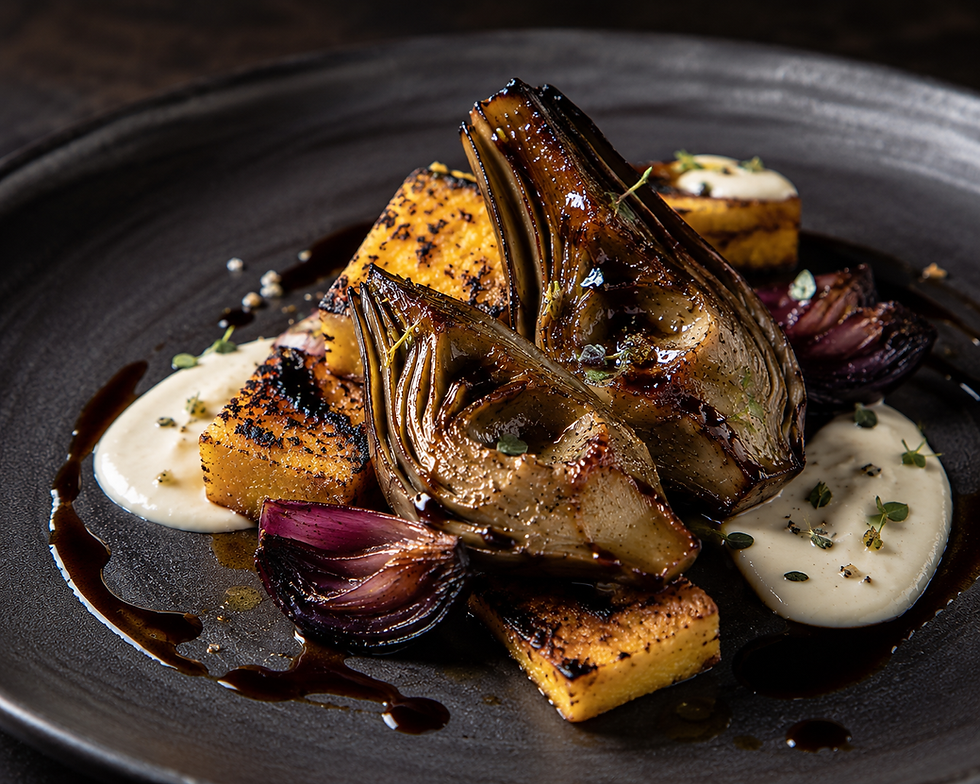
This is brasato al Barolo with the beef taken out of it. Everything else that makes the Sunday dish of the Langhe recognisable stays in place: the wine reduced until it lacquers, the polenta underneath, the mountain cheese, the onion cooked far past the point most kitchens would stop. What sits in the middle of the plate is an artichoke heart braised until it yields to a spoon, then painted with the same glaze that would have gone over the meat.
It works because an artichoke braised properly behaves like a braise rather than like a vegetable. It takes on the flavour of the liquid it cooks in, it holds a fondant texture without falling apart, and its own faint bitterness stands up to a tannic reduction. Around it are three Piedmontese things doing what they do in the meat version: polenta for the starch and the crunch, Castelmagno for salt and fat, burnt onion for the sweetness underneath.
Yield: 4 servings. Prep: 45 minutes. Cook: 1 hour 10 minutes. Polenta chilling: at least 4 hours. Total: about 6 hours including chilling. Difficulty: advanced. Course: primo piatto or vegetarian main. Region: Piedmont, the Langhe and the Valle Grana.
The Story
Every element on this plate except the artichoke is native to a small piece of the province of Cuneo. Barolo comes from eleven communes in the Langhe hills, where Nebbiolo has been vinified since at least the fourteenth century and where brasato al Barolo, beef marinated for a day in the wine and then braised in it, became the Sunday dish. The technique that matters here is the last stage of that braise, when the cooking wine is reduced hard until tannin and sugar concentrate into something that coats.
Castelmagno is older still. It is made in only three communes of the Valle Grana, and the earliest record of it is an arbitration ruling of 1277 on grazing rights, in which the cheese was accepted as payment of rent to the Marquis of Saluzzo. It is crumbly, sharp and faintly blue when aged in the caves, and it melts at a lower temperature than the hard grating cheeses of the plain, which is why it makes a cream rather than a string.
The artichoke is the outsider, and it arrives by an old road. The Langhe grow no artichokes worth speaking of, but the Ligurian coast just over the hills does, and the spiny artichoke of Albenga travelled inland along the salt routes that linked the Riviera to Piedmont for centuries. Putting it where the beef would be is a modern decision rather than a traditional one, but the pairing of Ligurian vegetable and Piedmontese wine is not an invention. It is what those roads were for.
Ingredients
For the braised artichokes
Large globe artichokes, 4
Lemons, halved, 2
Extra virgin olive oil, 3 tbsp (45 ml)
Shallot, thinly sliced, 1
Garlic cloves, lightly crushed, 2
Thyme sprigs, 3, and bay leaf, 1
Dry white wine, 1/2 cup (120 ml)
Vegetable stock, 2 cups (475 ml)
Fine sea salt, 1 tsp (6 g)
For the Barolo glaze
Barolo or young Nebbiolo, 1 cup (240 ml)
Reserved artichoke braising liquid, 1/2 cup (120 ml)
Honey, 1 tbsp (21 g)
Bay leaf, 1
Cold unsalted butter, cubed, 1 tbsp (14 g)
For the crisp polenta
Coarse yellow polenta, 1 cup (160 g)
Water, 4 cups (950 ml)
Fine sea salt, 1 1/2 tsp (9 g)
Unsalted butter, 1 tbsp (14 g)
Parmigiano Reggiano, grated, 1 oz (30 g)
Extra virgin olive oil for frying, 3 tbsp (45 ml)
For the Castelmagno cream
Castelmagno DOP, rind removed and crumbled, 3 oz (85 g)
Heavy cream, 1/2 cup (120 ml)
Whole milk, 1/4 cup (60 ml)
Freshly ground white pepper, to taste
For the burnt red onion
Red onion, large, 1
Extra virgin olive oil, 1 tbsp (15 ml)
Red wine vinegar, 2 tsp (10 ml)
Honey, 1 tsp (7 g)
Flaky sea salt, 1 pinch
Preparation
Cooking and setting the polenta first
Start here, because the polenta needs hours of cold before it can be fried. Bring the water to a boil with the salt, then rain the polenta in while whisking so no lumps form. Drop the heat until the surface barely blips and cook for 40 minutes, stirring often. Beat in the butter and Parmigiano, spread it about 3/4 inch (2 cm) thick on an oiled tray, and refrigerate uncovered for at least 4 hours.
Turning and trimming the artichokes
Squeeze the lemons into a bowl of cold water and drop the spent halves in. Snap off the tough outer leaves by hand until you reach the pale yellow ones, cut the top third away, and pare the base and stem until only tender flesh remains. Halve each heart and scrape the choke out with a teaspoon. Put every piece into the lemon water as you finish it, because a cut artichoke browns within a minute and the discolouration goes right through.
Braising the artichokes until fondant
Warm the olive oil in a pan just wide enough to hold the hearts in a single layer and sweat the shallot, garlic, thyme and bay for 3 minutes without colour. Add the drained artichokes cut side down, pour in the wine and reduce it by half, then add the stock and salt. Cover with a circle of parchment rather than a lid, keep the liquid at a bare simmer, and cook for 35 to 40 minutes until a knife slides into the base without resistance. Reserve the liquid.
Reducing the Barolo to a glaze
Strain 1/2 cup of the braising liquid and combine it with the Barolo, honey and bay leaf in a small saucepan. Simmer and reduce slowly over medium low heat until roughly one third of the volume remains and the liquid draws a clean line across the back of a coated spoon. This takes 15 to 20 minutes and must not be rushed, because wine driven at a hard boil turns harsh and astringent. Remove the bay leaf, take the pan off the heat and whisk in the cold butter.
Making the Castelmagno cream
Warm the cream and milk in a small pan until they steam, then take the pan off the heat before adding the cheese. Add the crumbled Castelmagno a handful at a time, stirring until each addition disappears, returning it to the lowest heat only if it stops melting. Never let it boil. Season with white pepper and no salt, because the cheese brings plenty. Pass it through a fine mesh sieve and hold it over a bain marie.
Charring the red onion
Cut the onion into wedges through the root so the layers stay attached. Heat a heavy pan over medium heat with the oil, lay the wedges cut side down and leave them alone for 8 to 10 minutes, until the face is properly blackened at the edges rather than merely brown. Turn and repeat. Add the vinegar and honey off the heat, swirl once, and season with flaky salt. The bitterness of the char does the work, so stopping early wastes the step.
Frying the polenta
Turn the chilled slab out and cut it into neat squares, about two per serving. Pat every face dry. Heat the oil in a heavy pan over medium high heat and lay the pieces in without crowding, then leave them 3 to 4 minutes a side until a hard golden shell forms and they release on their own. Moving them early tears the crust off. Drain on a rack, never on paper, and never stack them.
Lacquering the artichokes and finishing
Warm the braised hearts in a wide pan with two tablespoons of glaze over low heat, turning them so every surface takes colour, then add a little more and turn them again. Repeat three or four times. Thin successive coats build a gloss that a single heavy pour cannot, and keep the reduction from sliding onto the plate. Hold the last spoonful back for the plate.
Plating
Use a wide plate with a flat centre, warmed to around 130°F (55°C). Cold china kills the cheese cream within seconds, and a bowl traps steam under the polenta and undoes the crust. Spoon two tablespoons of cream slightly off centre and pull the back of the spoon through it once.
Set the fried polenta down first, leaning one piece on the other so it stays clear of the cream on at least one face, then place two lacquered artichoke halves against it, cut side up. Tuck two or three charred onion wedges beside them, black edges out.
Finish with a few drops of the reserved glaze around the plate rather than over the artichokes, which already carry it. Nothing green is needed here: this is a dish about wine, cheese, maize and char, and a scattering of herbs only softens a plate meant to look dark.
Professional Technique
The problem this dish is built to solve is cynarin. Artichokes carry it in quantity, and it temporarily blocks the sweet receptors on the tongue, so whatever is tasted next reads as sweeter and often metallic. That is why artichoke has a reputation for destroying wine. Reducing Barolo concentrates its sugar and tannin far above the level of the poured wine, so the plate carries a sweetness cynarin cannot flatten, and the fat of the cheese cream blunts the effect further.
The glaze itself is controlled reduction. Wine loses alcohol first, then water, and only in the last third does tannin concentrate enough to give the syrupy hold that makes a lacquer. Push it hard and the tannin turns bitter before the texture arrives. The half cup of braising liquid is not filler: it brings glutamates and a little natural gelatin that give the reduction body, and the honey supplies just enough sugar for gloss. The cold butter goes in off the heat, where it emulsifies rather than splits.
Frying polenta is a starch problem rather than a heat problem. Freshly cooked polenta is a hot gel full of free water and it disintegrates in oil. Chilled for several hours the amylose retrogrades, the gel firms and the surface dries, and only then can a fried face set into a shell. Four hours is the minimum, uncovered, so the surface loses moisture rather than sweating under film.
Texture and Moisture Control
Four textures share the plate and each fails differently. The artichoke should be fondant, yielding to a spoon with no fibrous resistance at the base, which means judging it by knife and not by clock. The polenta must be brittle outside and soft inside, the cream pourable and completely smooth, the onion still in its layers rather than collapsed into a paste.
Castelmagno is the fragile one. It is a low melting cheese with high moisture, and above about 160°F (70°C) its proteins tighten and squeeze the fat out, leaving a grainy cream with an oil slick on top. That is why the pan comes off the heat before the cheese goes in, and why it is held over a bain marie. If it splits, a tablespoon of cold milk whisked in hard will usually bring it back.
Moisture moves the moment the plate is assembled, so the order is not decorative. Cream goes down first and the polenta sits at its edge rather than in it, because the crust surrenders to a wet surface within a minute. The artichokes are lacquered in the pan rather than sauced on the plate, so nothing pools underneath. Plate at the last moment and send immediately.
Professional Mise en Place
Only the frying and the final lacquering happen at service. Everything else is done ahead, and the polenta the day before.
Equipment and tools
Heavy saucepan, whisk and an oiled tray for the polenta
Wide sauté pan with a parchment circle for braising the artichokes
Two small saucepans, one for the glaze and one for the cheese cream
Fine mesh sieve, bain marie and a small offset spatula
Heavy pan for the onion and a rack for draining the polenta
Prepared ahead
Polenta cooked, spread and chilled uncovered, at least 4 hours, ideally overnight
Artichokes braised and cooled in a little of their liquid, up to 2 days ahead
Barolo glaze reduced but not yet buttered, up to 3 days ahead, refrigerated
Onion charred and dressed, up to 1 day ahead, held at room temperature
Castelmagno crumbled and weighed, cream and milk measured
Service setup
Castelmagno cream warm over a bain marie, covered, never on direct heat
Glaze loosened over low heat, cold butter whisked in at the last moment
Polenta cut, patted dry and laid out ready for the pan
Artichokes at room temperature so they lacquer without stewing
Plates warmed to around 130°F (55°C) and the onion drained
Chef Tips
Buy one more artichoke than the recipe asks for. Turning them down to the heart removes far more than it looks as though it will, and one hidden bruise can cost you a portion when you are already committed.
Do not use an expensive mature Barolo for the glaze. Reduction destroys the aromatic complexity the price buys and concentrates only structure, so a young Barolo or a good Nebbiolo d'Alba gives the same result. Save the older bottle for the glass.
Taste the glaze cold, on a cold spoon, before you commit to it. Every reduction tastes more balanced hot than it will on the plate, and a glaze that seems right in the pan can set into a sticky varnish twenty minutes later. Loosen it with a teaspoon of stock over low heat rather than water.
If Castelmagno is unavailable, use a young Gorgonzola Dolce rather than a generic blue. The recipe needs a cheese that melts low and carries salt without aggression. A hard alpine cheese strings instead of flowing, and a strong blue buries the wine.
Common Mistakes
Frying the polenta before it is properly set. Polenta given two hours in the refrigerator is still a soft gel: it breaks apart in the pan, sheds starch into the oil and never forms a crust. Give it four hours at the minimum, uncovered, and overnight if you can.
Reducing the wine over high heat. A hard boil concentrates tannin faster than it builds texture, and the result is bitter and gritty rather than glossy. Keep the pan at a slow simmer for the full 15 to 20 minutes and stop while the glaze still moves.
Adding the cheese to boiling cream. Castelmagno breaks above roughly 160°F (70°C), releasing its fat and turning the cream grainy. Take the pan off the heat first, add the cheese in stages, and hold it over a bain marie afterwards.
Glazing the artichokes in one heavy pour. A single thick coat slides off and pools on the plate. Build the lacquer in three or four thin coats in the pan, turning the hearts between each one.
Stopping the onion at golden. The dish is called cipolla rossa bruciata for a reason. Without genuine char the onion gives only sweetness, and the plate loses the bitter edge that holds glaze and cheese apart.
Wine Pairing
Barolo DOCG: The wine already in the glaze, and the most coherent bottle on the table. A Barolo with eight or ten years behind it has resolved its hardest tannin into tar, rose and dried cherry, which meets the reduction as a continuation. The cheese cream is what makes it possible: the fat coats the palate and keeps the tannin from turning metallic against the artichoke.
Barbaresco DOCG: The same grape from lighter soils across the Tanaro, and the better choice if the artichokes are young. Barbaresco has more perfume and a finer tannic grain, so it does less damage to a vegetable heart while still carrying enough structure for the char and the fried crust.
Nebbiolo d'Alba DOC: The everyday version of the same idea, drunk young and served cool at around 61°F (16°C). It gives the red fruit and rose note of Nebbiolo without the tannic weight, which helps on a plate where cynarin is already working against the wine. This is also the bottle to reduce for the glaze.
Barbera d'Asti DOCG: The Piedmontese answer when acidity is needed more than tannin, which is the case here. Barbera has very little tannin and a great deal of bright red fruit acidity, which cuts the cream and the fried polenta and sidesteps the metallic clash artichoke provokes in a tannic red. Choose an unoaked bottling.
Roero Arneis DOCG: The local white, for anyone who would rather not put a red against an artichoke at all. Arneis is dry and low in acid for a white, with pear, almond and a soft chalky finish that flatters the Castelmagno, and its gentle bitterness runs alongside the char on the onion.
Storage & Reheating
Store the components separately, never the assembled plate. Braised artichokes keep refrigerated with a little of their liquid for 2 days. The glaze, reduced but unbuttered, keeps 3 days refrigerated in a sealed jar. The charred onion keeps 1 day at room temperature and the uncooked polenta slab keeps, wrapped, for 3 days.
Rewarm the artichokes in a covered pan with a spoonful of their liquid, then lacquer them fresh, because a glaze refrigerated on the vegetable turns dull and tacky. Bring the glaze back over low heat and whisk the butter in only once it is warm. The cheese cream is better made to order, but if it must be held, reheat it over a bain marie.
Only the polenta freezes well. Cut the chilled slab into portions, freeze them on a tray and bag them for up to 1 month, then fry from frozen with an extra minute a side. Do not freeze the artichokes, which go watery and fibrous, or the cheese cream, which separates on thawing.
Nutrition
Per serving, based on 4 servings:
Calories: 480 kcal
Total Fat: 27 g
Saturated Fat: 12 g
Trans Fat: 0 g
Unsaturated Fat: 14 g
Cholesterol: 48 mg
Sodium: 690 mg
Total Carbohydrates: 42 g
Fiber: 8 g
Total Sugars: 10 g
Added Sugars: 4 g
Protein: 13 g
Lactose: 2.1 g
Principal micronutrients: calcium, folate, vitamin K, vitamin C, potassium, magnesium
These figures are estimates. Alcohol cooks off during the reduction but its sugars remain, and the fat total depends on how much frying oil the polenta takes up, which varies with how well the slab was dried.


Comments