
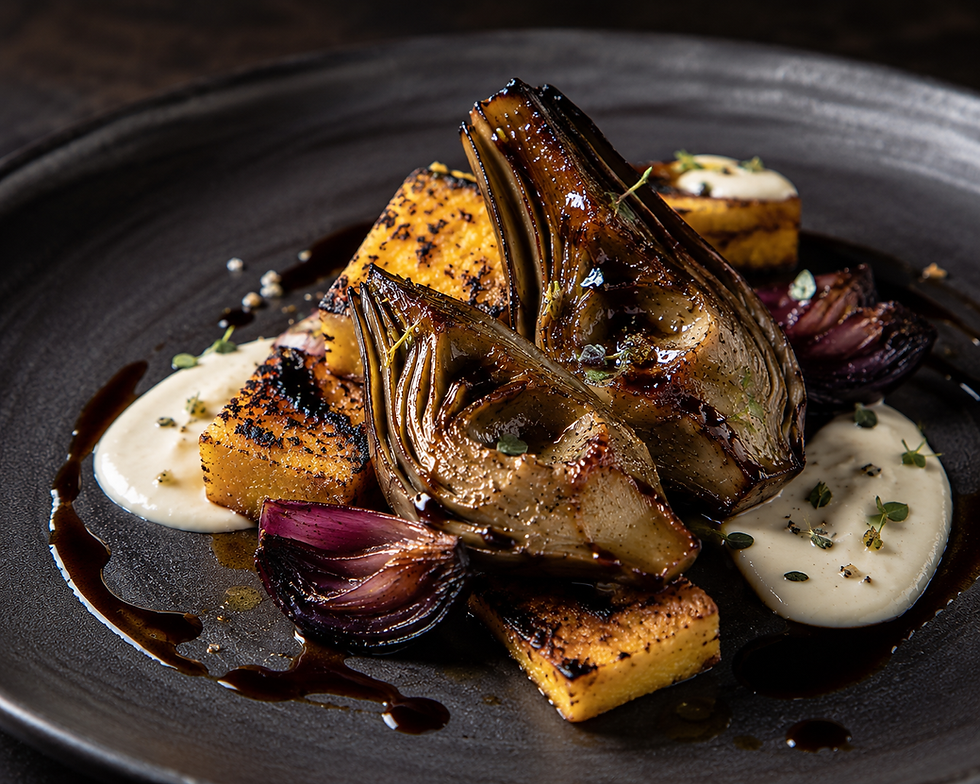
White Miso Glazed Artichoke with Goat Cheese, Hazelnut and Coffee Jus | Carciofo Glassato al Miso Bianco, Caprino, Nocciola Tostata e Jus al Caffè

This is a contemporary plate, not a recipe handed down from anyone's grandmother, and it is worth saying so at the start. A braised artichoke heart is lacquered with white miso, set against whipped goat cheese, dusted with toasted hazelnut and finished with a short coffee jus. Nothing in that combination belongs to the Italian canon, though every element apart from the miso is Italian.
What holds it together is one idea about bitterness. The artichoke is bitter and the coffee is bitter, but the two are chemically unrelated, so they read as separate sensations rather than doubling up. The miso supplies the salt and the sweetness that keeps them civil, and the fat of the caprino draws the line between them. Everything difficult about the dish lives in the glaze, which is why the technique section is spent almost entirely on it.
Yield: 4 plated servings. Prep: 45 minutes. Cook: 40 minutes. Total: about 1 hour 25 minutes. Difficulty: advanced. Course: secondo vegetariano or a substantial antipasto. Origin: contemporary author cooking, Italian ingredients, Japanese seasoning.
The Story
There is no village festival behind this plate. It is author cooking, built in a professional kitchen in the last fifteen years or so, when Italian chefs stopped treating Japanese fermented seasonings as exotic and began treating them as pantry salt with a longer history than our own. Miso entered Italian kitchens the way colatura di alici had always been there: a way of adding savoury depth without adding another recognisable flavour.
The artichoke, on the other hand, is as Italian as anything on the table. Italy grows more artichokes than any country on earth: the Romanesco of Lazio, the violetto of Sant'Erasmo in the Venetian lagoon, the spinoso sardo, the thorny Ligurian varieties from Albenga. Rome fries them, Venice braises the tiny castraure, Sardinia grills them over vine cuttings. What all those traditions share is that the artichoke is never left alone with its bitterness. It is always pushed against salt, fat or acid: guanciale, pecorino, anchovy, mint, lemon.
White miso does that job better than any of them, and that is the argument for it. Shiro miso is fermented for weeks rather than years, with a high proportion of rice koji to soybean, so it finishes pale, sweet and comparatively mild. It carries a great deal of free glutamate and a load of residual koji sugar, exactly what a Mediterranean vegetable wants: savoury depth behind the artichoke, sweetness to round the bitter edge without sugaring it. The coffee and the hazelnut then close the plate with two more Italian habits, one from the bar and one from the Piedmont hills.
Ingredients
For the artichokes
Large globe artichokes, Romanesco type, 4
Lemon, halved, 1, for the acidulated water
Extra virgin olive oil, 3 tbsp (45 ml)
Dry white wine, 1/2 cup (120 ml)
Water or light vegetable stock, 1 cup (240 ml)
Garlic clove, smashed, 1
Thyme sprigs, 2
Fine sea salt, 1/2 tsp (3 g)
For the white miso glaze
White miso, shiro miso, 2 1/2 tbsp (45 g)
Mirin or dry white wine, 2 tbsp (30 ml)
Artichoke braising liquid, strained, 2 tbsp (30 ml)
Honey, 1 tsp (7 g)
Rice vinegar, 1 tsp (5 ml)
For the coffee jus
Brown mushroom or vegetable stock, 1 1/2 cups (360 ml)
Freshly brewed espresso, medium roast, 2 tbsp (30 ml)
Shallot, thinly sliced, 1
Dry white wine, 1/4 cup (60 ml)
Unsalted butter, cold and cubed, 1 tbsp (14 g)
Sherry vinegar, 1/2 tsp (2.5 ml)
For the whipped goat cheese
Fresh Italian caprino, soft goat cheese, 5 oz (140 g)
Heavy cream, 3 tbsp (45 ml)
Extra virgin olive oil, 2 tsp (10 ml)
Finely grated lemon zest, from 1/2 lemon
Fine sea salt, 1/4 tsp (1.5 g)
For finishing
Piedmont hazelnuts, 1/3 cup (45 g)
Chervil or small flat leaf parsley leaves, 12
Extra virgin olive oil, a few drops per plate
Freshly ground black pepper, to taste
Preparation
Turning and trimming the artichokes
Squeeze the lemon into a bowl of water. Snap off the tough outer leaves by hand until you reach the pale tender ones, cut the stem to about 1 inch (2.5 cm) and pare it to the white core, then cut the crown away so roughly 1 1/2 inches (4 cm) of heart remains. Halve each heart, dig out the choke with a teaspoon and drop every piece into the acidulated water: cut artichoke greys in under a minute.
Braising the hearts until tender
Heat the olive oil in a wide sauté pan over medium heat, drain the hearts and lay them cut side down. Let them colour lightly for 3 minutes, add the wine and let it boil off. Add the stock, garlic, thyme and salt, cover and cook at a bare simmer for 18 to 22 minutes, until a knife tip meets no resistance at the base. Strain the liquid and keep 2 tablespoons for the glaze.
Building the coffee jus
Sweat the shallot in a small saucepan with a few drops of oil, add the wine and reduce until almost dry. Pour in the stock and reduce until about 1/3 cup (80 ml) remains and it coats a spoon thinly. Strain, stir in the espresso off the boil, correct with the sherry vinegar and salt, then whisk in the cold butter one cube at a time for gloss. Never let it simmer again once the coffee is in.
Loosening the miso glaze
Whisk the white miso in a cold bowl with the mirin, the reserved braising liquid, the honey and the rice vinegar until smooth and about the consistency of single cream. Keep it away from heat. It has to be thin enough to brush on as a transparent film: a thick glaze sits on the artichoke as a paste, burning outside while staying raw underneath.
Whipping the goat cheese
Let the caprino come to room temperature, about 30 minutes, then beat it with the cream, olive oil, lemon zest and salt until smooth and pipeable. A hand whisk is enough and a food processor is too much, since overworking fresh goat cheese breaks it and releases whey. Pipe it into a bag and hold it at cool room temperature, never in the refrigerator.
Toasting the hazelnuts
Toast the hazelnuts at 325°F (165°C) for 9 to 11 minutes, until the skins crack and the nuts smell sweet. Rub them in a clean cloth to remove most of the skins, since the skin carries a harsh tannic bitterness and this plate already has two bitters to manage. Crush them roughly with the flat of a knife, keeping some pieces almost whole.
Glazing the artichokes to order
Set a heavy pan over medium heat, no hotter, and lay the braised hearts cut side up with a little oil. Brush on a thin coat of glaze, wait 40 to 50 seconds, brush again, repeat once more. Three coats build a lacquer that is amber and glossy at the edges. Watch the colour and pull the pan the moment it turns from honey to deep bronze, then grind over black pepper and plate.
Plating
Use a wide flat plate at room temperature, never a warmed one. A hot plate pushes the glaze past where you stopped it and dulls the aromatics of the miso, which are the first thing a guest should smell. Pipe three small mounds of goat cheese slightly off centre and flatten each with the back of a spoon.
Set two glazed halves per plate, one leaning on the cheese and one beside it, glazed side up so the lacquer is visible. Spoon the coffee jus around them in a broken line and never over them: poured on top it washes the glaze off within seconds and turns the plate one shade of brown.
Scatter the hazelnuts over the cheese and the bare plate rather than over the glaze, where they stick and soften. Finish with the herb leaves and a few drops of olive oil on the jus. Serve at once, while the artichoke is hot and the cheese is still cool.
Professional Technique
Everything difficult about this dish lives in the miso glaze, so it is worth understanding what you are working with. White miso is a paste of soybeans and a large proportion of rice koji, fermented for weeks rather than years, and that short fermentation leaves two things behind in quantity: free amino acids and residual koji sugars. Put those on a hot surface and you have the ideal substrate for the Maillard reaction, which is precisely a reaction between amino acids and reducing sugars. White miso therefore browns far faster than any neutral glaze, and it travels from golden to burnt in seconds rather than minutes.
That dictates the method. Dilute the miso with a liquid until it brushes on as a film, keep the pan at moderate heat and apply it only in the last three minutes, in three thin coats with time between them. Never glaze at the start, never over high heat, never in one thick layer. Equally important, miso must never be boiled. Above roughly 160°F (70°C) the live enzymes are destroyed and the volatile esters carrying the fermented aroma are driven off, which leaves salt and little else. Everything you want from the miso is in the top notes, and heat removes them.
The coffee jus works on a different principle, and it is the reason the plate holds together. Coffee bitterness comes from alkaloids and from the phenolic compounds formed in roasting. Artichoke bitterness comes from sesquiterpene lactones, principally cynaropicrin, concentrated in the leaves and the base of the heart. These are unrelated classes of molecule binding to different receptors, so the palate registers two distinct bitters rather than one amplified one. The fat of the caprino keeps that legible: it coats the tongue and shortens the finish on both at once. Drop the cheese and the balance collapses.
Texture and Moisture Control
Four textures have to reach the table intact. The artichoke should be completely tender at the base while still holding its shape, which means braising covered at a bare simmer and testing with a knife rather than watching the clock: undercooked it is fibrous and no glaze rescues it, overcooked it slumps when you lift it. The glaze should be tacky and slightly resistant, not wet and not brittle, which is what three thin coats give you and one thick one does not.
The goat cheese has to stay smooth and cool. Fresh caprino is an acid set cheese with a fragile protein network, so overwhipping or warming it releases whey that pools on the plate and thins the jus. Beat it just to smoothness and hold it at around 60°F (16°C). The hazelnuts stay crisp only on dry surfaces, so they go on last.
Reduce the jus until it naps a spoon but still flows. Too thin, it runs under the cheese and lifts it. Reduced to a syrup, it tastes of roast and nothing else.
Professional Mise en Place
The braise, the jus, the glaze and the cheese are all done in advance. Only the glazing is à la minute, and it takes under four minutes, so organize the station around that window.
Equipment and tools
Wide sauté pan with a lid for the braise, a second heavy pan for glazing
Small saucepan and a fine mesh strainer for the jus
Silicone brush for the glaze, piping bag for the cheese
Offset spatula, instant read thermometer
Prepared ahead
Artichokes braised and cooled, up to 1 day ahead, refrigerated cut side up
Coffee jus reduced and strained but not yet buttered, up to 2 days ahead
Miso glaze whisked and kept cold in a sealed jar, up to 5 days ahead
Whipped goat cheese in a piping bag, on the day, at cool room temperature
Hazelnuts toasted, peeled and crushed, on the day, held dry
Service setup
Braised hearts at room temperature, never straight from the refrigerator
Jus warm below a simmer, butter whisked in at the last moment
Glaze and brush beside the stove, pan on medium heat only
Plates at room temperature, herbs and hazelnuts within reach
Chef Tips
Buy white miso and read the label. Anything sold simply as miso is usually a red or mixed paste fermented a year or more, far darker and roughly three times as salty. Substituted here it overwhelms the artichoke and burns on contact with the pan.
Use a medium roast espresso, not a dark one. Dark roasts bring ashy notes that read as a fault next to the artichoke, while a medium roast gives cocoa, dried fruit and enough acidity to lift the jus. Brew it fresh and add it off the heat.
Keep the braising liquid you do not use for the glaze. It is concentrated artichoke stock, it freezes well and it is the best base you will have the next time you make a risotto.
Taste the glaze cold before using it, and adjust with the rice vinegar rather than salt. Miso brands vary enormously in salinity, and acidity is the lever that keeps the koji sweetness from turning cloying on the plate.
Common Mistakes
Boiling the miso. Heat above about 160°F (70°C) destroys the enzymes and drives off the fermentation aromatics, leaving salt behind. Whisk the glaze cold and brush it on at the end.
Glazing over high heat or too early. The koji sugars and free amino acids brown in seconds. Keep the pan at medium and glaze only in the final three minutes, in three thin coats.
Using a dark aged miso. Red and barley pastes are far saltier and more assertive, and they bury both the artichoke and the coffee. Only shiro miso has the sweetness this plate needs.
Reducing the coffee jus too far. Past a syrup the roast notes turn acrid and the plate tastes scorched. Stop while the jus still flows off the spoon.
Leaving the choke or the outer leaves in. The hairy choke and the fibrous leaves hold the harshest concentration of bitter lactones. Trim properly and hold every cut piece in acidulated water.
Serving the goat cheese cold. Straight from the refrigerator it will not spread and the temperature contrast with the hot artichoke is lost.
Wine Pairing
Vermentino di Gallura DOCG: The most reliable bottle against an artichoke, a notoriously difficult vegetable for wine because cynarin distorts sweetness on the palate. Grown on granite, it answers with a saline bite and a firm citrus acidity that stands up to that distortion instead of tasting flabby, and a bitter almond finish that runs alongside the hazelnut.
Etna Bianco DOC: Carricante from volcanic soil, with searing acidity and a smoky mineral finish that is the closest thing in wine to the roast character of the coffee jus. That acidity cuts straight through the fat of the caprino, and the wine carries no oak or residual sugar to clash with the miso.
Greco di Tufo DOCG: The choice when you want weight rather than cut. It has real body, a slightly waxy texture and a sulphurous mineral depth that meets the savoury glutamate of the miso on equal terms, and the gentle bitterness on its finish sits with the artichoke rather than fighting it.
Collio Friulano DOC: Friulano finishes on a marked bitter almond note, the exact bridge between the hazelnut and the artichoke, and it carries more texture than most Italian whites of its weight. Dry, unoaked and moderately acidic, it handles the goat cheese without turning sharp against the coffee.
Alto Adige DOC Pinot Nero: The one red worth pouring here, and only a cool climate version served at around 57°F (14°C). Tannin is the enemy of artichoke and a mountain Pinot Nero has very little of it, while its earthy dried cherry register picks up the coffee jus directly. Anything more structured tastes metallic.
Storage & Reheating
Store the components separately, never the assembled plate. Braised hearts keep in an airtight container with a little of their liquid for up to 2 days. The coffee jus keeps 2 days refrigerated, unbuttered. The miso glaze keeps 5 days in a sealed jar. The whipped goat cheese is best the same day.
To reheat, bring the artichokes to room temperature, warm them covered at 300°F (150°C) for 6 to 8 minutes with a spoonful of their liquid, and glaze them fresh in the pan. Never reheat an artichoke that is already glazed: the lacquer either burns or dissolves. Warm the jus gently and whisk the cold butter in at the end.
Freezing suits none of this. The artichoke turns watery, the cheese separates, the jus loses its gloss. The one exception is the strained braising liquid, good for 3 months.
Nutrition
Per serving, based on 4 plated portions:
Calories: 385 kcal
Total Fat: 27 g
Saturated Fat: 9 g
Trans Fat: 0 g
Unsaturated Fat: 17 g
Cholesterol: 35 mg
Sodium: 780 mg
Total Carbohydrates: 22 g
Fiber: 7 g
Total Sugars: 8 g
Added Sugars: 2 g
Protein: 12 g
Lactose: 1.8 g
Principal micronutrients: folate, vitamin K, magnesium, potassium, copper, vitamin E, manganese
These figures are estimates. Sodium depends almost entirely on the brand of miso and on how much glaze stays on the artichoke rather than in the pan.



Comments