
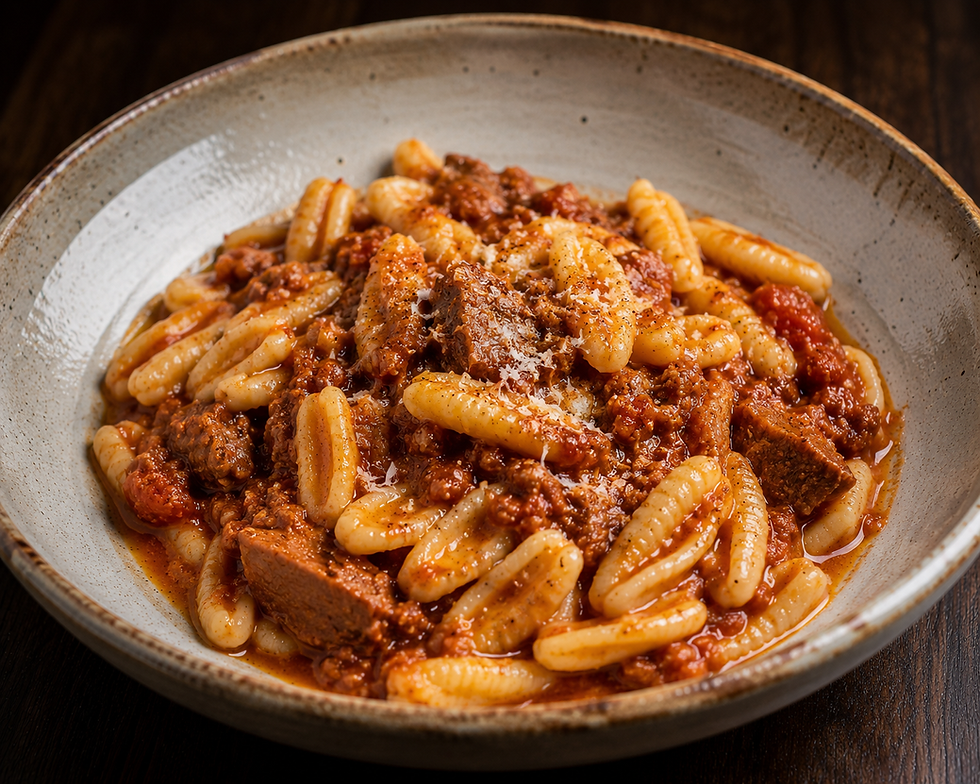
Italian Molise Cavatelli with Ragù | Cavatelli al Ragù Molisano

Molise is the smallest region in Italy after the Aosta Valley and the one nobody can place on a map, and its Sunday dish is a pot of ragù built on three cuts of pig and left on the lowest flame in the house for four hours. The pasta under it is cavatelli, rolled from semola and water by hand, no egg, and curled with two fingers against a wooden board.
This is a ragù of pieces, not of mince. Pork ribs, a length of sausage and a rolled braciola of pork shoulder go in whole, brown in lard and oil, then cook down in tomato until the sauce has taken everything the bones had to give. The meat is eaten afterwards as the secondo. Only the sauce dresses the pasta.
It is a slow recipe and an almost unattended one. The browning takes twenty minutes and then the pot looks after itself while you make the cavatelli. What you cannot do is hurry it, because the character of this sauce comes from collagen turning to gelatin over hours and from tomato losing its edge in the same time.
Yield: 6 servings, plus the boiled meats as a second course. Prep: 50 minutes. Cook: 4 hours. Difficulty: intermediate. Course: primo piatto. Region: Molise, the province of Campobasso and the high country around Agnone.
The Story
Molise cooks the way a region of shepherds and smallholders cooks. For centuries its economy ran on transumanza, the seasonal movement of flocks along the tratturi, the grass roads that crossed the region from the Abruzzo mountains down to the Tavoliere in Puglia. The tratturo Castel di Sangro to Lucera still cuts across the province, and the food along it was cooked slowly over wood.
Cavatelli are the region's own pasta, cavatill in dialect, made from durum semola and water alone. No egg, because eggs were sold rather than eaten, and durum wheat because that is what grows there. The shape is made by pressing a small cylinder of dough with two fingertips and pulling it towards you so it hollows. That hollow is functional: it traps a heavy meat sauce in a way a flat noodle never can.
The ragù itself is a Sunday and feast day dish, and in Molise it is inseparable from the pig. Every rural family kept one and killed it in winter, and the sausage in this sauce descends directly from that, seasoned with chilli and sometimes wild fennel. Serving the sauce first with pasta and the meats afterwards was not presentation. It was how one pot fed a table twice.
Ingredients
For the cavatelli
Durum wheat semola rimacinata, 3 1/2 cups (500 g)
Warm water, about 1 cup (240 ml), at 105°F (40°C)
Fine sea salt, 1 tsp (6 g)
Extra semola for the board and the tray
For the ragù
Pork spare ribs, separated, 1 1/4 lb (570 g)
Fresh pork sausage, coarse ground, in one or two lengths, 10 oz (280 g)
Pork shoulder, in one thin slice for the braciola, 8 oz (230 g)
Pecorino, grated, for the braciola filling, 2 tbsp (15 g)
Garlic clove, chopped, and parsley, chopped, for the filling, 1 tbsp total
Lard, 1 tbsp (15 g), or olive oil if you prefer
Extra virgin olive oil, 2 tbsp (30 ml)
Yellow onion, finely chopped, 1 medium (150 g)
Dry red wine, 1/2 cup (120 ml)
Passata di pomodoro, 4 cups (1 kg)
Tomato paste, 1 tbsp (17 g)
Water, 1 cup (240 ml), for rinsing the tomato jars
Bay leaf, 1, and a basil sprig
Dried chilli, small, 1, or to taste
Fine sea salt and freshly ground black pepper, to taste
For finishing
Pecorino, aged, freshly grated, 3/4 cup (75 g)
Coarse salt for the pasta water, 1 tbsp per 4 quarts (4 l)
Basil leaves, torn, a few
Preparation
Step 1
Make the cavatelli dough. Pile the semola on a board, dissolve the salt in the warm water and work it in a little at a time until the dough is stiff and slightly rough. Knead it for a full 10 minutes. Semola and water need that time to hydrate, and a dough that feels dry at minute three becomes smooth and elastic at minute nine. Wrap it and rest it for 30 minutes while you start the sauce.
Step 2
Roll the braciola. Lay the pork shoulder flat, beat it to an even thickness and season it with salt, pepper, the pecorino, the garlic and the parsley. Roll it tightly along the long side and tie it with string at three points. The roll holds its shape through four hours of simmering and the filling perfumes the sauce from the inside.
Step 3
Brown the meats properly. Melt the lard with the oil in a heavy pot over medium heat and brown the ribs, the sausage and the braciola in batches, giving each piece real colour on every side. This is 15 to 20 minutes of work and it is not optional. The browned residue on the base of the pot is the backbone of the flavour, and a crowded pot steams the meat grey. Lift the meats onto a plate.
Step 4
Soften the onion in the fat. Lower the heat, add the onion and cook it for 8 to 10 minutes until translucent, scraping the base as it releases its moisture and loosens the browned residue. Add the chilli. The onion should stay pale, because this sauce is long enough that colour taken now turns bitter by hour three.
Step 5
Deglaze and build the tomato. Pour in the red wine, raise the heat and let it bubble until the alcohol smell has gone and the liquid has almost disappeared. Stir in the tomato paste, cook it for a minute, then add the passata. Swirl the water in the empty jars and add that too. Bring it to a simmer with the bay leaf and basil, then return the meats and their juices.
Step 6
Cook it for four hours on the lowest heat. Set the lid ajar and hold the pot at the barest simmer, where a bubble rises every few seconds and nothing more. Stir every 30 minutes, reaching the bottom each time. It is finished when it has darkened from red to brick, the oil has surfaced in small pools and the rib meat pulls from the bone.
Step 7
Shape the cavatelli while the sauce cooks. Roll a piece of dough into a rope the thickness of a finger and cut it into pieces about 3/4 inch (2 cm) long. Press each one with two fingertips on an unfloured board and drag it towards you so it curls into a hollow shell. Keep the rest of the dough covered and lay the finished cavatelli on a tray dusted with semola without letting them touch.
Step 8
Lift out the meats and correct the sauce. Take the ribs, the sausage and the braciola out and keep them warm in a covered dish under a ladle of sauce. Fish out the bay leaf and the tired basil, then taste and correct the salt and pepper. If the sauce is still loose, simmer it uncovered for 10 minutes; if it has gone tight, loosen it with hot pasta water later.
Step 9
Cook the pasta and finish it in the pan. Bring 5 quarts (5 l) of water to a rolling boil and salt it lightly, because the sauce is already salty. Fresh cavatelli need 4 to 6 minutes and are ready when they rise and the centre of the curl is just past chalky. Lift them into a wide pan with two thirds of the sauce, add a ladle of pasta water and toss over medium heat for a minute, then off the heat add the pecorino and keep tossing until the sauce clings.
Plating
This is served in two acts and the first goes out fast. Warm deep plates, because cavatelli are dense and hold their heat badly once the sauce is spread thin. Divide the dressed pasta with tongs rather than a spoon so the curls stay separate.
Add a spoonful of the reserved sauce on top of each portion, not stirred through, so the plate reads in two tones. Grate pecorino at the table and tear a little basil across. No olive oil here: the sauce has released plenty of pork fat already.
The meats follow as the secondo, on a warmed platter for the table. Slice the braciola across the roll so each piece shows the pecorino and parsley spiral, cut the sausage on the diagonal and leave the ribs whole. Bitter greens or a sharply dressed chicory salad is the traditional accompaniment.
Professional Technique
The defining technique here is cooking meat in pieces rather than mince, which changes the sauce completely. Spare ribs bring bone and connective tissue, and four hours at a bare simmer turns their collagen into gelatin that dissolves into the tomato and gives the sauce a clinging body no ground meat can produce. That is why the ribs go in bone and all and are not trimmed of every scrap of fat.
The three meats do three different jobs. The ribs give gelatin and depth, the sausage gives fat, salt and spice that season the sauce from within, and the braciola gives a lean sweetness plus the pecorino and parsley in its filling. Drop one and the sauce still works, but it loses a register. That layering is what separates this ragù from a plain pork sugo.
Cavatelli themselves are a technique rather than a recipe. Because the dough is only semola and water, the texture comes from hydration and from the drag across the board, which stretches the gluten on the outer face while leaving the inside thicker. That difference is why a cavatello stays chewy at the centre while its edges take sauce, and why an extruded version never eats the same way.
Texture and Moisture Control
Two water balances have to be managed and they pull in opposite directions. The sauce loses water for four hours and must finish thick enough to coat but loose enough to move in the pan, while the pasta absorbs water and must stop while its centre still resists. Drag a spoon across the base of the pot: the trail should close slowly rather than instantly.
Semola pasta made with water has no egg protein to hold it together, so the dough depends on gluten developed by kneading and on being hydrated at around 48 percent. Too wet and the cavatelli stick to the board; too dry and they crack at the edges and cook unevenly. The dough should feel firm and just slightly tacky after resting.
The finish in the pan is where the two meet. Cavatelli shed a great deal of surface starch into the water, and a ladle of it tossed with the sauce emulsifies the pork fat into a glossy coating instead of leaving oil on top. Add the pecorino off the heat: over a flame its proteins tighten and the sauce turns grainy.
Professional Mise en Place
The timing is dictated by the sauce, so start it first and treat the pasta as what you do while waiting. Everything except the final toss can be done a day ahead.
Equipment and tools
Heavy pot or Dutch oven of at least 6 quarts (6 l) with a lid
Unfloured wooden board for shaping, plus trays dusted with semola
Kitchen string for the braciola and a meat mallet or heavy pan
Wide sauté pan large enough to toss all the pasta at once
Spider for lifting the cavatelli straight from the water
Prepared ahead
Ragù cooked complete, up to 2 days ahead, refrigerated with the meats in it
Braciola rolled and tied the night before, kept cold
Cavatelli shaped and dried on semola for 2 hours, or frozen on the tray
Pecorino grated and covered, no more than a few hours ahead
Chilli, bay and basil measured out beside the pot
Service setup
Sauce warm and loose, two thirds in the pan and a third reserved for the top
Meats kept warm under sauce for the second course
Pasta water at a rolling boil and lightly salted
Warmed deep plates and tongs ready before the pasta goes in the water
A cup of pasta water standing by for the toss
Chef Tips
Use semola rimacinata and nothing else. Coarse semola hydrates unevenly in a water dough and all purpose flour gives a soft pasta that collapses under a sauce this heavy. The twice milled grind is what lets the dough take the drag of two fingers.
Buy the sausage rather than making it, but buy it coarse and unsmoked. A fine ground one breaks up and muddies the sauce, while a coarse one holds together for four hours and stays sliceable for the second course. A southern sausage with chilli or wild fennel is the profile this ragù wants.
Make the sauce the day before if you can. Cooling and reheating settles the flavours and lets you lift the hardened fat off the top next morning. It is better on day two than on day one.
Freeze the cavatelli on their tray and bag them once solid. They go into boiling water straight from the freezer and need a minute longer. Never thaw them first: they turn sticky and lose their curl.
Common Mistakes
Using ground meat instead of whole cuts. Mince cooks in forty minutes and gives none of the gelatin that makes this sauce cling, so the result is a bolognese in the wrong region. The three cuts go in whole and come out whole.
Rushing the browning. Crowding the pot leaves the meat grey and the base clean, which means there is no browned residue to build on. Work in batches and accept that this takes twenty minutes.
Cooking the sauce at a real simmer. Anything more than the occasional bubble drives off water too fast, scorches the base and leaves the tomato sharp. The flame should be low enough that you doubt anything is happening.
Adding the pecorino over the flame. Sheep cheese seizes at high heat and turns the sauce stringy. Take the pan off the burner, let it lose a few degrees, then add the cheese and toss.
Overworking the pasta water with salt. The ragù carries salt from the sausage, the braciola filling and four hours of reduction, so heavily salted water pushes the plate over the edge. Salt lightly and correct at the end.
Wine Pairing
Tintilia del Molise DOC Rosso: The regional answer and very nearly an obligation. Tintilia is Molise's own grape, grown above 1300 feet and almost extinct forty years ago, and it gives a dark, peppery red with firm acidity and a wild herb edge. That acidity is what the dish needs against reduced pork fat, and the pepper lines up with the chilli in the sausage.
Biferno DOC Rosso: From the Biferno valley running down to the Adriatic, a blend led by Montepulciano. Softer and rounder than Tintilia, with ripe plum fruit and mild tannin, it is the everyday bottle of the province and the one most likely on a Molisano table on a Sunday. It flatters the sweetness of the tomato rather than challenging it.
Pentro di Isernia DOC Rosso: A rare mountain red from the upland province of Isernia, Montepulciano with a share of Sangiovese. The altitude keeps it lean and savoury, with sour cherry and a dusty tannin that scrubs the palate between forkfuls. It is the right weight for the pasta course rather than for the meats.
Tintilia del Molise DOC Riserva: The same grape given longer ageing, deeper in colour and with the pepper softened towards liquorice and dried fig. Save it for the second course, when the ribs and the braciola arrive: it has the tannic grip for fatty pork off the bone.
Montepulciano d'Abruzzo DOC: The neighbour over the border and the easiest bottle to find outside Italy. Deeply coloured, low in acidity and generous in dark fruit, it has the body for a long cooked pork sauce. Choose a young unoaked example, since new wood and slow cooked tomato rarely have much to say to each other.
Storage & Reheating
The ragù keeps refrigerated for 4 days airtight and improves for the first two. Store it with the meats submerged in the sauce, which keeps them from drying out. Reheat slowly over low heat with a splash of water, stirring, until it moves freely again.
It freezes well for 3 months, with or without the meats, in portions with a little headroom. Thaw it overnight in the refrigerator, since a fast thaw separates the fat and leaves the sauce oily. Uncooked cavatelli keep 2 months frozen and cook from frozen with an extra minute.
Dressed pasta is the one thing that does not keep. Cavatelli in sauce go soft overnight and no reheating brings the bite back, so cook only the pasta you will serve. If a plate is left over, spread it in a buttered dish, cover it with sauce and pecorino and bake at 375°F (190°C) for 20 minutes.
Nutrition
Per serving, based on 6 servings of pasta with sauce, before the meats:
Calories: 690 kcal
Total Fat: 24 g
Saturated Fat: 9 g
Trans Fat: 0 g
Unsaturated Fat: 13 g
Cholesterol: 55 mg
Sodium: 880 mg
Total Carbohydrates: 89 g
Fiber: 6 g
Total Sugars: 9 g
Added Sugars: 0 g
Protein: 26 g
Principal micronutrients: iron, zinc, selenium, calcium, potassium, vitamin B12, niacin
These figures are estimates. The meats eaten afterwards add roughly 320 kcal and 22 g of fat per person.




Comments