
Italian Basilicata Cavatelli | Cavatelli con Ragù di Maiale
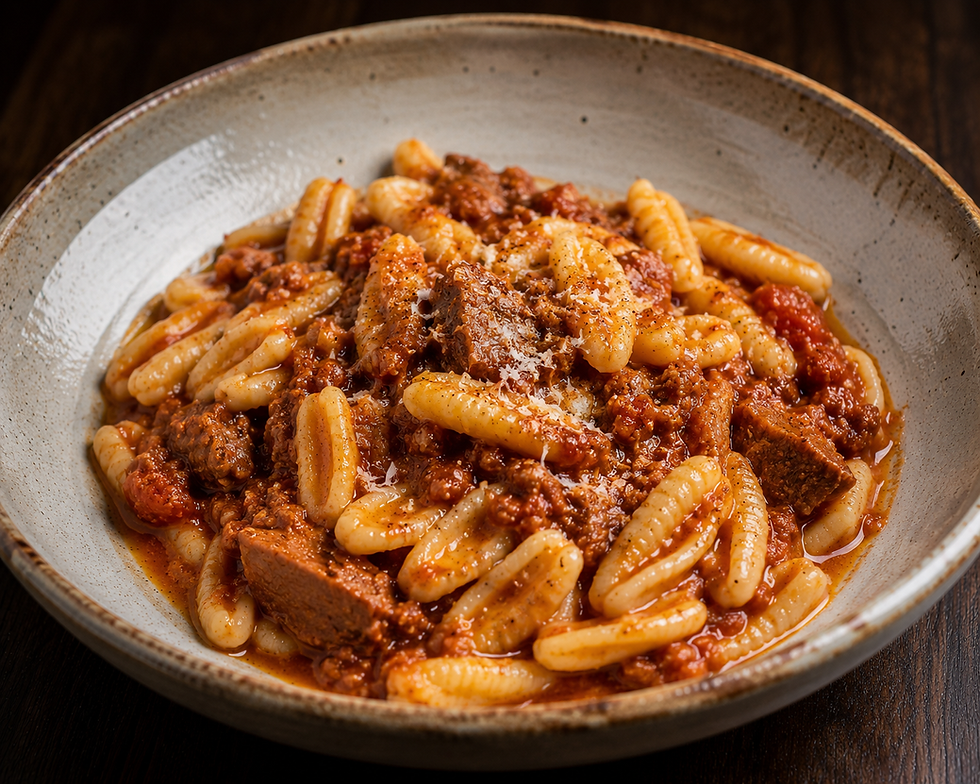
Cavatelli are made by dragging a small piece of semolina dough across a wooden board with two fingers, so it rolls over on itself and opens into a shell with a hollow centre. That hollow is the point. It catches the small pieces of pork and thick tomato a lucanian ragù is built from, so the sauce arrives inside the pasta rather than beside it.
The dough is semolina and water, with no egg. It is firmer than egg pasta, it takes a real kneading, and it stays chewy enough to stand up to two hours of simmered pork. Nothing about it is delicate and nothing about it needs a machine.
The ragù is the other half. Cubed shoulder and crumbled sausage are browned hard, the wine reduces before any tomato goes near the pot, and the sauce simmers until the meat gives way. The pasta finishes its last two minutes in the pan, where its starch and the pork fat emulsify into a glossy coating.
Yield: 4 servings. Prep: 1 hour. Cook: 2 hours 15 minutes. Rest: 30 minutes for the dough. Total: about 3 hours 15 minutes. Difficulty: moderate. Course: primo. Region: Basilicata, the Vulture and the Potenza interior.
The Story
Basilicata grows hard durum wheat and very little that is easier, and its pasta reflects that exactly: semolina, water, salt, a board and a pair of hands. Eggs belonged to the hens and were counted, so they stayed out of the everyday dough. What the region built instead was a family of short dragged shapes, cavatelli among them, known locally as cavatìddi and in the Potenza villages as minuich when they are rolled long on an iron rod. The technique survives because it needs no equipment at all.
Pork is the other constant. Until recently almost every household in the interior kept a pig, killed in the cold weeks after Christmas, and the year was organised around it. The shoulder and the trimmings that could not be cured went into the pot, which is why a lucanian ragù is small pieces of meat rather than the large braised cuts of the Neapolitan version. Fresh sausage went in beside them, and the pot went on the fire on a Sunday morning and stayed there.
The finish is regional too. Pecorino di Filiano DOP comes from the villages under Monte Vulture, aged in the tufa cellars of the area and sharp enough to season a whole bowl with a small handful. The crushed peperoncino that goes into the pot is the same chilli tradition that runs through the south. Put those beside browned pork, tomato and a chewy semolina shell and the plate tastes of one stretch of mountain country, not of southern Italy in general.
Ingredients
A short list, which means the semolina, the pork and the cheese all have to be good.
For the cavatelli
Semolina rimacinata, 3 cups (500 g)
Warm water, about 1 cup (240 ml), up to 1 1/4 cups (300 ml)
Fine sea salt, 1 tsp (6 g)
Semolina for dusting the trays, 1/4 cup (40 g)
For the ragù
Pork shoulder, cut into 1/2 in (1 cm) cubes, 1 lb (450 g)
Fresh Italian pork sausage, casings removed, 6 oz (170 g)
Extra virgin olive oil, 2 tbsp (30 ml)
Yellow onion, finely diced, 1 small, about 4 oz (115 g)
Carrot, finely diced, 1, about 2 oz (60 g)
Celery stalk, finely diced, 1, about 2 oz (60 g)
Garlic cloves, minced, 2
Tomato paste, 1 tbsp (16 g)
Dry red wine, 1 cup (240 ml)
Crushed tomatoes, 2 cups (480 g)
Light meat stock, 1 cup (240 ml), plus more if needed
Bay leaf, 1
Rosemary sprig, small, 1
Crushed dried peperoncino, 1/2 tsp (1 g)
Fine sea salt and black pepper, to taste
For finishing
Pecorino di Filiano DOP or Pecorino Romano, finely grated, 1/2 cup (50 g)
Reserved pasta cooking water, about 1 cup (240 ml)
Extra virgin olive oil, a few drops per plate
Preparation
Mix and knead the semolina dough
Tip the semolina onto a work surface, stir the salt through it and make a well. Add the warm water a little at a time, drawing the flour in with your fingers. Warm water hydrates durum semolina far faster than cold. Knead for 8 to 10 minutes: the dough starts rough and grainy and turns smooth, firm and slightly springy, noticeably harder than egg pasta. Wrap it and rest it 30 minutes so the semolina finishes hydrating.
Shape the cavatelli
Cut off a quarter of the dough and keep the rest wrapped, since exposed semolina skins over quickly. Roll it into a rope about 1/2 in (1 cm) thick and cut pieces the same length. Press each with two fingertips and drag it firmly toward you across an unfloured wooden board: it rolls over itself and opens into a curled shell. Work for consistency rather than beauty, since uneven pieces cook at different rates.
Brown the pork and the sausage
Heat the olive oil in a heavy pot over medium high heat and add the cubed shoulder in an uncrowded layer, in two or three batches. Leave each batch undisturbed until a deep crust forms. This is where most of the flavour of the sauce is made, and crowding drops the temperature and steams the meat. Lift the pork out, then brown the sausage in the same fat, breaking it up.
Build the soffritto and cook out the tomato paste
Lower the heat to medium, add the onion, carrot and celery with a pinch of salt and cook 8 to 10 minutes, scraping the browned fond off the bottom. When they are soft and colouring, add the garlic for one minute, then the tomato paste. Cook the paste 2 minutes, stirring, until it darkens from bright red to brick. Paste that has not been cooked out leaves a tinny edge that survives the whole simmer.
Deglaze with the wine and reduce
Pour in the red wine and raise the heat, scraping the bottom clean. Reduce it by half, until the harsh alcohol smell has gone. This has to happen before any tomato arrives, because tomato acidity slows evaporation and locks a raw wine note into the sauce. Return the pork and its juices, then add the tomatoes, stock, bay leaf, rosemary and peperoncino.
Simmer the ragù slowly
Bring the pot to a bare simmer, bubbles breaking only at the edges, and cook partly covered for 1 1/2 to 2 hours, stirring every twenty minutes and adding hot stock if the surface looks dry. A rolling boil tightens pork shoulder into dry fibres no matter how long it then cooks. When the meat crushes against the side of the pot, remove the bay leaf and rosemary stem and break the cubes into smaller pieces. Do not shred them into threads: a lucanian ragù is small identifiable pieces.
Reduce, season and hold
Reduce the sauce until it is thick but still fluid, loose enough to move when you tilt the pan. It must stay looser than the consistency you want on the plate, because the pasta absorbs a surprising amount in the final two minutes. Season it now, but slightly short, since the pecorino carries plenty of salt of its own.
Cook the cavatelli and manage the water
Bring a large pot of water to a rolling boil and salt it until it tastes clearly seasoned, about 1 tbsp (18 g) of coarse salt per 4 quarts (4 L). Semolina pasta takes its seasoning only from the water, and underseasoned water gives bland pasta no sauce corrects. Drop the cavatelli in and stir once. Fresh ones float after 4 to 6 minutes, thicker pieces take 8. Pull them while the centre still has a firm bite, just short of al dente, since they cook another two minutes in the pan. Reserve a cup of the cloudy water.
Finish in the pan and mantecare
Ladle enough ragù for the plates into a wide skillet, loosen it with a splash of pasta water and bring it to a lively simmer. Lift the cavatelli straight from the pot with a spider into the pan, carrying water with them. Toss and shake continuously for 2 to 3 minutes, adding pasta water in small amounts, until the sauce thickens around the pasta and turns glossy. Off the heat, wait a few seconds, then add the pecorino in two or three handfuls, tossing between each. Cheese added over a flame breaks into strings.
Plating
Warm the bowls. Semolina pasta with a meat sauce loses heat quickly and a cold bowl costs you the gloss within a minute. Wide shallow bowls give the pasta room to lie in a loose layer rather than pile into a mound that steams itself.
Serve straight from the pan, lifting with tongs or a large spoon so the cavatelli land loosely and stay separate. Every shell should be coated and a few pieces of pork should be visible on top, but the pasta should not disappear under a ladle of extra sauce poured over it. If the plate looks dry by the time it reaches the table, the fault was in the pan, not the serving.
Finish with a light grating of pecorino at the table, a few drops of good olive oil and nothing else. No parsley, no basil, no cream. Take the plates out immediately: handmade semolina pasta keeps absorbing sauce as it sits.
Professional Technique
The technique that defines this plate is the drag itself. Pressing and pulling the dough across an unfloured board stretches the outer surface and compresses the inner one, so the piece curls and thins at the edges while staying thick at the centre. That unevenness is deliberate: the thin edge cooks quickly and the thick spine keeps its bite. A floured board makes the dough slide instead of grip.
Browning is the second. Pork shoulder has enough connective tissue and fat to survive a long simmer, but the roasted flavour of the ragù comes entirely from the Maillard crust built in the first ten minutes. Cubes packed into the pan release water, the temperature falls below the browning threshold and the meat greys. Two unhurried batches separate a sauce that tastes of roasted pork from one that tastes only of tomato.
The third is the pan finish, the mantecatura. Cavatelli release a great deal of surface starch, and that starch, worked together with pork fat and a little pasta water over heat, forms a genuine emulsion, with the starch doing the work of the emulsifier. It cannot happen in a colander, which is why the pasta goes from the water into the pan while it is still short of done.
Texture and Moisture Control
Start with the dough. Semolina hydrates slowly, so judge it after the rest rather than during the knead. Too dry and the pieces crack at the edges as you drag them; too wet and they stick to the board and lose the hollow. The target is firm and smooth with a faint spring. Correct a sticky dough with a dusting of semolina, never a handful of flour at once.
The ragù has one enemy, reducing too far before the pasta arrives. Cavatelli drink sauce in the pan, and a ragù that looks perfect in the pot reads as heavy and pasty on the plate. Keep it a stage looser than you want it. The reverse fault, a thin sauce, is corrected by reducing before the pasta goes in, not by boiling hard afterwards.
Pasta water is the control at the end. It is salted, loaded with starch and hot, so it thickens rather than dilutes. Add it a tablespoon at a time while tossing and watch the sauce go from matte to shining. Once the pecorino is in, it tightens again within seconds, which is when a final splash brings it back. Serve at that moment.
Professional Mise en Place
The ragù is long and forgiving, the last three minutes are neither. Everything below exists so the finish happens with both hands free.
Equipment and tools
Heavy pot or Dutch oven of 5 to 6 quarts (5 to 6 L) for the ragù
Unfloured wooden board, or a ridged cavatelli board, for shaping
Wide skillet or saute pan large enough to toss 4 portions
Spider or slotted spoon for moving the pasta wet into the pan
Trays dusted with semolina and a bench scraper
Prepared ahead
Ragù made up to 2 days ahead and refrigerated, or frozen up to 2 months
Cavatelli shaped up to 4 hours ahead and held uncovered on semolina
Cavatelli frozen on the tray, then bagged, and cooked straight from frozen
Pecorino grated close to service, never the day before
Soffritto diced and held covered in the refrigerator
Service setup
Ragù held warm and a stage looser than the finished consistency
Pasta water at a rolling boil and correctly salted before the first order
Reserved pasta water in a jug beside the stove, not in the sink
Bowls warming, plates and tongs within reach of the pan
Chef Tips
Make the ragù the day before. It improves overnight in a way few sauces do: the fat sets, the seasoning settles, the tomato loses its edge. It also turns a three hour dish into a thirty minute one.
Shape a dozen cavatelli and cook them before committing the whole batch. Two minutes of testing tells you whether your pieces are too thick, and that is easier to fix at piece twelve than at piece two hundred.
Keep the board bare. Every instinct says to flour the surface for shaping, and flour is precisely what stops the dough gripping and curling. Dust the trays instead, once the shells are made.
Taste the pecorino first. Filiano, Romano and a supermarket pecorino differ enormously in salt, and the one in front of you decides how far short you leave the ragù at the seasoning stage.
Common Mistakes
Crowding the pot when browning the pork. The cubes release water, the pan temperature collapses and the meat stews grey. Work in batches and leave each one alone until a crust forms.
Adding the tomato before the wine has reduced. Tomato acidity slows evaporation and traps a raw alcoholic note in the sauce that two hours of simmering will not remove. Reduce the wine by half first.
Shaping the cavatelli too thick. A thick spine leaves a chalky raw centre while the edges are already soft. Roll the ropes no thicker than 1/2 in (1 cm) and drag with real pressure.
Draining the pasta and pouring sauce over it. Without the pan finish there is no emulsion, the starch goes down the sink and the sauce slides off the shells. Move the cavatelli into the pan wet and two minutes early.
Adding the pecorino over direct heat. Sheep milk cheese seizes and strings the moment it hits a boiling surface. Pull the pan off the flame, wait a few seconds, then add it in handfuls.
Wine Pairing
Browned pork, reduced tomato and salty sheep cheese need a dry red with real acidity and enough tannin to cut the fat. Sweet wines have no place here, and anything soft and low in acid is flattened by the pecorino.
Aglianico del Vulture Superiore DOCG: The local bottle, grown on volcanic soils above Filiano and Barile. Its high acidity handles the reduced tomato head on, and the long ageing the Superiore requires has softened the aggressive young tannin into something that grips the pork fat rather than fighting it. The smoky note the volcanic soil gives picks up the browned crust on the meat.
Taurasi DOCG: The same aglianico grape from the hills inland of Avellino, firmer and more structured than the Vulture version. Its tannin is substantial, which is why it needs the fat of a pork ragù underneath it. Dried cherry, leather and tobacco depth stand up to the sharpness of an aged pecorino.
Primitivo di Manduria DOC: Choose the dry version and it is the rounder option, from the Salento plains a few hours east. Ripe black fruit and a faintly balsamic warmth flatter the sausage and the chilli, and the softer tannin drinks easily with a chewy semolina pasta. Serve at 61°F (16°C).
Salice Salentino DOC: Built on negroamaro, it sits between the other three: mid weight, savoury, with a bitter herbal twist on the finish that answers the rosemary and the peperoncino. The acidity is bright enough to reset the palate between mouthfuls of a rich sauce.
Storage & Reheating
The ragù stores better than almost anything else in the kitchen. Cooled quickly in an airtight container it holds 3 days in the refrigerator and 2 months in the freezer, and it is genuinely better on day two. Freeze it in portions sized to the plates you are likely to want.
Raw cavatelli keep a few hours on a tray dusted with semolina, uncovered, at cool room temperature. For longer, freeze them spread out on the tray until hard, then bag them, and cook them straight from frozen with about 2 minutes added to the time. Never thaw them first: they slump and stick together into one mass.
Dressed pasta does not keep well and a day is the limit. Reheat it in a skillet over medium low heat with a spoonful of water and an extra spoonful of ragù, tossing about 3 minutes until it loosens and shines again. Avoid the microwave, which overheats the sauce, dries the shells and leaves the centres cold.
Nutrition
Estimated per serving, based on 4 generous portions including the finishing pecorino:
Calories: 840 kcal
Total Fat: 29 g
Saturated Fat: 10 g
Trans Fat: 0 g
Unsaturated Fat: 17 g
Cholesterol: 95 mg
Sodium: 860 mg
Total Carbohydrates: 102 g
Fiber: 8 g
Total Sugars: 9 g
Added Sugars: 0 g
Protein: 41 g
Lactose: 0.3 g
Micronutrients: iron 5.2 mg, zinc 6.1 mg, calcium 320 mg, potassium 1150 mg, vitamin B12 1.4 mcg, thiamine 1.1 mg, niacin 12 mg, selenium 55 mcg
Contains wheat, gluten and milk. These figures are estimates and move with the fat content of the shoulder and the sausage and how heavy the hand is with the pecorino.



Comments