
Italian Potato Gnocchi with White Rabbit Ragù and Taggiasca Olives | Gnocchi di Patate Rivisitati con Ragù Bianco di Coniglio e Olive Taggiasche
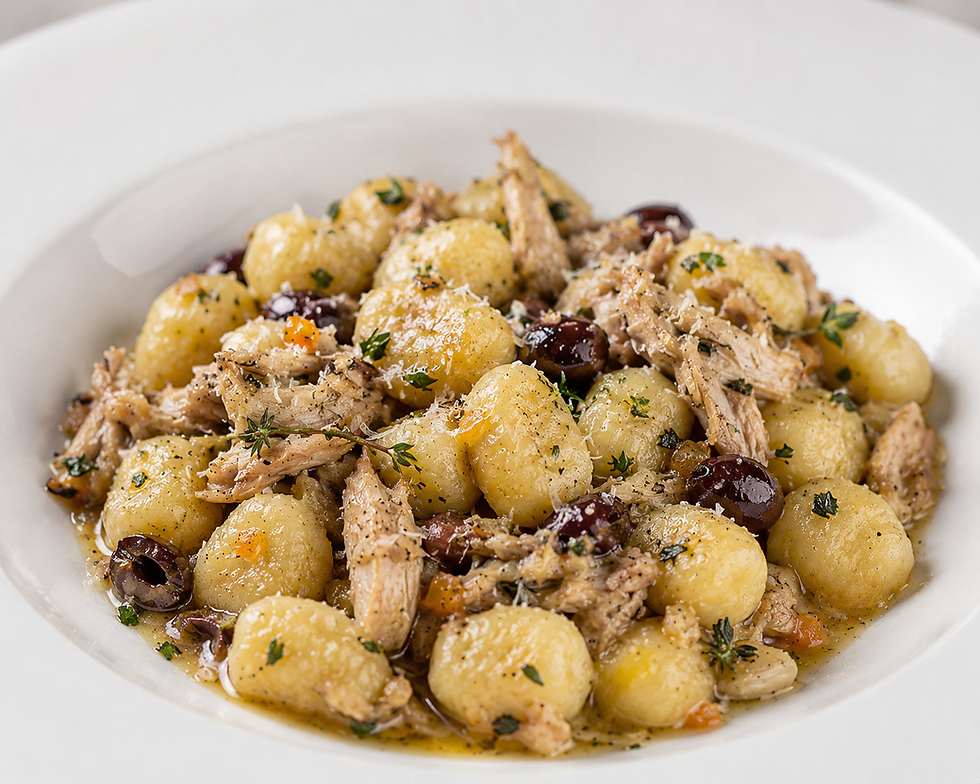
A white rabbit ragù is defined by everything it refuses. No tomato, no stock cube, no cream, no long reduction of dark juices. What carries it is the rabbit itself, browned hard on the bone, a glass of dry white wine, Taggiasca olives added late, and a little stock made from the carcass while the rest of the animal braises. The result is pale, almost ivory, and it tastes of rabbit, rosemary and brine rather than of sauce.
The gnocchi are revisited in one specific way. The potatoes are baked on a bed of coarse salt rather than boiled, which drives water out instead of letting it in, and the dough takes roughly half the flour a boiled potato demands. The gnocchi then get thirty seconds in the rabbit fat before the sauce goes on, so each arrives with a thin golden face and a centre that is still light.
Everything here is Ligurian in origin even though the combination is not. Rabbit cooked white with olives, pine nuts and herbs is the standard preparation of the western Riviera, and potato gnocchi are made across Liguria, almost always with pesto. The sauce is the regional one, cooked as it is cooked there, and only the pasta underneath has moved.
Yield: 4 servings. Prep: 1 hour. Cook: 1 hour 30 minutes. Total: about 2 hours 30 minutes. Difficulty: advanced. Course: primo piatto. Region: Liguria, the Riviera di Ponente around Taggia and Imperia.
The Story
The Taggiasca olive takes its name from Taggia, inland from the coast between Sanremo and Imperia, and it is one of the few Italian cultivars whose arrival can be credited to a specific community. Benedictine monks of the abbey of San Colombano settled there in the medieval period and planted the terraces with an olive suited to thin soil and steep drops. It is small, dark, slow to ripen and low in bitterness, and it gives both a delicate oil and a table olive that behaves unlike any other in cooking. It does not shout. It salts.
Rabbit is the meat of the Ligurian hinterland for the plainest of reasons. The land behind the coast is vertical, terraced and poor, with room for olives, vines and herbs and very little grazing. Rabbits need no pasture and feed themselves on scraps, so every family kept them, and coniglio alla ligure became the Sunday dish of the valleys above Sanremo, Taggia and Dolceacqua. It is cooked white, with rosemary, thyme and bay from the hillside, pine nuts from the maritime pines, and the local olives thrown in near the end.
Gnocchi belong to Liguria too, though they live in the shadow of pesto. Trofie and trenette take the basil sauce, and potato gnocchi appear in the same kitchens dressed the same way. Nobody in Taggia would put a rabbit braise on them, which is why this version is called rivisitato. Its claim is narrow: a white ragù built as the Ponente builds it sits on gnocchi better than on the tagliatelle it usually meets.
Ingredients
For the gnocchi
Floury potatoes, russet or similar, 2 lb (900 g)
Coarse sea salt, for the baking bed, 2 lb (900 g)
Type 00 flour, 3/4 cup (100 g), plus more for the board
Egg yolk, large, 1
Fine sea salt, 1 tsp (6 g)
Freshly grated nutmeg, 1 pinch
For the white rabbit ragù
Whole rabbit, about 3 lb (1.4 kg), with liver and kidneys if available
Extra virgin olive oil, Taggiasca if possible, 3 tbsp (45 ml)
Yellow onion, finely diced, 1 small
Carrot, finely diced, 1 small
Celery, finely diced, 1 stalk
Garlic cloves, lightly crushed, 2
Dry white wine, 1 cup (240 ml)
Fresh rosemary, 1 sprig
Fresh thyme, 4 sprigs
Bay leaf, 1
Fine sea salt, 1 1/2 tsp (9 g)
Freshly ground black pepper, to taste
For the rabbit stock
Rabbit bones and carcass, from the rabbit above
Cold water, 5 cups (1.2 L)
Onion, halved, 1/2
Celery, 1 stalk
Black peppercorns, 6
Bay leaf, 1
For finishing
Taggiasca olives in brine, pitted, 1/2 cup (85 g)
Pine nuts, 3 tbsp (25 g)
Unsalted butter, cold, 2 tbsp (28 g)
Grated Parmigiano Reggiano, 1/3 cup (35 g)
Lemon zest, finely grated, from 1/2 lemon
Flat leaf parsley, chopped, 1 tbsp
Extra virgin olive oil, for the plates
Preparation
Break down the rabbit
Separate the rabbit into front legs, hind legs, saddle and rib cage. The hind legs are the slowest cuts and the saddle is lean enough to dry out beside them, so cut it away in one piece and set it aside. Trim silver skin from the legs and pat every piece completely dry. Keep the rib cage, neck and loose bones for the stock, and chop the liver and kidneys finely.
Make the rabbit stock
Put the bones, rib cage and neck in a saucepan with the cold water, half onion, celery, peppercorns and bay leaf. Bring it slowly to a bare simmer and hold it there 45 minutes, skimming the grey foam for the first ten. Never let it boil: a rabbit carcass is lean, and a rolling boil emulsifies its little fat into a cloudy stock that tastes flat. Strain and reduce to about 1 1/2 cups (360 ml).
Bake the potatoes on salt
Heat the oven to 400°F (200°C). Spread the coarse salt in a roasting tray and set the unpeeled potatoes on it, not touching. Bake 55 to 70 minutes, until a skewer passes through with no resistance. The salt bed holds the potatoes off the metal so they cook in dry heat on every side, and pulls moisture out of the skin.
Rice the potatoes while they are hot
Cut each potato in half the moment it leaves the oven and scoop the flesh straight into a ricer held over the work surface, discarding the skins. Let it fall in a loose mound and steam freely two or three minutes. Working hot matters more than anything else here: starch allowed to cool sets into a gluey mass that fights the flour.
Mix and shape the gnocchi
Spread the riced potato out, scatter over the fine salt, nutmeg and two thirds of the flour, add the egg yolk and bring it together with a bench scraper, folding rather than kneading. Add the rest of the flour only if the dough still clings to your fingers, and stop as soon as it holds. Roll ropes 3/4 inch (2 cm) thick, cut them, roll each down a gnocchi board and lay them on a floured tray in one layer.
Brown the rabbit and build the ragù
Heat the olive oil in a wide heavy pan over medium high heat and brown the legs on every side until properly golden, about 8 minutes, in two batches so the pan never steams. Take them out, lower the heat and cook the onion, carrot, celery and garlic with a pinch of salt for 10 minutes until soft and pale, scraping up what the rabbit left. Return the legs, add the herbs, pour in the wine and reduce by half.
Braise, then shred and finish
Add 1 cup (240 ml) of the reduced stock, cover and cook at a bare simmer for 50 minutes, adding the saddle for the final 20 only. Lift out every piece, pull the meat off the bones while warm and shred it coarsely by hand rather than chopping it. Return it to the pan with the chopped liver, the olives and the toasted pine nuts, and simmer uncovered 8 minutes. The olives go in here, never at the start, because long cooking turns them bitter and grey.
Boil the gnocchi and mantecare
Bring a wide pan of water to a gentle rolling boil and salt it lightly, 1 tbsp (18 g) for 4 quarts (4 L), since the ragù and the olives are already saline. Slide the gnocchi in, in two batches, and lift each out 20 seconds after it rises. Add a spoonful of rabbit fat to a large sauté pan and give them 30 seconds over high heat to colour on one side. Add the ragù, a ladle of cooking water and the cold butter, and swirl until the sauce turns glossy and clings.
Plating
Serve in warm shallow bowls, never on flat plates or on anything straight from a hot cupboard. The target is around 130°F (55°C): hot enough that the butter emulsion stays liquid to the last forkful, cool enough that the olives keep their perfume instead of turning medicinal. Warm the bowls with hot water and dry them.
Lift the gnocchi in with a slotted spoon first so they sit in a low mound rather than swimming, then arrange the rabbit and the olives over and between them and spoon the remaining emulsion around the edge. Scatter the pine nuts last so they stay dry, add the lemon zest and parsley, and finish with a few drops of Taggiasca oil.
Professional Technique
A white ragù has no reduction to hide behind. A red ragù builds colour, sweetness and body from tomato over two or three hours and small errors vanish into it. Here the sauce is pale, the cooking under an hour, and the flavour comes from three places: the fond left by browning the legs, the gelatin in a stock made from the same animal, and the brine of the olives. Miss the browning and there is nothing to recover with, which is why the legs go in dry and in two batches.
The second technique is the split cooking of the cuts. Rabbit is not one meat: the hind legs carry connective tissue needing close to an hour of gentle heat, while the lean saddle is done in twenty minutes. Braise the whole animal for the same time and you get either tough legs or a saddle with the texture of cotton. Holding the saddle back is what lets one pot produce both.
Texture and Moisture Control
Gnocchi are a starch and water problem before they are anything else. A potato boiled in its skin gains water, and every gram has to be bound by flour, which is why boiled doughs drift towards a cup or more and end up dense. Baking on salt sends the same potato the other way: the flesh comes out drier and floury, and 3/4 cup (100 g) is enough for 2 lb (900 g). Less flour means less gluten, and less gluten is the point.
The cooking water does the final adjustment. Gnocchi shed starch fast, so the water becomes a usable binder within a minute, but they fall apart if they sit in it. Lift them 20 seconds after they surface, when the centre is hot and before the surface dissolves, and carry a ladle of that water to the pan. Cold butter swirled in with it turns a thin braising liquid into a sauce that coats.
Then the sear, which is the part people leave out. Thirty seconds in rabbit fat sets a thin skin on one face of each gnocco. That skin is not about crunch, which the sauce kills instantly, but about structure: it stops them drinking sauce like sponges and holds them intact through the mantecatura.
Professional Mise en Place
The ragù improves overnight and the gnocchi do not, so the two halves are prepared on different days in a professional kitchen.
Equipment and tools
Potato ricer, the one tool this recipe cannot do without
Roasting tray deep enough for a bed of coarse salt
Wide braising pan with a lid, plus a saucepan for the stock
Large sauté pan for the sear and the mantecatura
Bench scraper, spider skimmer, floured trays
Prepared ahead
Rabbit stock, reduced and strained, 3 days refrigerated or 2 months frozen
Ragù up to the shredding stage, 2 days refrigerated, without the olives
Olives pitted and pine nuts toasted, on the day
Gnocchi shaped on floured trays, up to 3 hours, uncovered and cold
Parsley, lemon zest and cheese in small containers
Service setup
Ragù warm, olives added only in the last 8 minutes
Salted water at a gentle rolling boil, not a violent one
Sauté pan hot with rabbit fat, cold butter within reach
Cooking water ladle at hand, bowls at around 130°F (55°C)
Chef Tips
Buy a whole rabbit and break it down yourself. Pre cut packs almost never include the rib cage or the neck, and without those bones there is no stock and this sauce has no body at all.
Taste one olive before committing the half cup. Taggiasche vary enormously between producers, and those packed in a strong brine can carry more salt than the whole dish needs. If yours are aggressive, rinse them and cut the salt in the ragù by half a teaspoon.
Test a single gnocco before shaping the rest. Drop one into boiling water as soon as the dough comes together. If it dissolves, work in another tablespoon of flour. If it surfaces whole but tastes floury and tight, you have too much, and the only fix is to bake another potato and rice it back in.
Save the rendered fat from the browning stage. It is the correct medium for searing the gnocchi and costs nothing, and olive oil there is a real loss: that fat carries the fond and ties the two halves of the plate together.
Common Mistakes
Boiling the potatoes. Boiling in the skin ends with a dough that needs half again as much flour, and that flour is what makes gnocchi heavy. Baked on coarse salt, the same potatoes take a third less.
Working the dough cold. Riced potato that has cooled sets into a sticky, resistant mass and the flour will not go in cleanly. Rice it straight from the oven, steam it two minutes and mix at once.
Adding the olives at the start. Taggiasche simmered for an hour go grey, lose their perfume, turn flatly bitter and salt the sauce past correction. They belong in the last 8 minutes.
Cooking the saddle with the legs. The lean saddle is done in twenty minutes while the hind legs need close to an hour. Braised together, one of the two is always wrong.
Leaving the gnocchi in the water. They are ready 20 seconds after they rise. Another minute and the surface starch dissolves, the sauce loses its binder and the gnocchi break in the pan.
Wine Pairing
Roero Arneis DOCG: A dry white with enough weight to meet the butter emulsion and enough acidity to lift it. Arneis from the sandy left bank of the Tanaro gives white peach and a chalky finish that resets the palate between mouthfuls of rabbit fat and olive brine. It is quiet enough aromatically to leave the rosemary alone.
Collio Friulano DOC: The bitter almond note that closes every good Friulano runs straight into the Taggiasca olives, which are themselves more almond than bitter. Grown on the marl and sandstone of the Collio, it has a waxy texture that sits under potato gnocchi without thinning. Serve it at 54°F (12°C), warmer than most whites, or that texture disappears.
Verdicchio dei Castelli di Jesi Classico Riserva DOCG: The Riserva bottlings have lees time and a structure closer to a light red than a simple white, which is what a shredded meat sauce needs. Its saline length handles the olives and its acidity keeps the bowl from turning rich halfway down.
Cerasuolo d'Abruzzo DOC: A serious dry rosé rather than a pale afterthought, made from Montepulciano with real extraction and a dark cherry core. It has the red fruit to follow rabbit and the acidity to follow olives, and at 53°F (12°C) it bridges white and red.
Alto Adige DOC Pinot Nero: The red that works with rabbit, because its tannin is fine and its fruit red rather than black. Pinot Nero from the Mazzon slopes carries a savoury, faintly earthy edge that follows the braise and the pine nuts. Serve it at 57°F (14°C) and choose a bottling with little or no new oak.
Storage & Reheating
Store the ragù and the gnocchi apart and never refrigerate the finished dish. The ragù keeps airtight 3 days refrigerated and freezes 2 months, better frozen before the olives go in since they soften through a thaw. Reduced stock keeps 3 days refrigerated, 2 months frozen.
Raw gnocchi do not hold. On floured trays, uncovered and cold, they last about 3 hours before the surface weeps and they stick. Beyond that, freeze them in one layer until solid, then bag them and cook from frozen with 30 seconds added. Cooked gnocchi should never be refrigerated: they turn gummy and no reheating recovers them.
Reheat the ragù covered over low heat with two or three tablespoons of stock, stirring gently so the meat does not break into threads. Never use a microwave, which drives the fat out of suspension. Then boil fresh gnocchi and finish as usual: the sauce keeps, the pasta is the part you make again.
Nutrition
Per serving, based on 4 servings:
Calories: 690 kcal
Total Fat: 31 g
Saturated Fat: 10 g
Trans Fat: 0 g
Unsaturated Fat: 19 g
Cholesterol: 175 mg
Sodium: 980 mg
Total Carbohydrates: 60 g
Fiber: 5 g
Total Sugars: 4 g
Added Sugars: 0 g
Protein: 46 g
Lactose: 0.6 g
Principal micronutrients: vitamin B12, niacin, selenium, phosphorus, potassium, iron, vitamin C
These figures are estimates. Sodium in particular depends on the brine of the olives and on how heavily the cooking water was salted, and most of that water is discarded rather than eaten.


Comments