Italian Ricotta Gnocchi | Gnocchi di Ricotta
Updated: Oct 24

This is the base recipe, the one all the others on this site are built on. There is no sauce to hide behind and nothing to distract from the only question that matters in a ricotta dumpling: how much flour does this particular cheese need, and how little can you get away with.
Four things decide whether it works. Which ricotta you buy. How long you drain it. How you bring the flour in, which is by folding and not by working. And how hot the water is when the gnocchi go in, which should be barely hot enough to call it cooking. Everything else in this recipe is detail around those four decisions.
The quantities below are a starting point, not a formula. A ricotta that has given up a cup of whey overnight takes less flour than one that has given up a spoonful, and the only reliable way to find the number is to poach a single piece and look at it.
Yield: 6 first course servings. Ricotta draining: 12 hours. Prep: 45 minutes. Cook: 15 minutes. Total: about 1 hour plus draining. Difficulty: intermediate. Course: primo. Region: made throughout Italy, with its roots in the sheep dairying regions.
The Story
Ricotta is not a cheese, and the name says so. It means recooked, and it describes what happens to the whey left in the vat after the curd for pecorino or another proper cheese has been lifted out. That whey still holds albumin and globulin proteins that rennet does not catch. Heated a second time to around 185°F (85°C), often with a little fresh milk added, those proteins denature and rise as a soft white foam, and the cheesemaker skims it off with a flat ladle. The yield is small, roughly 1 to 2 pounds from 25 gallons of whey, and it was for centuries the shepherd's own share rather than something to sell.
That origin explains the cooking. Ricotta spoils within two or three days, it cannot be aged, and it arrived in the house in quantity on the same days the cheese was made. So the dishes built on it are quick, domestic, and nearly all involve binding it with something dry: flour, semolina, breadcrumbs, or the shell of a pasta. What we now serve as a light first course was a way of getting a perishable byproduct eaten before Thursday.
Its nearest relatives are worth knowing, because they come from the same pastoral economy. Malloreddus, the ridged semolina gnocchetti of Campidano in southern Sardinia, are rolled on a reed basket and often coloured with saffron. Culurgiones, from the Ogliastra on the east coast, are filled with potato and pecorino and closed with a pleated seam that looks like an ear of wheat. Neither contains ricotta, but both come from the same shepherding country and the same habit of making small hand shaped things from what the flock produced.
Ingredients
For the gnocchi
Whole milk ricotta, 2 lb (900 g) before draining
All purpose flour, 1 1/2 to 2 cups (190 to 250 g), depending on the ricotta
Parmigiano Reggiano, finely grated, 1 cup (90 g)
Eggs, large, 2 (about 3 1/2 oz, 100 g without shells)
Fine sea salt, 1 tsp (6 g)
Freshly grated nutmeg, 1 small pinch, optional
For the brown butter and sage
Unsalted butter, 6 tbsp (85 g)
Fresh sage leaves, 16
Lemon, 1 (about 4 oz, 120 g), zest only
Freshly ground black pepper, to taste
For finishing
Parmigiano Reggiano, finely grated, 1/4 cup (25 g)
Coarse salt for the poaching water, about 3 tbsp (45 g) for 6 quarts
All purpose flour for the board and the tray, about 1/2 cup (65 g)
Preparation
Step 1

Set a sieve over a bowl, line it with two layers of cheesecloth, tip in the ricotta and leave it in the refrigerator for twelve hours. Do not press and do not weight it. What collects underneath is the measurement that matters: a good ricotta gives up 1/2 to 1 cup (120 to 240 ml) of whey, and that is whey you will not have to absorb with flour.
Step 2

Push the drained ricotta through a fine sieve into a clean bowl with the back of a ladle. Three minutes of work breaks the curd grains into something smooth and uniform. It is the difference between a dumpling that eats evenly and one with dense pockets in it, and mixing will not achieve the same thing without overworking the dough.
Step 3

Add the eggs, Parmigiano, salt and nutmeg and fold them through with a spatula. Sift 1 1/2 cups (190 g) of the flour over in three additions, cutting down and turning over rather than stirring. Stop when the last dry streak disappears. Hold the rest back: you may not need it, and once it is in you cannot take it out.
Step 4

Bring a small pan of salted water to a bare simmer and poach one walnut sized piece for 90 seconds. If it holds, rises and lifts out whole, the dough is finished. If it fuzzes at the edges or begins to dissolve, fold in another 2 tablespoons of flour and test again. Two or three tests are normal.
Step 5

Flour the work surface well and divide the dough into six. Roll each piece into a rope about 3/4 inch (2 cm) thick with flat open hands, moving outwards from the centre with no downward weight. The dough is soft and wants to stick, so flour under it rather than pressing harder.
Step 6

Cut the ropes straight across into pieces as long as they are wide and lay them on a heavily floured tray in a single layer. Leave them plain. Ridges are for potato gnocchi, where a firmer dough holds a shape; rolling these on a board or a fork compresses the surface you have spent half an hour keeping open.
Step 7

Melt the butter in a wide sauté pan over medium heat and add the sage leaves whole. The butter foams, the foam subsides, and the milk solids go from pale to hazelnut. Take it off the heat while they are golden brown, not dark, and lift the sage out if it is already crisp. Residual heat keeps browning the solids for another half minute.
Step 8

Bring 6 quarts of water to a simmer, salt it, and bring it back to where the surface trembles and only the occasional bubble breaks. Never a rolling boil. Slide in a third of the gnocchi, wait for them to rise, then count 45 to 60 seconds. The water only has to be hot enough to set the egg.
Step 9

Lift them out with a slotted spoon, draining against the side of the pan, and slide them into the brown butter over the lowest heat. Swirl to coat, adding a tablespoon of poaching water to bring butter and starch together into something that clings. Thirty seconds is enough; longer and the gnocchi give up their own moisture.
Step 10

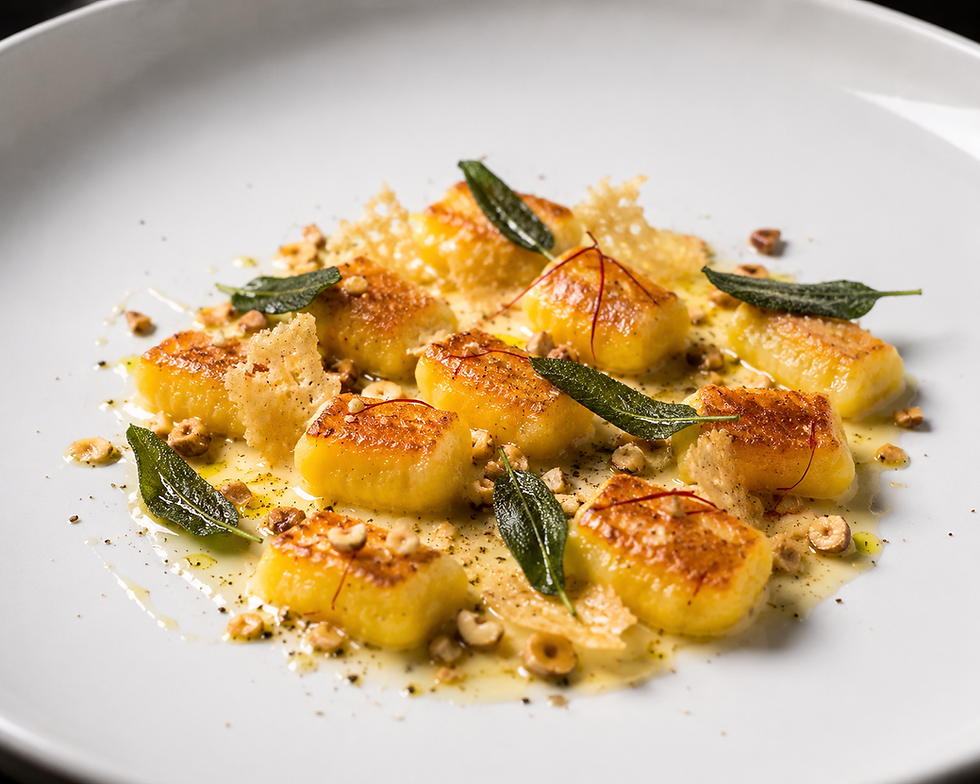
Divide them among warm plates, spoon over the butter and sage, and grate the lemon zest directly over the top so the oil in the skin lands on hot food. Finish with the remaining Parmigiano and black pepper. Serve at once: the window is about two minutes, after which the butter dulls and the gnocchi tighten.
Plating
Warm plates, dried, not hot from an oven. A shallow bowl or a wide plate with a slight lip both work, because the butter needs somewhere to sit without running to the edge. Count the gnocchi out rather than spooning them, eight or nine to a portion, in a loose single layer the butter can reach.
The lemon zest goes on last and goes on at the table, not in the pan. Grated onto hot butter it releases its oils upward, which is the whole point of it; stirred into the pan a minute earlier it turns dull and faintly bitter. Keep the sage leaves visible on top rather than buried, and finish with Parmigiano and pepper. Nothing else belongs here.
Professional Technique
The governing technique is subtraction of water, not addition of flour. Fresh ricotta is roughly 72 to 75 percent water, and a good part of that is free liquid sitting between the curd grains rather than held inside them. Draining overnight removes the free portion, and every ounce that leaves the sieve is an ounce the flour does not have to absorb. Two identical bowls of ricotta, one drained and one not, differ by half a cup of flour in the finished dough, and that half cup is the difference between a dumpling that dissolves on the tongue and one you have to chew.
The second is folding rather than mixing. Flour in contact with water forms gluten as soon as it is moved, and gluten is exactly what you do not want: there is no yeast here, no lamination, nothing that benefits from an elastic network. Folding brings flour into contact with the curd in the fewest possible strokes, which is why it goes in sifted and in three additions. A dough stirred for an extra thirty seconds comes out springier, and it will not relax again.
The third is poaching below a simmer. Egg proteins begin to set around 145°F (63°C) and are firm by 180°F (82°C), so water held at roughly 190°F (88°C) sets the outside of a gnocco within seconds. A rolling boil adds nothing to that chemistry and a great deal of mechanical violence. The rule is simple: if the water is moving the gnocchi, it is too hot.
Texture and Moisture Control
The target is a dumpling that holds its shape on the spoon and collapses under the tooth with no resistance at all. That comes from a high ratio of curd to starch, which is only affordable if the curd is dry. Judge the dough by feel: it should be soft, slightly tacky, and just rollable with floured hands. If it handles like a pasta dough, there is too much flour in it and no later step fixes that.
Moisture keeps moving after the dough is made. Shaped gnocchi left on a tray weep within an hour or two, and the flour underneath turns to paste and glues them down. The remedy is a thick bed of flour, a single layer, no covering, and the coldest shelf in the refrigerator. If they must wait longer, freeze them solid on the tray.
In the pan, the butter and the starchy poaching water do the same work an emulsion does in a pasta sauce. Butter alone slides off a gnocco and pools; butter with a spoonful of poaching water swirled in clings as a thin coat. Add water by the tablespoon and swirl rather than stir. The sauce should look glossy, never separated into clear fat and white sediment.
Professional Mise en Place
This recipe is almost entirely preparation with a very short execution. The draining happens the day before, the dough an hour before, and the last five minutes carry the whole service.
Equipment and tools
Fine sieve and cheesecloth for draining, plus a second sieve for passing the curd
Wide bowl and a flexible spatula for folding
Bench scraper and well floured trays
Wide shallow pan for poaching and a slotted spoon or spider
Wide sauté pan, pale coloured inside if possible, for judging the butter
Prepared ahead
Ricotta drained overnight and the whey measured and set aside
Curd passed through the sieve and kept cold, up to 4 hours ahead
Cheeses grated, sage picked, lemon washed and dried
Gnocchi shaped up to 2 hours ahead on floured trays, or frozen solid
Poaching water salted and brought up before the butter goes on
Service setup
Butter browned and held off the heat, reheated gently at the last moment
Sage lifted out if crisp, returned to the pan at the end
Poaching water held trembling, topped up between batches
Plates warmed and dried, never straight from a hot oven
Grater and pepper mill beside the plates, not beside the stove
Chef Tips
Buy ricotta from a counter rather than a sealed tub where you can, and read the label if you cannot. A ricotta whose ingredients include stabilisers, gums or starch will not drain, because those additives are there to hold water in. It will make gnocchi, but only with a great deal of flour.
Weigh the flour if you own a scale. A cup scooped from the bag can be 30 grams heavier than a cup spooned in and levelled, which here is the margin between light and leaden. Working by volume, spoon the flour into the cup, sweep it level and lean towards the lower figure.
Freeze the surplus. Shaped gnocchi frozen solid on a tray and then bagged behave better than refrigerated ones. They go into the water frozen, take about 60 seconds longer, and hold their shape better than fresh ones because the outside sets before the centre thaws.
Keep the whey. It is faintly sweet, mildly acidic and full of the same proteins that made the ricotta. Use it in place of part of the liquid in bread or focaccia dough the next day.
Common Mistakes
Adding all the flour at once. The recipe gives a range because the ricotta decides the number, not the page. Start at the low end, test a piece, and add more only if the test fails.
Using ricotta straight from the tub. Undrained ricotta carries free whey the flour then has to absorb, pushing the dough towards pasta and away from a dumpling. Twelve hours in a sieve is the least demanding step and the most decisive.
Kneading the dough on the board. The instinct comes from bread and pasta, and here it is exactly wrong. Every stroke builds gluten and compacts the curd, and gnocchi from a kneaded dough are springy in a way no sauce disguises.
Ridging the gnocchi. A ricotta dough has no potato starch to hold a ridge, and rolling the pieces on a board presses the surface closed. Leave them as plain cut pillows.
Boiling instead of poaching. A rolling boil breaks the pieces apart before the egg has set, and the water clouds with dissolved dough. Keep the surface trembling at around 190°F (88°C) and cook in batches so the temperature does not crash.
Taking the butter too far. Brown butter goes from hazelnut to burnt in under a minute, and the solids keep colouring off the heat. Pull the pan while they are golden and the smell is nutty.
Wine Pairing
Vermentino di Gallura DOCG: Grown on decomposed granite in northern Sardinia, and the natural bottle for anything built on sheep dairy. It has a saline bite and a firm citrus acidity that cuts through browned butter, and a bitter almond finish that follows the toasted milk solids rather than fighting them.
Nuragus di Cagliari DOC: Lighter and more neutral than Vermentino, with high acidity, modest alcohol and green apple fruit. That restraint is the point on a plate this simple: it refreshes between mouthfuls of butter and cheese without adding a fourth flavour. The everyday white of the Campidano plain, where malloreddus come from.
Collio Friulano DOC: The mainland answer and a precise one. Friulano finishes on bitter almond, the same register as browned butter, and carries a dry herbal edge that lines up with the sage. Medium bodied and low in aromatics, so it supports the plate rather than talking over it.
Erbaluce di Caluso DOCG: A high acid white from northern Piedmont with a stony, almost austere profile and a long citrus finish. Its job is contrast: this is a rich dish with little acidity of its own beyond the lemon zest, and Erbaluce keeps the sixth gnoccho as interesting as the first.
Lugana DOC: Turbiana grown on the clay south of Lake Garda gives a white with more weight and softer acidity than the others here. Choose it when the gnocchi are generously buttered: its rounder texture meets the fat on its own terms, and its citrus and white flower aromatics pick up the lemon zest.
Storage & Reheating
Raw shaped gnocchi keep on a floured tray, uncovered, in the refrigerator for up to 4 hours. Beyond that they weep and the flour underneath turns to glue. For longer, freeze them on the tray until solid, bag them and keep for up to 2 months. They go into the water straight from frozen, take about 60 seconds longer, and must never be thawed first.
The dough itself does not hold. Once the flour is in, salt draws water out of the curd and the mixture slackens, so shape the whole batch within half an hour. Ricotta and drained curd both keep 2 to 3 days refrigerated before the dough is made, which is the sensible place to split the work.
Cooked gnocchi are best eaten at once, but leftovers work if you treat them as a different dish. Refrigerate in a single layer, covered, for up to 2 days, then fry them in butter over medium heat until golden and crisp. Do not microwave them and do not reheat them in water, which turns them to porridge. They do not freeze once cooked.
Nutrition
Per serving, based on 6 first course portions:
Calories: 530 kcal
Total Fat: 30 g
Saturated Fat: 18 g
Trans Fat: 0.8 g
Unsaturated Fat: 10 g
Cholesterol: 150 mg
Sodium: 620 mg
Total Carbohydrates: 38 g
Fiber: 1 g
Total Sugars: 4 g
Added Sugars: 0 g
Protein: 27 g
Lactose: 4 g
Principal micronutrients: calcium, phosphorus, vitamin A, vitamin B2, vitamin B12, selenium, zinc
These figures are estimates. Most of the salt in the poaching water is discarded rather than eaten, and the fat varies with how much butter reaches the plate.


Comments