Vegan Italian Easter Dove Cake with Almond Glaze, Reinterpreted | Colomba Pasquale Vegana Rivisitata con Glassa alle Mandorle

Colomba pasquale is the Easter cake of Milan: a soft, naturally leavened dough shaped like a dove, rich with candied orange and covered with a crackling almond glaze, whole almonds and pearl sugar. The classic Milanese colomba is made with butter, fresh egg yolks and milk, and its glaze with egg whites; this version is a vegan reinterpretation, not the legal recipe. It is the spring sister of panettone, made with the same patience and the same two doughs, but it has no raisins and its crown is the sweet, crunchy glaze that browns in the oven. This version is entirely plant-based. A stiff lievito madre leavens it, plant butter and soy milk build the tender crumb, and aquafaba, the cooking liquid of chickpeas, binds the almond glaze. The result has the long, silky threads, the orange perfume and the crisp top of the Milanese colomba.
Yield: 1 colomba of about 2 lb (900 g), 12 servings. Prep: 1 hour 15 minutes of active work over 2 days, plus 12 hours for the starter refreshments. Cook: 45 minutes. Rest: 12 hours for the first dough, 6 to 8 hours of proofing, 10 hours hanging. Course: dessert. Region: Lombardy.
The Story
The colomba as Italy knows it today was born in Milan in the 1930s, in the bakery of Motta, the company that had already made panettone famous. The idea is generally credited to Dino Villani, who worked on Motta's advertising: the same dough, the same ovens and the same workers that produced panettone at Christmas could produce an Easter cake in spring, shaped like a dove, the symbol of peace and of the Resurrection. The new cake had candied orange instead of raisins and citron, and an almond glaze on top. It was an immediate success and soon every Italian bakery made its own.
Older legends try to give the colomba deeper roots. One tells of a Lombard king, Alboin, who in the sixth century received a dove-shaped bread as a sign of peace during the siege of Pavia; another links the dove to the Battle of Legnano in 1176. These stories are told every Easter, but they cannot be documented, and food historians treat them as legends. What is documented is the twentieth-century Milanese invention, and the speed with which the colomba became the national Easter cake.
Italian law defines the colomba as it defines panettone. A ministerial decree of 22 July 2005 reserves the name for the classic natural leavened cake made with flour, sugar, butter, fresh egg yolks and candied orange peel, with a glaze and almonds on top. A plant-based colomba therefore cannot follow the legal recipe, and this article says so openly. It follows the method instead: the stiff starter, the two doughs, the dove-shaped mold, the glaze and the upside-down cooling. Plant butter replaces the dairy butter, soy milk replaces the milk proteins and part of the work of the egg yolks, and aquafaba takes the place of the egg white in the glaze.
At Easter in Lombardy and across Italy, the colomba closes the lunch of Easter Sunday, often next to the chocolate treats of the season and a glass of sweet wine, and it is offered as a gift during the holy week. This recipe keeps the shape and the flavors of the Milanese cake, and adds precision to every phase: the strength of the flour, the temperature of the dough, the drying of the candied fruit and the exact texture of the glaze.
Ingredients
Use a very strong bread flour with at least 13.5 percent protein, sold for panettone or colomba; a weaker flour cannot hold the fat, sugar and fruit. Choose plant butter in blocks, about 80 percent fat, and unsweetened soy milk. The candied orange should come in large, soft pieces from an Italian pastry supplier: it is the only fruit of the colomba, so its quality is evident in every slice. For the glaze, use aquafaba from home-cooked chickpeas, reduced until it has the consistency of a light syrup, or from a can of unsalted chickpeas. Choose unpeeled whole almonds, which give the glaze a deeper roasted note. For a strictly plant-based kitchen, use a cane sugar certified as not processed with bone char.
For the starter refreshments (3 times)
Stiff lievito madre, active, 3 1/2 oz (100 g) for each refreshment
Strong bread flour, 3 1/2 oz (100 g) for each refreshment
Water at 82°F (28°C), 3 tbsp (45 ml) for each refreshment
For the first dough
Refreshed lievito madre, 2 1/2 oz (70 g)
Strong bread flour, 1 3/4 cups plus 2 tbsp (230 g)
Unsweetened soy milk, at room temperature, 1/2 cup (110 ml)
Granulated sugar, 1/3 cup (65 g)
Plant butter in a block, softened, 4 1/2 tbsp (60 g)
For the second dough
Strong bread flour, 2/3 cup (80 g)
Granulated sugar, 3 1/2 tbsp (45 g)
Unsweetened soy milk, 2 tbsp (30 ml)
Fine sea salt, 3/4 tsp (4 g)
Plant butter in a block, softened, 5 tbsp (70 g)
Seeds of 1 vanilla bean and finely grated zest of 1 unwaxed orange
Candied orange peel, diced 3/8 inch (1 cm), 5 1/2 oz (160 g)
For the almond glaze and the top
Aquafaba, 3 tbsp (45 ml)
Granulated sugar, 1/3 cup (70 g)
Almond flour, finely ground, 1/3 cup (35 g)
Cornstarch, 1 1/2 tsp (5 g)
Whole unpeeled almonds, 1 oz (30 g)
Pearl sugar, 2 tbsp (25 g)
Powdered sugar, for dusting
Dove-shaped paper colomba mold for about 2 lb (900 g) of dough, and 2 long metal skewers
Preparation
Step 1

Refresh the starter and make the first dough. On day one, refresh the lievito madre three times, every 4 hours, kneading 100 g of starter with 100 g of flour and 45 ml of water at 82°F (28°C) and letting it triple at 82°F (28°C) each time. In the evening, knead 230 g of flour, the sugar and the soy milk with 70 g of the last refreshment in a stand mixer at low speed for 8 to 10 minutes, until smooth. Add the softened plant butter a tablespoon at a time and knead until the dough stretches into a thin, translucent film, keeping it below 79°F (26°C). Warm, close refreshments keep the starter strong and only mildly acidic.
Step 2

Let the first dough triple. Shape the dough into a ball, place it in a straight-sided container, mark the level and cover it. Leave it at 79 to 82°F (26 to 28°C), in an oven with only the light on, for 10 to 12 hours, until it has tripled and the surface is slightly domed. A dough that has only doubled has too few active yeasts to lift the sugar, fat and fruit of the second dough.
Step 3

Make the second dough. Put the tripled dough in the mixer with 80 g of flour and knead at low speed for 5 minutes, until elastic. Add the sugar in three additions, then the salt, then the soy milk a spoonful at a time, waiting each time for the dough to pull away from the bowl. Beat the remaining plant butter with the vanilla seeds and orange zest, add it in four additions and knead until glossy and stretchy. Dry the candied orange on a towel and add it last, at the lowest speed, for about 1 minute. Final dough temperature: 79 to 81°F (26 to 27°C).
Step 4
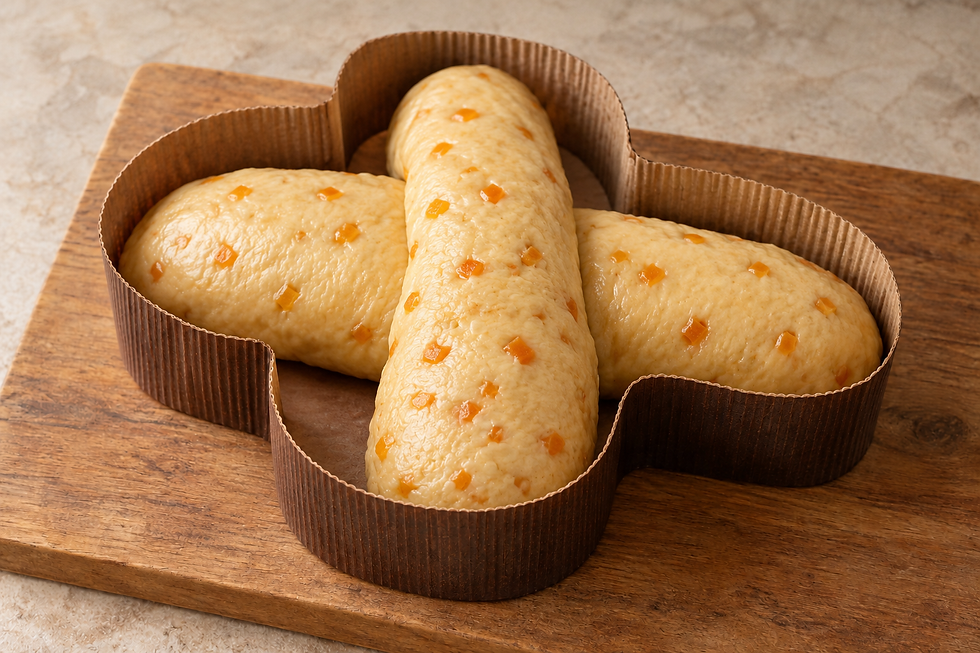
Shape the dove. Let the dough rest, covered, on a lightly oiled board for 30 minutes. Divide it into two pieces, one of about 55 percent of the weight for the wings and one of 45 percent for the head and tail. Roll each into a tight log: the larger one as long as the width of the mold, the smaller one as long as the mold from head to tail. Lay the larger log across the mold, where the wings are, and the smaller one on top of it, lengthwise. Good tension on each log keeps the shape clear during the rise; loose logs merge into a shapeless mass.
Step 5

Proof the colomba. Cover the mold and leave it at 79 to 82°F (26 to 28°C) for 6 to 8 hours, until the dough has filled the mold and its highest point is about 1/2 inch (12 mm) below the rim of the paper. Leave it uncovered for the last 20 minutes so the surface dries slightly and holds the glaze. Meanwhile heat the oven to 340°F (170°C), rack in the lower third.
Step 6

Make the almond glaze. Whisk the aquafaba with the sugar for 1 minute, until the sugar is mostly dissolved and the mixture is foamy. Add the almond flour and the cornstarch and stir into a smooth, thick paste that falls from the spoon in a slow ribbon. The aquafaba proteins set in the oven like the traditional glaze and hold the almond flour in a thin, crisp crust, while the cornstarch keeps it from running down the sides. If the glaze is too fluid, add almond flour 1 tsp (3 g) at a time.
Step 7

Glaze and bake. With a spatula or a piping bag, spread the glaze in an even layer about 1/8 inch (3 mm) thick over the whole surface, without letting it drip onto the paper. Press the whole almonds lightly into the glaze, scatter the pearl sugar and dust generously with powdered sugar, which forms the classic white, crackled crust. Bake for 45 minutes, until the glaze is deep golden and the center reads 201°F (94°C) on an instant-read thermometer. If the glaze browns too fast after 25 minutes, cover it loosely with foil.
Step 8

Hang it upside down. Immediately after baking, push two long skewers through the base of the mold, one through each wing, about 1 inch (2.5 cm) above the bottom, and hang the colomba upside down between two tall supports. Leave it for at least 10 hours, until completely cold. The hot crumb is too soft to hold its own weight; hanging stretches the threads as they set and keeps the cake tall. Once cold, seal it in a food-safe bag.
Plating
Serve the colomba at room temperature, about 72°F (22°C), when the crumb is soft and the orange aroma is open. Set it whole on a board for the table, glaze up, so the guests see the dove. Cut it lengthwise first, from head to tail, then into wedges, with a long serrated knife and a gentle sawing motion so the glaze cracks cleanly instead of shattering.
Each guest should receive a wedge of about 2 1/2 oz (75 g) with a piece of the glazed crust and at least one almond. Serve it on its own, or with a spoonful of whipped oat cream flavored with orange zest, which softens the crunchy glaze and echoes the candied peel.
Professional Technique
The key number is the threefold rise. The starter must triple after each refreshment and the first dough must triple before the second dough. Each tripling proves that the yeasts are strong enough for the heavier dough that follows. Mark the container and wait for the volume, whatever the clock says.
The hidden variable is the thickness of the glaze. Too thin and it disappears into the crust; too thick and it stays soft underneath, sinks into the dough and makes the top heavy. A layer of about 1/8 inch (3 mm), spread over a dough that has dried for 20 minutes in the air, bakes into a crisp shell that cracks under the knife and stays crunchy for days.
The doneness test is the core temperature of 201°F (94°C), measured from the top through the thickest part, where the two logs cross. The glaze browns long before the center is set, so color alone is misleading. An underbaked colomba collapses when it is hung upside down.
Glaze and Crust Control
The glaze is a meringue-like paste of sugar, almond and a protein that sets with heat. In the classic recipe the protein comes from egg whites; in this version it comes from aquafaba, which contains proteins and soluble starches from the chickpeas. Whisking it with the sugar dissolves the crystals and incorporates a little air, so the glaze bakes light and crisp rather than hard and glassy.
Sugar on top does three things. The pearl sugar stays whole and gives crunch, the powdered sugar melts partly into the glaze and forms a white, crackled surface, and the sugar in the glaze caramelizes slightly, giving color and a roasted almond flavor. Dust the powdered sugar generously and evenly, because bare spots bake darker and turn bitter.
The crust under the glaze must be dry enough to hold it. If the dough is still wet from the proofing chamber, the glaze slides and sinks. Twenty minutes uncovered at room temperature is enough to form a thin skin; longer than that, and the dough begins to crack and loses its spring in the oven.
Professional Mise en Place
Organize the two days in advance. Day one: three starter refreshments, first dough in the evening. Day two: second dough in the morning, shaping before midday, proofing in the afternoon, glazing and baking in the evening, hanging overnight. Weigh the glaze ingredients while the colomba proofs, so the glaze is fresh when the dough is ready.
Equipment and tools
Stand mixer with dough hook, digital scale accurate to 1 g
Straight-sided container with volume marks, instant-read thermometer
Dove-shaped paper mold, 2 long metal skewers, two tall supports
Small whisk, offset spatula or piping bag, fine sieve for powdered sugar
Prepared ahead
Lievito madre refreshed daily for at least 2 weeks
Candied orange diced and dried on a towel the evening before
Aquafaba reduced to a light syrup and cooled
Plant butter weighed and softened to 64°F (18°C)
Service setup
Colomba at room temperature, sealed until serving
Long serrated knife, wooden board
Oat cream whipped with orange zest, chilled, if serving it on the side
Dessert wine at the right temperature, glasses on the pass
Chef Tips
Reduce thin aquafaba before using it. Liquid from a can can be watery; simmer it gently until it has reduced by about one third, then cool it completely. A thicker aquafaba gives a glaze that holds its shape and bakes crisp.
Cut the candied orange larger than for panettone. Pieces of about 3/8 inch (1 cm) stay visible and juicy in the crumb, and since the orange is the only fruit, each bite should find some.
Toast nothing before baking. The almonds and the glaze bake for 45 minutes on top of the cake; almonds already toasted would turn bitter and dark.
If you cannot find a dove mold, bake the same dough in a round panettone mold and glaze it the same way. It will not be a colomba in shape, but it will be one in taste.
Common Mistakes
Using wet candied fruit. Syrup on the peel tears the gluten and leaves holes in the crumb. Dry the pieces on a towel before adding them.
Shaping loose logs. Without tension the dove loses its wings and head during the rise. Roll each log tight and smooth.
Glazing a wet surface. The glaze slides off and sinks. Let the dough dry uncovered for 20 minutes first.
Spreading the glaze too thick. A heavy glaze stays raw underneath and weighs the top down. Keep it to about 1/8 inch (3 mm).
Letting the glaze drip onto the paper. The drips burn and glue the cake to the mold. Stop the glaze just inside the edge of the dough.
Taking it out early. A golden glaze hides a raw center. Measure 201°F (94°C) at the core.
Cooling it upright. The colomba sinks and loses its height. Hang it upside down at once.
Wine Pairing
Moscato di Scanzo DOCG: A rare sweet red from the hills near Bergamo, in Lombardy, with rose, sour cherry and sweet spice. Its gentle tannins and aromatic depth suit the candied orange and the roasted almond glaze. Serve it at about 57°F (14°C).
Moscato d'Asti DOCG: Lightly sparkling, low in alcohol, from Piedmont, with peach, sage and orange blossom aromas. The classic Easter partner of the colomba: fresh and sweet without weighing on the palate. Serve it at about 46°F (8°C).
Vin Santo del Chianti Classico DOC: The Tuscan sweet wine aged in small barrels, with notes of dried apricot, walnut and almond. Its nutty depth mirrors the glaze and the almonds. Serve it at about 57°F (14°C).
Ramandolo DOCG: A sweet white from Friuli, made from Verduzzo Friulano grapes, with dried fruit, chestnut and a light tannic finish. Its sweetness is restrained, which keeps it lively next to the sugary glaze. Serve it at about 54°F (12°C).
Storage & Reheating
Room temperature: sealed in a food-safe plastic bag, away from heat and light, the colomba stays soft for 8 to 10 days thanks to the acidity of the natural starter, and the glaze stays crisp for 3 to 4 days. Once cut, press the bag against the cut surface. Freezer: wrap in thick wedges and freeze for up to 2 months; thaw in the bag at room temperature for 3 to 4 hours. The glaze softens after freezing. Do not refrigerate the colomba, because cold stales the crumb and makes the glaze sticky.
To refresh a wedge, place it for 4 to 5 minutes in an oven at 300°F (150°C), glaze up, until the crumb is fragrant and the glaze crisp again. Avoid the microwave, which softens the glaze.
Nutrition
Per serving, based on 12 servings:
Calories: 310 kcal
Total Fat: 11 g
Saturated Fat: 3 g
Trans Fat: 0 g
Unsaturated Fat: 8 g
Cholesterol: 0 mg
Sodium: 150 mg
Total Carbohydrates: 48 g
Fiber: 2 g
Total Sugars: 24 g
Added Sugars: 21 g
Protein: 6 g
Principal micronutrients: vitamin E, magnesium, manganese, iron, B vitamins
These figures are estimates, calculated on the quantities listed and rounded to the nearest whole number. They vary with the fat content of the plant butter, the sugar in the candied orange and the amount of glaze and powdered sugar on top.


Comments