

Italian Ricotta Tart with Sour Cherries and Dark Chocolate | Crostata alla Ricotta, Amarene e Cioccolato Fondente
Updated: Sep 14
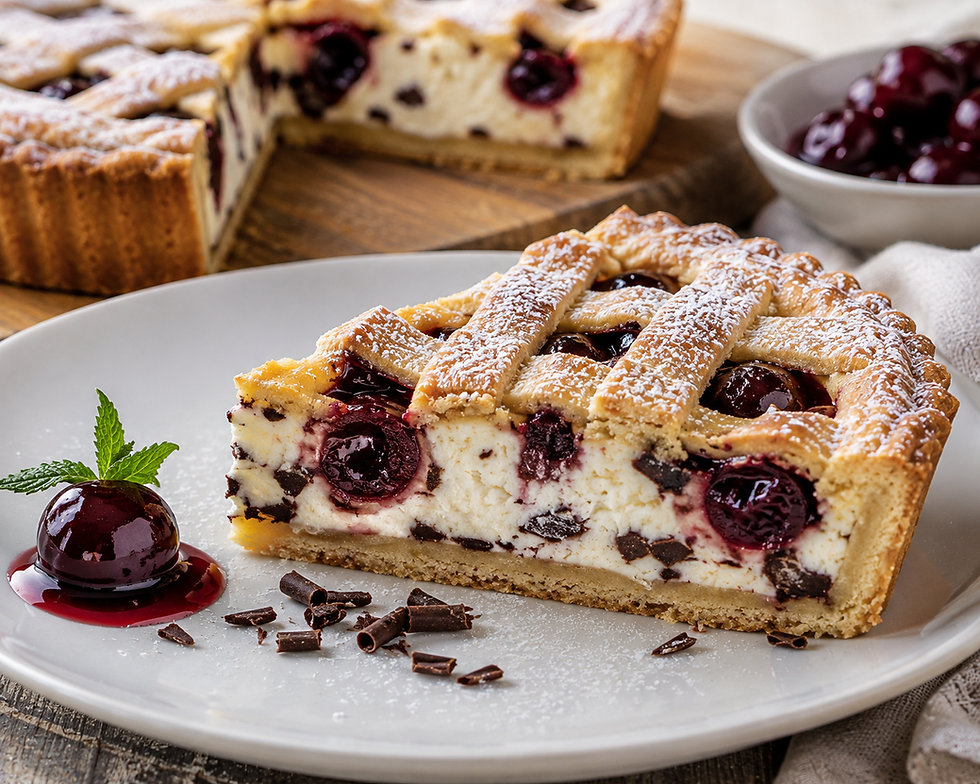
This crostata puts three Italian pastry ideas on top of one another and asks each to hold its own: a short, sandy pasta frolla, a baked fresh cheese filling, and sour cherries whose acidity keeps the whole thing from turning into a sweet, heavy slab. Amarene are the right fruit because their sharpness carries a faint almond bitterness, and dark chocolate is laid straight onto the raw pastry, where it does structural work rather than decoration.
What makes or breaks it is water. Ricotta arrives wetter than it looks and amarene arrive swimming in syrup, and every drop of that liquid is heading for the base of the shell. Drain both, seal the pastry with chocolate, bind the filling lightly with cornstarch, and pull the tart from the oven while the middle still moves. Everything else follows from those four decisions.
Yield: one 9 inch tart, 8 slices. Prep: 40 minutes. Ricotta draining: 4 hours or overnight. Chill: 1 hour. Bake: 45 to 55 minutes. Cool: 2 hours. Difficulty: intermediate. Course: dessert. Region: Rome, with a Sicilian chocolate accent.
The Story
This tart has an address. Crostata di ricotta e visciole belongs to the old Jewish quarter of Rome, the Portico d'Ottavia, where the Pasticceria Boccione still bakes it with the top taken almost to black and sells it by the wedge with no ceremony at all. The usual explanation for the closed double crust is that dairy could not be sold openly by the Jewish bakers of the ghetto, so the ricotta was hidden between two sheets of pastry and covered over with fruit. Historians argue about how literally to take that; nobody argues about the tart. Visciole are wild sour cherries from the hills north of the city, and amarene are their cultivated relatives, preserved in syrup. Both give acid and a bitter almond edge no sweet cherry can supply.
The dark chocolate is an import, and an honest one. It comes from Sicily, where ricotta and chocolate have shared a cannolo and a cassata for centuries and nobody finds the combination remarkable. It earns its place for two reasons: bitterness sits precisely in the gap between the sweetness of the syrup and the mildness of the cheese, and chocolate against raw pastry melts into a thin waterproof seal in the first minutes of baking. Rome does without it and is perfect as it is. This is not a correction, it is a Sicilian sentence added to a Roman paragraph.
Ingredients
For the pasta frolla
All purpose flour, 2 cups (250 g)
Granulated sugar, 1/2 cup (100 g)
Cold unsalted butter, cubed, 10 tbsp (140 g)
Whole egg, 1 large
Egg yolk, 1 large
Finely grated lemon zest, 1 tsp, from 1 lemon
Fine sea salt, 1/4 tsp (1.5 g)
For the ricotta filling
Whole milk ricotta, drained, 2 cups (500 g) before draining
Granulated sugar, 1/2 cup (100 g)
Whole eggs, 2 large
Cornstarch, 1 tbsp (8 g)
Pure vanilla extract, 1 tsp (5 ml)
Finely grated lemon zest, 1 tsp, from 1 lemon
Ground cinnamon, 1 pinch
For the fruit and chocolate layer
Amarena cherries in syrup, drained, 1 cup (200 g)
Dark chocolate, 60 to 70 percent, chopped, 5 oz (140 g)
For finishing
Reserved amarena syrup, 2 tbsp (30 ml)
Confectioners sugar, for dusting, 1 tsp
Oven temperature: 350°F (175°C)
Preparation
Draining the ricotta and the cherries
Tip the ricotta into a fine mesh sieve set over a bowl, cover it and refrigerate for at least 4 hours, overnight if you can. A supermarket tub commonly gives up 3 to 4 tbsp of whey. Separately, drain the amarene for 20 minutes, spread them on paper towel and blot them dry, keeping 2 tbsp of their syrup for the glaze. These two operations decide whether the base is crisp or wet, and nothing later repairs them.
Making the pasta frolla
Rub the cold cubed butter into the flour with the sugar, lemon zest and salt using fingertips only, until the mixture looks like coarse sand with a few pieces of butter the size of a pea still visible. Work fast: warm hands melt butter and greasy frolla bakes hard rather than crumbly. Add the whole egg and the yolk and bring the dough together with a few decisive strokes, stopping the second it coheres. Kneading builds gluten, which is exactly what you do not want here. Flatten into two discs, two thirds for the base and one third for the lattice, wrap and chill 1 hour.
Refining and mixing the filling
Press the drained ricotta through a fine mesh sieve with a rubber spatula until completely smooth, then beat it with the sugar until combined. Add the eggs one at a time, mixing only until each disappears, followed by the vanilla, lemon zest, cinnamon and cornstarch. From here beat as little as you possibly can. Air whipped into a baked cheese filling expands in the oven, lifts the surface into a dome, then drops it into a crater as the tart cools. The filling should pour thickly, like a loose batter.
Lining and chilling the shell
Roll the larger disc to about 1/8 inch (3 mm) and line a 9 inch (23 cm) tart tin with a removable base, pressing the dough down into the corner rather than stretching it across. Stretched dough shrinks back down the sides in the oven and you lose the height of the rim. Trim the edge level with a rolling pin and chill the lined shell 20 minutes. Cold butter in a cold shell sets into layers; warm butter opens channels for the filling to run through.
Building the chocolate seal and the layers
Scatter the chopped chocolate evenly over the raw base. This is the moisture barrier: it melts in the first minutes of baking into a thin sheet between pastry and cheese, the single most effective defence against a soggy bottom in a wet filled crostata. Spoon in half the filling, then distribute the drained amarene evenly across it, laying them in rows if necessary, because cherries that clump leave whole slices with no fruit. Cover with the remaining filling and level it.
Cutting and laying the lattice
Roll the second disc and cut strips about 3/4 inch (2 cm) wide with a ruler and a plain wheel. Lay them across in one direction, then the other, pressing the ends firmly onto the rim and trimming them flush. Work quickly and keep spare strips in the refrigerator if the kitchen is warm, because frolla softens on the bench within minutes and a warm strip tears the instant you lift it.
Baking to the right wobble
Bake at 350°F (175°C) for 45 to 55 minutes on the lower middle shelf, where the base gets enough bottom heat to set before the filling does. The tart is ready when the lattice is deep golden, the exposed filling has gone matte, and a gentle shake produces a slight movement at the very centre, about the wobble of set yogurt. Do not bake it firm: ricotta goes on setting as it cools, and a filling taken to firmness in the oven is dry and faintly rubbery. If the lattice colours early, tent it loosely with foil for the last 15 minutes.
Cooling, glazing and resting
Cool the tart in its tin on a wire rack for at least 2 hours and do not attempt to unmould it before then. Once fully at room temperature, remove the outer ring and leave the tart on the tin base for support. Warm the reserved amarena syrup until just fluid and brush it over the exposed filling between the lattice strips only, never across the pastry, which it would soften. Given the patience, rest it several hours more: it is markedly better on the second day.
Plating
Cut with a thin bladed knife warmed under hot water and wiped dry between every slice. A cold blade drags the ricotta forward and tears the lattice, and one careless cut spoils the look of the whole tart. Eight generous wedges is right for a 9 inch tin. Dust the lattice alone with a very light veil of confectioners sugar, keeping it off the glazed filling where it dissolves into a grey smear.
Serve at cool room temperature, never straight from the refrigerator, which hardens the butter in the frolla and mutes both the lemon and the cherries. The tart needs no accompaniment: the components already cover crisp, creamy, sour and bitter between them. If you want one, a spoon of barely sweetened whipped cream or three extra amarene with a little syrup beside the slice is as far as it should go. Coffee, not cream, is the traditional Roman partner.
Professional Technique
The governing technique here is the chocolate barrier, worth understanding rather than simply copying. Pasta frolla is a high fat, low gluten dough with an open sandy crumb, which is precisely why it tastes good and precisely why it drinks liquid. Chopped chocolate scattered on the raw base melts at around 90°F (32°C), long before the filling begins to set, and cocoa butter is hydrophobic, so the sheet it forms repels the water leaving the ricotta above. Cocoa solids melting into the pastry surface also carry flavour downward, which is why the base of a slice tastes of chocolate rather than merely of butter.
The second technique is the deliberate under baking of a cheese custard. Ricotta is a whey cheese and the proteins that set it are albumin and lactoglobulin, both of which continue to coagulate through carryover heat after the tart leaves the oven, then firm further as it cools. Baked to visual firmness, the same filling arrives dry and faintly squeaky. The 1 tbsp of cornstarch buys tolerance: starch granules swell and hold the free water the drained ricotta still carries, so the set stays smooth even if your oven runs hot, and the margin for error widens by several minutes.
Texture and Moisture Control
There is water on both sides of the pastry, in the cheese above it and in the syrup clinging to the fruit, and both must be dealt with before the shell is ever filled. Drain the ricotta hard, drain and blot the amarene, lay the chocolate directly on the raw base, bind what remains with cornstarch. If the base still comes out damp, the likeliest cause is a shell that was not chilled before filling: the butter melted outward instead of setting into layers.
Cracking is a different fault, and it is never a lack of thickener. A cracked surface means the filling was over beaten, so air expanded then collapsed, or over baked, so the proteins contracted and tore, or hit by a sudden temperature drop from an oven door opened in the first 30 minutes. Temperature at service matters as much as temperature in the oven: cold flattens the lemon aroma and closes down the cherries, so rest the finished tart at cool room temperature rather than in the refrigerator whenever the kitchen allows it.
Professional Mise en Place
This is a make ahead dessert with one narrow window, the moment the frolla leaves the refrigerator, and good organisation is mostly about protecting that window.
Equipment and tools
9 inch (23 cm) tart tin with a removable base
Fine mesh sieve for the ricotta and a second small sieve for the cherries
Ruler or straight edge and a plain pastry wheel for the lattice
Offset spatula, pastry brush, sheet of foil cut to size in advance
Digital scale, because a scooped cup of flour can carry twenty percent more than a spooned one
Prepared ahead
Pasta frolla, made the day before and rested overnight, which improves both handling and flavour
Ricotta drained in the same session, at least 4 hours and preferably overnight
Chocolate chopped and amarene drained and blotted on the morning of baking
Reserved amarena syrup measured into a small covered bowl
Lemon zested immediately before use, half into the flour and half into the filling
Service setup
Tart fully cooled and glazed, held at cool room temperature under a dome
Knife, hot water jug and clean cloth ready at the point of slicing
Confectioners sugar in a small fine sieve, used only on the lattice
Plates at room temperature, coffee ready to go out with the dessert
Chef Tips
Buy real amarene in syrup, the Italian jars from Bologna or Modena, and never maraschino cherries, which are bleached, dyed and sweetened out of all recognition and will make the tart taste of cough syrup. If you find visciole, the wild sour cherries of the Roman original, use them.
Choose a chocolate between 60 and 70 percent cacao. Milk chocolate disappears entirely against the acidity of the fruit, and anything above 75 percent turns astringent once it meets the lactic tang of ricotta. Chop it by hand into pieces the size of a grain of rice rather than buying chips, which are formulated to resist melting and will not form the seal you need.
If the dough cracks as you roll it, it is too cold rather than too dry. Let it sit five minutes and press the cracks together with your thumb. Adding water now ruins the texture permanently. Bake the trimmings alongside as small biscuits and you have the cook's reward.
Do not leave out the lemon zest in the frolla. It is the element that stops the pastry tasting merely sweet, and it costs nothing. The pinch of cinnamon in the filling works the same way from the other direction, rounding the dairy without announcing itself as a spice.
Common Mistakes
Over beating the ricotta filling. This is the most common error and it produces the domed surface that sinks into a crater, the signature of an amateur crostata di ricotta. Mix only until each addition disappears, and stop the moment the filling is homogeneous.
Baking the tart until it is firm. Ricotta sets further through carryover heat and again as it cools, so a tart taken to firmness in the oven arrives dry and faintly rubbery. Pull it while the centre still carries a slight wobble.
Skipping the chocolate against the pastry. Scattering the chocolate through the filling instead, or leaving it out and adding cocoa to the cheese, throws away the moisture barrier entirely and usually costs you the base of the tart.
Using amarene straight from the jar. Undrained cherries flood the filling with syrup, stain the whole tart pink and push it sweet, which is the exact opposite of the point. Drain them, then blot them on paper.
Unmoulding the tart while it is warm. The filling is fragile and the pastry still soft for the first two hours, and a tart lifted early cracks across the middle or loses its base outright at the very last moment.
Wine Pairing
Recioto della Valpolicella DOCG: Dried Corvina grapes give a sweet red full of macerated sour cherry and cocoa, which meets the amarene and the chocolate on their own ground rather than contrasting with them. Its residual sugar sits just above that of the tart, the rule that keeps a dessert wine from tasting thin.
Brachetto d'Acqui DOCG: A lighter Piedmontese answer, sweet, lightly sparkling and low in alcohol, with an unmistakable aroma of rose and fresh red cherry. The bubbles scrub the fat of the ricotta and the frolla off the palate, and the modest 6 percent alcohol keeps the pairing from turning heavy late in a meal.
Vin Santo del Chianti Classico DOC: Dried Trebbiano and Malvasia aged for years in small barrels under a wide temperature swing. Its oxidative walnut, dried apricot and caramel run alongside the buttery pastry, while a firm thread of acidity stops the combination of cheese and sugar from turning cloying.
Moscato di Scanzo DOCG: A rare red Moscato passito from a tiny zone near Bergamo, aromatic as no other sweet red is, with rose, dried cherry and a note of sage and tobacco. Its light tannin gives grip against the chocolate seal at the base of each slice, where a purely sweet wine would slide past.
Montefalco Sagrantino Passito DOCG: The most structured option, and the one for a very dark chocolate. Sagrantino carries the highest tannin of any Italian grape even when dried and sweetened, and that tannin binds the cocoa butter directly, while blackberry and dried plum stand up to the sourness of the amarene.
Storage & Reheating
The crostata keeps 3 days at cool room temperature under a cake dome or loosely tented with foil, and it is genuinely better on day two than on day one. Refrigerate it only if the kitchen is warm or you need to hold it longer, in which case it lasts 5 days but must come back to room temperature for at least an hour before it is served. Never wrap it tightly in plastic film, which traps moisture against the lattice and turns the crisp top leathery within a few hours.
It freezes acceptably whole or in slices for up to 2 months, wrapped first in parchment and then in foil. Thaw at room temperature, still wrapped, then unwrap and refresh in a 300°F (150°C) oven for 10 minutes to bring the pastry back and drive off the condensation. Do not reheat a slice in a microwave: the frolla goes soft immediately and the filling separates. Unbaked pasta frolla freezes very well for 3 months, so it is worth making a double batch of dough and keeping one disc in reserve.
Nutrition
Per serving, based on 8 slices from one 9 inch tart:
Calories: 470 kcal
Total Fat: 25 g
Saturated Fat: 14 g
Trans Fat: 0 g
Unsaturated Fat: 9 g
Cholesterol: 105 mg
Sodium: 130 mg
Total Carbohydrates: 52 g
Fiber: 2 g
Total Sugars: 28 g
Added Sugars: 22 g
Protein: 11 g
Lactose: 3 g
Principal micronutrients: calcium, phosphorus, vitamin B12, vitamin A, choline, iron, magnesium, anthocyanins from the sour cherries and flavanols from the dark chocolate
These figures are estimates. The sugar total varies most, since it depends on how thoroughly the amarene were drained and how much syrup is used for the final glaze.


Comments