
Italian Bomboloni with Vanilla Custard, Dark Chocolate and Sicilian Pistachio | Bomboloni Italiani alla Crema, Cioccolato Fondente e Pistacchio Siciliano

A bombolone is judged before anyone tastes it. Turn one over and look for the pale band running around its middle: that ring is the whole craft of the thing, written on the crust. These are filled three ways, with vanilla custard, with dark chocolate and with Sicilian pistachio cream, all from one batch of the same enriched dough. Everything that matters happens in the two hours before they reach the oil. The frying is the short part, and the least forgiving of the lot.
Yield: 12 bomboloni, 4 of each filling. Prep: 45 minutes. Rise: about 2 hours 30 minutes. Cook: 20 minutes. Total: about 4 hours. Difficulty: intermediate. Course: dolce. Region: Tuscany, with Sicilian pistachio from Bronte.
The Story
The bombolone is Tuscan, and it is Tuscan in a specific way: it is not a Carnival pastry that the rest of the year forgets. Its ancestor is the Krapfen of the Austrian and German bakeries, which travelled south through the Habsburg north of Italy and arrived in Tuscany as one more fried and filled sweet among many. What Tuscany did with it was move it out of the festive calendar and into the morning. The name comes from bomba, and it describes the shape rather than any explosion of flavour: a round, squat, slightly flattened sphere of enriched dough, fried, rolled in sugar while still warm, and eaten standing up.
The place that made it famous is the Versilia coast. In Viareggio, Forte dei Marmi and Lido di Camaiore the bombolone is beach food, sold from kiosks and from the trays that vendors used to carry along the sand in August, calling out while the sugar melted in the heat. In Florence and Prato it belongs to the pasticceria at seven in the morning, bought warm, wrapped in a square of paper, eaten on the way to work with a caffè. The dough is leaner than a brioche and the sugar on the outside is granulated rather than powdered, because powdered sugar dissolves and a bombolone has to be handled. The good bakeries still fry in batches through the morning rather than once at dawn, so what you buy at eight is not what was left over at six.
Filling was originally optional. The classic Tuscan version is bombolone vuoto, sugared and hollow, split with the teeth rather than a knife, and the filled one came later, piped through the side with crema pasticciera. The chocolate and the pistachio are the modern pasticceria answer to the same dough, and the pistachio brings Sicily into a Tuscan pastry without apology. The nut is from Bronte, on the lava soils of the western slope of Etna, protected as a DOP since 2009 and harvested only in odd numbered years, since the trees are stripped of their flower buds in the alternate season to concentrate the crop. That is why the price is what it is, and why the colour is closer to emerald than to the pale green of an ordinary pistachio. Bronte accounts for a very small fraction of the world crop, and almost none of it leaves Sicily unprocessed.
Ingredients
For the dough
Bread flour, 3 1/2 cups (440 g)
Whole milk, lukewarm, 3/4 cup (180 ml)
Granulated sugar, 1/4 cup (50 g)
Fresh yeast, 3/4 oz (20 g), or instant dry yeast, 2 tsp (7 g)
Egg yolks, 3
Whole egg, 1
Unsalted butter, soft, 4 tbsp (57 g)
Fine sea salt, 1 tsp (6 g)
Finely grated lemon zest, from 1 lemon
Vanilla extract, 1 tsp (5 ml)
For the vanilla custard
Whole milk, 1 1/4 cups (300 ml)
Egg yolks, 4
Granulated sugar, 1/3 cup (65 g)
Cornstarch, 2 tbsp (16 g)
Vanilla bean, split and scraped, 1
Fine sea salt, 1 pinch
For the dark chocolate filling
Dark chocolate, 70 percent, chopped, 4 oz (115 g)
Heavy cream, 1/2 cup (120 ml)
Unsalted butter, 1 tbsp (14 g)
Flaky sea salt, 1 small pinch
For the pistachio cream
Bronte pistachio paste, unsweetened, 3 oz (85 g)
Whole milk, 1/2 cup (120 ml)
Egg yolks, 2
Granulated sugar, 3 tbsp (38 g)
Cornstarch, 1 tbsp (8 g)
For frying and finishing
Peanut oil or sunflower oil, 8 cups (2 litres)
Granulated sugar for rolling, 1 cup (200 g)
Shelled Bronte pistachios, chopped, 2 tbsp (18 g)
Dark chocolate for grating, 1 oz (30 g)
Preparation
Step 1
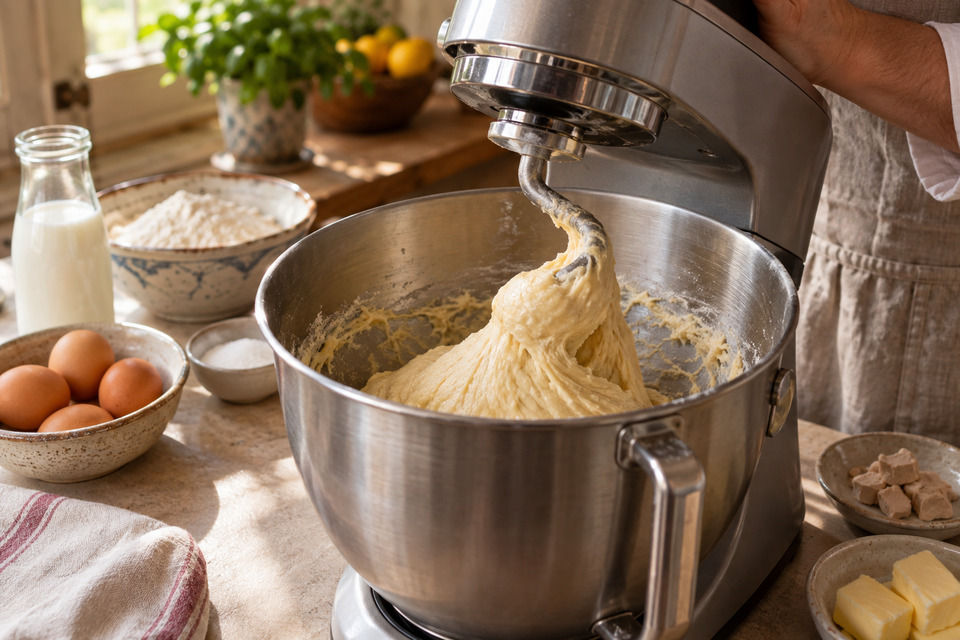
Mix the dough. Dissolve the yeast in the lukewarm milk with a spoonful of the sugar and leave it 10 minutes. Put the flour, the rest of the sugar, the lemon zest and the vanilla in a mixer bowl, add the milk, the yolks and the whole egg, and knead on low for 5 minutes until it comes together into a shaggy mass. Fresh yeast gives a cleaner flavour here, but dry works on the same timing.
Step 2
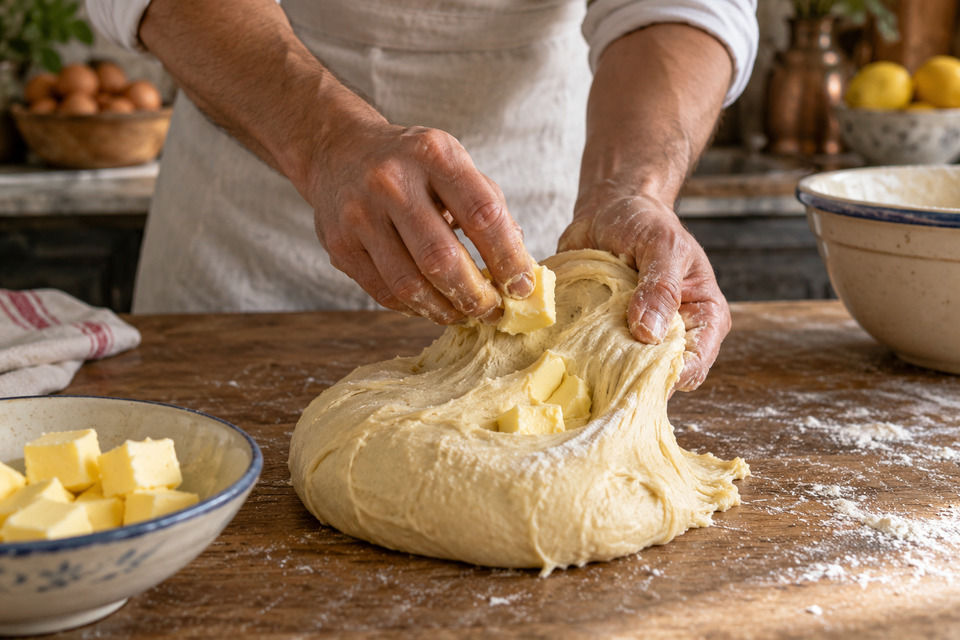
Add butter and salt, then rise. Add the salt, then the soft butter one piece at a time, waiting for each to disappear before the next goes in. Knead 10 minutes more, until the dough is smooth, elastic and pulls cleanly off the bowl. Cover and leave at room temperature until doubled, about 1 hour 30 minutes.
Step 3
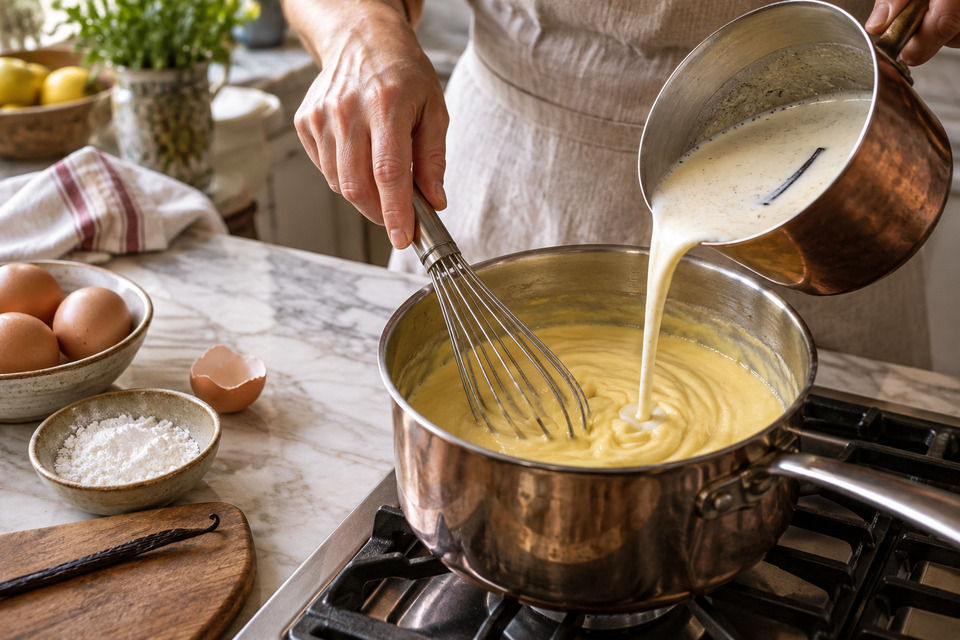
Cook the vanilla custard. Heat the milk with the split vanilla bean to just below a simmer. Whisk the yolks, sugar, cornstarch and salt until pale, pour in the hot milk in a thin stream, return everything to the pan and cook over medium heat, whisking, until it thickens and just bubbles. Cook 1 minute more, lift out the bean, then chill it flat under contact film so no skin forms.
Step 4
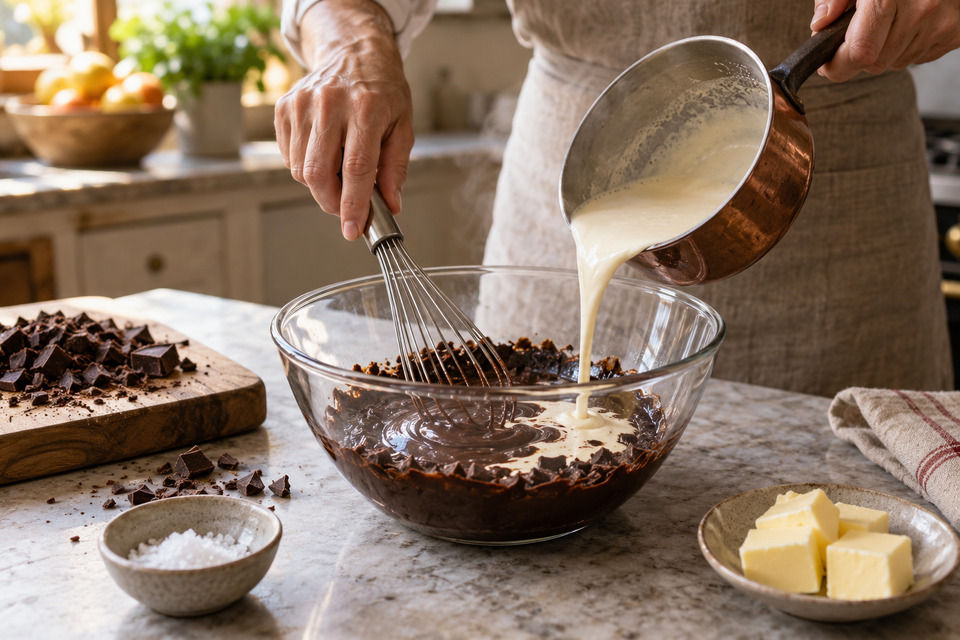
Make the chocolate and pistachio fillings. Bring the cream to a simmer, pour it over the chopped chocolate, wait 1 minute, then stir from the centre outward into a glossy ganache and beat in the butter and the flaky salt. For the pistachio, cook a second custard with the milk, yolks, sugar and cornstarch, then whisk the pistachio paste into it while still warm. Chill both.
Step 5
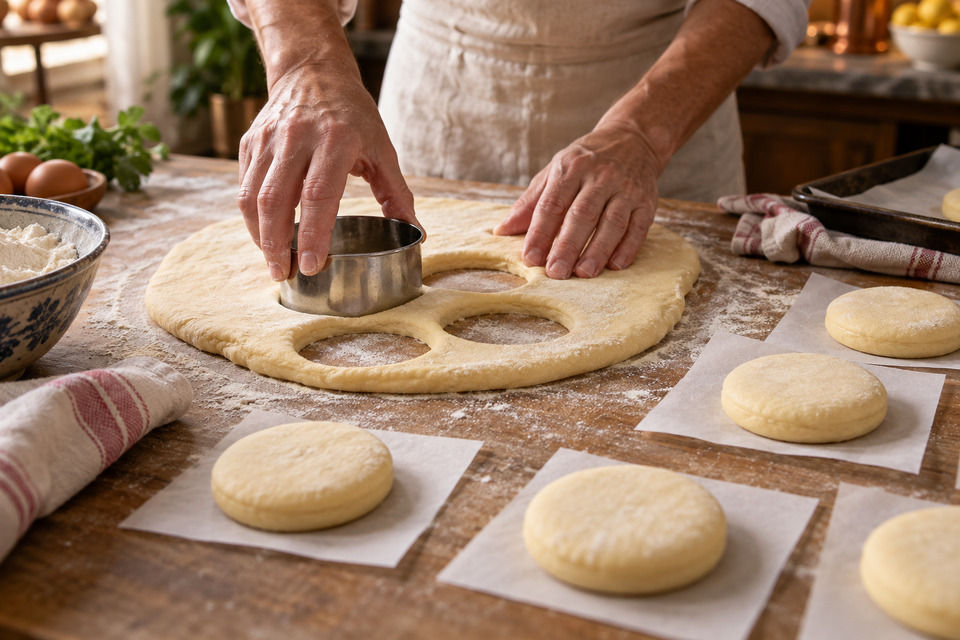
Shape and give the second rise. Turn the dough out without punching it down and roll it to 1/2 inch (12 mm). Cut 12 rounds of 2 3/4 inches (7 cm) and set each one on its own small square of parchment paper. Do not reroll the trimmings with the first cuts, since a second rolling gives a tighter crumb. Cover loosely and prove until visibly puffy and light to the touch, about 50 minutes.
Step 6

Fry them. Bring the oil to 340°F (170°C) and check it with a thermometer, not by eye. Lower two or three bomboloni at a time, paper side down, and slide the paper out with tongs once it lifts away. Fry 90 seconds, turn once, fry 90 seconds more. They should float high and colour to a deep gold, never brown.
Step 7
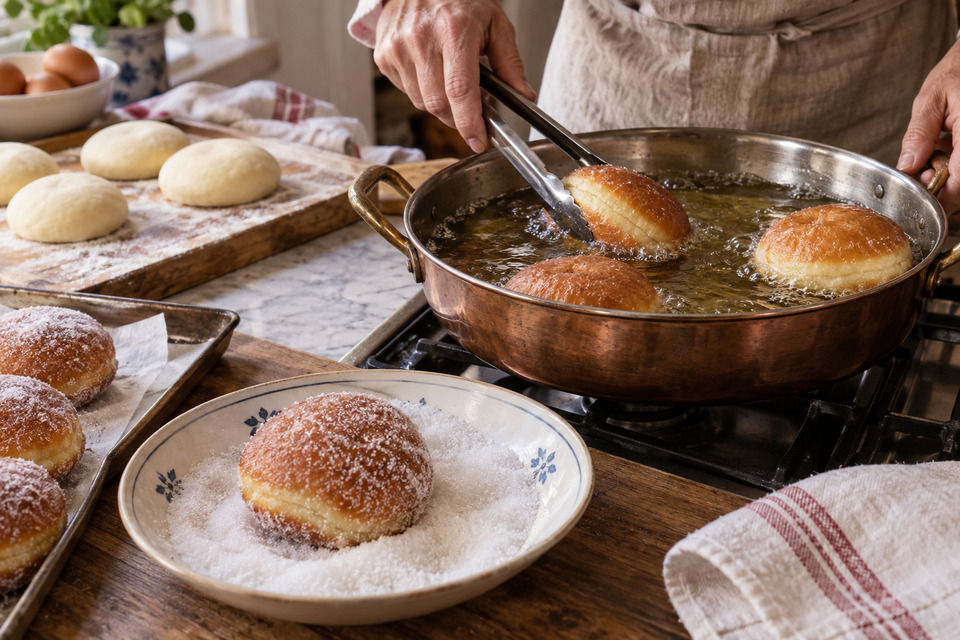
Drain and sugar. Lift them onto a rack, not onto paper towels, so steam escapes from underneath instead of soaking the base. Wait about 1 minute, until they are hot but no longer glistening with oil, then roll each one in the granulated sugar, pressing lightly so the sugar grips the whole surface, including the pale band around the middle. Use a deep bowl rather than a plate.
Step 8
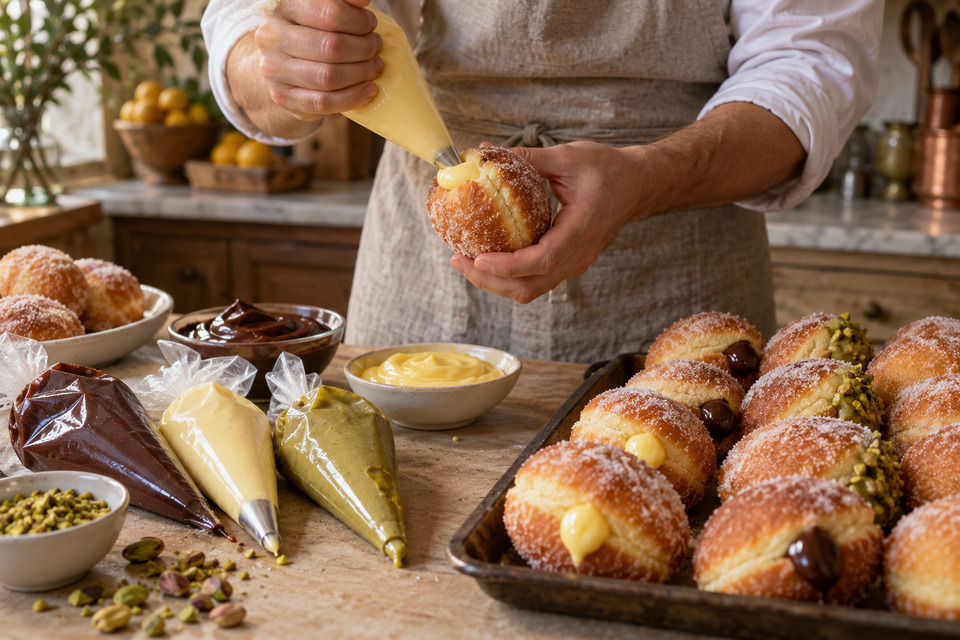
Fill them. Pierce each bombolone once through the pale band with a small knife, working the tip gently from side to side to open a pocket without tearing the crust. Fit a long narrow nozzle, load the three fillings into three bags and pipe about 1 1/2 tablespoons into each one, until it feels heavy and the filling just shows at the hole.
Plating
Serve them warm, within half an hour of frying, on a plate or a wooden board rather than anything chilled, and never under a cloche, which traps steam and softens the crust in minutes. Three per person, one of each filling, set with the pierced side facing up so a guest can tell them apart.
Mark each filling discreetly: a pinch of chopped Bronte pistachio on the pistachio one, a light grating of dark chocolate on the chocolate one, nothing at all on the custard. Leave the pale band visible on every bombolone rather than turning it underneath, since it is the mark of a well fried one and it deserves to be seen. No sauce, no dusting of powdered sugar, no fruit.
Professional Technique
The pale band around the middle of a bombolone is not decoration. It is evidence. A properly proved bombolone is lighter than the oil it goes into, so it settles at half depth and floats there, with a strip of its own equator above the surface, in contact with the air. That strip never touches oil hot enough to brown it, so it stays the colour of raw dough while everything above and below turns gold. The crust sets from the outside while the gas trapped inside expands and pushes the crumb against it: the ring records that balance between buoyancy and cooking.
When the ring is missing, one of two things went wrong. Either the dough was too heavy, under proved or knocked down while shaping, so it sank and cooked submerged, coloured all over, or the oil was too hot and the surface browned faster than the dough could rise, giving a dark bombolone with a raw seam. The band is the fastest diagnostic in the kitchen: one glance tells you whether proof and temperature were right.
The parchment paper serves the same balance. A proved bombolone deflates if you pick it up with your fingers, and the gas you press out never returns. Lifting it on its own paper square and lowering the whole thing into the oil means nothing touches the dough; the paper releases itself in seconds and comes out with tongs. The single turn follows the same logic: each turn interrupts the upward push of the crumb and drags the uncooked equator through hot oil, colouring away the band and letting oil into the seam. One turn, halfway.
Texture and Moisture Control
The target is a thin crust, a crumb full of irregular open holes and a filling cold enough to contrast with the warm dough. Oil temperature governs all of it. At 340°F (170°C) the surface dehydrates and sets fast enough to seal, while the interior has the 3 minutes it needs to expand and cook through. Below 320°F (160°C) the seal never forms and the dough drinks oil, which is the real cause of a greasy bombolone, not the frying itself. Above 360°F (180°C) the crust finishes before the centre does: colour outside, wet dough inside.
Humidity matters during the second proof. A dough that dries out forms a skin, and a skin cannot stretch, so the bombolone splits rather than swelling evenly. Cover the tray loosely, away from draughts. Moisture also decides the sugar: roll them while hot but no longer wet with oil, since too early the sugar dissolves into syrup and too late it will not stick.
Fill as close to service as possible. Custard and pistachio cream are around 70 percent water and migrate into the crumb within an hour, turning the inside damp and the crust limp. The ganache, mostly fat, holds longer.
Professional Mise en Place
This is a dish of three cold preparations and one hot one. Finish everything possible the day before, so the only live work is frying and filling.
Equipment and tools
Stand mixer with a dough hook, and a digital scale
Deep heavy pot or fryer, plus a probe thermometer
Round cutter of 2 3/4 inches (7 cm), and parchment cut into 12 squares
Three piping bags with a long narrow filling nozzle
Wire rack set over a tray, and a wide bowl for the sugar
Prepared ahead
Vanilla custard and pistachio cream, up to 2 days ahead, under contact film
Chocolate ganache, up to 3 days ahead, brought back to piping consistency
Pistachios chopped and kept airtight, on the day
Dough mixed and risen once, then refrigerated overnight for a morning service
Service setup
Oil at 340°F (170°C), thermometer in the pot, second burner ready
Proved bomboloni on their paper squares within reach of the oil
Sugar bowl and rack beside the pot, piping bags filled
Plates at room temperature, never warmed or chilled
Chef Tips
Fry two or three at a time and no more. Every bombolone that goes in drops the oil temperature, and a crowded pot falls below the seal point, which is how a whole batch turns greasy. Let the oil climb back to 340°F (170°C) between batches.
Buy pistachio paste rather than grinding your own, and read the label: it should list pistachios and nothing else. Supermarket pistachio creams are mainly sugar, oil and milk powder, and they make the filling taste like syrup.
Judge the second proof by touch, not by the clock. A ready bombolone feels light and springs back slowly when you press its edge. If your finger leaves a dent that stays, it has gone too far and will collapse.
For breakfast service, mix the dough in the evening, give it the first rise and refrigerate overnight. It rolls more easily cold and the slow fermentation gives a better flavour. Let it sit 30 minutes at room temperature before cutting.
Common Mistakes
Frying at the wrong temperature. Too cool and the dough absorbs oil and stays pale and heavy, too hot and the outside darkens before the middle cooks. Use a thermometer and hold 340°F (170°C); the eye cannot read frying oil.
Handling the proved dough with your fingers. Picking one up to move it into the pot presses the gas out and no ring will ever appear. Cut each one onto its own square of parchment at shaping and never touch it again.
Turning them repeatedly. Every turn interrupts the rise, colours away the pale band and opens the seam to oil. One turn at the halfway point is all they get.
Sugaring at the wrong moment. Sugar on a bombolone still wet with oil dissolves into syrup, and sugar on a cold one slides off. Wait about 1 minute on the rack, until hot and dry to the touch.
Filling them hours in advance. The water in the custard and pistachio cream moves into the crumb and the crust goes soft. Fry, sugar and fill, then serve.
Wine Pairing
Vin Santo del Chianti Classico DOC: The Tuscan answer to a Tuscan pastry, and the most complete match. Its dried fig and toasted almond character sits on the fried dough, while a firm line of acidity under the sweetness keeps the crust fat off the palate. Serve it cool: it suits custard and pistachio equally.
Moscato d'Asti DOCG: The lightest choice and the best for the custard. Its gentle pressure scrubs the fried surface clean between bites, the alcohol stays around 5 percent so it never fights a breakfast pastry, and its peach and orange blossom notes run with the vanilla. Serve at 43°F (6°C).
Moscato di Noto DOC: The Sicilian bottle for the Sicilian nut. Sweeter and denser than the Piedmontese Moscato, with candied citrus peel and a faint bitterness on the finish, it meets the Bronte pistachio filling on its own ground and echoes its resinous edge. The residual sugar stays balanced enough to refresh.
Marsala DOC: For the dark chocolate one, and specifically a dry or semi dry Superiore, not a sweet cooking Marsala. Its oxidative walnut and dried apricot notes and its fortified weight stand up to 70 percent chocolate, where a lighter wine vanishes, and the alcohol cuts the ganache fat at the same time.
Recioto della Valpolicella DOCG: The red option, and a good one with the chocolate filling. Made from dried grapes, it brings sweet black cherry and a residual tannin few dessert wines have, and that tannin grips the cocoa solids instead of sliding past. Serve at 57°F (14°C), cooler than a table red.
Storage & Reheating
A filled bombolone has a life of about 3 hours, and the components keep far better than the pastry. Vanilla custard and pistachio cream hold 2 days refrigerated under contact film, the ganache 3 days, the dough 12 hours after its first rise.
Keep unfilled bomboloni in a paper bag at room temperature for up to 1 day, never in the refrigerator, where the crumb stales within hours. To revive them, give 4 minutes at 300°F (150°C), then roll in fresh sugar and fill. Never use a microwave: it steams the crust and turns it leathery.
Fried unfilled bomboloni freeze for 1 month in a sealed bag. Thaw at room temperature, refresh as above, then sugar and fill. Never freeze a filled one: the custard separates and floods the crumb.
Nutrition
Per bombolone, based on 12 filled pieces, averaged across the three fillings:
Calories: 340 kcal
Total Fat: 18 g
Saturated Fat: 6 g
Trans Fat: 0 g
Unsaturated Fat: 11 g
Cholesterol: 115 mg
Sodium: 160 mg
Total Carbohydrates: 37 g
Fiber: 1.5 g
Total Sugars: 17 g
Added Sugars: 14 g
Protein: 7 g
Lactose: 1.8 g
Principal micronutrients: vitamin A, vitamin E, iron, phosphorus, potassium, magnesium
These figures are estimates. Frying oil absorption varies with temperature control, and the chocolate filling runs higher in fat while the custard one runs higher in sugar.




Comments