
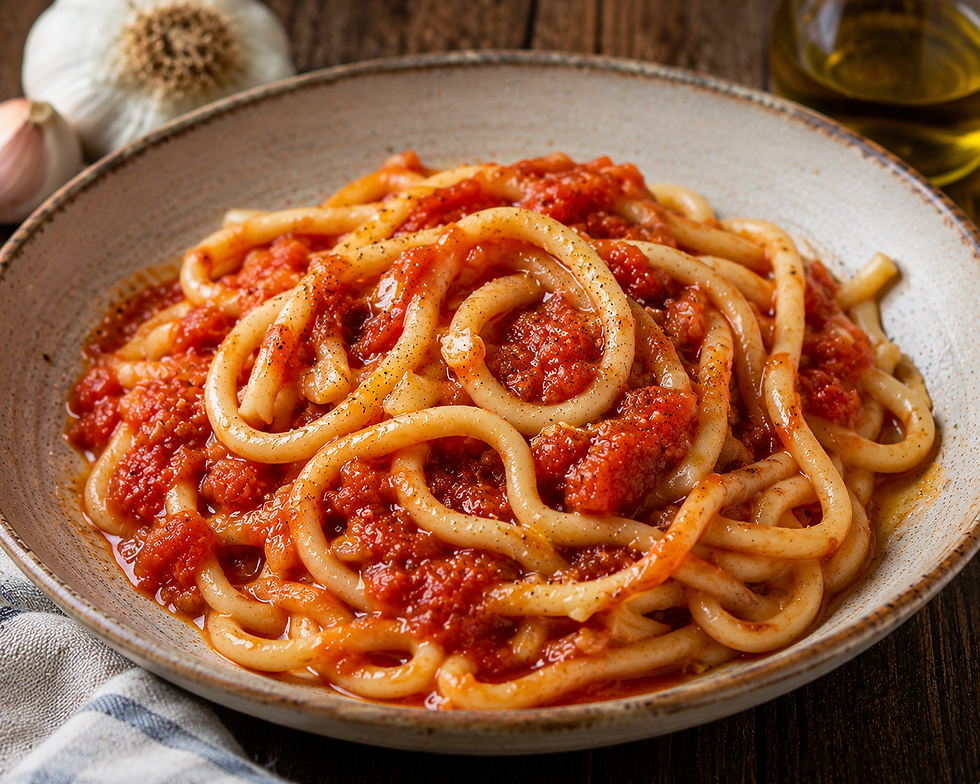
Rigatoni with Italian Tomato Sauce | Rigatoni al Sugo

Sugo is not a recipe in Italy, it is a category. The word covers any sauce that seasons pasta, polenta, gnocchi or rice, and an Italian who says pasta al sugo at home almost always means the same thing: tomato, olive oil, garlic or onion, basil, and nothing else that would complicate it. What makes the dish worth writing about is not the ingredient list, which anyone can guess, but the four or five decisions that separate a thin acidic sauce sliding off the pasta from a glossy one that clings to every ridge.
Rigatoni is the right shape for it. The wide tube holds sauce inside as well as outside, and the deep ribbed grooves give the emulsion something to grip. A sauce that would slip off spaghetti stays put on rigatoni.
The method here is the one used in Italian home kitchens and in restaurant service alike: cook the tomato until it stops tasting raw, undercook the pasta deliberately, and finish the two together in the pan with starchy cooking water. That last step is the whole dish.
Yield: 4 servings. Prep: 15 minutes. Cook: 45 minutes. Total: about 1 hour. Difficulty: easy to intermediate. Course: primo piatto. Region: central and southern Italy, with the technique common from Lazio to Campania.
The Story
Tomato arrived in Italy from the Americas in the sixteenth century and spent close to two hundred years treated as an ornamental curiosity, suspected of being poisonous because it belongs to the nightshade family. The first Italian cookbook to print a tomato sauce was Antonio Latini's Lo Scalco alla Moderna, written in Naples in 1692, and even then the sauce was Spanish in style and served with meat rather than pasta. The marriage of tomato and pasta is barely two centuries old.
It took the Neapolitan climate to make it happen. The volcanic soil on the slopes of Vesuvius produced tomatoes sweet enough and low enough in water to cook down into something worth eating, and the San Marzano variety selected there in the nineteenth century became the standard. At the same time the towns around Gragnano were drying pasta in the sea breeze and selling it cheaply by weight. Two industrial products of the same region found each other.
Rigatoni is a shape of the centre and the south, ridged because the extrusion dies used in Gragnano and later in Abruzzo cut grooves that helped the pasta dry evenly and hold sauce better. The name comes from riga, a line or a stripe. In Rome it carries carbonara and amatriciana, in Naples it carries ragu on Sunday, and on every other day of the week it carries nothing more complicated than sugo.
Ingredients
For the sauce
Canned whole peeled San Marzano tomatoes, 28 oz (800 g)
Extra virgin olive oil, 1/4 cup (60 ml)
Garlic cloves, lightly crushed, 3
Yellow onion, finely diced, 1/2 cup (75 g), optional
Fresh basil, 1 large sprig plus 8 leaves for finishing
Fine sea salt, 1 tsp (6 g), plus more to taste
Granulated sugar, 1/4 tsp (1 g), only if the tomatoes need it
Freshly ground black pepper, to taste
For the pasta
Dried bronze cut rigatoni, 1 lb (450 g)
Water, 5 quarts (4.7 liters)
Coarse sea salt for the water, 2 tbsp (35 g)
For finishing
Grated Parmigiano Reggiano, 2/3 cup (60 g)
Extra virgin olive oil, 1 tbsp (15 ml)
Reserved pasta cooking water, about 1 cup (240 ml)
Preparation
Step 1
Break down the tomatoes by hand. Tip the tomatoes into a bowl and crush them between your fingers into rough pieces, leaving some larger than others. Do not use a blender or a food processor. Blades shear the seeds and the tomato tissue at speed, which releases bitterness and whips air into the pulp, turning a red sauce orange. Keep every drop of the packing liquid, since it carries a good share of the flavour.
Step 2
Build the base in oil, not in water. Set a wide heavy pan over medium low heat, pour in the olive oil and add the crushed garlic cloves, with the onion if you are using it. Cook gently for 5 to 7 minutes, stirring, until the garlic is fragrant and just turning pale gold and the onion is translucent. Stop well short of brown. Garlic that browns turns acrid, and that bitterness sits under everything else in the finished sauce.
Step 3
Add the tomatoes and set the simmer. Tip in the crushed tomatoes with their liquid, add the basil sprig whole with the stem attached, season with the fine sea salt and bring the pan to a simmer. Lower the heat until the surface is barely moving, with a bubble breaking every second or two. A hard boil drives water off fast but scorches the sugars against the base of the pan and pushes the sauce towards a flat cooked flavour.
Step 4
Cook the sauce for 35 to 40 minutes. Leave the pan partly uncovered and stir every 8 to 10 minutes, scraping the bottom. It is ready when the colour has darkened from bright red to brick, when the oil begins to pool at the edges, and when a spoon drawn across the base leaves a channel that closes slowly. Fish out the basil sprig and the garlic, taste, and add the pinch of sugar only if the tomatoes are sharp. Grind in black pepper.
Step 5
Salt the pasta water and bring it to a rolling boil. Use 5 quarts (4.7 liters) of water for 1 lb (450 g) of rigatoni and add the coarse salt once the water boils, not before. It should taste clearly of salt, close to seawater. This is the only chance to season the pasta from the inside, and an unsalted boil gives bland pasta that no sauce will rescue. Never add oil to the water: it coats the surface and stops the sauce adhering.
Step 6
Cook the rigatoni two minutes short. Drop the pasta in, stir for the first 30 seconds so nothing sticks, and set a timer for two minutes less than the shortest time on the packet. Before you drain anything, lift out about 1 cup (240 ml) of the cooking water with a ladle. That cloudy water is the binding agent for the whole dish. Drain the rigatoni and do not rinse it under any circumstances.
Step 7
Finish the pasta in the sauce. Return the sauce pan to medium heat, add the drained rigatoni and pour in about half the reserved cooking water. Toss and stir constantly for the final two minutes. The pasta absorbs liquid and finishes cooking inside the sauce, taking the flavour with it, while the starch combines with the oil and the tomato into a glossy coating. Add more cooking water a splash at a time if the pan looks tight.
Step 8
Mantecare off the heat. Pull the pan off the burner, add the grated Parmigiano Reggiano and the tablespoon of raw olive oil, and stir vigorously for 20 to 30 seconds. Off the heat is essential: cheese added over a flame seizes into strings instead of dissolving. Tear in the basil leaves, taste for salt, and if the sauce has tightened loosen it with a final spoonful of the reserved water. Serve immediately.
Plating
Warm the bowls before anything else, either in a low oven or by filling them with hot water and drying them at the last second. Pasta loses heat fast, and a cold bowl will take the shine off the sauce within half a minute of service. Use a bowl rather than a flat plate, since the curved wall gives you something to turn the pasta against.
Serve with tongs, lifting the rigatoni so the tubes fall into the bowl in a loose mound rather than spread flat. Scrape whatever sauce is left in the pan over the top, because that is the most concentrated part of it. Finish each bowl with a small basil leaf, a thread of raw olive oil and a light dusting of Parmigiano Reggiano, and put the rest of the cheese on the table.
Professional Technique
The technique that defines this dish is mantecatura, the emulsion built in the pan at the end. Olive oil and water do not combine on their own, but the starch released by dried pasta during boiling acts as a stabiliser, holding fat and liquid in suspension the way an egg yolk does in mayonnaise. Tossing undercooked rigatoni with sauce and starchy water over heat is not simply mixing three things, it is producing a physical emulsion that coats every tube and stays there. Pour the cooking water down the sink and that emulsion cannot be built.
The second technique is the deliberate undercooking. Pasta pulled two minutes early is still absorbing liquid, so finishing it in the pan means it absorbs tomato and oil instead of plain water. Pasta cooked fully in water and then dressed tastes of pasta with sauce on it, while pasta finished in the pan tastes of one thing. Italians call the result pasta risottata, cooked the way rice is cooked.
The third is the treatment of the fat. Olive oil goes in twice, once at the start to carry the garlic and cook the tomato, and once raw at the very end. Cooked oil gives body and depth but loses its aroma, while raw oil added off the heat keeps its peppery green character intact. That is why the small final tablespoon matters far more than its volume suggests.
Texture and Moisture Control
The sauce needs to reduce until the oil separates, and that visual cue beats any timer. Canned tomatoes are roughly 90 percent water, and until enough of it has left the pan the sauce tastes thin and sharp however good the tomatoes were. Once small pools of red tinted oil appear at the edges, the water has gone and the sugars have concentrated. A sauce pulled off earlier loosens further on contact with the pasta and ends up as liquid in the bottom of the bowl.
Pasta starch is the other half of the equation and it is finite. Bronze cut pasta, extruded through bronze rather than teflon dies, has a rough chalky surface that sheds far more starch into the water and holds far more sauce afterwards. Use plenty of water so the pasta moves freely, but resist an enormous pot, because very dilute cooking water carries too little starch to bind anything.
Judge doneness by bite and not by clock. Rigatoni is al dente when the tube resists slightly at the centre and a bitten piece shows a thin pale core. That core disappears during the final two minutes in the pan. If you cannot see it when you drain, the pasta is already cooked through and will be soft at the table, since it keeps cooking in hot sauce exactly as it does in water.
Professional Mise en Place
The sauce is the only element that takes time and it improves on standing, so the order is sauce first and pasta last. Everything below assumes the sauce is already made.
Equipment and tools
Wide heavy sauté pan or a low sided casserole, large enough to hold all the pasta
Large stockpot for the boil, at least 6 quart capacity
Ladle for the cooking water and a spider or tongs for the pasta
Colander, and a microplane or fine grater for the cheese
Prepared ahead
Tomato sauce cooked and cooled, up to 3 days refrigerated, gently rewarmed before use
Garlic peeled and crushed, onion diced, held covered
Parmigiano Reggiano grated fresh on the day, never in advance
Basil washed, dried and kept whole at room temperature, torn only at the end
Service setup
Sauce warm in the wide pan, loose rather than tight, ready to receive the pasta
Water at a rolling boil and salted, timer set two minutes short
Ladle sitting in the pot so the cooking water is never forgotten
Bowls warming, cheese grated, olive oil and basil within reach
Chef Tips
Buy whole peeled tomatoes rather than chopped or passata. Chopped tomatoes are treated with calcium chloride to keep the pieces firm, which stops them breaking down, and most passata has been through a mill that introduces exactly the bitterness hand crushing avoids. A tin of genuine San Marzano is the single largest variable in this recipe.
Cook the sauce the day before if you can. Tomato sauce genuinely improves overnight in the refrigerator, as the acidity settles and garlic, oil and basil integrate. Rewarm it gently and loosen it with a spoonful of water before the pasta goes in.
Never add the pinch of sugar out of habit. Ripe tomatoes do not need it, and sugar in a sauce that was already balanced makes it taste like commercial ketchup. Taste first, add the smallest pinch only if the sauce is genuinely sharp, and taste again after a minute before adding more.
Keep the basil stem in the sauce while it cooks and the leaves out of it. The stem carries a great deal of aroma and releases it slowly without going black, while leaves boiled for forty minutes turn dark and bitter. The bright top note comes from fresh leaves torn in at the very end.
Common Mistakes
Browning the garlic. Garlic taken past pale gold turns acrid, and that bitterness dissolves into the oil and infects every spoonful of the finished sauce. Keep the heat medium low, watch the pan, and pull the garlic out the moment the tomatoes go in if you are unsure.
Blending the tomatoes. A blender aerates the pulp and shears the seeds, which lightens the colour towards orange and adds a bitter edge. Crushing by hand takes one minute and produces a deeper red sauce with texture in it.
Draining the pasta without saving water. The starchy cooking water is what binds oil and tomato into a glossy coating. Without it the sauce sits separately from the pasta and collects at the bottom of the bowl. Fill a mug before you touch the colander.
Rinsing the cooked pasta. Rinsing washes away the surface starch that the sauce needs to grip, and cools the pasta at the exact moment it should be hottest. There is no situation in this recipe where rinsing helps.
Adding the cheese over the flame. Parmigiano Reggiano dropped into a pan still on the heat seizes into rubbery strings instead of melting into the emulsion. Take the pan off the burner, wait a few seconds, then stir the cheese in.
Wine Pairing
Chianti Classico DOCG: Sangiovese and cooked tomato share an affinity that comes down to acidity meeting acidity. The wine has enough of its own to stand beside the sauce instead of being stripped flat by it, and its sour cherry fruit echoes the tomato rather than competing. The tannin is firm but dusty rather than grippy, which suits a dish with oil and cheese but no meat.
Montepulciano d'Abruzzo DOC: Softer and rounder than the Tuscan option, with darker plum fruit and gentler tannin, which makes it the easier bottle when the sauce has been cooked long and tastes sweet rather than sharp. Its moderate acidity keeps it refreshing across a large bowl of pasta, and the faint herbal note underneath picks up the basil torn in at the end.
Lacryma Christi del Vesuvio DOC: The wine of the same volcanic slopes that grow the tomatoes, made largely from Piedirosso, so the pairing works on shared terroir as much as on flavour. Volcanic soil gives it a smoky mineral edge and a savoury finish that flatters concentrated tomato, while the light body keeps it from overwhelming a sauce this simple.
Cerasuolo d'Abruzzo DOC: A deeply coloured dry rosato with real structure, and the sharpest choice for a warm evening. It carries the red fruit of a light red and the brisk acidity of a white at the same time, which handles both the tomato and the olive oil without needing tannin to do the work. Serve it at around 54°F (12°C), cold but not icy.
Valpolicella Classico DOC: The lightest red on the list and useful for that reason, since this dish is easily buried by a big bottle. Corvina gives bright cherry fruit, a faint bitter almond finish and very low tannin, so it refreshes between mouthfuls. Served near 57°F (14°C) it behaves almost like a white against the sauce.
Storage & Reheating
Store the sauce and the pasta separately whenever you can. Plain tomato sauce keeps in an airtight container in the refrigerator for 4 to 5 days and freezes well for up to 3 months, ideally in portions of about 1 cup (240 ml). Cool it to room temperature first, leave headspace in the container if it is going into the freezer, and defrost it overnight in the refrigerator rather than in a microwave.
Dressed leftover pasta keeps 2 days in a sealed container and does not freeze acceptably, since the rigatoni turns mealy on thawing. Reheat it in a pan and never in a microwave: put the pasta in a nonstick pan over medium low heat with 2 to 3 tablespoons (30 to 45 ml) of water, cover for the first minute so the steam loosens everything, then uncover and toss until hot. The water rebuilds the emulsion that broke in the refrigerator.
Nutrition
Per serving, based on 4 servings:
Calories: 620 kcal
Total Fat: 23 g
Saturated Fat: 5 g
Trans Fat: 0 g
Unsaturated Fat: 17 g
Cholesterol: 12 mg
Sodium: 780 mg
Total Carbohydrates: 85 g
Fiber: 6 g
Total Sugars: 10 g
Added Sugars: 0 g
Protein: 20 g
Lactose: 0.2 g
Principal micronutrients: lycopene, vitamin C, vitamin A, potassium, calcium, iron, folate
These figures are estimates. Most of the salt used in the boiling water is poured away rather than eaten, and the final sodium depends largely on how much Parmigiano Reggiano goes on at the table.




Comments