
Italian Tuscan Pici with Aglione Tomato Sauce | Pici all'Aglione
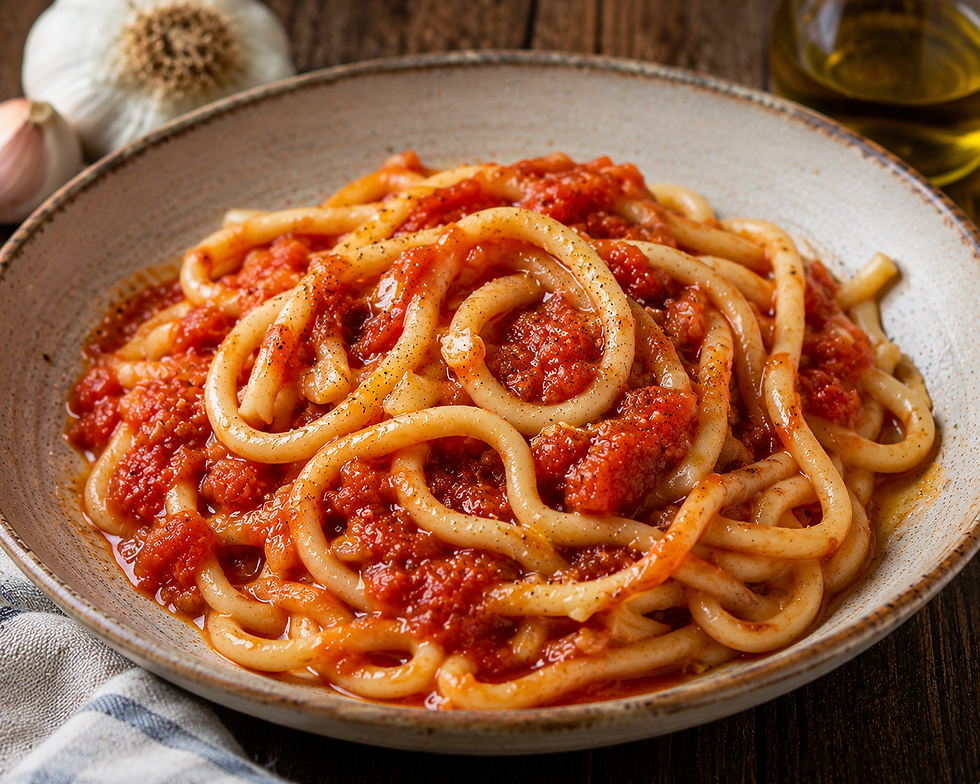
Pici all'Aglione is a sauce built on one ingredient that almost disappeared. Aglione is not garlic as the rest of Italy knows it. It is a giant bulb of the Val di Chiana, closer to the leek than to the common clove, with segments weighing three ounces each and a flavour that is sweet and mild rather than pungent. Cooked slowly in olive oil until it collapses, it gives a tomato sauce a depth no quantity of ordinary garlic could produce without turning harsh.
The pasta under it is the other half of the dish. Pici are rolled by hand from flour and water, no eggs, each strand worked out on a board to roughly the thickness of a pencil and never perfectly even. That irregularity is the point: the thick uneven surface holds a loose tomato sauce in a way extruded pasta cannot.
Yield: 4 servings. Prep: 50 minutes. Rest: 40 minutes. Cook: 1 hour 10 minutes. Total: about 2 hours 40 minutes. Difficulty: intermediate. Course: primo piatto. Region: Tuscany, Val di Chiana and the province of Siena.
The Story
Aglione is grown in a narrow strip of Tuscany and almost nowhere else: the flat alluvial floor of the Val di Chiana, between Chiusi, Montepulciano, Cortona and Foiano della Chiana, on deep silty soil left behind when the valley was drained over centuries of works begun under the Medici. The plant is Allium ampeloprasum, the same species as elephant garlic, but the Chiana population is an old local selection that farmers kept going by replanting their own bulbs.
By the 1980s it was effectively gone. Mechanised agriculture had no use for a crop planted, weeded and lifted by hand, and the valley turned to cereals and tobacco. Aglione survived in kitchen gardens, kept by a few families who still made the sauce. The revival came in the early 2000s, when growers around Valiano and Acquaviva replanted it commercially and a consortium was formed to protect the name. It is now a Slow Food presidium.
What made it worth saving is chemical as much as cultural. Aglione holds far less of the sulphur compound that gives ordinary garlic its bite and its afterlife on the breath, which is why the valley calls it the garlic you can kiss after. Cooks there use three or four ounces to a single pan of tomato and the result is round and faintly sweet. The sauce was poor food, made in summer when tomatoes were plentiful, and it is still the dish the Val di Chiana puts first on a festival table.
Ingredients
For the pici
Durum wheat semola rimacinata, 2 cups (300 g)
Type 00 flour, 3/4 cup (100 g)
Warm water, about 100°F (38°C), 3/4 cup plus 1 tbsp (195 ml)
Extra virgin olive oil, 1 tbsp (15 ml)
Fine sea salt, 1/2 tsp (3 g)
Semola for dusting the board and the tray, 1/2 cup (75 g)
For the aglione sauce
Aglione, peeled and thinly sliced, 3 1/2 oz (100 g), about two large segments
Extra virgin olive oil, 1/3 cup (80 ml)
Peeled plum tomatoes, San Marzano type, crushed by hand, 28 oz (800 g)
Dry white wine, 1/4 cup (60 ml)
Dried red chilli, 1 small, crumbled
Fine sea salt, 1 tsp (6 g)
Freshly ground black pepper, to taste
For finishing
Coarse sea salt for the pasta water, 2 tbsp (35 g)
Extra virgin olive oil, 2 tbsp (30 ml)
Pecorino Toscano stagionato, finely grated, 1 1/2 oz (40 g)
Reserved pasta cooking water, about 1 cup (240 ml)
Preparation
Step 1
Mix and hydrate the dough. Combine the semola, the type 00 flour and the salt in a wide bowl and make a well. Pour in the warm water and the olive oil and bring the flour in from the edges until you have a shaggy mass with no dry powder left. It will look too firm compared with egg pasta, and it should: semola absorbs water slowly, so mix for two full minutes before adding more.
Step 2
Knead until smooth and rest it. Turn the mass onto an unfloured surface and knead for a solid 10 minutes, pushing with the heel of the hand and folding the dough over itself. It goes from rough to elastic around the seventh minute, ending as smooth as modelling clay. Wrap it tightly and rest it at room temperature for 40 minutes so the gluten relaxes and the water reaches the starch.
Step 3
Peel and slice the aglione. Separate the segments and peel away the papery skin and the thin membrane underneath, which stays tough however long you cook it. Slice each segment lengthways into slivers the thickness of a coin: sliced this way the aglione melts evenly into the sauce, while chopped small it browns in patches. Do not crush it, since crushing releases the sharp compounds this bulb is valued for not having.
Step 4
Sweat the aglione in oil. Put the slices and the olive oil in a cold wide pan, set it over the lowest heat you can manage and cook for about 20 minutes, stirring every few minutes. Starting cold and staying low is the single most important instruction in the recipe. The slivers should turn translucent, then soft, then begin to fall apart, and at no point take colour. Add the crumbled chilli for the last 3 minutes. Pale gold at the edges means the sweetness is turning bitter.
Step 5
Deglaze and add the tomatoes. Raise the heat to medium, pour in the white wine and let it bubble for a minute until the sharp alcohol smell has gone. Crush the peeled tomatoes by hand directly into the pan, in rough pieces rather than pureed, and add the salt. Bring to a simmer, then drop the heat so it barely moves: hand crushed tomato releases its water gradually, which lets the sauce concentrate rather than seize.
Step 6
Simmer the sauce down. Cook uncovered for 40 to 45 minutes, stirring occasionally and scraping the bottom. It is ready when the oil has separated into small orange pools and a spoon dragged across the pan leaves a track that closes slowly. Taste for salt now. If it tastes flat rather than sweet, the aglione was cooked too fast and more simmering will not fix it.
Step 7
Roll the pici by hand. Flatten the rested dough into a disc half an inch thick, brush it lightly with oil and cut it into strips a quarter of an inch wide. Roll one strip at a time under flat palms from the centre outward, moving your hands apart, until the strand is the thickness of a pencil and 10 to 12 inches long. Work with almost no flour, since pici need friction to lengthen, and lay each strand on a semola dusted tray, kept separate.
Step 8
Cook the pici and finish them in the pan. Bring 5 quarts (4.7 litres) of water to a rolling boil and add the coarse salt, which should make it taste assertively of the sea. Cook the pici 4 to 6 minutes from the moment the water returns to the boil, until cooked through but still firm at the core, and reserve a cup of the cloudy water. Lift the pasta into the sauce with tongs, add a ladle of water and the olive oil, and toss over medium heat for 60 to 90 seconds until every strand is coated. Off the heat, add the pecorino and pepper and toss once more.
Plating
This is a rustic primo and should look like one, but it still needs to arrive hot and gathered rather than spread flat. Warm the bowls to about 140°F (60°C), since pici are thick and a cold bowl pulls the heat out of the strands within a minute. Use wide shallow bowls with a rim so the sauce stays in one place.
Serve straight from the pan with tongs. Lift a quarter of the pasta, turn it once against the inside of the bowl to build a loose nest and let it sit taller in the centre. Do not press it down or arrange the strands. Spoon the remaining sauce on top rather than around the edge.
Finish with grated pecorino and a thread of raw olive oil, both at the table if you can. Nothing else belongs on the plate, no herbs and no garnish that would put a second flavour in front of the aglione. Carry the bowls out immediately, since the sauce tightens as it cools.
Professional Technique
The technical heart of this recipe is a long cold start confit of the aglione, and it exists because of what this bulb is not. Ordinary garlic is taken to light gold because browning creates the flavour a cook is after. Aglione holds far fewer of those sulphur precursors and far more simple sugar, so the same treatment gives scorched sugar rather than roasted garlic. Held in oil below 250°F (120°C) for 20 minutes, the cell walls soften and that sugar dissolves into the oil, which carries it through the sauce.
The second technique is the deliberate underhydration of the dough. At about 43 percent hydration it is far firmer than egg pasta, and it is rolled thick rather than sheeted thin. Both choices protect the pici during a long boil and a vigorous finish: a wetter or thinner strand surrenders its surface starch too early and breaks when tossed, while the thick strand keeps a firm core long enough for the outside to soften into the sauce.
The third is the finish itself, the mantecatura, a controlled emulsion. Starch suspended in the pasta water binds olive oil and tomato liquid into one glossy coating instead of leaving oil on a watery sauce. It needs movement, heat and the right ratio: too little water and the sauce stays greasy, too much and it never tightens.
Texture and Moisture Control
Pici are thick, so the window between raw at the centre and soft all through is wider than for thin pasta, but the margin at the finish is smaller. Pull them when the centre still shows the faintest resistance under the tooth, a minute before you would call them done: a strand of this diameter stores heat and keeps softening for two minutes after it leaves the pot.
The cooking water is a working ingredient, not a byproduct. Boiling hand rolled pici in a moderate volume of water gives a cloudy starch rich liquid, and that starch emulsifies the sauce. Add it in stages: half a ladle first, another splash only if the sauce tightens faster than the pasta absorbs it. Never substitute plain hot water, which brings no starch.
On the sauce side, the target is a reduction that still moves but no longer runs. Oil separating at the surface is the sign that enough water has gone; if the sauce is still watery when the pasta is ready, hold the pasta back and boil the sauce hard for two minutes. Keep the pecorino off the heat: added over a flame it seizes into threads, while the same cheese stirred in off the burner melts into the coating.
Professional Mise en Place
Everything here can be staged in advance except the final two minutes, and organising it that way is what keeps the pasta from waiting. Work in the order below.
Equipment and tools
Wooden board for rolling, with an unfloured area to work on
Wide heavy sauté pan large enough to hold the finished pasta
Large pot, at least 6 quarts, and a pair of long tongs
Trays dusted with semola for holding the rolled strands
Ladle for the pasta water and a fine grater for the pecorino
Prepared ahead
Aglione sauce, up to 3 days ahead, refrigerated in a sealed container
Pici dough, mixed and kneaded up to 6 hours ahead, wrapped and held at room temperature
Pici rolled and laid on semola dusted trays up to 2 hours before service
Pecorino grated and covered, olive oil measured into a small jug
Service setup
Sauce warm in the sauté pan over the lowest heat, loosened with a spoon of water if needed
Pasta water at a full rolling boil and already salted
Bowls warming, tongs and ladle within reach of the stove
Everyone seated before the pici go into the water
Chef Tips
If you cannot find genuine aglione, do not substitute the same weight of ordinary garlic. Use elephant garlic, the same species, or 1 oz (30 g) of regular garlic sliced thin and sweated the same way, plus half a sweet white onion for body. It will be a good garlic and tomato sauce, but it is not aglione.
Roll the pici with slightly damp hands rather than floured ones. Moisture gives the palms grip and lets the strand lengthen evenly, while dry flour makes your hands skid so the strand thins and tears.
Taste the sauce three times: after the aglione has sweated, after the wine has evaporated and at the end of the simmer. The first is the only point where you can still correct a heat mistake, by adding more raw sliced aglione and continuing gently. Once the tomato goes in, everything is set.
Rolled pici freeze better than they hold. Working more than two hours ahead, freeze the strands solid in one layer on a semola dusted tray, then bag them and cook from frozen in the same salted water, allowing two extra minutes. Left on a tray for half a day, the surface dries and cracks.
Common Mistakes
Browning the aglione. The commonest and most damaging error. Colour means the sugars have caramelised past what this bulb tolerates, and the sauce turns bitter in a way no simmering will remove. Start in cold oil and pull the pan off for a moment if anything sizzles briskly.
Making the dough with eggs. Pici are a flour and water pasta and the difference is structural. Egg dough is softer and far more fragile at this thickness, and it collapses under a long boil and a hot finish in the pan. Keep to semola, water and a spoon of oil.
Draining the pasta into the sink. Losing the cooking water means losing the only thing that will bind the oil and the tomato. Lift the pici out with tongs directly into the sauce and keep a full cup of water beside the stove.
Finishing the pasta in a lukewarm pan. The emulsion needs real heat and real movement. A merely warm pan leaves the sauce in a pool with oil on top and the pasta dry inside it. Get the pan properly hot before the pasta arrives and keep it moving for the full 90 seconds.
Wine Pairing
Chianti Classico DOCG: The reference pairing and the bottle this sauce was built beside. Sangiovese carries high natural acidity, and a tomato sauce needs a wine at least as acidic as itself or the wine tastes flabby beside it. The grippy tannin cuts the olive oil, while the sour cherry and dried herb character sits with the sweetness of the cooked aglione rather than competing.
Rosso di Montalcino DOC: A softer and more immediate answer from thirty miles south. Same grape, released young and without long oak ageing, so it offers riper fruit and rounder tannin, which suits a sauce with no meat in it. Serve at 60°F (16°C); cooler, and the chilli makes the tannin feel sharper than it is.
Vernaccia di San Gimignano DOCG: The Tuscan white that can stand up to tomato, and the right choice in summer. It has more structure and phenolic grip than most Italian whites and finishes on a bitter almond note that picks up the faint bitterness at the edge of long cooked tomato. Its acidity handles the oil and its restraint leaves the aglione audible.
Cerasuolo d'Abruzzo DOC: A dry rosato of real substance, deeply coloured, made from Montepulciano, and an unusually good match for a chilli spiked tomato sauce. Chilli heat amplifies alcohol and tannin, so a wine with little tannin and moderate alcohol tastes kinder here than a big red. Its red berry fruit and saline finish refresh the palate between forkfuls.
Storage & Reheating
Sauce and pasta keep well separately and badly together, so never dress more pici than you will serve. The sauce keeps in an airtight container in the refrigerator for 4 days and improves on the second. It freezes cleanly in portions for 3 months; thaw overnight in the refrigerator rather than in a pan, which splits the emulsion before it warms through.
Uncooked pici are best frozen rather than refrigerated: spread them on a semola dusted tray, freeze solid, then bag them for up to 2 months. Cooked and dressed pici hold 2 days in a covered container, though they absorb sauce and firm up as they sit.
To reheat a dressed portion without overcooking it, use a sauté pan rather than a microwave. Add 2 tbsp (30 ml) of water, cover, and set over medium low heat for 3 to 4 minutes, shaking occasionally. The steam loosens the sauce and warms the pasta through without bringing it back to a boil. Uncover for the last 30 seconds and add the pecorino fresh, since cheese reheated twice turns grainy.
Nutrition
Per serving, based on 4 servings:
Calories: 630 kcal
Total Fat: 27 g
Saturated Fat: 5 g
Trans Fat: 0 g
Unsaturated Fat: 21 g
Cholesterol: 10 mg
Sodium: 760 mg
Total Carbohydrates: 81 g
Fiber: 6 g
Total Sugars: 9 g
Added Sugars: 0 g
Protein: 17 g
Lactose: 0.3 g
Principal micronutrients: lycopene, vitamin C, vitamin K, potassium, iron, selenium, manganese
These figures are estimates. Most of the salt in the pasta water is discarded rather than eaten, and the sodium depends largely on how much pecorino reaches the bowl.


Comments