
Italian Tuscan Hand Rolled Pasta | Pici al Ragù di Cinta Senese

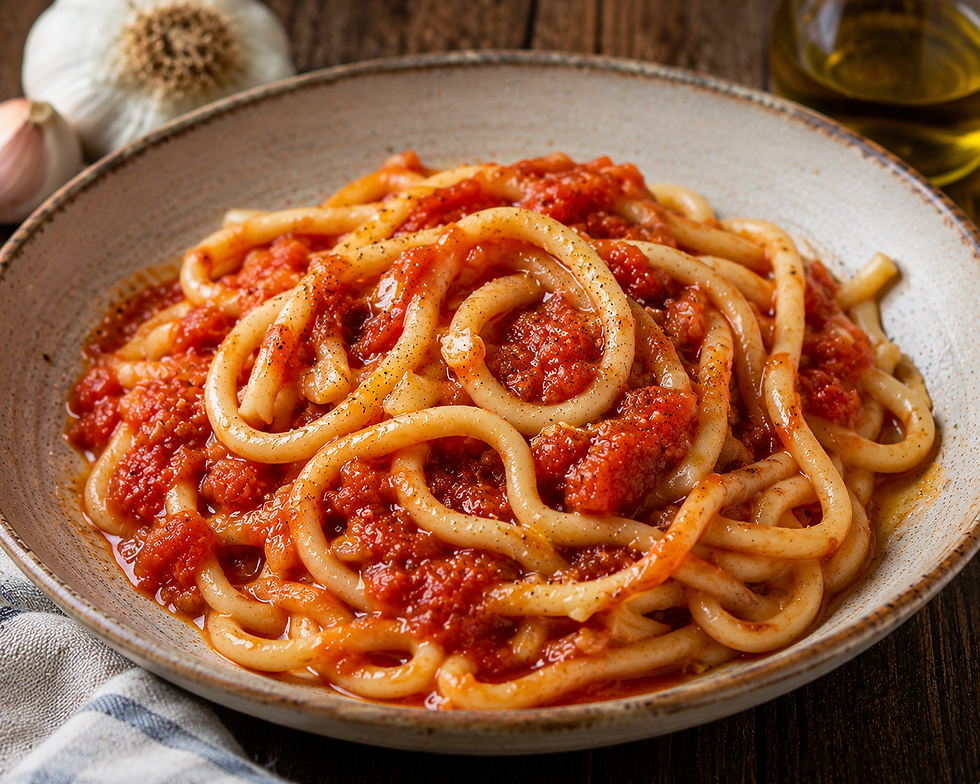
Pici are the pasta of the Sienese countryside and the least mechanical shape in the Italian repertoire. Flour, water, a little olive oil, salt, and nothing else: no egg, no machine. Each strand is rolled under the palms to roughly the thickness of a pencil, irregular along its length, and that irregularity is the point. A smooth extruded strand carries sauce on its surface; a pici strand, uneven and faintly rough, drags sauce along with it.
The ragu is built on Cinta Senese, the black pig with the pale band across its shoulders that grazes the oak and chestnut woods south of Siena. It is a slow growing breed with dense marbled meat and a fat that melts at a lower temperature than commodity pork, which is why a ragu made from it turns glossy rather than greasy. The sauce cooks for hours over very low heat with soffritto, red wine and a restrained amount of tomato, until the meat surrenders completely.
What follows is the version cooked in Sienese homes, not a restaurant reinterpretation. No cream, no stock cube, no reduction poured over at the end. The finishing move is the one that matters: the drained pici go into the pan with the ragu and a ladle of their starchy water, and the two are tossed over heat until the sauce grips every strand.
Yield: 4 generous main course servings. Prep: 50 minutes. Rest: 30 minutes. Cook: 3 hours. Total: about 4 hours 20 minutes. Difficulty: intermediate. Course: primo piatto. Region: Tuscany, the province of Siena and the Val d'Orcia.
The Story
Pici belong to a band of southern Tuscany running from Siena through the Val d'Orcia to Montepulciano and Montalcino, and they carry different names within a few kilometres of each other: pici in Siena, pinci around Montalcino, lunghetti in villages of the Val di Chiana. The most quoted evidence for their age is an Etruscan tomb painting at Tarquinia showing what look like long hand rolled strands, though scholars argue about it. What is beyond argument is that pici are cucina povera in the strictest sense: flour and water, made by hand, in a region where eggs were sold rather than eaten.
Cinta Senese has a far better documented past. The pig appears, unmistakably belted, in Ambrogio Lorenzetti's fresco of good government in the Palazzo Pubblico of Siena, painted between 1338 and 1339. The breed grazed the Montagnola Senese for centuries on acorns and chestnuts, then very nearly vanished in the twentieth century when producers switched to fast growing pink breeds. By the early 1990s fewer than a hundred breeding sows remained. Sienese farmers rebuilt the population, and the meat received DOP status in 2012.
The pairing of the two is not a marketing invention. In the Sienese hills the pig was the household animal, killed in winter, and the cuts that could not be cured went into a long simmered sauce that fed a family for days. Pici were the pasta a woman could make without buying anything. The combination survived into the trattorie of Siena and Pienza, where a plate of pici al ragu is still the dish by which cooks are judged.
Ingredients
For the pici
Durum wheat semola rimacinata, 1 2/3 cups (280 g)
All purpose flour, 3/4 cup (100 g)
Warm water, about 3/4 cup (180 ml)
Extra virgin olive oil, 1 tbsp (15 ml)
Fine sea salt, 1 tsp (6 g)
Semola for dusting the board, as needed
For the ragu
Cinta Senese pork shoulder, coarsely ground or hand chopped, 1 lb (450 g)
Cinta Senese pancetta or guanciale, diced small, 3 oz (85 g)
Yellow onion, finely diced, 1 medium
Carrot, finely diced, 1 medium
Celery stalk, finely diced, 1
Garlic cloves, minced, 2
Extra virgin olive oil, 3 tbsp (45 ml)
Dry red Tuscan wine, 1 cup (240 ml)
Tomato paste, 1 tbsp (16 g)
Canned peeled tomatoes, crushed by hand, 1 1/4 cups (300 g)
Meat or light chicken stock, warm, 1 1/2 cups (360 ml) plus more as needed
Bay leaves, 2
Fresh rosemary sprig, 1
Fine sea salt, 1 1/4 tsp (7 g)
Freshly ground black pepper, to taste
For finishing
Coarse sea salt for the pasta water, 2 tbsp (35 g) per 4 quarts (4 l)
Pecorino Toscano stagionato, finely grated, 2 oz (55 g)
Extra virgin olive oil, 1 tbsp (15 ml)
Freshly ground black pepper, to taste
Preparation
Step 1
Mix and knead the pici dough. Combine the semola and the all purpose flour on a board, dissolve the salt in the warm water, and add the water and olive oil in stages, drawing the flour in with your fingers. You want a dough noticeably firmer than fresh egg pasta, almost stiff under the hand. Knead a full 10 minutes until smooth and elastic, then wrap it and rest it 30 minutes at room temperature so the gluten relaxes.
Step 2
Start the soffritto and the meat. While the dough rests, warm the olive oil in a heavy pot and render the diced pancetta over medium low heat until it gives up its fat. Add the onion, carrot and celery and cook them very slowly, 12 to 15 minutes, until soft and sweet and barely coloured. Add the garlic for the last minute. Raise the heat, add the ground shoulder, break it up with a wooden spoon and let it brown properly rather than steam, in two batches if the pot is crowded.
Step 3
Deglaze and build the base. Stir in the tomato paste and cook it out for a minute so it loses its raw edge. Pour in the red wine, scrape the bottom of the pot clean, and let the liquid reduce by half. Add the crushed tomatoes, the bay leaves, the rosemary, the salt and a generous grinding of pepper, then pour in enough warm stock to just cover the meat. Bring it to the barest simmer.
Step 4
Cook the ragu low and long. Set the lid slightly ajar and hold the pot at a bare tremble for 2 1/2 to 3 hours, stirring every twenty minutes and adding warm stock a ladle at a time whenever the surface looks dry. This is where Cinta Senese earns its reputation: the connective tissue dissolves into gelatin and the marbled fat melts into the liquid, so the sauce thickens without flour or cream. It is done when the meat falls apart under the spoon and a film of orange fat sits on top. Remove the bay and rosemary.
Step 5
Roll the pici. Cut the rested dough into four pieces and keep the rest covered. Flatten one piece into a rectangle about 1/4 inch (6 mm) thick, brush it lightly with olive oil and cut it into strips the same width. Roll each strip under your flattened palms from the centre outward, hands moving apart, until the strand is about 12 inches (30 cm) long and the thickness of a thin pencil. Do not chase uniformity. Dust with semola and lay them loosely in a nest.
Step 6
Boil the pici correctly. Bring 4 quarts (4 l) of water to a rolling boil and salt it heavily, because a flour and water dough seasons only from the outside. Shake the excess semola off, drop them in and stir immediately. Fresh pici need 4 to 6 minutes depending on thickness, and they are ready when a strand bites with a slight resistance in the centre. Start tasting at 3 minutes. Before draining, reserve 1 1/2 cups (360 ml) of the water.
Step 7
Marry the pasta and the ragu. Warm a wide saute pan with two generous ladles of ragu and a splash of the pasta water, drop the drained pici straight in and toss over medium heat for about a minute, adding starchy water a little at a time. The sauce will move from loose to glossy and start clinging to the strands. Kill the heat, add the olive oil and half the pecorino and keep tossing off the flame so the cheese emulsifies rather than seizes. Serve at once.
Plating
Warm the bowls properly. Pici are heavy strands carrying a fat rich sauce, and a cold bowl sets that fat within thirty seconds and leaves the pasta looking dull. A few minutes in a low oven or a rinse in very hot water is enough. Use wide shallow bowls rather than deep ones, so the strands can be spread instead of piled.
Lift the pici out with tongs and twist them loosely into a mound at the centre, keeping some strands visible rather than burying everything. Spoon a little extra ragu over, add some of the remaining pecorino and one turn of black pepper. A thread of raw olive oil is traditional. Serve immediately, with the rest of the pecorino on the table.
Professional Technique
The defining technique is hand rolling under the palms, and it fails in a predictable way. Beginners press down, which flattens the strand into a ribbon and drives the dough outward unevenly. The movement is a light forward and backward roll with almost no downward pressure, hands travelling apart as the strand lengthens. The slight taper and faint roughness that result are what let a pici strand hold a heavy ragu, which is why pici are never extruded.
The second technique is the long low braise. Cinta Senese shoulder is rich in collagen, and collagen converts to gelatin only in a narrow window, above roughly 160°F (71°C) and below a real boil. Held at a tremble for three hours it dissolves and gives the sauce its body. Pushed to a boil, the muscle fibres contract, squeeze out moisture and go stringy while the fat separates into a slick layer. More than an occasional bubble breaking the surface means the heat is too high.
Texture and Moisture Control
The starch in the pasta water is the working ingredient of the final minute. Pici shed a great deal of semola starch, which is why their water is more useful than that of dried pasta and why it should never be diluted in an oversized pot. Agitated with the fat in the ragu over heat, those suspended granules form an emulsion. Fat and water that would otherwise separate are held together, and the result coats the pasta instead of pooling under it.
Control the doneness for what happens after draining. Pici finish cooking in the pan, so they should leave the water with a firm core still present, a minute before you would want to eat them. A strand already perfect in the pot will be soft by the time it reaches the bowl. The ragu should look looser than seems right before the pasta goes in, because the starch tightens it fast.
Cheese is the last variable. Pecorino Toscano added over direct heat clumps and threads rather than melting, because the heat drives the proteins together before the fat can disperse. Pull the pan from the flame, wait a few seconds, then add it while tossing.
Professional Mise en Place
The ragu is the long job and it is entirely a day ahead preparation. The pici can be rolled several hours before service. Only the boiling and the tossing are a la minute, and that window is about six minutes wide.
Equipment and tools
Heavy pot or Dutch oven with a lid, 5 quart (5 l) or larger
Wooden board, unfloured and slightly oiled
Bench scraper and a knife for cutting strips
Tall pasta pot and a spider or tongs
Wide saute pan, large enough for four portions
Prepared ahead
Ragu cooked a day ahead and refrigerated, which improves it noticeably
Soffritto diced fine the day before, covered and cold
Pici rolled up to 4 hours ahead on a semola lined tray
Pecorino grated fresh, never in advance
Service setup
Ragu warm in the saute pan, loosened with a little stock
Pasta water at a rolling boil and salted, heatproof cup beside it
Bowls warming, olive oil and pepper mill within reach
Everything else cleared away: the last minute needs both hands
Chef Tips
Make the ragu the day before. Refrigerating it overnight lets the fat set so you can lift off any excess, and the flavour of a slow pork sauce deepens noticeably between the first day and the second.
Oil the board rather than flouring it when you roll. Extra flour makes the strand slide instead of gripping, so you press harder to compensate and flatten it. A barely oiled wooden board gives exactly the friction the movement needs.
If Cinta Senese is unavailable, buy the fattiest free range pork shoulder you can find, ask for a coarse grind and add a little more pancetta. Lean supermarket pork gives a thin sauce no amount of cooking will fix, because there is nothing in it to melt.
Hand chop the shoulder rather than grinding it if you have the patience. Pieces around 1/4 inch (6 mm) keep a texture in the finished sauce that ground meat loses entirely, and this is how the older cooks in the Val d'Orcia still do it.
Common Mistakes
Making the pici dough too soft. A wet dough cannot be rolled under the palm; it stretches, tears and sticks. It should feel firm and resistant when you finish kneading. Add water a spoonful at a time and stop early, because semola keeps absorbing.
Boiling the ragu instead of simmering it. A visible boil tightens the muscle fibres and splits the fat out, giving dry meat in a greasy liquid. Hold the pot so a bubble breaks the surface only every few seconds, and use a flame diffuser if your burner runs hot.
Draining the pasta water away. Without a cup of that starchy water there is no emulsion and the sauce sits in the bottom of the bowl. Reserve it before you drain, every time, and keep it hot.
Serving the ragu spooned on top. Pici finished in the pan taste completely different from pici sauced in the bowl, because the strands absorb some of the sauce during the toss. Sauce on top is a shortcut, not the Tuscan method.
Adding the pecorino over the flame. Direct heat makes the cheese clump into threads instead of melting. Take the pan off the heat first, then add it while tossing, and loosen with hot water if it tightens.
Wine Pairing
Chianti Classico DOCG: The default answer and a genuinely good one. Sangiovese arrives with high acidity and a firm grip of tannin, and both are working here: the acidity cuts the melted pork fat, while the tannin binds the protein in the meat and leaves the mouth clean for the next forkful. Its sour cherry and dried herb character sits on top of the rosemary in the sauce.
Vino Nobile di Montepulciano DOCG: The most local bottle on the list, grown on the hills where pici are still rolled daily. Prugnolo Gentile gives a rounder, plummier fruit than Chianti with softer tannin, which suits a sauce cooked for three hours into something sweet and yielding. A bottle with a few years of age carries the earthy tobacco note that meets the braised pork.
Rosso di Montalcino DOC: The choice when you want Sangiovese without the weight. Released young and usually without heavy oak, it brings bright red fruit and lively acidity at a lower tannic load, so it refreshes between mouthfuls instead of adding structure to a dish that already has plenty. This is the everyday bottle in Montalcino trattorie, served cool.
Carmignano DOCG: An unusual pick with a specific advantage. The small proportion of Cabernet blended into the Sangiovese adds a herbaceous edge and a darker berry note that picks up the tomato and the pepper in the ragu. Its tannin is finer grained than most Tuscan reds of the same weight, so it never dries out a sauce built on richness.
Brunello di Montalcino DOCG: Reserve this for a hand chopped ragu made with real Cinta Senese, because it needs that fat to soften it. Long ageing brings leather, dried flowers and balsamic depth, and the structure is powerful enough for meat this rich. Open it an hour ahead.
Storage & Reheating
The ragu keeps in an airtight container in the refrigerator for 4 days and freezes well for up to 3 months. Freeze it in portions with a little of its liquid and thaw overnight in the refrigerator, never in a microwave, which breaks the emulsion. Rewarm it over low heat with a splash of stock. Uncooked pici can be dusted with semola, frozen flat on a tray, bagged once solid and boiled from frozen with 2 minutes added.
Dressed pici do not store well and no technique fully rescues them. Keep leftovers covered in the refrigerator for no more than 2 days and reheat them in a saute pan over medium heat with a few tablespoons of water, tossing until they loosen and steam through. Never microwave them, which cooks the strands further and turns them pasty, and never reboil them. Better to cook only as much pasta as you will eat and refrigerate the sauce on its own.
Nutrition
Per serving, based on 4 generous main course portions:
Calories: 780 kcal
Total Fat: 34 g
Saturated Fat: 11 g
Trans Fat: 0 g
Unsaturated Fat: 21 g
Cholesterol: 95 mg
Sodium: 890 mg
Total Carbohydrates: 78 g
Fiber: 5 g
Total Sugars: 7 g
Added Sugars: 0 g
Protein: 38 g
Lactose: 0.5 g
Principal micronutrients: iron, zinc, selenium, thiamine, vitamin B12, niacin, calcium, phosphorus
These figures are estimates. Most of the salt in the pasta water is discarded rather than eaten, and the fat content depends on the breed of pork and on whether surface fat is skimmed after chilling.




Comments