

Sicilian Stuffed Beef Roll | Falsomagro Siciliano

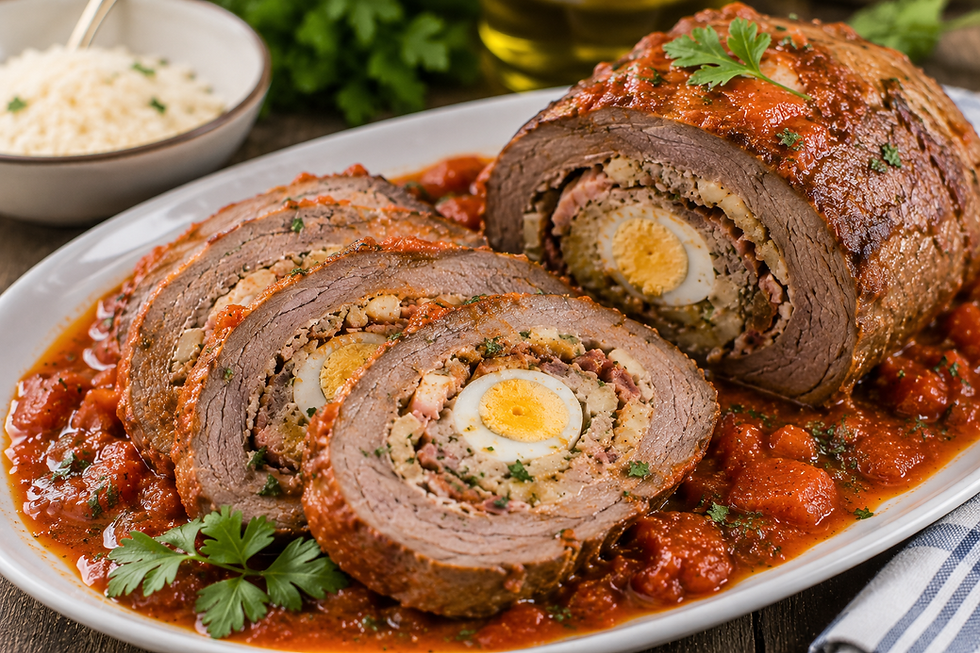
Falsomagro is the Sunday roast of Sicily, one of the few dishes on the island built to be cut open in front of the people eating it. A wide slice of beef is beaten thin, covered with ground meat, salame, cheese, breadcrumbs and parsley, laid with whole hard boiled eggs down its length, rolled tight, tied and braised slowly in tomato. Sliced, every round shows a ring of beef, a spiral of filling and a pale centre of egg.
Everything that can go wrong here goes wrong in three places, and none of them is the sauce. The beef has to be beaten to one even thickness or it tears as it rolls. The tie has to be genuinely tight, because a loose roll lets the filling migrate and the braise pushes it into the pan. And the roll has to rest completely before the knife touches it, since a hot falsomagro has no structure at all.
This is the plain home version, with the braising sauce going onto pasta as a first course and the sliced roll following as the main. The technique is all in the hands: the mallet, the twine and the patience to leave it alone once it leaves the pot.
Yield: 6 servings. Prep: 45 minutes. Cook: 2 hours. Rest: 40 minutes. Total: about 3 hours 25 minutes. Difficulty: intermediate. Course: secondo. Region: Sicily, Palermo and the western provinces.
The Story
The name is the argument. One reading takes it from the French farce maigre, the lean stuffing, carried into Sicilian kitchens by the monsu, the French trained cooks who ran the kitchens of the Palermo aristocracy from the eighteenth century onward. Monsu is a Sicilian corruption of monsieur, and those cooks left a permanent mark: timballi, baked pasta domes, elaborate rolled and stuffed meats, and a taste for dishes that reveal a hidden interior when cut. Falsomagro belongs to that family completely.
The second reading is the Sicilian one and the funnier one. Falso magro means false lean: a piece of meat presenting itself as a modest cut while hiding eggs, cheese and salame inside. Both may be true at once, since a monsu dish would have been renamed by the people who cooked it at home. In Palermo it is often called farsumagru, and outside the city you will hear bruciuluni for the same roll.
It survived the fall of the aristocratic kitchens because it works as peasant cooking too. One cheap slice of beef feeds six once padded out with breadcrumbs, eggs and a little cured pork, and the long braise tenderises a tough cut while producing the pasta sauce at the same time. One pot, two courses: that arithmetic kept it on Sunday tables in Palermo, Trapani and Agrigento long after the monsu were gone.
Ingredients
For the beef
Beef top round or flank, one wide slice about 3/4 inch thick, 2 1/4 lb (1 kg)
Fine sea salt, 1 tsp (6 g)
Freshly ground black pepper, to taste
Butcher twine, about 6 ft (180 cm)
For the filling
Ground beef, 9 oz (255 g)
Salame, Sicilian or a good coarse ground type, sliced, 3 1/2 oz (100 g)
Caciocavallo or primosale cheese, in strips, 5 oz (140 g)
Pecorino Siciliano, grated, 2 oz (55 g)
Dry breadcrumbs, 3/4 cup (75 g)
Whole milk, 1/4 cup (60 ml)
Egg, large, 1, for binding the filling
Eggs, large, hard boiled and peeled, 4
Flat leaf parsley, chopped, 1/3 cup (20 g)
Garlic clove, minced, 1
Fine sea salt, 1/2 tsp (3 g)
Freshly ground black pepper, to taste
For the braise
Extra virgin olive oil, 3 tbsp (45 ml)
Yellow onion, finely chopped, 1 medium
Dry red wine, 3/4 cup (180 ml)
Canned peeled tomatoes, crushed by hand, 28 oz (800 g)
Tomato paste, 1 tbsp (16 g)
Bay leaves, 2
Fresh basil, 4 leaves
Water or light beef stock, 1/2 cup (120 ml) as needed
Fine sea salt, 1 tsp (6 g)
Freshly ground black pepper, to taste
Preparation
Step 1

Boil and cool the eggs. Bring four eggs to a boil from cold, cook 9 minutes, chill them in iced water until cold through and peel them whole. Nine minutes gives a fully set but tender yolk, which matters because these eggs spend two more hours in a braise. They must be completely cold going into the roll, since a warm egg softens the cheese around it.
Step 2

Beat the beef to an even thickness. Lay the slice between two sheets of plastic wrap and work it with the flat face of a mallet, from the centre outward with overlapping strokes, to one even rectangle of about 1/4 inch, roughly 12 by 14 inches. Work steadily rather than hard, since heavy blows in one spot punch holes the filling escapes through. Feel the sheet with your palm and flatten any ridge.
Step 3

Mix the filling. Soak the breadcrumbs in the milk for 5 minutes, squeeze them lightly, and combine with the ground beef, pecorino, parsley, garlic, the raw egg, salt and pepper. Work it by hand only until it comes together, since overworked ground beef cooks rubbery. Fry a spoonful and taste it: your only chance to correct the seasoning.
Step 4

Season and layer the beef. Pat the beaten beef dry, season both faces, and lay the salame over it in a single overlapping layer, leaving a clear 1 inch border on all four edges. That border is what seals the roll. Spread the filling over the salame about 1/2 inch thick, pressing out air pockets, then lay the cheese strips on top, also off the edges, since cheese at the seam leaks out.
Step 5

Lay the eggs down the centre. Arrange the four cold eggs end to end in a straight line along the rectangle, slightly nearer the edge you roll from than the middle, so they finish in the heart of the cylinder. Press them into a shallow channel rather than leaving them on top, and push filling against their sides so there is meat, not air, around every egg.
Step 6

Roll it tight. Starting from the edge nearest the eggs, fold the beef over the first egg and pull it snug, then roll away from yourself in one continuous movement with constant tension. After each half turn, run your thumbs along the length to push filling back toward the centre, and fold the short sides inward before the last turn. The roll must feel solid, because every gap fills with steam and forces it open.
Step 7

Tie the roll. Start with one tight knotted loop around the middle, then work outward to each end with loops about 1 1/4 inch apart, pulling each until the twine bites into the meat. Finish with one loop running lengthwise to hold the ends shut. Spacing matters as much as tension: anything wider leaves seam unsupported, and a loose tie ruins the concentric pattern.
Step 8

Brown the roll on all sides. Heat the oil in a heavy braising pot just wide enough to hold the roll and brown it about 4 minutes per side, turning with two wooden spoons rather than a fork so you never pierce it, until the exterior is deep brown. Most of the flavour is made here, since tomato and wine cannot produce that roasted depth. Do not wipe the pot: the fond belongs in the sauce.
Step 9

Build the sauce and braise. Lower the heat, soften the onion in the same pot for 8 minutes, scraping up the fond. Add the wine and reduce by half, the tomato paste for 1 minute, then the crushed tomatoes, bay, basil, salt and pepper. Return the roll, spoon sauce over it, cover and hold at a bare simmer for 2 hours, turning every 30 minutes and adding water or stock if it reduces too far. A rolling boil will split the tie.
Step 10

Rest completely, then slice. Lift the roll onto a board and leave it uncovered a full 40 minutes, until warm rather than hot. Hot, the filling is molten and the roll has no structure, so a knife pushes it sideways and the slices fall apart. Cooling sets the cheese and firms the gelatin. Snip away every loop of twine, then cut rounds about 3/4 inch thick with one slow pass of a long sharp knife.
Plating
Serve it as Sicilian families do, two courses out of one pot. Skim the fat from the sauce, thin it with a ladle of pasta water and dress bucatini with it as the first course, finished with grated pecorino. Keep the rest back for the meat, and never serve the roll dry.
Warm the plates, because falsomagro is served warm rather than hot and cold porcelain takes what little heat it has. Spoon a thin pool of sauce down first, then lay two rounds slightly overlapping on it, cut side up so the egg and the spiral face the diner. Sauce goes under and beside the slices, never across their faces, which hides the pattern the dish exists for.
One basil leaf is enough. Roasted potatoes or braised greens dressed with olive oil and lemon are the right accompaniments, and anything more elaborate fights the sauce.
Professional Technique
The heart of this dish is three mechanical operations, each solving a structural problem. The beating creates a sheet of uniform thickness so the beef contracts uniformly around the filling, which is what makes the cylinder round instead of lumpy. Uneven beef is the origin of nearly every misshapen falsomagro, because thick areas contract later and harder than thin ones and drag the roll out of true.
The tie is a containment system under pressure. As the roll heats, the filling expands, the cheese liquefies and steam forms in any internal gap. Tight loops at regular intervals resist that pressure and hold the seam closed for two hours; loose loops let it open, and the cheese ends up in the sauce instead of the slice.
The rest is a phase change. At braising temperature the melted cheese, the rendered fat and the gelatin dissolved out of the connective tissue are all liquid, so the roll is held together by almost nothing. Cooling toward 140°F (60°C) sets all three, and only then does the cylinder survive a knife. Slicing hot does not cost a little: it destroys the dish.
Texture and Moisture Control
Two textures have to be managed inside the same piece of meat. The beef casing is a tough cut needing long slow heat to convert collagen to gelatin and become sliceable rather than chewy, which is why two hours at a bare simmer is right and forty minutes at a hard boil is not. The filling is ground meat and tightens if driven hard, so it depends on the fat from the salame and cheese, and on the soaked breadcrumbs, to stay moist.
Keep the surface of the liquid barely moving. Boiling agitates the roll, stresses the twine and squeezes moisture out of the filling. The roll should sit about two thirds submerged so the lower part braises while the top steams under the lid, turned every half hour. If the sauce drops below that line, add water or stock rather than letting exposed beef dry.
Final temperature controls the slices. Out of the pot the core is above 175°F (80°C) and structurally liquid. Rest it uncovered until it reads about 140°F (60°C), roughly 40 minutes, and the cheese and gelatin will have set while the meat is still warm for eating. Cover it and trapped steam softens the crust you built.
Professional Mise en Place
The dish splits into work done well ahead and a short finishing sequence, which is why it suits a Sunday lunch or any service where the main cannot be assembled to order.
Equipment and tools
Flat faced meat mallet and two sheets of heavy plastic wrap
Heavy braising pot with a lid, just wide enough to hold the roll
Butcher twine and kitchen scissors
Two wooden spoons for turning the roll without piercing it
Long thin slicing knife and an instant read thermometer
Prepared ahead
Eggs boiled, peeled and refrigerated, up to 1 day ahead
Filling mixed and tasted, refrigerated, up to 1 day ahead
Beef beaten flat, covered and kept cold, up to 4 hours ahead
Roll assembled and tied, refrigerated, up to 6 hours ahead
Whole dish braised the day before and reheated in its sauce, which improves it
Service setup
Roll resting on a board, uncovered, with a thermometer in it
Sauce held warm and skimmed, split between the pasta course and the meat
Plates warm, twine snipped away before the first cut
Slices cut to order in front of the guests, not in advance
Warm jug of extra sauce ready at the table
Chef Tips
Ask the butcher for one wide slice from the top round, cut for involtini in a single piece, and say what it is for. A slice taken across the grain in the wrong place tears as soon as you beat it, and nothing saves a torn sheet except an offcut patch, which never rolls cleanly.
Make it the day before. Falsomagro is better on the second day: salame, cheese and tomato move into the beef overnight, the roll firms up completely, and cold slices cut far more neatly. Slice it cold, lay the rounds in the sauce and reheat gently, covered.
Use caciocavallo or primosale rather than mozzarella, which carries too much water, releases it under heat and leaves a wet channel where it sat. If neither Sicilian cheese is available, a young provolone behaves the same way.
Keep the trimmings. The offcuts from squaring up the slice go into the sauce at the browning stage and tell you exactly how tender the roll is without cutting into it.
Common Mistakes
Slicing the roll while it is hot. The cheese and gelatin are still liquid and the cylinder has no structure, so the rounds collapse into beef, crumbs and egg. Rest it uncovered a full 40 minutes, to about 140°F (60°C), and cut only then.
Tying the roll loosely. Slack twine lets the filling shift and the seam open under internal pressure, and the cheese ends up in the sauce. Loops every 1 1/4 inch, each pulled until the twine bites in, plus one lengthwise loop.
Beating the beef unevenly. Thick and thin areas contract at different rates and drag the roll out of shape, and heavy blows punch holes. Work outward from the centre with overlapping strokes to an even 1/4 inch.
Boiling the braise instead of simmering it. A hard boil stresses the twine and squeezes moisture out of the filling. Hold a bare simmer for the full 2 hours, turning every 30 minutes.
Using fresh mozzarella in the filling. It releases water under heat and leaves a wet hollow that shows up as a gap in the sliced pattern. Use caciocavallo, primosale or a young provolone.
Wine Pairing
Cerasuolo di Vittoria DOCG: The first choice, from the south east of the island. Nero d'Avola gives dark cherry fruit and enough tannin to cut the cheese and the fat of the salame, while Frappato lifts it with fresh red berry perfume and an acidity that answers the tomato directly. Body without weight, which is what this braise needs.
Etna Rosso DOC: Nerello Mascalese grown on volcanic ash gives a pale, firm, high acid red with fine grained tannin and a smoky mineral edge. That acidity handles long cooked tomato better than any richer Sicilian red, and the savoury iron note runs alongside the browned crust. Serve at around 61°F (16°C).
Faro DOC: A rare bottle from the hills above Messina, built on Nerello Mascalese and Nerello Cappuccio. It has more grip than Etna Rosso and a dried herb and sour cherry character that meets the pecorino and the cured pork without turning heavy against the eggs.
Grillo Sicilia DOC: The white for anyone who wants one here, and it should be a fuller styled bottling. Grillo has real extract, a saline finish and acidity enough to cut the fat of cheese and salame, and its herbal citrus lift refreshes the palate between rich slices. Serve at about 50°F (10°C).
Storage & Reheating
Falsomagro keeps better than almost any other secondo and improves on the second day. Store it whole and untied, or already sliced, submerged in its sauce in an airtight container in the refrigerator for up to 4 days. Never store the meat dry and separate from the sauce: the exposed surfaces dehydrate overnight and the slices lose the moisture the braise put in.
Reheat gently and always in the sauce. Lay the slices flat in one layer, spoon sauce over until half covered, cover and hold at a bare simmer over low heat for 8 to 10 minutes, turning once. Or cover with foil and give it 20 minutes in a 300°F (150°C) oven. Never a microwave on full power, which turns the eggs rubbery and separates the cheese into oil.
It freezes well in slices, packed flat with sauce around them, for up to 3 months, then thawed overnight in the refrigerator and reheated in the sauce as above. Do not freeze the roll whole and uncut, since the centre thaws far more slowly and the eggs suffer for it.
Nutrition
Per serving, based on 6 servings of two slices each with sauce:
Calories: 610 kcal
Total Fat: 38 g
Saturated Fat: 15 g
Trans Fat: 0.5 g
Unsaturated Fat: 21 g
Cholesterol: 245 mg
Sodium: 1080 mg
Total Carbohydrates: 18 g
Fiber: 3 g
Total Sugars: 7 g
Added Sugars: 0 g
Protein: 48 g
Lactose: 1.8 g
Principal micronutrients: iron, zinc, vitamin B12, selenium, phosphorus, potassium, vitamin A
These figures are estimates. Sodium depends heavily on the salame and pecorino, which vary a great deal, and total fat on how thoroughly the sauce is skimmed.




Comments