Vegan Sicilian Toasted Almond Granita | Granita di Mandorle Tostate Siciliana

Granita di mandorle is one of the great classics of the Sicilian summer: almonds, sugar and water, frozen slowly and stirred until the ice turns into fine, creamy crystals that melt on the tongue. In the east of the island, in Catania and Messina, it is eaten for breakfast in a glass with a warm brioche on the side. This version uses toasted almonds, the darker variant that many Sicilian bars serve beside the classic white one, which gives the granita a deep, nutty, almost caramel flavor. It is plant based by nature, and the method is designed for a home freezer, so the texture comes out smooth and spoonable, never icy or hard.
Yield: 6 servings. Prep: 30 minutes. Cook: 15 minutes. Rest: 8 hours infusing, 4 to 5 hours freezing. Course: dessert or summer breakfast. Region: Sicilia.
The Story
Granita grew out of Sicily's long relationship with snow. For centuries, snow from Mount Etna and from the mountain ranges of the Nebrodi and the Madonie was packed into stone pits called neviere, covered with straw and kept until summer. The nevaroli, the snow gatherers, cut it into blocks and carried it down to the towns, where it was sold to cool drinks and to make iced sweets. Early versions were scraped ice flavored with syrups; over time the ice was frozen together with the flavoring itself and stirred while it set, which is the granita Sicily knows today.
Almonds have been grown in Sicily since antiquity, and the island remains one of the most important almond regions of Italy. The southeast, around Noto and Avola in the province of Siracusa, is famous for its varieties, and the almonds of Noto are protected as a Slow Food Presidium. These almonds are rich in oil and strongly aromatic, and in Sicilian pastry they go into everything from marzipan to latte di mandorla, the almond milk drunk cold in summer. Granita di mandorle is a direct cousin of that almond milk, frozen.
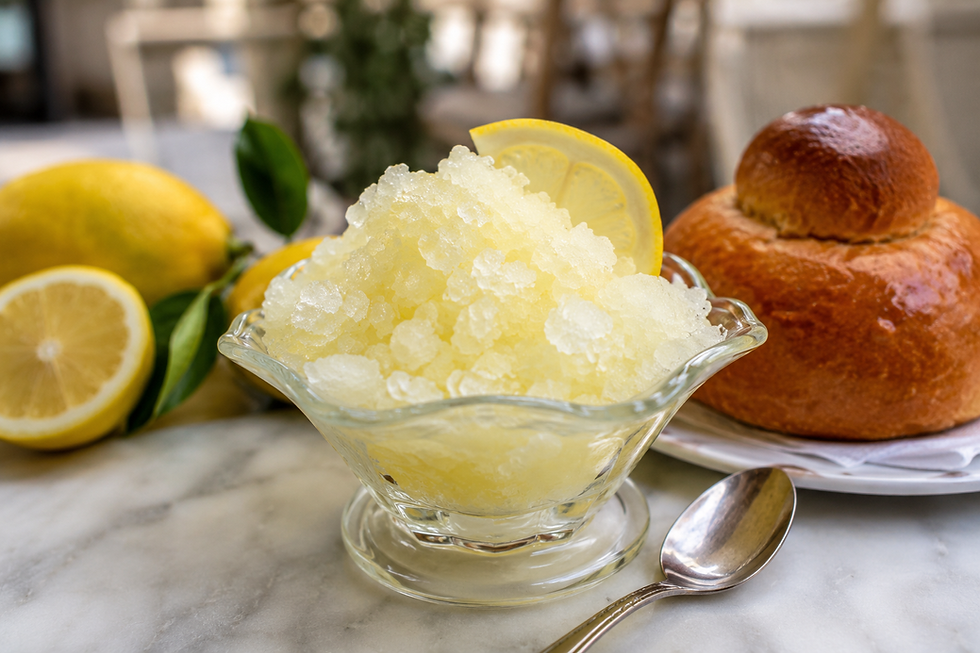
The breakfast ritual belongs above all to the eastern coast. In Catania and Messina, a summer morning often begins at the bar with a granita and a brioche col tuppo, the round brioche with a small knob on top, torn and dipped into the half melted ice. Almond, lemon, coffee, black mulberry and pistachio are the flavors found almost everywhere, and the toasted almond version, darker and more intense, is a favorite of many bars in the province of Catania.
The traditional granita di mandorle contains no animal ingredients at all: almonds, sugar and water are the whole recipe. Only the brioche served beside it is made with dairy and other animal ingredients, so this article pairs it with a vegan brioche. What matters here is technique: how the almonds are toasted, how long they infuse, how much sugar the water carries and how the freezing is managed. This recipe follows the Sicilian method and adds precision to each of those steps.
Ingredients
Buy whole, unpeeled Sicilian almonds when you can, ideally from Noto or Avola, and check that they smell sweet and fresh: old almonds taste rancid, and the flaw is impossible to hide in a granita. Blanch and peel them yourself rather than buying peeled almonds, which lose aroma faster. Sicilian bars often add a few bitter almonds for a stronger almond note, but raw bitter almonds contain amygdalin and are not used here; a drop of natural almond extract gives the same lift safely. Use plain white sugar, which leaves the color and taste of the almonds clean. Filtered water is worth the small effort: chlorine and hard minerals are easy to taste in a dessert made of so few ingredients.
For the toasted almond milk
Whole almonds, unpeeled, 7 oz (200 g)
Cold filtered water, 3 1/2 cups (830 ml)
Fine sea salt, 1 small pinch
For the syrup
Granulated sugar, 2/3 cup (130 g)
Water, 1/2 cup (120 ml)
Natural almond extract, 2 drops (optional)
Ground cinnamon, 1 small pinch (optional)
For serving
Vegan brioche, 6 small rolls, warmed
Toasted almonds, chopped, 2 tbsp (18 g)
Plant whipping cream, whipped, 1/2 cup (120 ml) (optional)
Preparation
Step 1

Blanch and peel the almonds. Bring a pot of water to a boil, add the almonds and cook them for 60 seconds exactly, then drain them and cool them under cold running water. Pinch each almond between thumb and finger and the skin slips off. Spread the peeled almonds on a towel and dry them well. The skins carry tannins that make the almond milk bitter and gray; removing them gives a pale, sweet base before toasting.
Step 2

Toast the almonds. Spread the peeled almonds on a baking sheet and toast them at 325°F (165°C) for 12 to 15 minutes, shaking the tray halfway, until they are an even light hazelnut brown inside when you split one. Let them cool completely. Toasting creates the Maillard compounds that give this granita its deep, nutty, caramel flavor; past a medium brown the oils scorch and the granita turns bitter. Set aside 2 tbsp (18 g) of almonds for serving and chop them coarsely.
Step 3

Grind and infuse. Put the rest of the cooled almonds in a blender with 1 cup (240 ml) of the cold water and blend for 1 minute into a thick, smooth paste. Add the remaining water and the salt and blend for 1 more minute. Pour the mixture into a jar, cover it and refrigerate it for 8 hours, or overnight. During the long, cold infusion the water draws out the almond oils and the aromatic compounds slowly, without the cooked taste that heat would give.
Step 4

Strain the almond milk. Line a fine strainer with a nut milk bag or a double layer of cheesecloth and set it over a bowl. Pour in the almond mixture and let it drain for 10 minutes, then gather the cloth and squeeze firmly until the pulp is almost dry. You should have about 3 cups (710 ml) of almond milk. The squeeze matters: the last part of the liquid carries the most oil and flavor. Keep the pulp for baking or for granola, toasted dry in a low oven.
Step 5

Make the syrup and season the base. Heat the sugar and 1/2 cup (120 ml) water in a small saucepan over medium heat, stirring only until the sugar dissolves, then let it simmer for 1 minute. Cool the syrup completely, then whisk it into the almond milk with the almond extract and the cinnamon, if using. Taste it: the base should taste slightly too sweet at room temperature, because cold dulls sweetness. A warm syrup would cook the almond milk and dull its fresh aroma, so always combine them cold.
Step 6

Freeze and stir. Pour the base into a shallow metal or glass dish, about 9 x 13 inches (23 x 33 cm), so the liquid is no more than 1 inch (2.5 cm) deep, and put it in the freezer. After 45 minutes, when ice forms at the edges, scrape it toward the center with a fork and stir it into the liquid. Repeat every 30 minutes for 3 to 4 hours, breaking the crystals finely each time, until the whole mass is a uniform, soft, creamy ice. Frequent stirring keeps the crystals small; long gaps let them grow into coarse flakes.
Step 7

Finish the texture. For the smooth, creamy texture of the Catania bars, transfer the set granita to a food processor or a blender and pulse it 5 or 6 times, just until it looks like wet snow, then return it to the freezer for 15 minutes. Do not over blend: the friction melts the ice. The granita is ready when it is soft enough to sip with a spoon from a glass, holds a shape for a moment and melts cleanly with no hard grains.
Plating
Serve in chilled glasses or small bowls, cooled in the freezer for 10 minutes, so the granita does not melt on contact. Spoon about 3/4 cup (180 g) into each glass, heaping it slightly, and press gently with the back of the spoon so it sits as one smooth dome.
Scatter the chopped toasted almonds over the top. If you like, add a spoonful of whipped plant cream, as many Sicilian bars offer granita con panna, and place a warm vegan brioche beside the glass. The guest tears the brioche and dips it into the granita, so the cold, nutty ice soaks into the soft, warm crumb, and then finishes the melted almond milk at the bottom of the glass with a spoon.
Professional Technique
The key number is the sugar concentration. The finished base should contain about 18 to 20 percent sugar by weight, around 18 to 20 degrees Brix if you have a refractometer. Below that, the granita freezes into hard, coarse crystals; above it, the base never sets and stays a slush. With 7 oz (200 g) of almonds, 3 cups (710 ml) of almond milk and 2/3 cup (130 g) of sugar, the recipe lands in that range.
The hidden variable is the almond oil. Almond milk is an emulsion of water, oil and fine solids, and those solids and fat sit between the ice crystals and make a granita di mandorle creamier than a fruit granita at the same sugar level. The longer infusion and the firm squeeze carry more of them into the base, which is why this granita feels almost like a sorbet while it contains nothing but almonds, sugar and water.
The doneness test is visual and on the spoon. A finished granita is opaque, ivory to light tan in color, and uniform, with no liquid at the bottom of the dish and no frozen crust at the sides. A spoon should pass through it with no resistance, and the crystals should feel fine, never crunchy.
Crystal and Temperature Control
Granita is controlled crystallization. Water freezes into ice crystals that grow as long as they are left alone. Stirring breaks them and seeds new ones, so the more often you stir, the finer the texture. The first stir, when ice first appears at the edges, is the most important: missing it lets a solid sheet form that is hard to break evenly.
The dish matters as much as the timing. A shallow metal dish freezes the base quickly and evenly; a deep container freezes the outside long before the center and gives a mixed texture. Spread the liquid no deeper than 1 inch (2.5 cm), and set the dish on a flat shelf away from the freezer door, where the temperature stays steady.
Serving temperature defines the experience. Sicilian granita is served softer than gelato, around 14 to 18°F (-10 to -8°C). Straight from a home freezer at 0°F (-18°C) it is too hard: let it rest 5 minutes in the refrigerator and fork it lightly before serving. If it has set solid overnight, break it into chunks and pulse it again in the food processor.
Professional Mise en Place
The almonds are toasted and infused the day before; on the day, the base is strained, sweetened and frozen in the morning for an afternoon or next morning service. Keep the freezer free of strong smells, because almond milk absorbs them easily.
Equipment and tools
Saucepan, baking sheet, blender or food processor
Fine strainer, nut milk bag or cheesecloth, large bowl
Shallow metal or glass dish, about 9 x 13 inches (23 x 33 cm)
Fork, small saucepan for the syrup, refractometer (optional)
Prepared ahead
Almonds blanched, peeled, toasted and cooled, up to 3 days ahead in a sealed jar
Almond milk infused overnight in the refrigerator
Syrup cooked and cooled, kept in the refrigerator
Chopped toasted almonds for the garnish
Service setup
Glasses chilled in the freezer
Granita forked and tempered 5 minutes before serving
Vegan brioche warmed in the oven at 300°F (150°C) for 4 minutes
Whipped plant cream in a bowl over ice, long spoons on the pass
Chef Tips
Make a half and half glass, as Sicilian bars often do: serve the toasted almond granita side by side with a lemon or coffee granita. The bitterness of coffee or the acidity of lemon sharpens the sweetness of the almond and makes the glass more complex.
For a white classic granita di mandorle, skip the toasting and infuse the raw blanched almonds instead. The flavor is fresher and more delicate, closer to latte di mandorla, and the color stays almost white.
If you own an ice cream machine, churn the cold base for 15 to 20 minutes, until it looks like soft snow, then freeze it for 1 hour. The texture is close to the smooth granita made in Sicilian bars with their slow churning machines, the granitiere.
Keep a jar of toasted almond milk in the refrigerator during summer. Sweetened and poured over ice, it becomes a cold latte di mandorla in seconds, and frozen with the method above it becomes granita overnight.
Common Mistakes
Leaving the skins on. Almond skins give a bitter, gray granita. Blanch and peel the almonds before toasting.
Toasting too dark. Dark brown almonds taste burnt and bitter in a frozen dessert, where cold makes bitterness stand out. Stop at an even light hazelnut brown.
Infusing in hot water. Heat gives a cooked, flat taste and extracts fewer aromatic compounds. Infuse cold and slowly in the refrigerator.
Not squeezing the pulp. The last liquid in the pulp carries most of the oil and aroma. Squeeze the cloth firmly.
Too little sugar. A base under about 18 percent sugar freezes into hard, coarse crystals. Weigh the sugar and taste the base: it should seem slightly too sweet before freezing.
Stirring too rarely. Long gaps between stirs let the crystals grow into large flakes. Stir every 30 minutes until set.
Serving it too hard. Straight from the freezer the granita is stiff and icy. Temper it for 5 minutes and fork it before serving.
Wine Pairing
Moscato di Noto DOC: From the same corner of Sicily as the finest almonds, a sweet Moscato Bianco with orange blossom, apricot and a light almond note. It speaks the same language as the granita and refreshes it. Serve it at about 50°F (10°C).
Moscato di Siracusa DOC: A historic sweet wine of the Siracusa area with dried apricot, candied citrus and a soft, round body. Its warm sweetness balances the cold of the ice and its aromas lift the toasted nut. Serve it at about 54°F (12°C).
Malvasia delle Lipari DOC: The sweet wine of the Aeolian Islands, made from dried Malvasia grapes, with notes of dried fig, apricot and caper flower. Its gentle acidity keeps the pairing fresh and its candied fruit suits the caramel tones of the almonds. Serve it at about 54°F (12°C).
Passito di Pantelleria DOC: The richest choice, from dried Zibibbo grapes on the island of Pantelleria, with candied orange, date and apricot. It works as a small glass sipped after the granita, with the brioche. Serve it at about 54°F (12°C).
Storage & Reheating
Freezer: granita is at its best within 24 hours. Keep it covered in its shallow dish for up to 3 days, forking it before serving; after that the crystals grow and the almond aroma fades. The unfrozen sweetened almond milk keeps for 2 days in the refrigerator in a closed jar, and the toasted almonds keep for 2 weeks in a sealed container. Store the granita away from onions, garlic and other strong foods, and always under a lid, because the fat of the almonds picks up smells within hours.
Granita is never reheated, only refreshed. If it has set into a solid block, let it rest 10 minutes in the refrigerator, break it into pieces with a fork and pulse it briefly in a food processor until it looks like wet snow, then return it to the freezer for 15 minutes. A granita that has fully melted can be stirred and frozen again with the same method, although its texture will be slightly coarser.
Nutrition
Per serving, based on 6 servings, without the brioche and the optional cream:
Calories: 290 kcal
Total Fat: 17 g
Saturated Fat: 1 g
Trans Fat: 0 g
Unsaturated Fat: 15 g
Cholesterol: 0 mg
Sodium: 30 mg
Total Carbohydrates: 28 g
Fiber: 2 g
Total Sugars: 23 g
Added Sugars: 22 g
Protein: 6 g
Principal micronutrients: vitamin E, magnesium, manganese, riboflavin, copper, calcium
These figures are estimates, calculated on the quantities listed and rounded to the nearest whole number, assuming that about 80 percent of the almond fat and part of the fiber pass into the almond milk and the rest stays in the pulp. They vary with the almonds and with how firmly the pulp is squeezed.




Comments