
Italian Sicilian Lemon Granita | Granita al Limone Siciliana
Updated: Sep 14
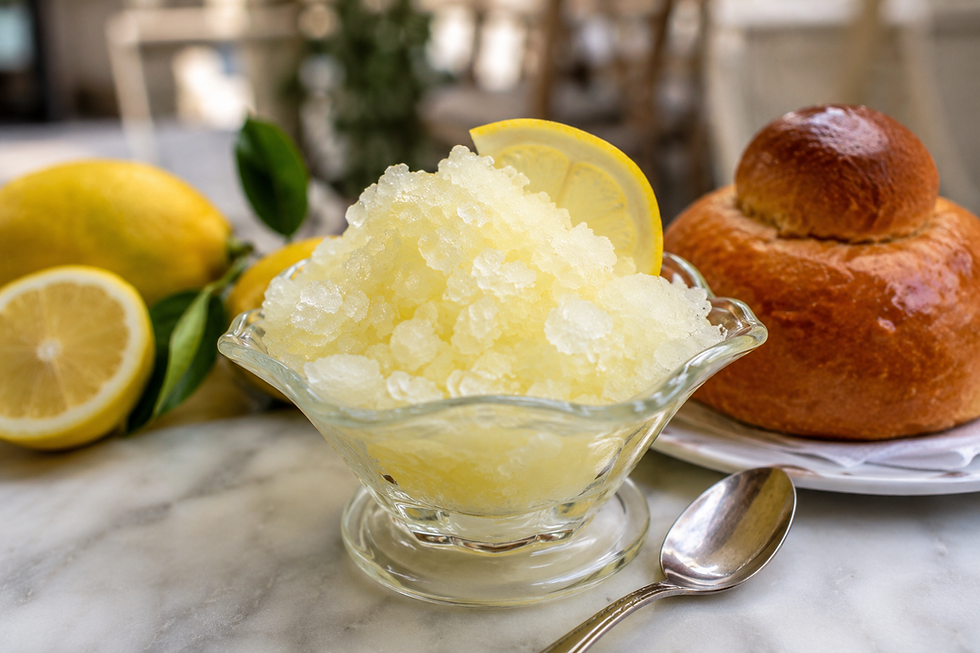
Granita al limone is the shortest recipe in Sicilian pastry and one of the least forgiving. Water, sugar and lemon juice, nothing else, frozen so that the crystals melt on the tongue rather than crunch against the teeth. There is no fat, no egg, no stabiliser to hide behind, and every fault in the fruit or the freezing arrives in the mouth undisguised.
In Messina and Catania it is not a dessert at all. It is breakfast, eaten between June and September at a bar counter, with a brioche col tuzzu torn apart and dipped into the glass. It is ordered by flavour and by softness, chi panna or senza panna, with or without the spoonful of unsweetened cream, and the barista asks before you have finished ordering.
What follows is the version the bars actually make. The sugar dissolves without the juice ever seeing heat, the base is judged while still liquid, and the freezing is done either in a machine or by hand on a tray with a fork. Both routes are correct.
Yield: 6 servings. Prep: 20 minutes. Chill: 2 hours. Freeze: 30 minutes in a machine or 4 hours by hand. Total: about 6 hours. Difficulty: easy in method, demanding in judgement. Course: breakfast or dessert. Region: Sicily, the Ionian coast between Messina and Catania.
The Story
Granita descends from the sherbet the Arabs brought to Sicily in the ninth century, but what made it possible was snow. Through the winter the nivaroli cut compacted snow from Etna, the Nebrodi and the Peloritani and buried it in stone pits called neviere, insulated with ash and chestnut leaves, then carried it down to the coastal towns by mule through the summer nights. The trade was regulated, taxed and fought over for centuries. Flavoured with lemon juice and sugar and sold by the glass, that snow is the direct ancestor of what sits in the freezer cabinet today.
The two cities on the Ionian coast still disagree about texture, and the disagreement is real rather than folkloric. Messina works the granita denser and smoother, close to a soft sorbet, and serves it in a tall glass with the brioche alongside. Catania keeps the crystal coarser and pushes the lemon harder. Both were made in the pozzetto, a wooden bucket holding a zinc canister packed round with ice and salt, turned and scraped by hand for the better part of an hour. The electric mantecatore replaced the bucket in the twentieth century and did the same job, which is why the machine version here is traditional rather than a shortcut. The fork and tray method is the domestic answer to owning neither.
Ingredients
For the granita
Still water, filtered if your tap water tastes treated, 2 cups (475 ml)
Granulated sugar, 3/4 cup (150 g)
Fresh lemon juice, strained, 3/4 cup (180 ml), from about 5 lemons
Finely grated zest of untreated lemons, from 2 lemons
Fine sea salt, 1 small pinch
For serving in the Sicilian way
Brioche col tuzzu, 6 small
Heavy cream, unsweetened, whipped to soft peaks, 1/2 cup (120 ml), optional
Lemon zest, finely grated, a very small amount for finishing
Preparation
Dissolving the sugar and infusing the zest
Warm the water and sugar over medium heat, stirring, only until the last grain has gone and the liquid runs clear. Do not let it boil: boiling evaporates water and shifts the balance you are about to measure. Take the pan off the heat, add the grated zest and infuse for exactly 10 minutes. Ten minutes captures the oil in the peel; twenty starts to draw the bitterness sitting just under it.
Chilling the syrup and adding the juice
Strain the syrup through a fine mesh sieve into a bowl, discard the zest and chill it to refrigerator temperature, about 2 hours, or set the bowl over ice and stir it down in 15 minutes. The juice goes in only when the syrup is cold. Added to warm syrup it loses its top notes within seconds and the granita tastes of cooked marmalade rather than fresh fruit. Stir in the strained juice and the pinch of salt, which sharpens the fruit without reading as salty.
Judging the balance before you freeze anything
Taste the base now, and expect it to seem too sweet. Cold suppresses sweetness and aroma, so a base perfectly balanced at room temperature freezes into something aggressively sour. For certainty, spread a spoonful on a small metal plate, freeze it 10 minutes and taste it half frozen: that sample tells you what the granita will taste like. Correct with more cold syrup or more juice, never with dry sugar, which will not dissolve in a cold acidic liquid.
Freezing in an ice cream machine
Chill the bowl thoroughly and pour in the base. Churn 20 to 30 minutes. You are not making sorbet, so stop while the mixture is still loose and visibly granular: the paddle is there to break crystals as they form, not to whip air into the mass. Transfer to a shallow container, film the surface and hold it in the freezer for no more than an hour before service.
Freezing by hand on a tray
Without a machine, pour the base into a wide shallow metal tray to a depth of about 1 inch (2.5 cm). Metal conducts cold far faster than glass and the shallow depth keeps the crystals small. Freeze 45 minutes, until a band of ice has set around the rim, then drag the frozen edges into the liquid centre with a fork. Repeat every 30 minutes for about 4 hours, raking in straight lines rather than stirring in circles, and breaking any solid plates instead of folding them in whole.
Bringing it to serving texture
Whatever route you took, give the granita one last rake immediately before it goes into the glass. If it has sat in a domestic freezer overnight it will be harder than a Sicilian bar would ever serve it: leave it out 5 to 10 minutes and work it again with the fork until it moves under the spoon. A granita served too hard tastes of nothing, because the crystals never melt and release the lemon before you swallow them.
Warming the brioche
The brioche col tuzzu should be barely warm, never hot. Ten minutes at 300°F (150°C) softens the crumb and wakes the butter. Warm it while you do the final raking so the two arrive together, and serve the granita in a chilled tall glass with the brioche on a separate plate.
Plating
The glass matters more than it should. Use a straight tall glass, the kind a bar in Messina keeps stacked in the freezer, chilled hard before the granita goes in. Warm glass melts the crystals on contact and the first spoonful arrives as lemon water. Fill to three quarters and no further, because the brioche has to be dipped and there must be room for it.
Finish with restraint. A very small amount of freshly grated zest over the surface restores the aroma the cold has suppressed, and it is the only garnish this dessert needs. If cream is served, put it on top in one soft spoonful and do not fold it in. No mint, no candied peel, no wafer. The brioche goes alongside whole, so the guest can tear the tuzzu, the little topknot, and dip it.
Professional Technique
Everything in a granita is decided by the concentration of sugar in the water, and the number to aim for is roughly 20 to 22 percent by weight of the total base. This recipe sits inside that window. Sugar depresses the freezing point of water, so a base at the right concentration never freezes into a single block: part of the water crystallises out as pure ice while the remaining syrup stays liquid and holds those crystals apart. Below about 18 percent you get a slab that can only be chipped. Above about 25 percent it never sets and slumps into slush in the glass. A refractometer reads this directly, but the tray tells you the same thing: after one hour the rim should be frozen and the centre still liquid.
The second technique is the interruption of crystal growth, and it is the only real work in the recipe. Ice crystals grow by adding water molecules to crystals that already exist, so the longer one is left undisturbed the larger it becomes and the coarser the granita feels. The paddle of a machine and a fork on a tray do exactly the same job: they shear growing crystals apart at regular intervals and redistribute the unfrozen syrup around them. That is why the interval is not negotiable, and why a blender is not a rescue. Blending produces a smooth sorbet, which is a different dessert.
Texture and Moisture Control
The target is a mass of separate crystals small enough to melt the instant they touch the tongue, loose enough to fall off a spoon, and wet enough to look glossy rather than snowy. Depth of the vessel is the main control you have. At 1 inch (2.5 cm) the base freezes evenly from every side and the crystals stay fine. At 3 inches the outside sets long before the centre and you finish with a coarse bottom and a slushy top in the same tray.
Service temperature is the other control, and Sicilian bars hold granita warmer than a home freezer runs. A domestic freezer at 0°F (minus 18°C) makes it noticeably harder than a granitiera does. Let it stand and rake it rather than diluting it with water, which weakens the base permanently. Avoid repeated melting and refreezing above all: each cycle melts the small crystals and refreezes their water onto the large ones, so the texture coarsens every time. Portion what will be eaten, return the rest to the freezer at once, and never refreeze a glass that has sat on a table.
Professional Mise en Place
A granita is made entirely ahead and finished at the last minute, so the mise en place is about timing and cold surfaces rather than knife work.
Equipment and tools
Wide shallow metal tray, or an ice cream machine with a bowl frozen for 24 hours
Small heavy saucepan and a fine mesh sieve
Microplane for the zest and a citrus press with a strainer
Sturdy fork kept in the freezer with the tray, and a digital scale
Tall glasses and small spoons, chilled hard before service
Prepared ahead
Syrup infused, strained and chilled, up to 3 days ahead in a sealed jar
Lemons juiced and strained on the day, kept covered and cold, never the day before
Base assembled, tasted and corrected at least 2 hours before it goes near the freezer
Brioche col tuzzu bought that morning, kept in paper, never in plastic
Cream whipped to soft peaks no more than 30 minutes ahead, held covered and cold
Service setup
Granita in a shallow covered container, surface filmed, raked before every round
Glasses and spoons out of the freezer only at the moment of filling
Brioche warming at 300°F (150°C) for the last 10 minutes, served barely warm
Zest grated to order over the glass, never in advance where it dries out
Chef Tips
Choose lemons by weight and smell rather than by size. One that feels heavy carries more juice, and one whose peel smells strongly when you scratch it with a thumbnail gives a fragrant zest. Untreated fruit is essential because the zest is infused directly, and wax and fungicide sit exactly where the aromatic oil does.
Juice the lemons no more than an hour before you use them. Fresh juice oxidises and loses its high aromatic notes within a couple of hours at room temperature, and in a dessert this bare the difference is obvious. Strain it, but do not press the pulp hard through the sieve or you drag bitterness in with it.
Never boil the base. Warm the water and sugar only until the syrup runs clear and take it off the heat at once. Boiling drives off water, raises the sugar concentration and pushes the freezing behaviour outside the window the recipe depends on, before you have added a drop of juice.
Sicilian varieties behave differently. The Femminello of Siracusa is more acidic and more aromatic, the Interdonato of the Messina coast rounder and less sharp. Taste the base before freezing and adjust rather than following the quantities blindly, because the same weight of juice from two varieties gives two different desserts.
Common Mistakes
Adding the lemon juice to warm syrup. The volatile aromatics in fresh juice are driven off almost immediately by heat, and what remains tastes cooked and faintly bitter. The syrup must be properly cold, at refrigerator temperature, before the juice goes anywhere near it. This single error accounts for most flat tasting lemon granita.
Freezing the base in a deep container. A tall narrow tub sets from the outside in and gives you a coarse frozen base under a slushy top. Use a wide metal tray filled to about 1 inch (2.5 cm), which freezes evenly and keeps every crystal small.
Skipping the raking intervals. Leave the tray alone for two hours and the crystals grow into a solid plate that a fork can only chip. Every 30 minutes for the full 4 hours is what the recipe asks, and the texture cannot be recovered afterwards.
Cutting the sugar to make it lighter. Sugar is not a seasoning here, it is the structural element that keeps the water from freezing solid. Drop it much below this level and the tray sets into a block of lemon ice that cannot be raked at all.
Using bottled lemon juice. Bottled juice is pasteurised and usually preserved, and its aroma is flat and slightly metallic. In a dessert with three ingredients there is nothing to cover it, and the result tastes of lemon flavouring rather than of lemons.
Wine Pairing
Moscato d'Asti DOCG: The easiest match and the hardest to get wrong. Its low alcohol, around five and a half degrees, means nothing burns against the cold, and its grapey, elderflower aromatics answer the lemon zest directly. The residual sugar sits a little above that of the granita, which is what keeps the pairing from reading as sour.
Recioto di Soave DOCG: Made from dried Garganega, this has the concentration of candied apricot and almond that gives the pairing some weight, and an acidity high enough that the sweetness never turns cloying against frozen citrus. Pour it in a small glass and cool, around 50°F (10°C), so its richness meets the granita rather than smothering it.
Colli Orientali del Friuli Picolit DOCG: A rarer and more delicate choice for a dessert that needs very little. Picolit is honeyed and floral rather than heavy, with a faint bitterness on the finish that picks up the oil in the lemon peel. Its restraint is the point: it adds perfume to the granita without adding another sweet element.
Conegliano Valdobbiadene Prosecco Superiore DOCG: Choose the Dry typology, which carries genuine residual sugar rather than the drier Brut. The fine bead lifts the crystals off the palate between spoonfuls and its pear and white flower fruit keeps the register light, which suits the granita served as breakfast with brioche better than any dessert wine does.
Storage & Reheating
Granita is best within a few hours of being made and acceptable for about 3 days. Keep it in a shallow airtight container rather than a deep tub, with film pressed onto the surface to stop ice forming on top, and store it away from the freezer door where the temperature swings most.
There is no reheating here, only tempering. Take the container out, leave it at room temperature for 5 to 10 minutes, then rake it thoroughly with a cold fork until the crystals separate again. Never microwave it, never add water to loosen it, and never let it melt down and refreeze whole, which coarsens the crystals irreversibly.
To work well ahead, store the base rather than the granita. The tasted and corrected liquid keeps in a sealed jar in the refrigerator for 3 days, or frozen flat in a bag for 1 month, then thawed in the refrigerator and frozen again by either method. Brioche col tuzzu keeps 1 day in paper at room temperature, or freezes 1 month and refreshes in 8 minutes at 325°F (165°C).
Nutrition
Per serving, based on 6 servings of granita alone, without brioche or cream:
Calories: 105 kcal
Total Fat: 0 g
Saturated Fat: 0 g
Trans Fat: 0 g
Unsaturated Fat: 0 g
Cholesterol: 0 mg
Sodium: 15 mg
Total Carbohydrates: 27 g
Fiber: 0.2 g
Total Sugars: 26 g
Added Sugars: 25 g
Protein: 0.2 g
Lactose: 0 g
Principal micronutrients: vitamin C, potassium, small amounts of folate and flavonoids from the citrus
These figures are estimates. One small brioche col tuzzu adds roughly 230 calories and 9 g of fat, and a spoonful of unsweetened whipped cream adds about 50 calories, so the Sicilian breakfast version lands near 390 calories per serving.


Comments