
Italian Sorrento Lemon Semifreddo | Semifreddo al Limone di Sorrento
Updated: Sep 14

A semifreddo is a frozen foam, and that single fact explains everything about how it is made. No churning, no machine, no paddle breaking ice crystals as they form: instead the crystals are prevented from growing in the first place, by whipping air into two separate preparations and folding them together so the water in the mixture is trapped in a matrix of fat and bubbles. Frozen solid, the result stays sliceable and yields under a spoon.
The two preparations are a cooked yolk foam, a pâte à bombe built over a bain marie, and cold cream whipped only to soft peaks. The lemon enters through both: its zest rubbed into the sugar so the oils are released before any heat touches them, and a strictly measured quantity of juice whisked into the yolks while they cook. Juice is the dangerous ingredient here, because juice is water, and water is ice.
Yield: 10 slices from a 9 by 5 inch (23 by 13 cm) loaf. Prep: 40 minutes. Cook: 15 minutes for the sabayon and the syrup. Freeze: at least 6 hours, preferably overnight. Total: about 7 hours. Difficulty: intermediate. Course: dessert. Region: Campania, the Sorrentine peninsula.
The Story
Semifreddo is the frozen dessert of kitchens that never owned an ice cream machine. The word means half cold, and the preparation belongs to a family of moulded frozen sweets, the spumoni and the biscotti gelati, that Italian cooks made by packing a mould into a bucket of ice and salt and leaving it alone. Stabilised by whipped cream and a cooked egg foam rather than by churning, it sets smooth with no machine at all, which is why it survives on trattoria menus while proper gelato stays in the gelateria.
The lemon version belongs to the Sorrentine peninsula because the fruit does. The Limone di Sorrento, the ovale, carries IGP protection and grows on terraces between Sorrento and Massa Lubrense under pagliarelle, mats of chestnut poles laid across the trees that slow the ripening and stretch the harvest. The fruit is large, pale and thick skinned, with an oil content in the rind that ordinary lemons cannot approach. The same fruit gives limoncello, delizia al limone and the granita sold on the seafront, so a frozen cream flavoured with its peel is the obvious thing to do with a summer surplus.
Ingredients
For the lemon sugar
Granulated sugar, 1/2 cup (100 g)
Sorrento lemons, untreated, 3, zest finely grated
For the cooked yolk base
Egg yolks, large, 6
Freshly squeezed lemon juice, strained, 1/3 cup (80 ml)
Fine sea salt, 1/8 tsp (0.7 g)
Pure vanilla extract, 1 tsp (5 ml)
For the whipped cream
Heavy whipping cream, 36 percent fat or higher, very cold, 2 cups (480 ml)
For the lemon syrup and candied peel
Lemon peel, pared from 1 lemon in fine strips, pith removed
Granulated sugar, 1/4 cup (50 g)
Water, 1/4 cup (60 ml)
Freshly squeezed lemon juice, 2 tbsp (30 ml)
Limoncello, 1 tbsp (15 ml), optional
Preparation
Chill the equipment and line the mould
Line a 9 by 5 inch (23 by 13 cm) loaf pan with plastic film, leaving 3 inches (8 cm) hanging over every side and pressing it smooth into the corners so it leaves no creases in the loaf. Put the pan, the bowl you will whip the cream in and the whisk into the freezer. Set a wide bowl of ice water beside the stove: you need it the moment the sabayon comes off the heat.
Rub the zest into the sugar
Wash and dry the 3 lemons and take the zest off with a fine rasp, removing only the yellow and stopping the instant white shows. Tip it into the 1/2 cup (100 g) of sugar and rub the two together with your fingertips for a full minute, until the sugar is damp, faintly yellow and openly fragrant. The crystals abrade the oil cells and drive the perfume into the sugar, where it stays. Squeeze and strain 1/3 cup (80 ml) of juice and measure it exactly.
Cook the sabayon over a bain marie
Whisk the 6 yolks, the lemon sugar, the strained juice and the salt together in a heatproof bowl until pale, then set the bowl over a saucepan holding an inch of barely simmering water, with the base clear of the water itself. Whisk constantly and vigorously for 8 to 10 minutes. The mixture loosens first as the sugar dissolves, then roughly triples and turns thick, pale and glossy, holding a slowly dissolving ribbon. Take it to 165 to 170°F (74 to 77°C): hot enough to pasteurise the yolks and set the foam, not hot enough to scramble them.
Cool the base over ice
Lift the bowl straight into the ice water and keep whisking for 3 to 4 minutes, until the base is genuinely cool to the touch and no warmer than about 70°F (21°C). Do not shortcut this. A base that still carries heat will melt the fat in the whipped cream on contact and collapse the whole mixture to half its volume, and there is no recovery from that. When it is cold, whisk in the vanilla.
Whip the cream to soft peaks only
Whip the 2 cups (480 ml) of very cold cream in the chilled bowl only to soft peaks, the point where the whisk leaves a trail that slumps back within a second or two. Stop there. Cream taken to stiff peaks has begun to break into butter grains, folds in as lumps, and gives a greasy, slightly gritty texture that no later step corrects.
Fold the two mixtures together
Fold about a third of the cream into the cold lemon base first, briskly and without care, purely to slacken it: this sacrificial third does not need to stay light. Fold in the rest in two further additions with a large spatula, cutting down through the centre, sweeping along the bottom and turning the bowl a quarter turn each stroke. Stop the instant the last white streak disappears. The mixture should hold a soft mound on the spatula.
Make the syrup and candy the peel
Pare the peel of 1 lemon into fine strips and scrape away any clinging pith. Blanch the strips from cold water three times, refreshing between each, which draws off bitterness. Bring the 1/4 cup (50 g) of sugar and 1/4 cup (60 ml) of water to a simmer, add the peel and cook just below a boil for 12 to 15 minutes, until the strips are translucent and the syrup coats a spoon. Dry the peel on a rack, stir the 2 tbsp (30 ml) of juice and the limoncello into the cooled syrup and refrigerate both.
Fill the mould and freeze
Scrape the mixture into the lined pan, work it into the corners and rap the pan twice on a folded towel to release trapped pockets. Level the top, then fold the overhanging film across so it lies directly on the surface, with no air gap anywhere, because an air gap is where crystals form. Freeze at least 6 hours and preferably overnight. It never sets rock hard: sugar, fat and trapped air depress the freezing point, and at 0°F (18°C below zero) it should still yield to firm thumb pressure.
Plating
Take the pan from the freezer and let it stand 5 to 10 minutes, no longer. Peel back the film, invert the loaf onto a chilled board, lift the pan away and remove the wrap in one piece. If it resists, hold a cloth wrung out in hot water against the outside of the pan for twenty seconds.
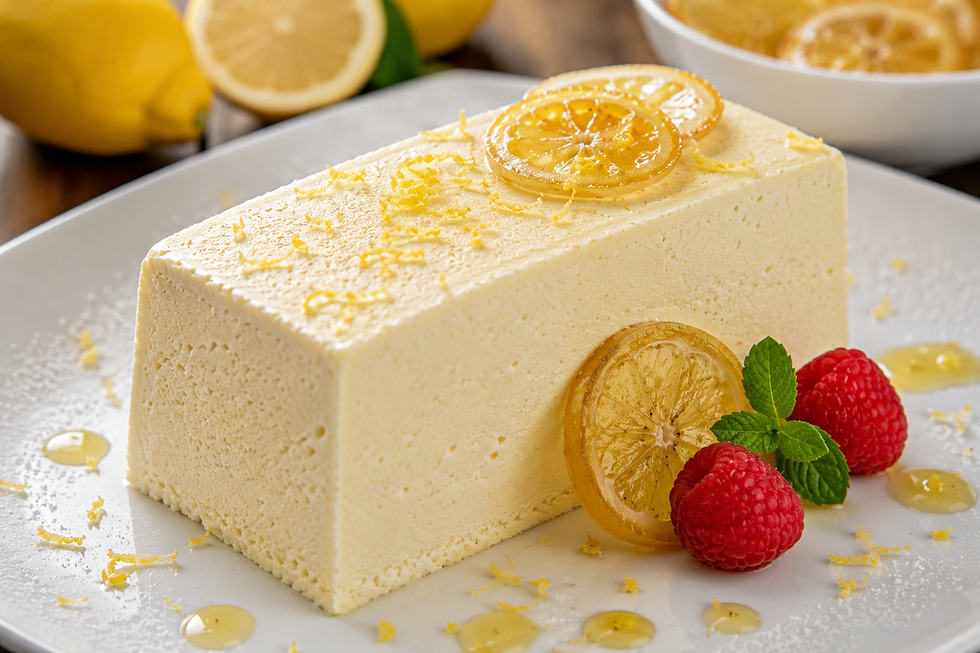
Slice with a long thin knife dipped in hot water and wiped dry before every cut, since a cold blade compresses the aerated structure and the slice arrives squashed. Cut at about 3/4 inch (2 cm) and lay each slice flat on a chilled plate so the cross section faces the guest: the fine even bubble structure is the proof that the folding was done properly.
Spoon the chilled syrup over at the last moment, letting it run down the sides in thin ribbons rather than pooling, and lay two or three strips of candied peel on top. Serve at around 10 to 14°F (12 to 10°C below zero), roughly eight minutes out of the freezer: colder and the aroma stays locked up, warmer and the slice slumps.
Professional Technique
The defining technique is aeration as a substitute for churning. In a gelato a paddle turns constantly during freezing and shears every crystal as it forms. A semifreddo has no paddle, so the same job is done structurally, before freezing begins. The yolk foam and the whipped cream together carry roughly 40 percent air by volume, and those bubbles, with the fat globules coating them, block water molecules from finding one another and growing into crystals the tongue can detect.
The second technique is the cooked pâte à bombe. Whisking yolks with sugar and acid over indirect heat denatures the proteins slowly, and the dissolved sugar raises their coagulation temperature, which buys the window from 165 to 170°F (74 to 77°C). Inside it the yolks pasteurise and the foam sets. Under 160°F (71°C) the foam never locks and the dessert weeps as it softens; over 175°F (80°C) the proteins clump into visible specks.
The third is the arithmetic of free water, which is why the juice is measured rather than poured. Every millilitre of lemon juice is almost entirely water, and water without something to bind it becomes hard crystalline ice. One third of a cup against 2 cups of cream and 6 yolks is the limit of what the fat and air can hold. Anything beyond that comes from zest, from limoncello whose alcohol lowers the freezing point, or from the syrup added at service.
Texture and Moisture Control
Three temperatures govern the texture, and all three are non negotiable. The sabayon must reach 165 to 170°F (74 to 77°C) so the foam sets. It must then come down below about 70°F (21°C) before it meets the cream, or the fat melts on contact and the volume collapses. And the cream must stay below 45°F (7°C) while it is whipped, because warm cream will not hold air: the commonest reason a semifreddo comes out dense.
Moisture control after freezing is about the surface. An uncovered semifreddo sublimates, losing water straight from ice to vapour, and within a day it carries a dry crystalline crust and has taken on every other smell in the freezer. Film pressed flat onto the surface, then foil over the pan, stops both.
Professional Mise en Place
Once the sabayon comes off the heat everything happens quickly and in sequence, so the work is front loaded. Nothing in this dessert can be paused halfway.
Equipment and tools
Loaf pan of 9 by 5 inches (23 by 13 cm) and a generous roll of plastic film
Heatproof bowl that sits over a saucepan without touching the water, plus a balloon whisk
Instant read thermometer, the only reliable way to judge the sabayon
Mixer with a bowl and whisk that have been in the freezer
Wide bowl of ice water, flexible spatula, fine rasp, small saucepan for the syrup
Prepared ahead
Zest rubbed into the sugar an hour before, so the oils bleed into the crystals
Juice squeezed, strained and measured exactly, not judged by eye
Eggs separated while cold, then the yolks brought to room temperature
Candied peel and syrup made the day before and kept refrigerated
Mould lined, bowl and whisk chilled, ice water ready beside the stove
Service setup
Semifreddo frozen at least 6 hours, tightly covered, at the back of the freezer
Plates and serving board chilled, never at room temperature
Jug of hot water and a clean cloth at the pass for wiping the blade between cuts
Syrup cold and loose, candied peel dry and separate so the strips do not stick together
Loaf out of the freezer exactly 8 minutes before the first slice is cut
Chef Tips
If Sorrento lemons are out of reach, look for Amalfi sfusato or any thick skinned unwaxed fruit. Ordinary Eureka lemons carry far less oil in a thinner peel, so use the zest of four or five rather than adding juice to compensate.
A tablespoon of limoncello folded into the base at the very end does two useful things at once. It deepens the lemon, since the liqueur is itself a peel infusion, and because alcohol depresses the freezing point it leaves the finished slice slightly softer and noticeably easier to cut.
Line the mould with crushed amaretti or split savoiardi if you want a layer with some resistance. Press the crumbs into the film before the mixture goes in and they end up on top once the loaf is turned out.
Make it two days ahead. The aroma settles and rounds out in the freezer, and a semifreddo eaten the same day it is made tastes noticeably sharper and less integrated than the same recipe given forty eight hours. This is one of the few desserts that genuinely improves with waiting.
Common Mistakes
Under cooking the sabayon. Below about 160°F (71°C) the yolk foam never properly sets, so the structure depends entirely on the cream. The semifreddo looks correct frozen and then weeps liquid as it softens on the plate. Use a thermometer rather than judging by the ribbon alone.
Over cooking the sabayon. Past about 175°F (80°C) the yolk proteins clump into fine scrambled specks that are visible in the cut slice and no amount of straining fully removes. Keep the water at a bare simmer and never let the bowl touch it.
Whipping the cream to stiff peaks. Stiff cream has already started to break into butter grains. It folds in as lumps instead of a smooth mass and leaves a greasy, faintly gritty texture in the frozen slice. Stop at the soft peak, where the trail slumps back.
Folding a warm base into cold cream. The residual heat melts the fat coating the air bubbles and the mixture drops to about half its volume within seconds. Cool the base over ice until it is genuinely cold to the touch, however impatient you are.
Adding more juice for more flavour. Juice is water, and water freezes into detectable crystals. More juice gives a harder, icier, less creamy dessert that tastes thinner rather than more lemony. Increase the zest instead.
Wine Pairing
Recioto di Soave DOCG: Garganega dried on mats gives almond, candied apricot and white flowers, with enough acidity to stand up to a dessert that is itself sharply acidic. It is sweet without weight, which matters against a frozen cream: a heavier dessert wine would sit on the palate long after the cold slice has melted away.
Malvasia di Bosa DOC: The unexpected choice and the most interesting one. Aged oxidatively under a film of yeast, it brings bruised apple, almond and dried nut depth that plays against the bright citrus instead of echoing it. Serve it cool in a small glass, and prefer a dolce bottling here rather than the fully dry version.
Conegliano Valdobbiadene Prosecco Superiore DOCG: In its dry or extra dry style, with a touch of residual sugar, the mousse does the work: fine bubbles scrub cream fat off the tongue between mouthfuls, and the green apple and white peach fruit keeps the whole thing light. Choose a bottling with some sweetness, since a brut will taste austere beside the sugar in the slice.
Brachetto d'Acqui DOCG: A sweet low alcohol red, lightly sparkling, and the choice when the semifreddo is served with berries or a raspberry coulis alongside. Its rose and red fruit aromatics have no tannin to speak of, so nothing clashes with the cold cream, and the fizz cuts the fat exactly as it would in a white.
Storage & Reheating
Wrapped tight in its film and then in foil, the semifreddo keeps 2 weeks at 0°F (18°C below zero) with no real loss of quality, and up to a month before the texture coarsens and the lemon fades. Keep it at the back of the freezer rather than in the door, where the temperature swings every time the door opens and each cycle grows the ice crystals a little larger. Once cut, press fresh film onto the exposed face before the loaf goes back in.
There is no reheating, only tempering: eight to ten minutes at room temperature for a full loaf, about four for a single slice. Never use a microwave, which melts the outside while the centre is hard and destroys the structure permanently. The syrup keeps 2 weeks refrigerated in a sealed jar, the candied peel a month in an airtight tin with a little of its sugar.
A semifreddo that has softened past slicing must not be refrozen: the air structure has collapsed and refreezing gives a coarse icy block. Use two smaller moulds if a whole loaf is more than the table will finish.
Nutrition
Per serving, based on 10 slices:
Calories: 312 kcal
Total Fat: 26 g
Saturated Fat: 15 g
Trans Fat: 0.8 g
Unsaturated Fat: 9 g
Cholesterol: 185 mg
Sodium: 52 mg
Total Carbohydrates: 17 g
Fiber: 0.1 g
Total Sugars: 16 g
Added Sugars: 15 g
Protein: 3.6 g
Lactose: 1.6 g
Principal micronutrients: vitamin A, vitamin D, choline, vitamin B12, riboflavin, selenium, phosphorus, calcium, vitamin C from the lemon
These figures are estimates. Almost all the fat comes from the cream, which gives the dessert both its richness and its structure, and the portion is small by design. Because the sugar is held to half a cup across ten slices the sweetness sits well below commercial ice cream. The yolks are cooked to 165°F (74°C) and therefore pasteurised.



Comments