
Italian White Peach and Lemon Sorbet | Sorbetto alla Pesca Bianca e Limone
Updated: Sep 14

White peach is the quietest stone fruit Italy grows and the hardest to put into a frozen dessert without losing it. Its perfume sits in the top notes, it carries almost no acidity of its own, and the flesh turns from ivory to dull tan within minutes of meeting a blade. This sorbetto is built around those three facts. The lemon is not a second flavour competing with the peach: it is acid scaffolding for a fruit with no backbone, and it is also what keeps the finished sorbet pale rather than beige.
Yellow peach makes a bolder sorbet that forgives rough handling. Pesca bianca does not. It has to be used the hour it is fully ripe, blended cold, acidified at once and frozen fast. Get that sequence right and the sorbet smells of jasmine and almond blossom before it reaches the mouth, then tastes of cold ripe fruit and nothing else. There is no dairy and no egg here, so texture is nothing but sugar, water, acid and how quickly the crystals form.
Yield: 6 servings, about 1 quart (1 litre). Prep: 30 minutes. Chill: 4 hours or overnight. Churn: 25 minutes. Ripen: 3 hours. Difficulty: intermediate. Course: dessert or palate cleanser. Season: July to early September.
The Story
Sorbetto is the oldest frozen dessert in the Italian repertoire, older than gelato. The technique arrived in Sicily with the Arab emirs as sharbat, fruit juice cooled with snow, and it survived because the island had the snow: neviere, stone pits dug into the flanks of Etna and the Madonie, were packed in winter and sold ice through August.
The white peach entered that repertoire from a different direction. Pesca bianca is a northern and central pride rather than a Sicilian one: the pesca di Volpedo in the Tortona hills of Piedmont, the peaches of the Romagna plain around Cesena, the perfumed white varieties on the volcanic soils behind Vesuvius. All of them bruise if you look at them and travel badly, so the fruit that never left the province was the fruit that went into the ice.
The lemon is Southern and its job is practical before it is aromatic. Italian cooks have always squeezed lemon over cut white peach for the same reason they squeeze it over artichokes: the acid slows the enzymatic browning that turns pale flesh grey. In a sorbet where the colour is half the pleasure, that matters as much as the flavour, and it is why the dessert is named for both fruits.
Ingredients
For the peach purée
White peaches, very ripe and fragrant, 2 1/4 lb (1 kg) whole
Fresh lemon juice, 1 tbsp (15 ml), for the cut fruit
For the syrup
Granulated sugar, 2/3 cup (135 g)
Water, 1/2 cup (120 ml)
Glucose syrup or light corn syrup, 2 tbsp (40 g)
Fine sea salt, 1 small pinch
For the lemon accent
Fresh lemon juice, 3 tbsp (45 ml), from about 1 large lemon
Finely grated lemon zest, from 1 unwaxed lemon
For finishing
White peach, ripe, 1, for the garnish
Granulated sugar, 1 tsp (4 g), for the garnish fruit
Fresh lemon juice, a few drops, for the garnish fruit
Lemon verbena or small basil leaves, 6
Finely grated lemon zest, for grating at the table
Preparation
Ripen the peaches and judge them by smell
Buy the fruit two or three days ahead and ripen it stem down on a tray at room temperature, never in the refrigerator, where the cold destroys the volatile compounds permanently. A white peach is ready when the shoulder yields to light thumb pressure and it smells of itself from a hand away. If it smells of nothing on the counter it will taste of nothing frozen.
Cook the syrup and chill it completely
Bring the sugar, water, glucose and the pinch of salt to a bare simmer, stirring only until the liquid runs clear, about 3 minutes. Do not reduce it and do not let it colour. The glucose adds almost no sweetness but blocks sucrose from crystallising, which is what keeps the sorbet scoopable. Pour it into a shallow tray and chill it at least an hour.
Peel the peaches without cooking them
Score a shallow cross in the base of each peach, lower them into boiling water for 20 to 30 seconds and lift them straight into iced water. Twenty seconds loosens the skin; a minute begins to poach the flesh beneath it, and cooked white peach loses exactly the floral notes this dessert exists to show. Slip off the skins, halve, stone and drop the slices into the tablespoon of lemon juice. You want about 1 1/2 lb (680 g) of flesh.
Blend and sieve the purée at once
Work fast. Blend to a completely smooth purée, then push it through a fine mesh sieve with a ladle, scraping the underside. The sieve is not optional: peach flesh holds fibre no blender breaks down, and frozen fibre reads on the tongue as grit. Keep the purée covered and cold, since exposed white peach browns visibly within twenty minutes and the ivory colour never comes back.
Acidify and balance the base
Whisk the cold syrup into the cold purée, then add the 3 tablespoons of lemon juice and the zest. Taste and think forward: the base should be distinctly sweeter and more perfumed than you want the finished sorbet, because freezing suppresses both by about a third, and it should taste faintly sharp, because if the lemon is invisible now it will be absent later. Correct a teaspoon of juice or a tablespoon of sugar at a time, aiming for 28 to 30 degrees Brix.
Rest the base cold
Cover and refrigerate for at least 4 hours, preferably overnight. The sugar hydrates fully, so the freezing point drops evenly through the mixture rather than in pockets, and the zest infuses, giving a rounder citrus perfume than raw zest ever does. Stir once before churning and taste again cold, since chilling will have muted it further.
Churn fast and stop early
Freeze the machine bowl a full 24 hours, not overnight, and not in the door. Start the paddle before you pour and churn 20 to 30 minutes, until the sorbet holds a soft ribbon and looks like thickly whipped cream. Past that point friction warms it and the crystals coarsen. Without a machine, freeze the base in a wide metal tray and beat the frozen edges into the centre with a fork every 30 minutes for about 3 hours.
Ripen it before serving
Scrape the sorbet into a shallow container that has itself been in the freezer an hour, because a warm container melts the outer layer and that layer refreezes as coarse ice. Press parchment onto the surface, seal, and leave it 2 to 4 hours so the temperature equalises and it firms from soft served to properly scoopable. Sorbet is served warmer than gelato, around 5 to 10°F, so temper it 3 to 5 minutes before scooping.
Plating
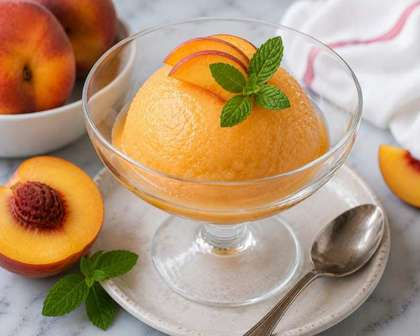
Chill the coupes until they are visibly frosted, because sorbet on a room temperature plate loses its edge within a minute and white peach loses its perfume faster than any other fruit ice. Slice the garnish peach thinly with the skin on, since the rose blush at the edge is the only colour on an otherwise ivory plate, dress the slices with lemon juice and the teaspoon of sugar and leave them fifteen minutes. Dip the scoop in hot water, shake off the drops and draw it across the surface in one arc to lift a smooth ball; scraping back and forth beats in air and kills the sheen.
Two small scoops per person, two slices of macerated peach leaning against them, one lemon verbena leaf, and a fine grating of lemon zest over the bowl at the last second so the citrus oil lands on the cold surface. Nothing else. Served between courses instead of as dessert, use one scoop and skip the fruit and the leaf entirely.
Professional Technique
The governing technique here is enzymatic browning management, and it is what separates this from every other fruit sorbet. Peach flesh contains polyphenol oxidase, which reacts with oxygen the moment a cell wall breaks and produces the brown pigments you see on a cut apple. Lemon juice interrupts that twice: the low pH slows the enzyme itself, and the ascorbic acid preferentially takes up the oxygen. That is why the lemon goes onto the cut fruit before it goes into the base, and why the minutes between blending and sieving are worked at speed.
The second technique is balancing sugar by taste in a mixture whose sugar content you do not control. Unlike a custard, where the recipe fixes the ratios, a very ripe white peach can carry half again the sugar of an underripe one, so a fixed weight of added sugar gives a different freezing point every time. The window is narrow: below about 26 degrees Brix the water freezes into a hard icy block, above 32 the sorbet never firms and weeps in the bowl. The third technique is crystal control, entirely a matter of speed and agitation: a bowl frozen hard for a full day pulls heat out faster than a half frozen one, the paddle keeps breaking crystals as they nucleate, and the usual domestic failure is a bowl chilled only overnight.
Texture and Moisture Control
With no fat and no egg to hide behind, this dessert is water, sugar and crystal size. Sugar is structure rather than indulgence, which is why cutting it to make the sorbet lighter is self defeating: it simply freezes harder and eats icier. The glucose does structural work of a different kind, raising viscosity and blocking sucrose from crystallising out, so the sorbet stays cuttable straight from a domestic freezer.
Acidity is textural as well as aromatic. Lemon juice lowers the pH of the base, which softens the fruit pectin slightly and gives a rounder, less brittle body; a base that tastes flat before churning almost always freezes glassy. Service temperature is the last variable and the window is small, roughly 5 to 10°F (minus 15 to minus 12°C). Too cold and the sorbet is brittle and mute, because volatile aromatics do not leave a surface at minus 18°C; too warm and it slumps. If a scoop shatters rather than curls the sorbet is too cold, and if it will not hold a shape it is too warm or the base carried too much sugar.
Professional Mise en Place
Almost all of this dessert is scheduling. Only the churn has to happen at a particular moment; everything else is a matter of having cold things cold and ripe things ripe on the same day.
Equipment and tools
Ice cream machine with the bowl frozen 24 hours, or a wide metal tray and a sturdy fork
High speed blender and a fine mesh conical sieve with a ladle
Small heavy saucepan for the syrup and a shallow tray for chilling it
Microplane for the zest, refractometer if you have one
Shallow airtight storage container, prechilled in the freezer
Prepared ahead
Peaches bought 2 or 3 days ahead and ripened on a tray, stem down, at room temperature
Syrup cooked the day before and kept cold in a sealed container
Machine bowl in the freezer a full 24 hours before churning
Base mixed, acidified and rested overnight in the refrigerator
Garnish peach sliced and macerated up to 2 hours ahead, kept cold
Service setup
Coupes or bowls frosted in the freezer for at least 30 minutes
Scoop standing in hot water with a cloth beside it
Whole lemon and microplane at the pass for grating to order
Sorbet tempered 3 to 5 minutes and no more before the first plate
Herb leaves picked, rinsed and held on damp paper in the refrigerator
Chef Tips
Buy peaches by smell and never by appearance. Supermarket white peaches are picked hard so they survive transport and they colour up without ever developing perfume, which is exactly the fruit this recipe cannot use.
Reserve the skins and stones. Simmered fifteen minutes with sugar and water and strained, they give a pale rose syrup with a faint almond note from the kernels, the most elegant thing you can put on the plate.
A tablespoon of Moscato or peach liqueur stirred in immediately before churning deepens the perfume and softens the set. Do not exceed a tablespoon: alcohol depresses the freezing point sharply and two will leave you with a sorbet that never sets.
For a classic variation, ripple a spoonful of raspberries crushed with lemon juice through the sorbet in the last thirty seconds of churning. Fold rather than blend, so the fruit stays in visible streaks.
Common Mistakes
Using peaches that are not fully ripe. White peach has a narrow ripeness window and fruit picked early never develops the aromatic compounds at all. The sorbet will be sweet, cold and completely anonymous. Ripen on the counter until fragrant and slightly soft at the shoulder, and postpone the dessert rather than compromise here.
Adding warm syrup to raw purée. Even syrup at hand temperature begins to cook the delicate flesh and dulls the floral note within seconds. Both elements must be genuinely cold when they meet, which is why the syrup is made a day ahead and chilled in a shallow tray rather than a deep jug.
Leaving the purée standing before it is acidified. Twenty minutes of air is enough to turn ivory purée a dull tan, and once oxidised the colour never comes back. Have the lemon juice waiting in the bowl before you start slicing, and sieve straight after blending.
Reducing the sugar to lighten the dessert. Sugar is the freezing point depressant that gives the sorbet its texture. Cut it and you get a solid block of flavoured ice that cannot be scooped. If you want a lighter result, use more fruit rather than less sugar.
Churning in an underfrozen bowl. This is the most frequent domestic failure and it cannot be corrected afterwards. A bowl chilled overnight rather than a full day freezes the base slowly, the crystals grow large, and no amount of time in the freezer refines them again.
Wine Pairing
Moscato d'Asti DOCG: Moscato and white peach share the same terpene aromatics, so the wine extends the fruit rather than answering it. Low alcohol and a gentle frizzante lift keep the pairing weightless, and the residual sugar sits just above the sorbet so the dessert never tastes sharp beside it.
Conegliano Valdobbiadene Prosecco Superiore DOCG: A drier option for anyone who finds sweet wine heavy after a cold dessert. Glera gives green apple and white flower notes that run parallel to the peach, and the bead scrubs the palate between spoonfuls. Choose Extra Dry over Brut, since a few grams of sugar stop the lemon cutting against the wine.
Colli Orientali del Friuli Picolit DOCG: An unusually delicate sweet wine, which is why it works where a heavier passito would flatten the dish. Picolit is floral and honeyed with a light body and moderate sugar, so it meets the white peach on its own scale, and its faint bitter almond finish echoes the peach stone.
Alto Adige Gewürztraminer DOC: Powerfully aromatic, with lychee, rose and ripe stone fruit that amplify the peach perfume. Use a dry version rather than a late harvest one and treat it as a contrast pairing; the mountain acidity of the Alto Adige style is what keeps it from cloying against the sugar.
Recioto di Soave DOCG: Made from dried Garganega, it brings candied citrus, almond and quince with enough acidity to stay bright beside the lemon. It is richer than the sorbet, so pour a small measure and serve it cool at around 50°F (10°C). This is the pairing for a dessert course rather than a palate cleanser.
Storage & Reheating
Sorbetto is at its best the day it is churned and remains very good for 3 days. Keep it in a shallow airtight container with parchment pressed directly onto the surface, at 0°F (minus 18°C) at the back of the freezer rather than in the door, where the temperature swings every time the door opens and each swing coarsens the crystals further.
Beyond about 5 days the crystals coarsen through repeated micro thawing and the perfume fades. Never refreeze a sorbet that has melted fully: the crystal structure is destroyed and the result is icy and separated. The unchurned base keeps 2 days covered in the refrigerator and improves in the first twelve hours as the zest infuses. It can also be frozen flat in a bag for up to 1 month and thawed in the refrigerator before churning, which is how you capture July peaches for a dinner in September. There is no reheating: this dessert is only ever tempered, 3 to 5 minutes before scooping.
Nutrition
Per serving, based on 6 portions of about 5 1/2 oz (155 g):
Calories: 165 kcal
Total Fat: 0.3 g
Saturated Fat: 0 g
Trans Fat: 0 g
Unsaturated Fat: 0.2 g
Cholesterol: 0 mg
Sodium: 25 mg
Total Carbohydrates: 42 g
Fiber: 2 g
Total Sugars: 39 g
Added Sugars: 26 g
Protein: 1 g
Lactose: 0 g
Principal micronutrients: vitamin C, vitamin A, potassium, niacin, vitamin E
These figures are estimates and shift with the ripeness of the fruit, since a very ripe white peach carries meaningfully more of its own sugar than a barely ripe one. As written the dessert is vegan, dairy free, egg free, gluten free and nut free.



Comments