
Italian Peach Sorbet | Sorbetto alla Pesca
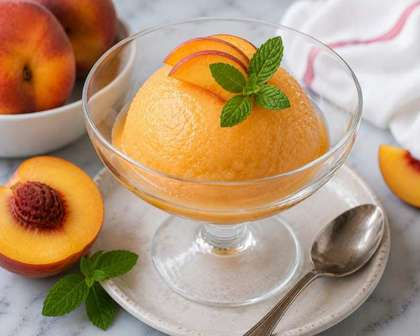
Sorbetto alla pesca is the sorbet that hides nothing. There is no cream to smooth it, no egg to lift it, no chocolate to cover a thin fruit. What reaches the spoon is peach, sugar, water and a squeeze of lemon, so every decision about the fruit shows up in the finished ice.
Two of those decisions matter more than all the rest: the fuzzy bitter skin has to come off cleanly, and the fibre underneath has to be taken out. Get both right and the sorbet is silky. Get either wrong and it is stringy.
Yield: about 1 quart (950 ml), 6 servings. Prep: 30 minutes. Chill: 4 hours. Churn: 25 minutes. Freeze: 3 hours. Total: about 8 hours. Difficulty: intermediate. Course: dolce. Region: Piedmont, Emilia Romagna and Campania.
The Story
Italy grows more peaches than any other country in Europe, and three areas argue about which grows them best. The Romagna plain around Cesena and Forli sends flat crates of them north every July. The Cuneo hills in Piedmont ripen the peach that Piedmontese cooks stuff with amaretti and bake. Campania, around Vesuvius and in the Sele valley, gives the most perfumed fruit of the three, because volcanic soil and sea air together seem to concentrate the aroma. Sorbetto alla pesca is made in all three places, and in none of them is it considered a recipe so much as a habit of the fruit season. The peach itself is not Italian in origin at all. It came out of China, travelled the trade routes through Persia, which is why the Romans called it the Persian apple, and was growing around Naples and in Roman gardens well before the empire fell. Two thousand years later it behaves like a native.
The sorbet came out of the same practical arithmetic as most fruit ices. Peaches ripen all at once, they bruise if you look at them, and a crate that is perfect on Monday is compost by Friday. Freezing the puree bought a family two more months of it, and unlike jam it took nothing away from the raw fruit: no long boil, no loss of perfume, no caramel note where there should be blossom. The ice held the peach almost exactly as it came off the tree. In the towns, the gelaterie made the same calculation on a larger scale, buying fruit at the bottom of the market when growers needed it moved that afternoon, which is why peach sorbet appears on Italian ice cream boards in late summer and vanishes the week the crates stop arriving.
There is also a Tuscan and Roman restaurant tradition of the sgroppino style sorbet, a small glass of fruit ice served between courses or at the end of a long meal, loosened with a little sparkling wine. Peach works particularly well in that role because its acidity is moderate and its perfume is high, so it refreshes without scouring the palate the way a lemon ice does. The modern version served in a coupe with a peach slice on the rim is a restaurant invention, but the ice inside it is the same one that has been made in home kitchens since peaches first came off the tree in quantity.
Ingredients
For the fruit
Ripe yellow peaches, 2 1/2 lb (1.15 kg), about 6 medium
Fresh lemon juice, 3 tbsp (45 ml)
Fine sea salt, 1/8 tsp (0.7 g)
For the syrup
Granulated sugar, 3/4 cup (150 g)
Water, 1/2 cup (120 ml)
Glucose syrup or mild honey, 2 tbsp (40 g)
For the blanching bath
Water, 3 quarts (2.85 l)
Ice, 4 cups (600 g), for the ice bath
For finishing
Vodka or peach grappa, 1 tbsp (15 ml), optional, for a softer scoop
Ripe peach, 1, for slices on the plate
Fresh mint leaves, small, 6
Preparation
Step 1
Make the syrup. Combine the sugar, water and glucose in a small saucepan and warm over medium heat, stirring, only until the crystals dissolve and the liquid turns clear. Do not let it boil or reduce, because the recipe depends on the water staying in it. Take it off the heat and cool it completely, in an ice bath if you are short of time. A warm syrup poured onto peach puree will dull the perfume in seconds.
Step 2
Blanch and peel the peaches. Bring the 3 quarts (2.85 l) of water to a rolling boil and set a bowl of ice water beside the stove. Score a shallow cross in the base of each peach, lower three or four at a time into the boiling water and count 30 seconds, then lift them straight into the ice. The skin will slip off in sheets under your thumb. Peaches that resist were underripe and need 15 seconds more, not force.
Step 3
Cut and weigh the flesh. Halve the peeled peaches along the natural seam, twist the halves apart and lift out the stones. Cut the flesh into rough chunks and weigh it: you want about 2 lb (900 g) of clean flesh from the starting 2 1/2 lb (1.15 kg). Toss the chunks with the lemon juice immediately. The acid stops the cut surfaces browning and holds the colour pale gold rather than grey.
Step 4
Blend to a puree. Blend the peach chunks with the salt at high speed for a full minute, until no visible pieces remain and the mixture climbs the sides of the jug smoothly. A short blend leaves cell walls intact and the sieve will then take out far too much volume. Scrape the sides down once and give it another 15 seconds.
Step 5
Sieve the puree. Pass the puree through a fine mesh sieve set over a bowl, working it with a stiff rubber spatula or a small ladle, and keep going until only a dry mat of fibre is left in the mesh. Scrape that mat out and discard it. Expect to lose about 3 ounces (85 g) in total. This is the step that decides whether the finished sorbet is silky or stringy, and it cannot be skipped.
Step 6
Combine and chill. Stir the cooled syrup into the sieved puree, add the vodka if you are using it, and taste. It should be a little sweeter and a little sharper than you want the frozen sorbet to be, because freezing mutes both. Cover the bowl and refrigerate for at least 4 hours, or overnight. A base at 39F (4C) going into the machine churns faster and finishes finer than a base at room temperature.
Step 7
Churn and ripen. Pour the cold base into a running ice cream machine and churn for 20 to 25 minutes, until it holds the texture of thick soft serve and a spoon drawn through it leaves a ridge. Transfer it to a chilled shallow container, press a sheet of parchment directly onto the surface and freeze for 3 hours before serving. That rest sets the structure; served straight from the machine it is delicious but slumps on the plate.
Plating
Chill the glasses or bowls in the freezer for 20 minutes before service. A room temperature bowl melts the outer layer of a fruit sorbet on contact and the first spoonful arrives wet. Take the container out of the freezer 5 minutes before you scoop, and dip the scoop in hot water between portions, wiping it dry each time.
Serve two small scoops rather than one large one, so the surface area shows the colour. Lay two thin slices of raw peach against the ice, add a single small mint leaf and nothing else. A crisp wafer or a sliver of amaretto biscuit on the side is the one addition worth making, because the dry crunch and the bitter almond both lift the fruit.
Professional Technique
The whole technical argument of a peach sorbet happens on the skin and in the fibre, and both have to be dealt with before a single gram of sugar goes in. Peach skin is covered in fine hairs that hold dust and carry a distinctly bitter, faintly green flavour, and a blender does not destroy either: it chops the hairs into the puree, where they register on the tongue as a rough dusty edge. Peeling with a knife takes flesh with it and wastes the best part of the fruit, which sits directly under the skin. The clean answer is 30 seconds in boiling water followed immediately by ice. That short shock loosens the bond between skin and flesh without warming the interior enough to cook it, so the skin comes away in whole sheets and the fruit underneath stays raw, perfumed and pale.
Underneath the skin the second problem waits. Peach flesh is built on radial strands of tough cellulose that run from the stone outwards, and those strands survive blending intact. In a baked peach they soften; in a frozen sorbet they stay firm and the ice eats stringy, with threads that catch between the teeth. Only a fine mesh sieve removes them. The choice of fruit changes how much there is to remove: yellow fleshed peaches are firmer, more acidic, more fibrous and give a deeper colour and a sorbet that holds its shape well, while white fleshed peaches are more delicate, more perfumed, lower in acid and far less fibrous, and yield a paler, softer ice that needs the full 3 tablespoons of lemon to keep it from tasting flat.
Texture and Moisture Control
A sorbet has no fat to hide behind, so its texture is decided by how small the ice crystals are. Three things keep them small: a cold base, constant movement while it freezes, and the glucose syrup, which interferes with crystal growth in a way ordinary sugar alone does not. Skip the glucose and the same recipe still works, but the sorbet sets harder and turns grainy after two days in the freezer.
Water content is the other lever. Peaches are roughly 88 percent water, which is why the syrup is made with only 1/2 cup (120 ml) and never reduced. Adding more water thins the fruit and gives an icy, splintery ice; boiling the syrup down concentrates the sugar and gives a soft mixture that refuses to set properly. Keep the proportions and the sorbet freezes firm but scoopable.
Once it is in the freezer, the enemy is air. A sheet of parchment pressed flat onto the surface, with the lid over it, stops the dry freezer air pulling moisture out of the top layer and leaving a crust of frost. Store the container at the back of the freezer, never in the door, where the temperature swings every time someone reaches for the milk.
Professional Mise en Place
The machine bowl and the chilling time set the schedule here, so plan backwards from service by a full day.
Equipment and tools
Ice cream machine with the bowl frozen at least 24 hours
High speed blender and a fine mesh sieve with a stiff spatula
Large pot for blanching, plus a wide bowl for the ice bath
Small saucepan for the syrup and a digital scale
Shallow metal container, chilled, and parchment cut to fit the surface
Prepared ahead
Syrup made and fully cooled, up to 5 days ahead, refrigerated
Peaches blanched, peeled, blended and sieved, on the day
Base combined and chilled overnight for the finest texture
Sorbet churned and ripened, up to 3 days ahead
Service setup
Glasses or bowls in the freezer 20 minutes before service
Jug of hot water and a dry cloth beside the scoop
Peach sliced at the last minute and held with a drop of lemon
Mint picked, rinsed and kept dry on paper
Chef Tips
Buy the peaches by smell, not by colour. A peach that perfumes the whole bag at room temperature will make a sorbet that tastes of peach; a firm, handsome, scentless one will make a sorbet that tastes of sweetened water, and no technique corrects it. If they are not quite there, leave them on the counter for two days.
Taste the base cold, not warm. Freezing flattens sweetness and acidity by a noticeable margin, so a base that tastes perfectly balanced in the bowl will taste dull in the glass. Push it slightly past where you think it should be, then check it again after chilling.
Keep the peeled flesh away from steel where you can. A few minutes in a reactive bowl is enough to give the puree a faint metallic edge, and glass or plastic costs nothing. The lemon juice helps, but it is not a licence to leave cut peaches sitting.
If you have no machine, freeze the base in a shallow tray and break it up with a fork every 30 minutes for about 3 hours. The result is coarser, closer to a granita, and worth doing: peach takes to that rougher texture better than most fruit.
Common Mistakes
Leaving the skin on. Blending unpeeled peaches puts the fuzz and the bitterness straight into the ice, and no amount of sugar hides the dusty edge it leaves on the tongue. Blanch for 30 seconds and the skin lifts off in sheets.
Skipping the sieve. Peach fibre survives any blade. Unsieved puree freezes into a sorbet full of threads that catch between the teeth, and the fault is unfixable once it is frozen.
Boiling the syrup. Reducing it concentrates the sugar past the point where the mixture can set, and you get a slushy sorbet that never firms up. Warm it only until the crystals dissolve.
Churning a warm base. A base that has not been chilled to 39F (4C) spends too long in the machine, grows large crystals and comes out grainy. Four hours in the refrigerator is a minimum, not a suggestion.
Storing it in the freezer door. The constant temperature swings there melt and refreeze the surface, which is exactly how frost crusts and coarse crystals form. Push it to the back.
Wine Pairing
Moscato d'Asti DOCG: The natural partner and the one poured most often in Piedmont, where both the peaches and the wine come from. Its low alcohol and gentle fizz lift a cold sorbet off the palate instead of weighing it down, and the grape itself smells of white peach and orange blossom, so the pairing reads as one flavour rather than two. The residual sugar sits close to the sorbet's own, which keeps the fruit from tasting sour by comparison.
Recioto di Soave DOCG: Dried Garganega gives a still sweet wine with real acidity behind it, and that acidity is what makes this work where a flabby dessert wine would not. Notes of dried apricot and candied citrus run parallel to cooked stone fruit while the freshness scrubs the palate between spoonfuls. Serve it at 50F (10C), colder than most passito wines, so it stays tight against the ice.
Moscato di Noto DOC: A small Sicilian production from the southeast corner of the island, richer and more floral than its Piedmontese cousin, with clear notes of honeysuckle and yellow peach. The extra weight and warmth suit a sorbet made from yellow fleshed fruit, and its sweetness carries further than the wine's modest acidity would suggest. Pour a small glass only: a full one overwhelms a dish this light.
Romagna Albana DOCG: The passito version, made where a great many of Italy's peaches actually grow, and the most interesting choice here. Albana skins are unusually rich in tannin for a white grape, which gives the sweet wine a faint grip on the finish that cuts the sugar of the sorbet and leaves the palate clean. Apricot, orange peel and a touch of almond sit alongside the peach without imitating it.
Storage & Reheating
The sorbet keeps its best texture for 3 days in a shallow airtight container with parchment pressed onto the surface, stored at the back of the freezer at 0F (minus 18C) or below. It stays perfectly safe for a month beyond that, but the crystals coarsen week by week and by then it eats closer to a granita.
Nothing here is reheated, so the equivalent operation is tempering. Move the container from the freezer to the refrigerator for 15 minutes, or leave it on the counter for 5, before scooping. Never soften it in a microwave: the edges melt while the centre stays solid, and any part that liquefies and refreezes comes back coarse and icy.
The sieved puree freezes better than the finished sorbet if you are working ahead. Freeze it flat in bags for up to 6 months, thaw it in the refrigerator, then add the syrup and churn. Peach season is short and this is the honest way to stretch it.
Nutrition
Per serving, based on 6 servings:
Calories: 175 kcal
Total Fat: 0.4 g
Saturated Fat: 0 g
Trans Fat: 0 g
Unsaturated Fat: 0.3 g
Cholesterol: 0 mg
Sodium: 55 mg
Total Carbohydrates: 44 g
Fiber: 2.5 g
Total Sugars: 41 g
Added Sugars: 28 g
Protein: 1.5 g
Lactose: 0 g
Principal micronutrients: vitamin C, vitamin A, potassium, niacin, vitamin E
These figures are estimates and move with the ripeness of the fruit and whether glucose or honey is used.


Comments