
Italian Mixed Grilled Seafood with Prawns, Octopus, Mussels and Lobster | Grigliata di Gamberoni, Polpo, Cozze e Aragosta

A grigliata di mare is not one recipe. It is four cooking problems arriving on the same platter at the same moment, and the only thing that turns them into a dish is timing. Gamberoni need three minutes, cozze four, a split lobster eight, an octopus the best part of an hour before it ever sees the fire. Put them on together and you serve rubber beside raw.
Everything here is built around that one problem. Octopus and lobster are brought most of the way to done in water and finished over the coals for colour and smoke. Prawns and mussels are cooked on the brace and nowhere else. The grill is divided into three heat zones and the four enter in a fixed order, slowest first, so everything reaches a hot platter inside the same ninety seconds. Nothing is marinated and nothing sauced: good oil and lemon go on raw, at the table.
Yield: 4 generous main course servings. Prep: 45 minutes. Octopus precooking: 50 minutes. Grilling: 20 minutes. Total: about 2 hours. Difficulty: advanced. Course: secondo di mare. Region: the Italian coast, Adriatic to Tyrrhenian and the islands.
The Story
The mixed seafood grill is what Italian coastal cooking produces when the catch decides the menu. It belongs to the trattoria on the harbour wall and to the lido that grills fifty metres from the water, and in both it is written on a board rather than printed, because nobody knows on Tuesday what lands on Thursday. A grigliata is not a fixed recipe, it is a method applied to whatever came in that morning.
The fire is the constant. Wood coals, not gas, and along much of the coast specifically olive, vine or holm oak, because hardwood embers give dry radiant heat and a faint resinous smoke that suits shellfish as nothing else does. A grigliata over briquettes tastes like grilled seafood. Over vine wood, it tastes of the place it came from.
What lands on the platter changes with the sea. On the Adriatic it leans on canocchie and scampi, what the sandy shallows of Romagna and Marche give up; on the Tyrrhenian side on gamberoni and squid; in Sardinia and Sicily the aragosta and polpo take the centre, seasoned plainer still. It is also a dish to share: one board for the middle of the table, lemon halves, a bowl for shells, everybody reaching.
Ingredients
For the octopus
Whole octopus, cleaned, 2 1/4 lb (1 kg)
Bay leaves, 2
Black peppercorns, 1 tsp (3 g)
Wine cork, 1, optional and traditional
For the lobster
Live lobster or spiny lobster, 1 1/2 lb (680 g)
Coarse sea salt, for the blanching water, 2 tbsp (36 g)
For the prawns and mussels
Large prawns, shell on, head on, 1 1/4 lb (570 g), about 12
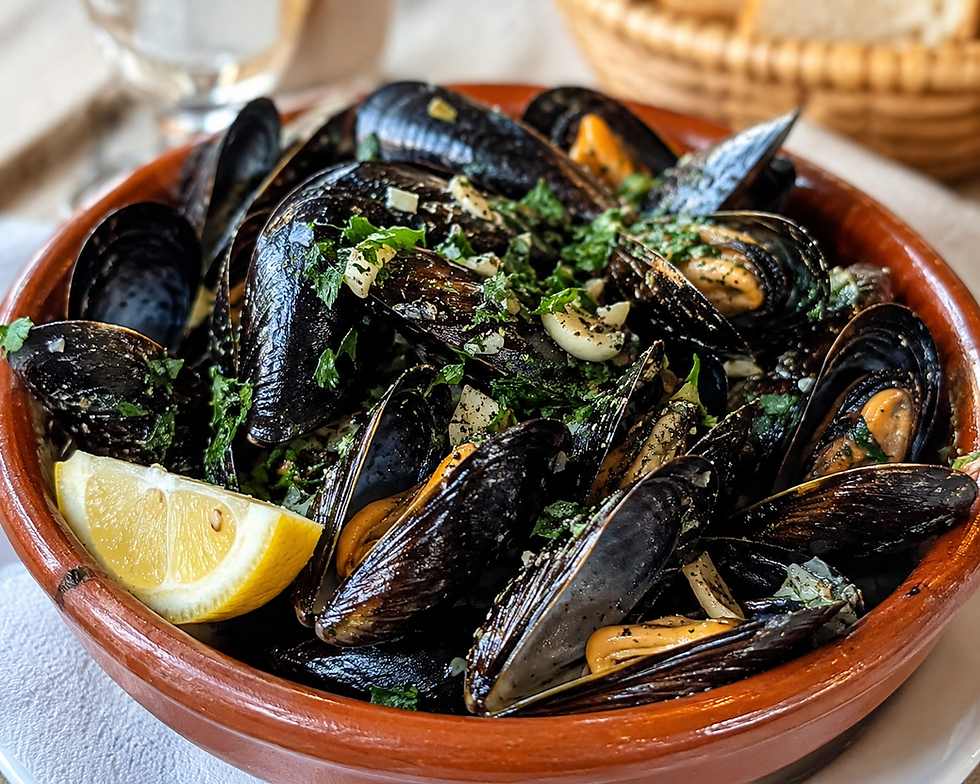
Mussels, 1 3/4 lb (800 g)
For the brushing butter
Unsalted butter, 3 oz (85 g), or extra virgin olive oil, 1/3 cup (80 ml)
Garlic cloves, lightly crushed, 2
Flat leaf parsley, finely chopped, 2 tbsp (8 g)
Finely grated lemon zest, from 1 lemon
Fine sea salt, 1/2 tsp (3 g)
For finishing at the table
Lemons, cut in half, 2
Best extra virgin olive oil, 1/4 cup (60 ml)
Flaky sea salt, to taste
Freshly ground black pepper, to taste
Preparation
Step 1
Choose the four products. Each is judged differently and one bad component ruins a shared platter. Prawns should smell of clean seawater with heads firmly attached; a darkened or loosened head means the enzymes have started on the flesh. Octopus should be firm and slippery, with no ammonia note. Lobster must be alive and heavy for its size. Mussels should be closed, or close when tapped.
Step 2
Precook the octopus. Into a deep pot with the bay and peppercorns, no salt and no added water, covered, at a bare simmer for 40 to 50 minutes, until a knife tip slides into the thickest tentacle with no resistance. Off the heat, cool it in its own liquid for 20 minutes so the flesh does not tighten. This is the one component that cannot be shortened. Separate the tentacles and pat them completely dry.
Step 3
Prepare the lobster. Blanch it in heavily salted boiling water for 4 minutes only, then plunge it into iced water. Split it lengthwise through head and tail, lift out the stomach sac behind the eyes and the dark line down the tail, leave the green tomalley. The half shell stays on throughout and is doing real work over the coals. Crack the claws so heat gets in without the shell bursting.
Step 4
Prepare the prawns and the mussels. Leave the prawns entirely in their shells, heads and all, and take out only the dark intestinal thread: slip a thin skewer under it between the second and third segments and lift it out whole. Scrub the mussels, pull away the beards, discard any that stay open when tapped, since one dead mussel spoils a platter. Keep everything cold on a rack.
Step 5
Build the fire and set three zones. Burn hardwood down to grey embers, then rake them into a bank: deep coals over one third of the grill for direct heat at about 500°F (260°C), a medium bed in the middle at roughly 400°F (205°C), a thin scatter or nothing on the last third to hold cooked pieces warm. Set the grate 4 inches (10 cm) above the coals, scraped clean.
Step 6
Make the butter and fix the order of entry. Melt the butter gently with the crushed garlic, infuse off the heat for 10 minutes, discard the garlic and stir in the parsley, lemon zest and salt. Keep it warm and liquid beside the grill with a brush in it. Then line the four trays up in the order they go on, slowest first: octopus, lobster, prawns, mussels. That order is the whole dish.
Step 7
Grill in sequence, then serve at once. Octopus tentacles onto the hot zone first, 3 to 4 minutes a side, until the edges char and curl. Lobster halves follow, cut side down on the hot zone for 3 minutes, then shell side down on the medium zone for 4 to 5 minutes, brushed twice. Prawns next, 2 minutes a side, until the shells turn coral and the heads run. Mussels last, straight onto the medium bed with no pan and no lid, opening in 3 to 4 minutes with their liquid in the lower shell. Everything moves to the cool third as it finishes, then onto a warmed platter, dressed only at the table.
Plating
This is a platter dish, and plating it individually works against it. Use the largest warmed oval platter or board you own and build height at the back: lobster halves cut side up so the tail meat is visible, charred tentacles laid diagonally beside them, prawns in a row in front with the heads all facing one way, mussels filling the gaps in their open shells with their liquid still in them.
Lemon halves go on the platter itself, cut face up, and the good oil into a small jug rather than over everything in the kitchen. Grilled bread on a separate plate is right; a starch on the platter is not, because it soaks up liquid that belongs in the shells.
Professional Technique
The technique that defines this dish is choreography rather than cookery. Four products with cooking times from three minutes to fifty have to arrive hot, together, off one grate. No single heat can do that, so the fire is divided and the entry order fixed before anything is lit. The hot third takes whatever needs char in a short window. The medium third takes whatever needs heat to travel through a shell. The cool third is not a cooking zone at all, it is a holding shelf, and it is the piece most cooks never build.
The second half of the choreography is deciding what is cooked twice and what is cooked once. Octopus and lobster are precooked in liquid, and the fire is used on them only for colour, smoke and a charred edge. Prawns and mussels are never precooked, because both finish faster than the grate takes to recover its heat, and any water phase costs them the exact texture the fire gives them. Sorting the four into those two categories before striking a match is the real work.
The order of entry is then arithmetic done backwards from service. Count back from the platter: mussels three minutes, prawns four, lobster eight including the turn, octopus eight. Octopus and lobster go on first and together, since their times overlap and neither suffers two minutes on the holding shelf; the prawns slide on when the lobster turns; the mussels scatter across the medium bed last. What makes it hard is that every wet piece pulls heat out of the coals beneath it, so keep a third of the bed untouched until the prawns arrive and give the fire air between products, or it sags and steams the last items.
Texture and Moisture Control
All four fail in different directions, and every failure is about water. A prawn overcooks from the inside once the shell is hot and turns cottony in about forty seconds, so two minutes a side is a maximum, not a target. Octopus, already tender from the simmer, turns leathery if left on the fire chasing char. Lobster tail meat seizes and shrinks from the shell past an internal 135°F (57°C). Mussels turn to rubber buttons a minute after they open.
A dry surface is what buys char without overcooking. Anything that comes out of liquid must be patted dry before it touches the grate, because a wet surface spends its first ninety seconds steaming rather than browning, and those seconds cook the flesh for nothing. The butter goes on after the first side has coloured, never before, for the same reason.
The last control is the holding shelf. Shellfish carry almost no thermal mass, so anything off the heat for three minutes is cold at the table, while anything left over coals out of fear of that is overcooked. Radiant warmth from the side, no coals underneath, pieces shell down: two minutes there is safe, five is not.
Professional Mise en Place
The fire is lit once and the service lasts twelve minutes, so everything that can be done in advance must be.
Equipment and tools
Wood or charcoal grill wide enough for three heat zones, adjustable grate
Deep lidded pot for the octopus, wide pot for blanching the lobster
Heavy chef knife and a sturdy board for splitting the lobster
Long tongs, fish spatula, thin skewer for the prawns
Heatproof brush and a small pan to keep the butter liquid by the fire
Large oval platter or wooden board, warmed, and bowls for shells
Prepared ahead
Octopus simmered and cooled in its liquid, up to 1 day ahead, refrigerated
Lobster blanched, split and cleaned, up to 4 hours ahead, cold on a rack
Prawns deveined in the shell and mussels scrubbed, up to 3 hours ahead
Brushing butter infused, strained, finished with parsley and zest
Service setup
Coals raked into three zones, grate hot and scraped clean
Four trays in order of entry: octopus, lobster, prawns, mussels
Butter warm and liquid, brush in it, within arm reach of the fire
Platter warming, lemons halved, oil and flaky salt on the table
Chef Tips
Buy the octopus a day early and precook it the day before. It is the only component that improves for the wait, and it takes the longest job off the critical path of the day itself.
Leave the prawns in their shells and do not be talked out of it. The shell lets a prawn take direct high heat without drying, and the head is where most of the flavour is, its fat running into the meat as it cooks. Peeled prawns on a grill are a waste.
Never cook the mussels in a pan or under a lid. Laid straight onto the grate they open on their own schedule and the lower shell holds every drop they release. That warm smoky liquid is what separates a grilled mussel from a steamed one, and a pan pours it away.
If the fire is not right, wait. A grigliata over young smoking coals tastes acrid and nothing later removes it. Embers should be grey outside, glowing underneath, giving off no visible smoke, which takes 30 to 40 minutes. Everything else can be rushed. That cannot.
Common Mistakes
Putting all four products on at once. This is the mistake the dish is designed around. Four cooking times from three minutes to eight cannot share one entry, and you get rubbery mussels beside undercooked lobster. Fix the order before lighting the fire.
Grilling the octopus without precooking it. It chars outside and stays tough through, because the tentacles need long moist heat a grate cannot give. The fire is for colour, after the simmer.
Peeling the prawns first. Without the shell the flesh meets radiant heat directly and dries in under a minute, and everything the head contributes is lost. Devein through the shell with a skewer.
Using a single heat level. One uniform bed forces a choice between charring the fast items and cooking the slow ones through. Hot, medium and a holding area with no coals under it is the mechanism, not a refinement.
Cooking the mussels in a pan. It steams them, loses the smoke and pours their liquid into the pan instead of the shell. Straight onto the grate, no lid, off the moment they open.
Wine Pairing
A platter carrying four different products asks for a versatile wine rather than a distinctive one: real salinity, firm acidity, dry throughout, able to sit behind a charred tentacle, a sweet prawn and a briny mussel without choosing a favourite. Anything sweet is wrong, since sugar against shellfish and smoke turns cloying within two mouthfuls.
Vermentino di Gallura DOCG: The first bottle to reach for and the most complete answer here. Grown on decomposed granite in northern Sardinia, it finishes genuinely saline, reading as an extension of the shellfish rather than a contrast, and has the citrus acidity to cut the butter. Its bitter almond finish suits the charred octopus.
Franciacorta DOCG: The metodo classico choice, and the wine that covers the widest range on the board. Bubbles and high acidity scrub the palate between one product and the next, which matters more on a shared platter than a plated dish. Its bread and hazelnut character from the lees follows the smoke. Choose a Brut.
Etna Bianco DOC: Carricante on volcanic soil gives sharp acidity and a stony cut that behaves much like salinity on the tongue. It is the most precise match for the mussels and their smoky liquid, with the tension to follow a prawn cooked in its shell without ever sitting heavily.
Grillo Sicilia DOC: Broader and more textural than the wines above, with white peach and a saline herbal edge, useful here for that width. The extra body handles the lobster and the butter, while the savoury tang keeps it from turning soft against the char.
Cerasuolo d'Abruzzo DOC: The rosato option, and a serious one rather than a compromise. Montepulciano with brief skin contact gives a dry wine with proper acidity, light pomegranate fruit and a dusty tannic grip most rosati lack. That grip is what makes it work against the smoke.
Storage & Reheating
A grigliata is a dish to finish, not to keep, and none of the four improves after grilling. What stores well is the work done before the fire. Simmered octopus keeps refrigerated in its own liquid for up to 2 days and is better on the second. Blanched split lobster keeps cold and covered for 24 hours. Cleaned mussels and deveined prawns keep on a rack over ice for a few hours.
Cooked leftovers keep refrigerated for 1 day at most, and the right move is to stop thinking of them as grilled seafood. Pick the octopus and lobster meat, shell the prawns and mussels, then make a cold salad with olive oil, lemon, parsley and celery, or fold it through hot pasta with a little reserved mussel liquid off the heat.
If you must reheat, do it fast and with fat rather than water: a very hot pan, a little of the leftover butter, forty seconds, out. Never microwave shellfish and never reheat mussels at all. Do not freeze any of it cooked; raw prawns and raw octopus freeze well, cooked ones turn to cotton on thawing.
Nutrition
Per serving, based on 4 main course portions:
Calories: 420 kcal
Total Fat: 22 g
Saturated Fat: 11 g
Trans Fat: 0 g
Unsaturated Fat: 9 g
Cholesterol: 310 mg
Sodium: 900 mg
Total Carbohydrates: 6 g
Fiber: 0 g
Total Sugars: 1 g
Added Sugars: 0 g
Protein: 48 g
Lactose: 0.2 g
Principal micronutrients: iodine, selenium, zinc, copper, iron, vitamin B12, omega 3 fatty acids
These figures are estimates. Cholesterol and sodium are naturally high in a platter built entirely on shellfish, and the final sodium depends mostly on the salt added at the table. Brushing with olive oil instead of butter removes almost all the saturated fat.




Comments