
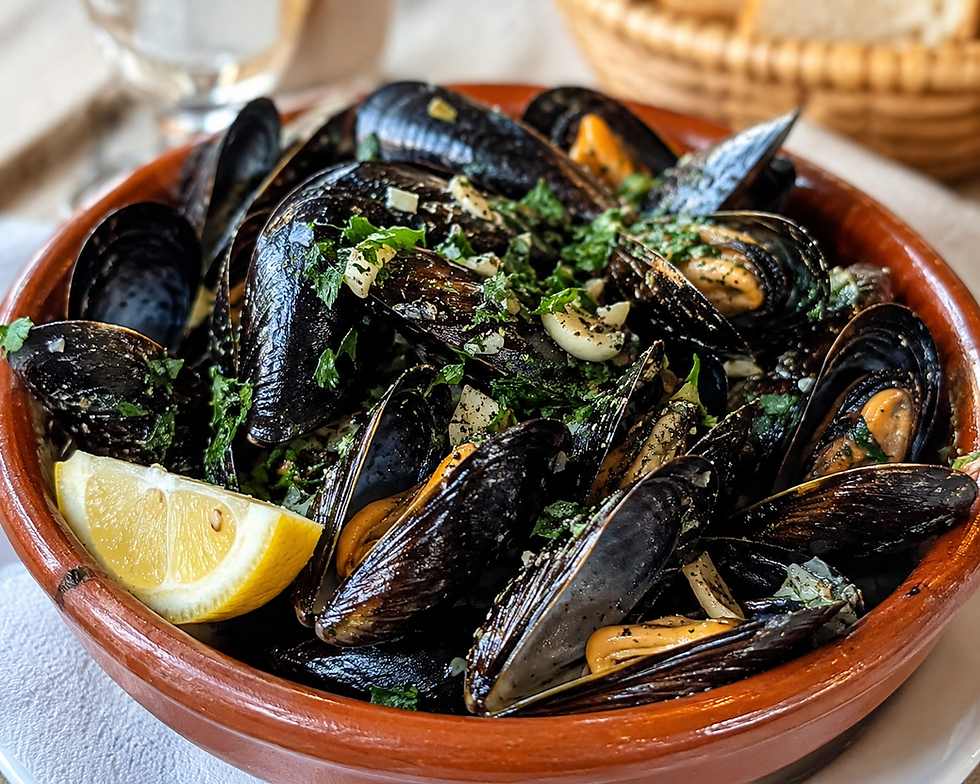
Livorno Style Mussel Stew | Cacciucco di Cozze alla Livornese

Cacciucco is the great fish stew of Livorno, and the version made with mussels alone is its poorest branch. No rockfish, no scorpion fish, no gurnard, no eel. There are mussels, garlic, chilli, olive oil, a restrained splash of red wine, tomato and stale bread, and the whole taste of the sea has to come out of the shells.
That subtraction changes the cooking. A classic cacciucco takes its body from bony spiny fish simmered to collapse and pushed through a sieve, so the sauce thickens itself. Here nothing does. The liquid the mussels release is thin, it has to be reduced, and the bread has to do the work the fish bones used to do.
This blog now carries two cacciucco, the full Livornese one built on sieved rockfish and this monoproduct version, plus six other mussel recipes, so the page below keeps to what makes the all mussel stew its own dish.
Yield: 4 servings as a main course. Prep: 40 minutes. Cook: 30 minutes. Total: about 1 hour 10 minutes. Difficulty: intermediate. Course: secondo piatto. Region: Tuscany, the port of Livorno.
The Story
Livorno was built as a free port by the Medici at the end of the sixteenth century, and its kitchen was shaped by the harbour rather than by the Tuscan countryside behind it. Greeks, Jews, Armenians and Dutch traders settled inside the same walls, and the food is unlike the rest of the region: more garlic, far more chilli, built on fish nobody wanted to buy.
The old rule of the port is the rule of the five C. The word cacciucco carries five of that letter, and tradition holds the pot must carry at least five kinds of fish, one for each. Which five was never fixed, because they were whatever came off the boat unsold: scorfano, gallinella, tracina, palombo, cuttlefish, and the mussels scraped off the harbour walls.
Two things stayed constant. The chilli, which here goes in with a heavier hand than anywhere else in Tuscany and is the clearest marker of the city on the plate. And the stale bread: thick slices toasted hard, rubbed with a raw garlic clove, laid in the bottom of the bowl before the stew is ladled over. The all mussel version is what the same kitchen produced on days when the boats stayed in.
Ingredients
For the mussels
Live mussels in the shell, 4 lb (1.8 kg)
Coarse sea salt for purging, 2 tbsp (36 g)
Cold water for purging, 8 cups (1.9 liters)
Garlic cloves, lightly crushed, 2
Flat leaf parsley stems, 6
Extra virgin olive oil, 1 tbsp (15 ml)
For the cacciucco base
Extra virgin olive oil, 1/3 cup (80 ml)
Garlic cloves, thinly sliced, 5
Fresh red chilli, finely chopped, 1, or dried peperoncino flakes, 1 tsp (2 g)
Dry red wine, 1/4 cup (60 ml)
Canned San Marzano tomatoes, crushed by hand, 1 1/2 cups (360 g)
Tomato paste, 1 tsp (6 g)
Reserved mussel liquor, strained twice, about 2 cups (475 ml)
Stale white bread, crust removed and finely grated, 1/3 cup (25 g)
Flat leaf parsley, chopped, 3 tbsp (9 g)
Fine sea salt, only if needed
Freshly ground black pepper, to taste
For the garlic bread and finishing
Stale country bread, thick slices, 4
Garlic clove, peeled and left whole, 1
Extra virgin olive oil, a thread per bowl
Flat leaf parsley leaves, small, 12
Preparation
Buy and check live mussels
A live mussel is heavy for its size, closed, or closing within seconds of a tap on the counter. Shells that stay open after a tap are dead and go in the bin, as do cracked shells. Smell the retina bag before leaving the shop: clean salt water and nothing else. Never store them sealed in plastic or under fresh water.
Debeard, scrub and purge
Pull the beard, the tough fibrous byssus, downward toward the hinge, never upward, so you do not tear out the flesh. Scrub the shells with a stiff brush and scrape off the barnacles. Dissolve the coarse salt in 8 cups (1.9 liters) of cold water and purge the mussels in it 30 to 60 minutes in the refrigerator: at sea strength they stay alive and spit out sand.
Open the mussels separately from the stew
Skipping this is why so much cacciucco di cozze is rubbery. Put a wide pan over the highest flame with the tablespoon of oil, the crushed garlic and the parsley stems, add the drained mussels, cover and shake twice. After two minutes lift them out with tongs one by one as the shells part, rather than waiting for the slowest.
Strain the liquor twice
Pour the liquid left in the pan through a fine mesh sieve, let it settle two minutes, then pour it again through the sieve lined with damp muslin, leaving the last spoonful of grit behind. You want about 2 cups (475 ml). Shell three quarters of the mussels and never rinse them.
Build the soffritto of garlic and chilli
Put the 1/3 cup (80 ml) of olive oil in a heavy wide pot with the sliced garlic and the chilli, over low heat. The quantity of oil is deliberate and Livornese: the garlic should be swimming, not sticking, because the oil carries the chilli into the sauce. Cook 5 to 6 minutes until the garlic is pale blond, never brown.
Add the red wine, and keep the dose small
Pour in the 1/4 cup (60 ml) of dry red wine and reduce it until the pot is almost dry, about 3 minutes. That dose is the key adjustment. A full Livornese cacciucco takes twice as much, because it is up against scorfano, palombo and eel. A mussel is delicate and sweet, and the same tannin simply covers it.
Tomato, then the reduction of the liquor
Stir in the tomato paste, cook it 1 minute, add the crushed tomatoes and simmer 10 minutes until the oil separates at the edges. Pour in the strained liquor and reduce it by a third, about 8 minutes. Without rockfish in the pot this liquor is the only marine element there is. Never boil it hard: it turns cloudy and metallic.
Thicken with grated stale bread
Sprinkle the 1/3 cup (25 g) of grated stale bread into the simmering base in three additions, stirring after each, and cook 4 to 5 minutes. The starch swells, the crumb dissolves, and the sauce moves from liquid to something that coats a spoon. This is the mechanical substitute for the gelatin a classic cacciucco pulls out of fish bones.
Return the mussels, taste, and do not salt
Take the pot off the heat, return the shelled mussels and those still in their shells, cover, and give them 60 seconds only. They are already cooked and you are only warming them. Cooked twice they turn to rubber. Stir in the parsley, grind over pepper, and taste before reaching for salt: the liquor is already saline and the reduction has concentrated it.
Plating
Toast the bread while the mussels go back into the pot, because it has to reach the bowl dry. Toast thick slices of stale country bread hard on both sides until the surface is sandy rather than merely golden, then rub one face firmly with the whole peeled garlic clove. The rough surface grates the garlic as you go, which is why it is toasted hard.
Lay one slice in the bottom of each bowl and never in the pot. Bread cooked in the stew dissolves and you lose both the crust and control of the sauce, which is why the thickening crumb is grated separately. Use a wide deep bowl with a real well in it, warmed and dried: a flat plate loses the sauce, a narrow one buries the shells.
Ladle the stew over the bread so the slice is submerged but the sauce does not rise above it, then set the mussels still in their shells around the rim, open side up. Finish with a thread of raw olive oil and a few parsley leaves. Nothing else: no lemon, no cheese, no basil.
Professional Technique
The technical problem is that this is a cacciucco with one ingredient instead of five, and the missing four were carrying the structure. In the classic pot the body of the broth comes from bony spiny fish, scorfano and gallinella above all, simmered until the flesh falls away and then forced through a sieve or a passaverdura. What passes through is collagen from skin, cartilage and fine bones, which converts to gelatin and gives the sauce the slight adhesive weight that lets it coat a piece of fish.
A mussel gives none of that. No skeleton, no skin, no cartilage, and the liquor out of the shells is a thin saline solution with a little dissolved protein in it. So the body is built twice over by hand. First the reduction: taking 2 cups (475 ml) of liquor down by a third concentrates the dissolved solids and the salt into something with presence. Second the grated stale bread, whose starch gelatinises in the hot liquid and thickens it mechanically, more matte than gelatin but clinging to shellfish the same way.
The third adjustment follows. Red wine belongs in Livornese cacciucco, unlike the white wine shellfish cooking further down the coast, but the dose is calibrated to fish with strong flesh. Scorfano absorbs tannin and red fruit and comes out tasting more of itself. A mussel cannot: tannin binds to its delicate sweet proteins and reads as a dry metallic edge. Halving the wine and reducing it almost to dryness keeps the Livornese signature while leaving the mussel audible, which is the only reason to cook a monoproduct cacciucco.
Texture and Moisture Control
The mussel is the fragile element and its window is narrow. Its proteins set around 140°F (60°C) and contract hard by 160°F (71°C), squeezing out the water that makes the meat plump, and a mussel shrunk to half its shell will not take that water back. Hence the separate pan, the individual lifting, and the 60 seconds off the heat at the end.
The sauce fails in the other direction, by staying loose. The right consistency coats the back of a spoon and holds a trail when you drag a finger through it. Judge it only after the crumb has cooked a full 4 minutes, because grated bread keeps swelling and a base that looks thin will tighten. If it goes too far, loosen it with reserved liquor, never with more tomato.
Temperature and salt are the last controls. Serve hot but not boiling, around 165°F (74°C) in the bowl, since above that the mussels keep cooking while the diner eats. Taste the strained liquor before it goes near the pot and cut it with a little water if it is fiercely saline. Correcting salt in a finished reduced sauce means adding volume, and volume dilutes everything you concentrated.
Professional Mise en Place
The base can be finished an hour ahead and the last two minutes decide the dish.
Equipment and tools
Wide pan with a tight lid, at least 12 inches (30 cm), for opening the mussels
Heavy wide pot for the base, deep enough for all the mussels
Fine mesh sieve, damp muslin and a clear jug for the double straining
Tongs for lifting mussels one by one, stiff brush for the shells
Fine rasp or box grater for the stale bread
Prepared ahead
Mussels scrubbed, bearded, checked and purged, up to 4 hours, kept cold
Liquor released and strained twice, refrigerated, up to 24 hours
Base built to the end of the tomato stage, up to 1 day, refrigerated
Stale bread grated for thickening, thick slices cut for the bowls
Garlic sliced and chilli chopped on the day, parsley at the last moment
Service setup
Base just below a simmer, liquor already reduced, crumb not yet added
Mussels shelled and covered, a quarter left in the shell on a separate tray
Bowls warm and dry, slices toasted to order and rubbed with garlic last
Reserved liquor in a jug for loosening, olive oil and parsley within reach
Chef Tips
Buy 4 lb (1.8 kg) for four people even though it looks like too much. Shells are most of that weight, some will be discarded at the checking stage, and the dish needs enough shellfish to give 2 cups (475 ml) of liquor.
Use bread that is genuinely stale, two or three days old, for both jobs. Fresh bread grated into the sauce turns gluey because its starch is still hydrated, and fresh slices under the stew go to mush in seconds.
Decide on your chilli before the oil is hot. Fresh red chilli gives a brighter, fruitier heat that arrives late; dried peperoncino flakes give a flatter, more persistent burn and infuse the oil better. Livorno uses both, often together, and a timid cacciucco does not taste like Livorno.
If the sauce tastes flat and the salt is already right, the reduction was too short. Lift the mussels out, reduce the sauce a few minutes on its own, then return them for 60 seconds. Never fix a thin cacciucco with more tomato paste.
Common Mistakes
Cooking the mussels in the stew from the start. They sit in hot liquid for the fifteen minutes it takes to build the sauce and come out as rubber, and the grit off the shells ends up in the pot.
Keeping mussels that will not close. A shell that stays open after a firm tap holds a dead animal, and one dead mussel taints the pot. Discard any shell that refuses to part during cooking too.
Purging in fresh water. Tap water kills a live mussel in minutes and draws out the liquor this recipe is built on. Purge in cold water salted at roughly sea strength.
Straining the liquor only once. Sand comes off the outside of the shells during cooking and a sieve alone will not catch it. A second pass through damp muslin costs two minutes.
Pouring in a full glass of red wine. The dose that suits scorfano and palombo in a classic cacciucco flattens a mussel and leaves a metallic edge over the sweetness. Use 1/4 cup (60 ml) and reduce it until the pot is nearly dry.
Putting the toasted slice in the pot. It dissolves within a minute and thickens the sauce in an uncontrolled way. The slice belongs in the bottom of the bowl, rubbed with raw garlic; the thickening crumb is grated separately.
Wine Pairing
Vernaccia di San Gimignano DOCG: The Tuscan white with enough structure to sit beside a tomato and chilli stew instead of vanishing under it. Its firmer than average body handles the generous olive oil, and the bitter almond note it finishes on runs alongside the toasted garlic bread.
Cinque Terre DOC: Grown on terraces that fall straight into the sea a short way up the same coast. Bosco, Albarola and Vermentino give a dry saline white with a faintly bitter herbal edge, and that salinity meets the concentrated liquor as an echo rather than a contrast.
Erbaluce di Caluso DOCG: For anyone who likes a white sharp. Erbaluce keeps ferocious acidity and a stony, almost austere palate with very little fruit sweetness, useful here because the stew brings its own sweetness from the shellfish and the tomato. It cuts the oil cleanly.
Romagna Albana DOCG: A dry Albana brings what no other white here has: real phenolic grip, a faint tannic texture from the thick skins of the grape. That gives the wine something to hold against a bread thickened sauce. Never a passito.
Bardolino DOC: If you want a red in the glass, this is the one. Corvina from the shore of Lake Garda gives a genuinely light red, pale, low in tannin, built on sour cherry acidity, and at 57°F (14°C) it behaves almost like a rosato.
Storage & Reheating
Store the parts rather than the finished bowl. The tomato and chilli base, before the liquor and the crumb go in, keeps 3 days refrigerated and freezes for 2 months. Strained mussel liquor keeps 2 days refrigerated and also freezes for 2 months.
Cooked mussels out of the shell keep 24 hours at most, covered with a spoonful of their own liquor so the surface does not dry. Do not freeze them once cooked: the flesh loses its water on thawing and comes back woolly.
To bring leftovers back, lift the mussels out, warm the sauce until it steams without simmering, take it off the heat and return the shellfish for 60 seconds. Avoid a microwave, which turns shellfish to rubber in one pass, and never reheat twice.
Nutrition
Per serving, based on 4 main course portions including one slice of bread:
Calories: 480 kcal
Total Fat: 26 g
Saturated Fat: 4 g
Trans Fat: 0 g
Unsaturated Fat: 21 g
Cholesterol: 65 mg
Sodium: 1120 mg
Total Carbohydrates: 33 g
Fiber: 4 g
Total Sugars: 7 g
Added Sugars: 0 g
Protein: 28 g
Lactose: 0 g
Principal micronutrients: vitamin B12, iron, manganese, selenium, zinc, iodine, vitamin C, folate
These figures are estimates. Sodium is the least predictable line, since it depends on the salinity of the liquor and how far it was reduced, and most of the purging salt is discarded.



Comments