
Neapolitan Peppered Mussels | Impepata di Cozze
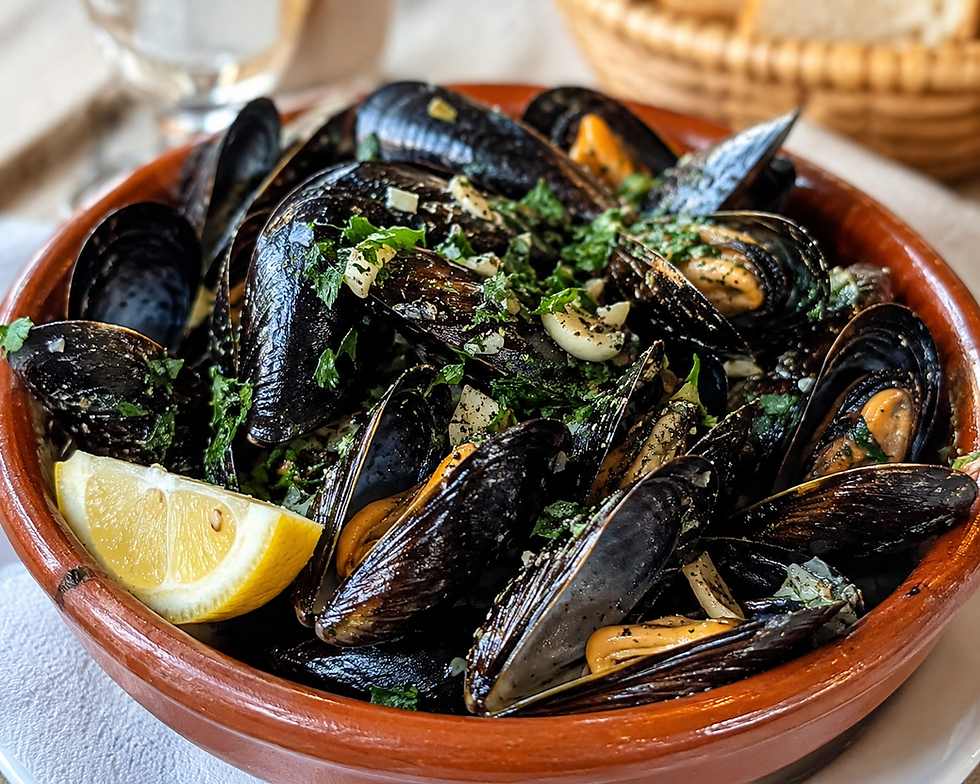
Impepata di cozze is the shortest recipe in the Neapolitan repertoire and one of the hardest to improve. Mussels go into a wide pot with a brutal quantity of cracked black peppercorns and a little olive oil. The lid goes on. Four minutes later the shells are open and the dish is finished. There is no garlic, no tomato, no wine, no stock and no salt, and every one of those absences is deliberate.
What replaces them is the liquor the mussels bring with them. A mussel holds a spoonful of seawater between its shells, and when several pounds of them open at once that water becomes a hot, intensely saline broth that needs nothing added to it. The pepper is not a seasoning here so much as a second ingredient: cracked coarse in a mortar, it perfumes that broth, bites against the sweetness of the shellfish and gives the dish the name it has carried for two centuries.
The last element is bread. Grilled slices of stale country loaf go beside the bowl, because the point of the whole preparation is what happens when the shells are empty and the broth is not. Neapolitans call that scarpetta.
Serves 4 as a main course or 6 as an appetizer. Prep: 30 minutes. Cook: 10 minutes. Total: about 40 minutes. Difficulty: easy in execution, demanding in sourcing. Course: secondo or antipasto. Region: Campania, the Gulf of Naples.
The Story
Naples has eaten mussels for as long as it has had a port. The beds of the Gulf and the brackish lagoons of the Campi Flegrei, Lago Fusaro above all, produced shellfish in such quantity that they were street food rather than restaurant food, sold from stalls and eaten raw with a squeeze of lemon on the waterfront at Santa Lucia. The vendor who sold them was as recognisable a figure as the pizzaiolo, and the raw mussel was the cheapest protein a poor household could buy.
That ended in 1884. Cholera swept through the overcrowded lower districts of Naples and killed thousands, and the shellfish beds of the polluted lagoons were identified as a carrier. The epidemic triggered the vast urban clearance known as the risanamento, and it changed how the city ate its mussels. Raw consumption fell away and cooked preparations took over, which is why the dishes that survive from that era, impepata among them, are built around opening the shellfish over heat.
The pepper has an older logic behind it. In the port cities of the south, black peppercorns were the cheap end of the spice trade and were used with a generosity that northern Italian cooking never adopted. A widely held belief that heavy peppering made shellfish safer to eat produced a dish where the spice is measured in tablespoons rather than pinches. Impepata simply means peppered, and the name is a description rather than a poetic flourish.
Ingredients
For the mussels
Live mussels in the shell, 4 lb (1.8 kg)
Black peppercorns, coarsely cracked, 2 tbsp (14 g)
Extra virgin olive oil, 3 tbsp (45 ml)
Flat leaf parsley, stems only, 6
For finishing
Flat leaf parsley leaves, finely chopped, 1/4 cup (15 g)
Lemon, 1 large, cut into wedges
Freshly cracked black pepper, 1 tsp (2 g)
Extra virgin olive oil, 1 tbsp (15 ml)
For the bread
Day old country loaf, cut into thick slices, 8
Extra virgin olive oil, for brushing, 2 tbsp (30 ml)
No salt appears anywhere in this list. The mussel liquor arrives at the table at roughly the salinity of seawater and any addition makes it undrinkable.
Preparation
Cleaning and sorting the mussels
Work through the mussels one at a time in a bowl of cold water. Pull the beard sharply toward the hinge to remove it, scrape the shells clean with the back of a knife and discard any that are cracked. Tap every open mussel firmly against the counter: a live one closes within a few seconds, and one that stays open goes in the bin without hesitation. Rinse under cold running water and drain. Do not soak them in fresh water, which kills them and washes out the liquor this dish is built on.
Cracking the peppercorns
Put the peppercorns in a mortar and crush them with a few heavy strokes, or crack them under the base of a saucepan on a board. You want irregular broken pieces, not powder. Ground pepper dissolves into the broth and turns it muddy and flatly hot, while cracked pieces stay suspended, release their oils slowly and can be eaten or left at the edge of the bowl. This one decision separates a good impepata from an aggressive one.
Opening the mussels in their own liquor
Choose the widest pot you own with a lid that seals. Warm the olive oil over medium heat, add the cracked pepper and the parsley stems and let them sizzle for about 30 seconds until the pepper smells sharp and fragrant. Tip in all the mussels at once, raise the heat to high and clamp the lid on. Add no liquid of any kind. Shake the covered pot every 30 seconds so the shells at the bottom change places with those on top.
Judging the moment they are done
After 3 minutes lift the lid and look. The mussels are ready when roughly nine out of ten have opened, which usually takes 4 to 5 minutes in total for this quantity. Take the pot off the heat then rather than waiting for every last shell, because the time a stubborn one takes costs the rest their texture. Discard any mussel still firmly shut after the pot has rested a minute.
Recovering and clarifying the broth
Lift the mussels out with a spider or slotted spoon into a warmed serving bowl and cover them loosely. Let the liquid stand undisturbed for a minute so the grit settles, then pour it slowly through a fine mesh sieve into a small pan, stopping while a cloudy tablespoon is still in the bottom. Warm the strained broth briefly but never reduce it: it is already at full salinity.
Grilling the bread and finishing the dish
Brush the bread lightly with olive oil and griddle it until marked and dry through, about 2 minutes a side. Do not rub it with garlic. Pour the clarified broth back over the mussels, add the parsley and the final teaspoon of cracked pepper, and turn the bowl once with a spoon. Finish with the raw olive oil and take the lemon and the bread to the table.
Plating
This is a bowl dish and it should look like one. Use a wide shallow bowl warmed in advance, pile the mussels loosely rather than arranging them, and ladle the broth around and under so that a good centimetre of liquid sits at the bottom. The shells should be glossy, the pepper visible in the broth, and nothing tidied into a pattern. An impepata that looks composed has been handled too much and lost heat.
Put an empty bowl on the table for the shells and a small spoon in the serving bowl, and hand the lemon wedges round rather than squeezing them over everything. Some diners want the acidity and some do not, and the broth is balanced enough to drink alone. The bread goes on a board beside the mussels, never underneath, because bread left in the broth is soaked and heavy by the time anyone reaches it.
Professional Technique
The governing technique here is cooking in a closed pot with no added liquid, and it depends entirely on pot width. A mussel opens when the heat denatures the adductor muscle that holds its two shells together, and the steam that does that work comes from the mussels themselves. In a wide pot the shellfish sit in a shallow layer and the steam reaches the top of the pile almost immediately. In a tall narrow pot the layer is deep, the bottom mussels overcook while the top ones are still shut, and three minutes can separate the first shell to open from the last.
The second technique is the pepper bloom at the start. Cracked peppercorns dropped into warm oil for half a minute before the mussels arrive release piperine and the volatile terpenes that carry the aroma into the fat, where they disperse evenly through the broth. The same pepper added at the end sits on the surface and tastes only of heat. That head start is why the order is always oil first, pepper second, mussels third.
The third is the settling and straining of the liquor, and it is what most home versions skip. Even well cleaned mussels carry fine grit inside the shell, and that grit falls to the bottom of the pot within about a minute of stillness. Decanting the clear liquid through a fine mesh sieve and leaving the last cloudy tablespoon behind removes the sand and nothing else. A gritty broth ruins a dish whose point is that the broth gets drunk.
Texture and Moisture Control
A mussel is plump and yielding for a very short window and rubbery for a long time afterwards. The muscle proteins set the moment the shell opens, and every additional minute over heat contracts them further and drives out the water that made the flesh tender. Pulling the pot off at nine shells in ten rather than ten in ten is the only way to keep the bulk of the batch inside that window, and the residual heat under the lid finishes the stragglers.
Temperature is the other half of it. This dish loses heat faster than almost anything else served in a bowl, because open shells have an enormous surface area and hold very little mass. Warm the serving bowl, keep the mussels covered while the broth settles and carry the dish straight to the table. Below about 150°F (65°C) the broth tastes flatly salty rather than sweet, and reheating cannot fix it, because reheating means cooking the mussels twice.
Professional Mise en Place
Almost nothing in this dish can be prepared in advance, which is precisely why the mise en place matters. The cooking window is five minutes long and there is no opportunity to chop, strain or find equipment once the lid is on.
Equipment and tools
The widest pot in the kitchen, with a lid that seals properly
Mortar and pestle, or a heavy pan base and a board, for the peppercorns
Fine mesh sieve and a small saucepan for the strained broth
Spider or large slotted spoon, and a wide shallow serving bowl kept warm
Prepared ahead
Mussels cleaned and debearded, up to 3 hours ahead, kept in the refrigerator under a damp cloth and never in water
Peppercorns cracked, up to a day ahead, kept in a sealed jar
Parsley chopped and bread sliced, up to 2 hours ahead
Lemon cut into wedges and the serving bowl warming
Service setup
Bread grilled last, while the mussels open, so it reaches the table hot
Sieve set over the small pan before the pot goes on the heat
Empty bowls for the shells already on the table
Everyone seated before the lid comes off, because this dish does not wait
Chef Tips
Buy the mussels the day you cook them and ask when they came in. Rope grown mussels are cleaner and far less sandy than dredged ones and carry more liquor. If the bag smells of anything other than clean seawater, leave it.
Use a peppercorn worth tasting. The dish contains almost nothing else, so the gap between tired supermarket pepper and a fresh fruity Tellicherry decides whether it works. Crack it within an hour of cooking.
Resist every instinct to add garlic, chilli, tomato or wine. Each makes a perfectly good mussel dish, and each makes a different one. This version earns its place by showing what mussels and pepper alone can do, and it stops being impepata the moment a fourth flavour arrives.
Save any broth that is left after the bread has done its work. Strained and cooled it is the best base there is for a seafood risotto or a pasta the next day, and it freezes cleanly. Throwing it away is the only real waste this recipe permits.
Common Mistakes
Adding water, wine or stock to the pot. It dilutes the one thing that makes this dish what it is. The mussels supply more liquid than most cooks expect, roughly a cup and a half from four pounds, and it arrives already seasoned. Anything poured in beside it gives a pale broth that tastes of nothing.
Using ground pepper instead of cracked. Powder disperses instantly, turns the broth grey and delivers a flat burn with none of the aroma. Cracked pieces perfume the fat and let the diner decide how much pepper reaches the mouth.
Waiting for every shell to open. The last stubborn mussel costs the other two hundred their texture. Take the pot off when nine in ten are open and discard whatever is still shut a minute later.
Skipping the settling and straining step. Grit sinks to the bottom of the pot within a minute, and pouring the broth straight back over the mussels carries it along. One gritty mouthful ruins a dish whose purpose is a drinkable broth.
Salting the broth. Mussel liquor sits at close to seawater salinity on its own. Salt added at any stage makes the dish undrinkable and cannot be corrected, because diluting it destroys what was there.
Wine Pairing
Falanghina del Sannio DOC: The bottle this dish grew up next to, and still the most reliable choice. Its brisk citrus and green apple acidity holds its own against a broth that is essentially seasoned seawater, and the bitter almond finish runs alongside the pepper instead of fighting it. There is body enough to carry the raw olive oil.
Lacryma Christi del Vesuvio DOC: Grown on volcanic ash on the slopes above the Gulf, and the pairing that puts the dish back in its own landscape. The white has a smoky mineral edge and a saline grip that mirror the mussel liquor, and its moderate acidity accompanies the shellfish rather than cutting through it. Serve it cold, around 48°F (9°C).
Greco di Tufo DOCG: The most structured white in Campania and the one to pour if the pepper has been used with a heavy hand. Its weight and flinty, faintly sulphurous character stand up to the heat instead of being erased by it, and the stone fruit underneath gives the palate somewhere to land. Pour it when lighter whites vanish behind the spice.
Fiano di Avellino DOCG: A softer and more aromatic answer, with hazelnut and honeyed pear over a firm acid spine. It flatters the natural sweetness of the mussel flesh, the element the pepper works against, and restores balance to a dish built on salt and heat. Choose a bottle with a year or two of age, since young Fiano gives little.
Franciacorta DOCG: The metodo classico option, and the best choice when the bread is doing serious work at the end. The fine bead scrubs oil and salt from the palate, the bready autolytic note picks up the grilled crust, and the high acidity handles a broth this saline better than almost anything still. Northern rather than Campanian, but the sharpest match here.
Storage & Reheating
This is a dish to eat immediately and it has almost no useful afterlife in its assembled form. Cooked mussels left in their broth keep refrigerated in a sealed container for 24 hours at the outside and will have lost their texture by then. Never cool them slowly at room temperature and never store them in the pot.
If you do have leftovers, treat them as a different ingredient rather than as the same dish. Pick the flesh from the shells while the mussels are still warm, cover it with a little strained broth and refrigerate the two together so it does not dry. The next day it goes into a pasta, a risotto or a cold salad with lemon and parsley.
Do not attempt to reheat whole mussels in the shell. Any method hot enough to warm them through cooks them twice and turns the flesh to rubber, and a microwave does it fastest. The strained broth is the exception: it freezes well for up to 2 months in a small sealed container and is worth keeping even when the mussels are gone.
Nutrition
Per serving, based on 4 main course portions including two slices of bread:
Calories: 420 kcal
Total Fat: 18 g
Saturated Fat: 3 g
Trans Fat: 0 g
Unsaturated Fat: 14 g
Cholesterol: 95 mg
Sodium: 1150 mg
Total Carbohydrates: 28 g
Fiber: 2 g
Total Sugars: 2 g
Added Sugars: 0 g
Protein: 38 g
Lactose: 0 g
Principal micronutrients: vitamin B12 20 mcg, iron 11 mg, selenium 75 mcg, zinc 4 mg, manganese 5 mg, iodine
Allergens: molluscs, and gluten in the bread. These figures are estimates, and the sodium in particular depends almost entirely on how much of the broth is actually drunk rather than left in the bowl.


Comments