
Italian Smoked Eggplant with Tomato Confit and Basil | Melanzana Affumicata, Pomodoro Confit e Basilico
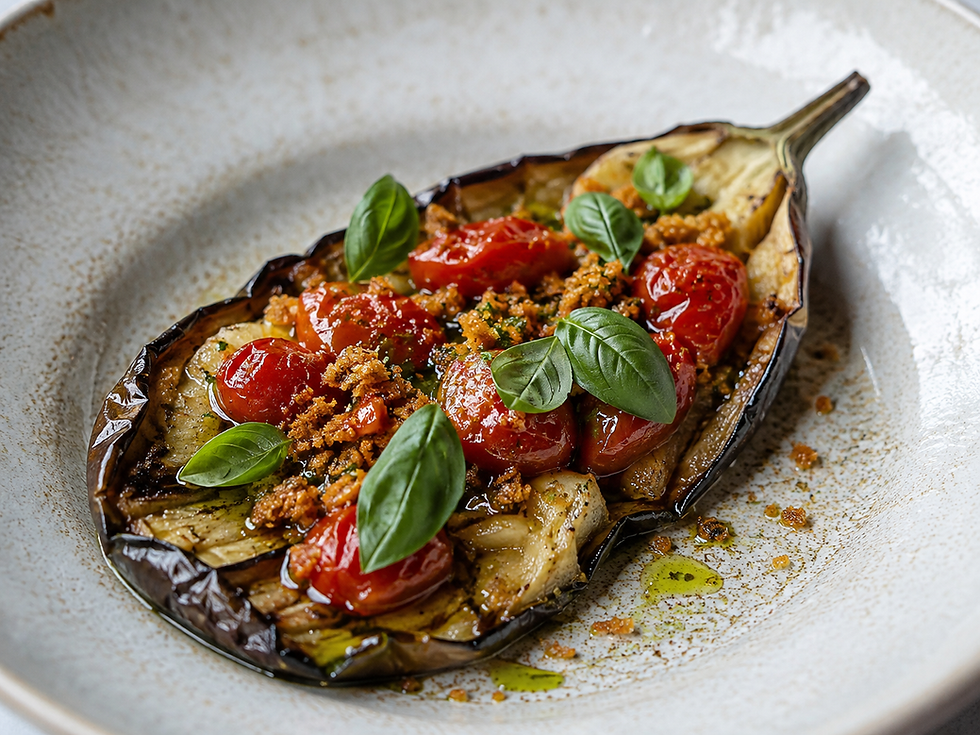
An eggplant put whole onto an open flame and left there until the skin is black and the body has given up its shape is a different vegetable from the one that went on. The smoke does not sit on the surface. It goes through the collapsing flesh, and what comes out is a pale grey cream that tastes of fire, of earth and faintly of something almost meaty. No oven produces it. The direct flame is the whole technique.
Around that cream go two things that answer it. The first is tomato confit, cherry tomatoes cooked for most of an hour at a heat so low that nothing browns and nothing boils, until the water has gone and the sugar and acid have doubled. The second is basil, blanched and blended into a green oil that goes on cold at the last moment. Between them they give sweetness, acidity and perfume to a vegetable that alone is savoury and austere.
This is not a caponata and it is not trying to be. There is no vinegar, no sugar syrup, no celery, no capers and no olives, and nothing is stewed together. The three elements are cooked apart, seasoned apart and meet only on the plate, where the diner tastes smoke, then sweetness, then herb, in that order. A spoonful of garlic breadcrumbs gives the plate something dry to bite against. The dish is completely vegan and at its best in August.
Yield: 4 servings. Prep: 30 minutes. Cook: 1 hour 10 minutes. Total: about 1 hour 40 minutes. Difficulty: intermediate. Course: contorno, also served as antipasto. Region: southern Italy.
The Story
Charring an eggplant whole over fire is one of the oldest ways of cooking it anywhere and belongs to no single country. It is how baba ghanoush is built in the Levant, how melitzanosalata is built in Greece, and how southern Italian households cooked eggplant before they owned ovens, on the embers of the hearth. The method survives in the melanzane arrostite of Calabria and Basilicata, where the blackened vegetable is peeled, torn and dressed with oil and garlic while still warm.
The eggplant reached Italy through Arab Sicily around the ninth century and spent several hundred years being distrusted. Its Italian name, melanzana, is commonly read as mela insana, the unhealthy apple, and physicians of the period believed it caused fever and madness. The south ignored them. By the seventeenth century it was established from Naples downward, and today Italy grows about a quarter of the European crop, most of it below Rome.
Tomato confit is the modern part of the plate, but its logic is old. Southern Italy has always concentrated tomatoes by removing water, splitting them on wooden racks in the Sicilian sun or cooking them into conserva so thick it was kept in jars under oil. A low oven does the same job in an afternoon instead of a fortnight, and without the almost burnt edge a hot oven gives. Basil is simply what grows next to the tomatoes, and Italian cooks have long known it must never be cooked.
Ingredients
For the smoked eggplant
Globe eggplants, about 1 lb (450 g) each, 2
Extra virgin olive oil, 3 tbsp (45 ml)
Lemon juice, 1 tbsp (15 ml)
Finely grated lemon zest, from 1/2 lemon
Garlic clove, grated, 1
Flat leaf parsley, chopped, 2 tbsp (6 g)
Fine sea salt, 3/4 tsp (4.5 g)
Freshly ground black pepper, to taste
For the tomato confit
Cherry or datterino tomatoes, halved, 1 1/4 lb (570 g)
Extra virgin olive oil, 1/4 cup (60 ml)
Garlic cloves, thinly sliced, 2
Fresh thyme sprigs, 4
Fine sea salt, 1/2 tsp (3 g)
Granulated sugar, optional, 1/2 tsp (2 g)
Freshly ground black pepper, to taste
For the basil oil
Fresh basil leaves, loosely packed, 1 1/2 cups (30 g)
Extra virgin olive oil, 1/2 cup (120 ml)
Fine sea salt, 1 small pinch
For the garlic breadcrumbs
Coarse dry breadcrumbs, 3/4 cup (45 g)
Extra virgin olive oil, 2 tbsp (30 ml)
Garlic clove, lightly smashed, 1
Flat leaf parsley, chopped, 1 tbsp (3 g)
Fine sea salt, 1 small pinch
For finishing
Small basil leaves, 12
Extra virgin olive oil, a few drops per plate
Flaky sea salt, to taste
Preparation
Step 1. Char the eggplants over open flame
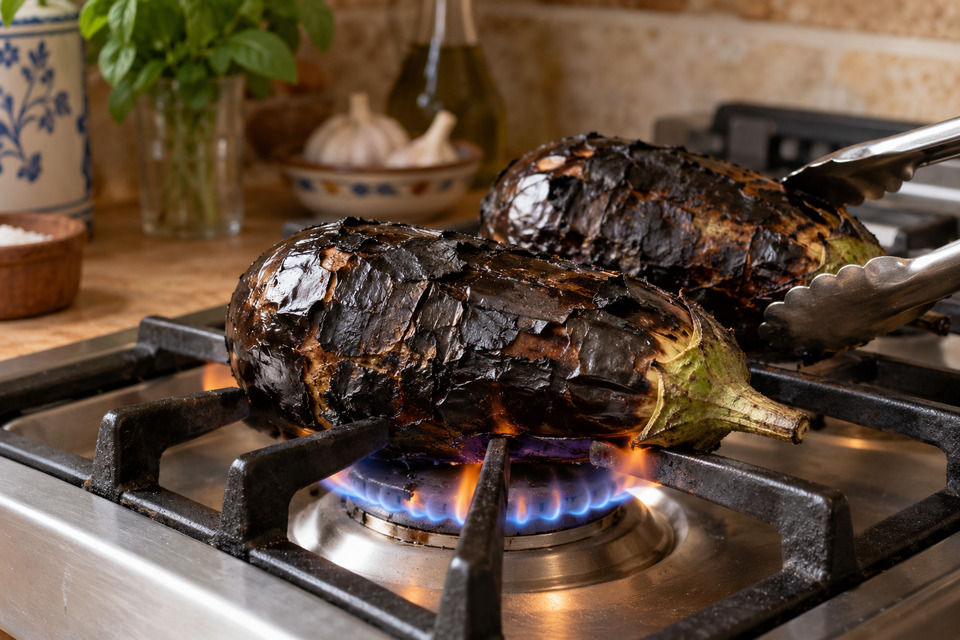
Set the whole eggplants on a gas burner over a medium high flame, or on the bars of a charcoal grill, turning them with tongs every few minutes. They need 10 to 15 minutes and are ready when the skin is uniformly black and split and the vegetable sags when lifted. A broiler takes closer to 25 minutes and gives a milder result. Cool them enough to handle, split them lengthways and scoop the flesh out, leaving every trace of blackened skin behind.
Step 2. Drain and dress the smoked flesh

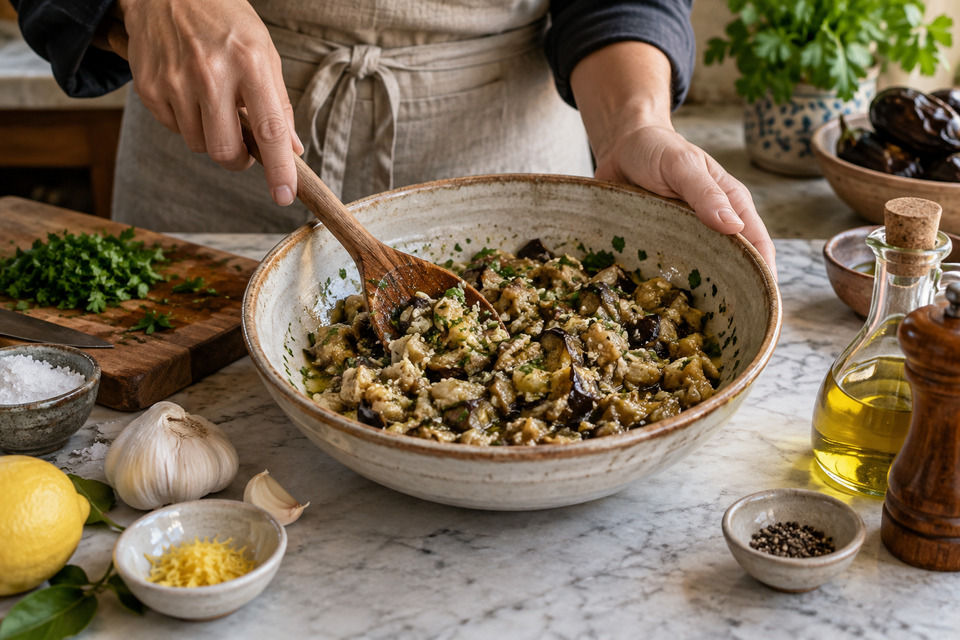
Tip the flesh into a sieve over a bowl and leave it 10 minutes. A surprising amount of dark liquid runs out, and it is bitter, so let it go. Chop the drained flesh roughly on a board rather than blending it, since a purée loses the torn texture that makes this read as vegetable rather than dip. Fold in the olive oil, lemon juice and zest, garlic, parsley, salt and pepper while it is still warm.
Step 3. Dress the tomatoes for the confit
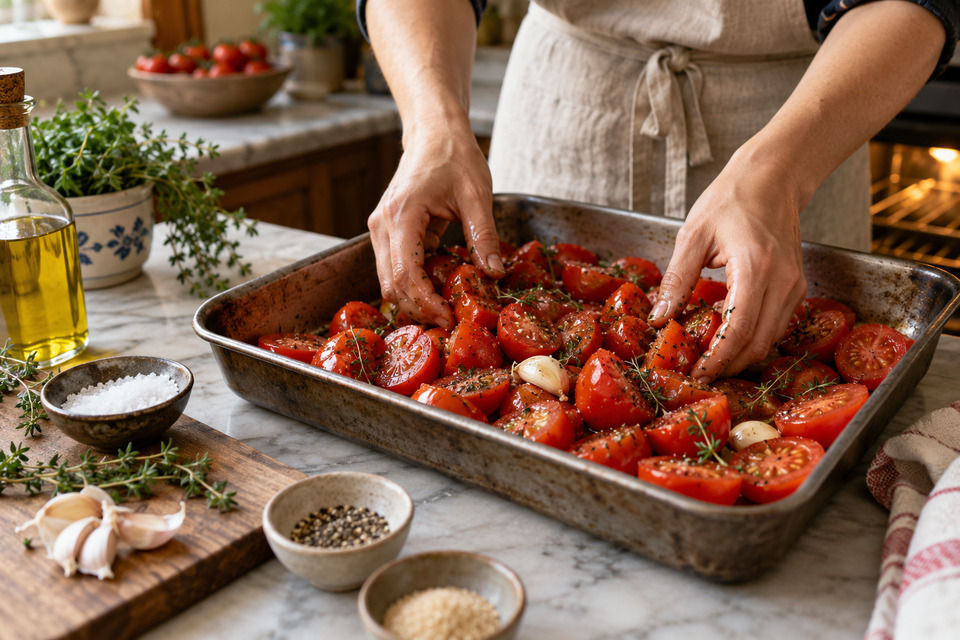
Halve the tomatoes through the equator rather than the stem, which opens more surface to the dry heat and lets water escape faster. Toss them gently with the olive oil, sliced garlic, thyme, salt and pepper, adding the sugar only if the tomatoes are out of season and taste flat. Lay them cut side up in one layer on a parchment lined tray with space between them, since crowded tomatoes steam one another and never concentrate.
Step 4. Confit the tomatoes at low heat
Roast at 300°F (150°C) for 45 to 55 minutes. You are not looking for colour and must not get any: the tomatoes should shrink, wrinkle and go glossy while staying red and holding their shape. If the edges begin to brown, drop the oven by 25°F (15°C) and continue. Take them out while still slightly plump and cool them on the tray in their own oil, which goes onto the plate with them.
Step 5. Blanch the basil and blend the oil
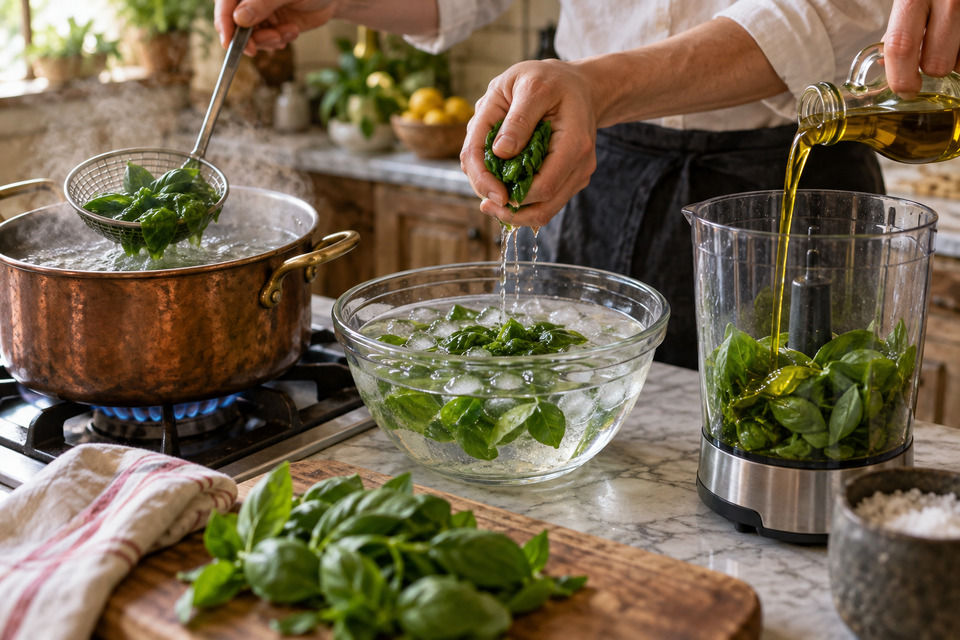
Drop the basil into boiling water for 10 seconds only, lift it straight into ice water, then squeeze it dry in a cloth until almost no moisture remains. The blanch deactivates the enzyme that turns basil black and fixes the colour for a day or two. Blend the leaves with the olive oil and a pinch of salt for a full minute, until vivid green, then pass the oil through a muslin lined sieve if you want it clear. Never heat it.
Step 6. Toast the garlic breadcrumbs
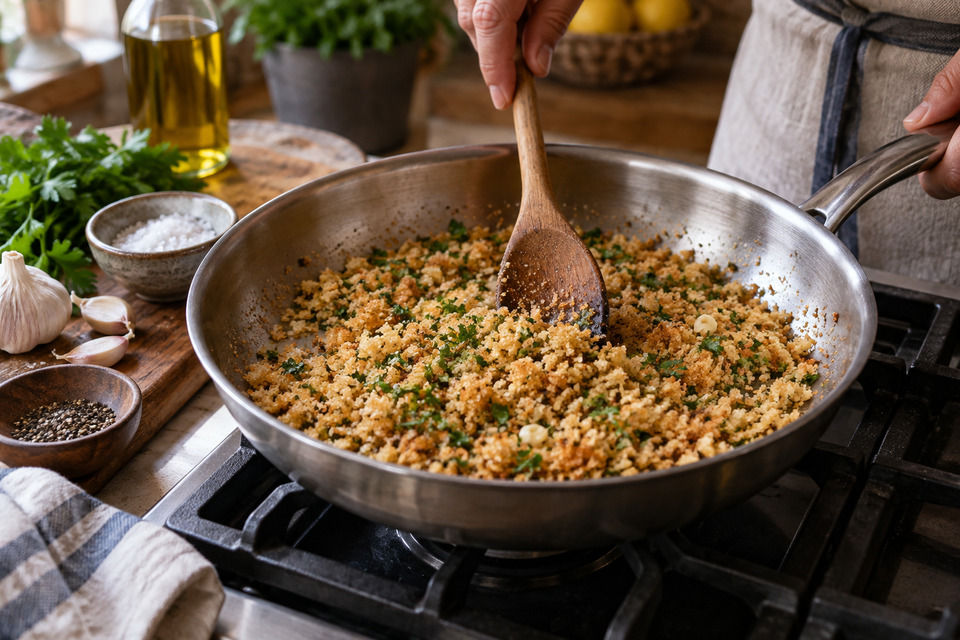
Warm the olive oil in a small skillet with the smashed garlic and let it perfume the oil for a minute, then lift the garlic out before it colours. Add the breadcrumbs and stir constantly 2 to 3 minutes, until evenly golden and smelling toasted. Off the heat stir through the parsley and a pinch of salt, then tip them onto a cold plate. Left in the hot pan they turn bitter.
Step 7. Taste and correct every element

Line the four components up and taste each alone before assembling. The eggplant should be smoky and savoury and will need more salt than expected. The tomatoes should be sweet with the acidity still present, not jammy. The basil oil should taste green and raw, the breadcrumbs audibly crisp. Correct now, because once plated only salt and oil can be added.
Plating
Serve it warm rather than hot, the eggplant at about body temperature and the tomatoes barely above room temperature. Heat pushes the smoke forward until it is all the plate tastes of, and it dulls the basil. Use a wide flat plate, not a bowl, and leave the rim clear.
Spoon the smoked eggplant slightly off centre and spread it into a loose, uneven layer with the back of a spoon, so it looks torn rather than piped. Arrange the tomato halves over and around it, cut side up, five or six per plate, with a little of their oil between them. Drizzle the basil oil in a broken line around the eggplant rather than over it, so the green stays green. Scatter the breadcrumbs last, in a narrow band along one side where they stay dry, and finish with small basil leaves, flaky salt and a few drops of raw olive oil.
Professional Technique
The technical core of this recipe is smoke absorption, and it depends on the eggplant being cooked by direct contact with flame rather than radiant heat. As the skin blackens it splits, and steam rising inside draws phenolic compounds from the burning skin down into the collapsing flesh. That transfer happens only while the interior is still generating steam, which is why an eggplant taken off the fire firm tastes of nothing and one left until it sags tastes of smoke to the centre.
The confit is the opposite discipline: heat kept below the point where anything happens fast. At 300°F (150°C) water leaves the tomato steadily by evaporation while the sugars stay well under the temperature at which they caramelise, so the fruit concentrates without browning and keeps its acidity. Push the oven to 400°F (200°C) to save half an hour and the exterior colours and turns bitter while the interior is still watery. The oil on the tray is not a cooking medium but a barrier that slows surface drying and holds the flavour leaving the fruit.
Texture and Moisture Control
Water is the enemy in all three cooked components and each sheds it differently. The eggplant releases a dark bitter liquid as it cools, and the ten minutes in a sieve separate a concentrated smoky spoonful from a grey one that weeps across the plate. The tomatoes lose most of their weight in the oven, and the point to stop is when they are wrinkled and glossy but still yield under a finger. The breadcrumbs must be kept away from steam once toasted.
Temperature carries as much of the structure as moisture does. This plate works warm, not hot: at serving temperature the eggplant is soft and spreadable, at fridge temperature it is stiff and tastes muted and faintly metallic. Basil oil must stay cold, since even gentle heat turns it from bright green to olive brown in minutes and takes the aroma with it. Assemble in order, eggplant, tomatoes, oil, crumbs, and each element reaches the fork with the texture it left the kitchen with.
Professional Mise en Place
The tomatoes take the longest and need no attention, so they go into the oven first while the eggplants are still on the flame. Everything else is quick.
Equipment and tools
Gas burner or charcoal grill, and long tongs
Parchment lined sheet tray for the confit
Fine sieve and a bowl for draining the eggplant
Blender and a muslin lined sieve for the basil oil
Small skillet and a cold plate for the breadcrumbs
Prepared ahead
Tomato confit, up to 3 days ahead, kept in its oil and refrigerated
Smoked eggplant, charred, drained and dressed, up to 2 days ahead
Basil oil, up to 2 days ahead, sealed and refrigerated
Breadcrumbs toasted on the day, in a sealed container
Service setup
Eggplant out of the refrigerator 40 minutes before service
Tomatoes and their oil at room temperature in a shallow tray
Basil oil in a squeeze bottle, away from any heat
Breadcrumbs, basil leaves and flaky salt within reach
Plates at room temperature, never warmed
Chef Tips
Choose eggplants that feel light for their size, with taut glossy skin and a green stem. A heavy dull one is old, seedy and bitter, and no amount of smoke hides it. Two medium ones char more evenly than one large.
With no gas burner and no grill, use a dry cast iron pan over the highest heat, turning the eggplants every few minutes, then finish them in a hot oven. It beats the broiler. What you must not do is peel and cube the eggplant and roast it, which gives a decent vegetable and none of this dish.
Save the oil from the confit tray. It has taken on tomato, garlic and thyme and is far too good to wash away. Keep it in a jar in the refrigerator for a week and use it on bread, on pasta or to start the next sauce.
Make the basil oil last, not first. Even sealed and refrigerated it starts losing colour after a few hours, and the difference between oil blended at four and at seven is visible on the plate. Ten seconds in boiling water is the whole blanch.
Common Mistakes
Taking the eggplant off the flame too early. A vegetable that is charred outside but still firm inside has no smoke at its centre and keeps a raw, faintly bitter taste. Wait until it sags visibly in the tongs and the stem end has gone soft, which is always longer than it looks.
Skipping the draining step. Undrained eggplant releases dark bitter liquid onto the plate, thins the dressing and leaves a grey pool under the tomatoes within minutes of service. Ten minutes in a sieve costs nothing and fixes it.
Roasting the tomatoes too hot. Above about 325°F (160°C) they brown at the edges and pick up a scorched bitterness instead of concentrating cleanly, and the acidity that balances the smoke burns off. Low and slow is the entire point of a confit.
Blending the basil without blanching it. Raw basil oxidises in the blender and turns from green to brown within an hour, and it tastes flat as well as looking dull. Ten seconds in boiling water, then ice water, then squeezed dry, fixes the colour for a day or two.
Wine Pairing
Lacryma Christi del Vesuvio DOC: The closest thing to a wine grown in the same conditions as this plate, from volcanic ash on the slopes of Vesuvius. The white is dry and firm with a smoky mineral undertone that meets the charred eggplant directly instead of cleaning it away, and enough acidity for the concentrated tomato. The red, served cool, works equally well.
Fiano di Avellino DOCG: A white with real weight and a nutty, smoky character of its own, which is what a dish this savoury needs. Lighter wines vanish beside smoked eggplant. Fiano stands level with it and has a long mineral finish that keeps the olive oil from coating the palate.
Cerasuolo d'Abruzzo DOC: A properly dry rosato from Montepulciano, deep in colour and more substantial than most rosé. Its red fruit runs alongside the tomato confit rather than against it, while a light tannic grip handles the char. The most versatile bottle here if the dish is one of several on the table.
Aglianico del Taburno DOCG: For anyone who wants a red with real structure, and the southern red whose firm acidity keeps pace with tomato. Its dark fruit and smoky, almost ashy edge echo the flame on the eggplant. Choose a young bottling rather than a riserva, whose tannin would flatten the basil.
Bardolino DOC: The light red option, from the shores of Lake Garda, pale and low in tannin and best served around 57°F (14°C). At that temperature its sour cherry fruit and faint bitter almond finish refresh between mouthfuls without covering anything, which is the risk every heavier red runs here.
Storage & Reheating
Store the components separately and never assemble in advance. The smoked eggplant keeps in an airtight container in the refrigerator for 3 days and deepens slightly on the second day. The tomato confit keeps 5 days as long as it stays submerged in its own oil, which seals it from the air. The basil oil holds 2 days refrigerated, though the colour fades. The breadcrumbs keep a week in a sealed container at room temperature, never in the refrigerator, where they go soft overnight.
Nothing here is reheated on direct heat. Take the eggplant out 40 minutes before service and let it come up on its own, or warm it gently in a covered bowl over hot water. The tomatoes need only room temperature, and the basil oil is never warmed at all. Breadcrumbs that have lost their edge go back into a dry skillet for 30 seconds and onto a cold plate. Undressed smoked eggplant freezes for 2 months and is thawed in the refrigerator and seasoned fresh, but the tomatoes and the basil oil do not freeze.
Nutrition
Per serving, based on 4 servings:
Calories: 310 kcal
Total Fat: 25 g
Saturated Fat: 3.5 g
Trans Fat: 0 g
Unsaturated Fat: 21 g
Cholesterol: 0 mg
Sodium: 460 mg
Total Carbohydrates: 19 g
Fiber: 6 g
Total Sugars: 8 g
Added Sugars: 0 g
Protein: 4 g
Lactose: 0 g
Principal micronutrients: lycopene, vitamin C, vitamin K, potassium, manganese, vitamin E
These figures are estimates. The dish is entirely plant based, so it carries no cholesterol and no lactose, and the fat is almost all monounsaturated. Most of the variation comes from how much confit oil is spooned onto the plate.


Comments