Vegan Sicilian Sesame Semolina Bread | Pane di Semola al Sesamo Siciliano

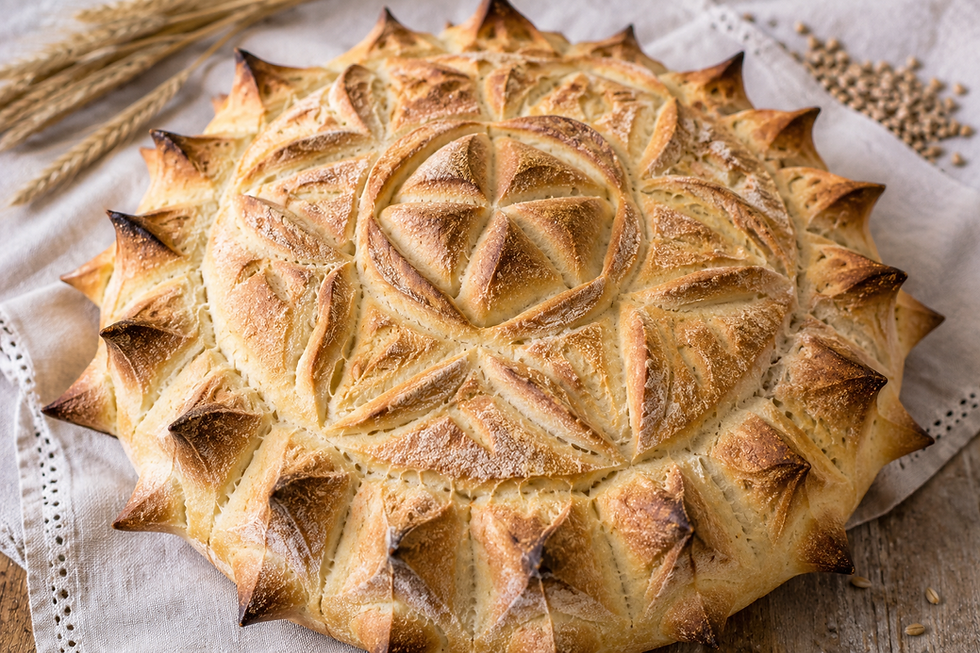
Pane di semola is the everyday bread of Sicily: a loaf of remilled durum wheat semolina with a golden, almost yellow crumb, a thin crackling crust and a gentle sweetness of wheat. In much of the island it is covered with sesame seeds, which toast in the oven and give the crust a nutty perfume. This version follows the Sicilian method closely, with a durum wheat sourdough, a high hydration that suits the thirsty semolina, and a long, cool fermentation, then shapes the dough as a mafalda, the serpentine loaf seen in Sicilian bakeries. The bread is plant based by nature, made only of semolina, water, leavening, salt, olive oil and sesame, and it is served here as an antipasto with Sicilian olive oil and olives.
Yield: 1 large loaf, 10 servings. Prep: 40 minutes. Cook: 40 minutes. Rest: 14 hours fermentation, plus 2 hours cooling. Course: antipasto. Region: Sicilia.
The Story
Sicily has been a land of durum wheat since antiquity, when the Romans called it the granary of Rome. Durum wheat thrives in the hot, dry climate of the island's interior, and its hard, amber grains give a flour rich in protein and in the yellow pigments that color Sicilian bread. Milled once, the grain becomes semolina, coarse and sandy, the flour of pasta; milled again, it becomes semola rimacinata, fine as powder, and that is the flour of Sicilian bread. Bread made entirely of durum wheat is rare elsewhere in Italy and is one of the clearest marks of the island's food culture.
Sicily also preserves many old varieties of durum wheat, such as Tumminia, also called Timilia, Russello and Perciasacchi, which small farms and mills have brought back in recent decades. Tumminia is the grain of the dark pane nero of Castelvetrano, while in the province of Enna a durum wheat loaf is protected as the Pagnotta del Dittaino DOP. Every area has its own breads, but they share the same principles: durum wheat, a natural leavening, a firm dough and a long fermentation that gives a loaf able to keep for days.
Sesame is the other half of the story. In Sicily it is called giuggiulena, a word that comes from the Arabic name of sesame, a reminder of the centuries of Arab rule on the island, when new crops and new flavors entered Sicilian cooking. Sesame appears in sweets such as cubbaita, the sesame brittle, and on bread, where it is pressed into the crust before baking. The traditional shapes are many: round loaves, rings, braids, and the mafalda, a rope of dough folded back and forth like a snake, with a strip of dough laid along its back.
The original bread contains no animal products, so this version changes nothing essential. It brings precision where it matters at home: the exact hydration for remilled semola, a sourdough refreshed with durum wheat, a cold fermentation that develops flavor and makes the dough easier to shape, and a bake with steam that gives the thin, golden crust and the soft, yellow crumb of the bakeries of Palermo and Catania.
Ingredients
Use an Italian semola rimacinata di grano duro, fine and pale yellow, ideally from Sicily; ordinary coarse semolina cannot absorb water evenly and gives a heavy, crumbly loaf. Many Sicilian mills also sell semola of ancient varieties such as Russello or Tumminia: they work well here but absorb less water, so hold back a little. Buy hulled sesame seeds, white or golden, from a shop with a quick turnover, because sesame is rich in oil and turns rancid. For serving, choose a Sicilian extra virgin olive oil such as Valle del Belice DOP and green Nocellara del Belice olives.
For the sourdough levain
Active sourdough starter, 1 3/4 oz (50 g)
Remilled durum wheat semolina, 3/4 cup plus 2 tbsp (100 g)
Water, about 80°F (27°C), 1/3 cup plus 2 tsp (90 ml)
For the dough
Remilled durum wheat semolina, 3 1/2 cups (450 g)
Levain, 7 oz (200 g), all of it
Water, about 77°F (25°C), 1 cup plus 2 tbsp (270 ml), plus 2 tbsp (30 ml) reserved
Fine sea salt, 2 1/2 tsp (12 g)
Extra virgin olive oil, 1 tbsp (15 ml)
Instant dry yeast, 1/4 tsp (1 g), optional, for a more reliable rise
For the sesame crust
Hulled sesame seeds, 1/2 cup (70 g)
Cold water, in a spray bottle or bowl, for brushing
Remilled durum wheat semolina, for the peel, 2 tbsp (20 g)
To serve
Sicilian extra virgin olive oil, 1/2 cup (120 ml)
Green olives, such as Nocellara del Belice, 1 cup (150 g)
Dried Sicilian oregano, 1 tsp (1 g)
Flaky sea salt, 1 pinch
Preparation
Step 1

Build the levain. In the morning, mix the active starter with 3/4 cup plus 2 tbsp (100 g) of semola and the warm water in a jar until smooth. Cover loosely and leave at about 78°F (26°C) for 4 to 5 hours, until it has doubled, its surface is domed and full of bubbles and a spoonful floats in water. Refreshing the starter with durum wheat semola gives the bread its full flavor and keeps the acidity mild: a young, active levain raises the dough well and leaves a sweet, wheaty taste, while an old, sour one makes the bread tangy and weakens the gluten of durum wheat.
Step 2

Mix and knead. In a large bowl or stand mixer, mix the semola with 1 cup plus 2 tbsp (270 ml) of water just until no dry flour remains, cover and rest for 45 minutes. This rest, the autolysis, is essential for durum wheat: its large starch grains and proteins absorb water slowly, and without it the dough stays sandy. Add the levain, the yeast if using, and knead on low speed for 5 minutes. Add the salt with the reserved 2 tbsp (30 ml) of water, knead 3 minutes more, then add the oil and knead until absorbed and the dough is smooth, silky and elastic, about 4 minutes. It should stretch into a thin, translucent sheet without tearing.
Step 3

Ferment cold. Place the dough in a lightly oiled container, cover it and leave it at about 77°F (25°C) for 2 hours, giving it a set of folds after 30 and 60 minutes: lift each side, stretch it up and fold it over the center. Then put the container in the refrigerator at about 40°F (4°C) for 10 to 12 hours, or overnight. Durum wheat gluten is strong but not very elastic, and the cold, slow fermentation relaxes it, develops flavor and acidity in balance and makes the dough firm and easy to shape the next morning.
Step 4

Shape the mafalda. Turn the cold dough onto an unfloured surface. Roll it under your palms, from the center outward, into an even rope about 32 inches (80 cm) long and 1 1/4 inches (3 cm) thick. Cut off a piece of about 6 inches (15 cm) and set it aside. Lay the long rope in a zigzag, folding it back and forth in tight loops of about 7 inches (18 cm), five or six loops in all, so the sides of the loops touch. Roll the short piece into a strip as long as the loaf and lay it along the center, over the loops, pressing it lightly. The loops must touch closely: during the bake they fuse into one loaf that can still be broken along the folds.
Step 5

Coat with sesame and proof. Spray or brush the whole surface of the loaf with cold water, then sprinkle it generously with the sesame seeds and press them gently with your palms so they adhere. Move the loaf onto a sheet of parchment dusted with semola. Cover loosely with a cloth and proof at about 77°F (25°C) for 2 to 2 1/2 hours, until it has grown by about half and a finger pressed into the side leaves a dent that fills back slowly. The cold dough needs this long proof to come back to temperature and rise; a loaf baked too early tears open along the loops.
Step 6

Bake with steam. One hour before baking, place a baking stone on the middle rack and an empty metal pan on the bottom, and heat the oven to 465°F (240°C). Slide the loaf on its parchment onto the stone, pour 1 cup (240 ml) of hot water into the pan and close the door at once. Bake for 15 minutes, remove the pan and the parchment, lower the heat to 410°F (210°C) and bake for another 20 to 25 minutes, until the crust is deep golden, the sesame is toasted and the bottom sounds hollow. The internal temperature should reach about 205°F (96°C).
Step 7

Cool and serve. Move the loaf to a rack and leave it for at least 2 hours. The crust will crackle softly as it cools, a sign of a good bake. Durum wheat bread sets slowly, and its crumb is gummy if cut warm. For serving, pour the olive oil into a shallow bowl, crumble the oregano over it between your fingers, and add a pinch of flaky salt. Break the mafalda along its loops by hand, or cut it into slices about 3/4 inch (2 cm) thick with a serrated knife, and serve it with the oil and the olives.
Plating
Present the mafalda whole on a large wooden board, so the guests can see its serpentine shape and its sesame crust, then break the first loops at the table. The bread should be at room temperature, never cold; if it was baked earlier in the day, warm it in the oven at 350°F (175°C) for 5 minutes to revive the crust and the aroma of the sesame.
Set the bowl of oregano oil and a dish of olives beside the board, with a small bowl for the pits. The guest tears a piece of bread, dips it in the oil, and eats it with an olive. The golden, slightly sweet crumb absorbs the green, grassy oil, and the toasted sesame adds a crunchy, nutty finish to every bite.
Professional Technique
The key number is the hydration. Remilled durum wheat semola absorbs more water than soft wheat flour, and the total hydration of this dough, counting the water in the levain, is about 72 percent. Below 65 percent the dough is stiff and the crumb dense and dry; above 76 percent the dough loses its shape and the mafalda spreads into a flat loaf. Ancient varieties such as Russello absorb less, so start at 65 percent and add water only if the dough feels stiff.
The hidden variable is the autolysis. A 45 minute rest of semola and water before adding the levain and the salt lets the starch and the proteins hydrate fully and the gluten start to form on its own. Skip it and the dough feels grainy, needs long kneading and still bakes into a loaf with a tight crumb. With it, the dough becomes silky and extensible within minutes.
The doneness test is double. The crust must be deep golden, darker than a white bread, and the sesame toasted to a light brown; a pale crust means a soft, chewy loaf that quickly loses its crunch. The bottom must sound hollow when tapped, and a probe in the thickest part of the loaf must read about 205°F (96°C).
Crust and Crumb Control
The crust of Sicilian semolina bread is thin and crackling, not thick and hard. That depends on the steam at the start of the bake, which keeps the surface moist while the loaf expands and lets the sugars on the surface caramelize evenly. Removing the steam after 15 minutes and lowering the heat lets the crust dry and color without becoming thick. The sesame protects the surface and toasts in its own oil, adding flavor and crunch.
The crumb of durum wheat bread is dense, soft and even, with small, regular holes, and its yellow color comes from the carotenoid pigments of the grain. A fermentation that is too warm or too long weakens the gluten of durum wheat, which is strong but fragile, and the loaf collapses. The cold fermentation keeps the process slow and controlled, so the crumb stays soft and the flavor sweet with only a light acidity.
Durum wheat bread keeps exceptionally well. Its starch retrogrades more slowly than that of soft wheat bread, so the crumb stays soft for days, which is why Sicilian families traditionally baked large loaves to last the week. Wrap the loaf only when completely cool, and keep the crust facing outward so it does not soften.
Professional Mise en Place
This bread spreads over two days with little active work: levain and dough on the first day, shaping and baking on the second. Plan the bake to finish at least 2 hours before service.
Equipment and tools
Large bowl or stand mixer with dough hook, digital scale, thermometer
Lidded container for the cold fermentation, dough scraper
Baking stone, metal pan for steam, parchment paper, peel or flat baking sheet
Spray bottle for water, wire rack, long serrated bread knife
Prepared ahead
Sourdough starter refreshed the evening before building the levain
Levain built 4 to 5 hours before mixing, at full activity
Dough fermented in the refrigerator overnight
Loaf baked and cooled, up to 1 day before service, wrapped in a cloth
Service setup
Wooden board for the whole loaf, serrated knife beside it
Olive oil with oregano and salt in a shallow bowl
Green olives in a dish, small bowl for the pits
Oven at 350°F (175°C) to revive the loaf, if baked ahead
Chef Tips
If you have no sourdough starter, make a biga the evening before: mix 1 cup (150 g) of semola with 1/3 cup plus 1 tbsp (90 ml) of water and 1/4 tsp (1 g) of instant yeast into a rough dough, and leave it covered at room temperature for 12 to 16 hours. Use it instead of the levain, and add 1/2 tsp (2 g) of yeast to the dough.
For a deeper flavor and color, replace a quarter of the semola with semola of an ancient Sicilian variety such as Tumminia, which has a darker crumb and a slightly smoky, toasted taste. Reduce the water by 2 to 3 tbsp, because ancient grains absorb less.
If the sesame does not stick, the surface was too dry. Spray the loaf generously just before sprinkling the seeds, and press them in firmly with both hands. For a more even coat, roll the shaped loaf gently on a damp cloth, then on a tray of sesame, before moving it to the parchment.
Day-old pane di semola makes the best toast and the best breadcrumbs of Sicilian cooking. Grate it, toast the crumbs in olive oil with a pinch of salt until golden, and use them over pasta with cauliflower, raisins and pine nuts or over roasted vegetables.
Common Mistakes
Using coarse semolina. Coarse semolina cannot absorb water evenly and bakes into a heavy, crumbly loaf. Use fine semola rimacinata.
Skipping the autolysis. Without the rest, durum wheat stays grainy and the bread is dense. Rest the semola and water for 45 minutes before kneading.
Adding all the water at once. Durum wheat absorbs slowly, and a wet dough is hard to knead. Keep back 2 tbsp (30 ml) and add it with the salt.
Using an old, sour levain. A levain past its peak weakens the gluten and makes the bread tangy. Use it when it has just doubled.
Underproofing a cold dough. Straight from the refrigerator, the loaf needs time to warm and rise. Proof until the dent fills back slowly, about 2 hours.
Baking without steam. A dry oven sets the crust too early, the loaf cannot expand and it cracks along the loops. Use a pan of hot water for the first 15 minutes.
Cutting the loaf warm. The crumb is still setting and turns gummy. Wait at least 2 hours.
Wine Pairing
Etna Bianco DOC: From the volcanic slopes of Mount Etna, a white based on Carricante with citrus, white flowers and a strong mineral, almost salty finish. Its acidity matches the green olive oil and the olives, and its minerality suits the toasted sesame. Serve it at about 50°F (10°C).
Sicilia DOC Grillo: A white from western Sicily with notes of citrus peel, almond and Mediterranean herbs. Its round body and fresh finish follow the sweet wheat taste of the crumb. Serve it at about 50°F (10°C).
Sicilia DOC Frappato: A light, fragrant red from the southeast of the island, with strawberry, pomegranate and a delicate spice, low tannins. Served cool, it is a perfect red for bread, oil and olives. Serve it at about 57°F (14°C).
Cerasuolo di Vittoria DOCG: The only DOCG of Sicily, a blend of Nero d'Avola and Frappato from the area of Vittoria, with cherry fruit, floral notes and a soft structure. Its freshness and fruit suit the toasted crust and the oregano. Serve it at about 59°F (15°C).
Storage & Reheating
Pane di semola keeps for 4 to 5 days at room temperature, wrapped in a cotton cloth or stored in a paper bag inside a bread box, cut side down on the board. Do not refrigerate it: the cold speeds up the staling of the starch and the crust absorbs moisture. The loaf freezes well for up to 2 months: let it cool completely, cut it into pieces or slices, wrap them tightly in plastic and then in foil.
To revive the bread, sprinkle the crust with a little water and bake it at 375°F (190°C) for 8 to 10 minutes for a whole piece, or toast the slices. Thaw frozen bread in its wrapping at room temperature, then refresh it in the oven in the same way. Never reheat it in the microwave, which makes the crumb chewy and the crust soft.
Nutrition
Per serving, based on 10 servings (bread with oil and olives):
Calories: 330 kcal
Total Fat: 17 g
Saturated Fat: 2 g
Trans Fat: 0 g
Unsaturated Fat: 15 g
Cholesterol: 0 mg
Sodium: 690 mg
Total Carbohydrates: 38 g
Fiber: 3 g
Total Sugars: 1 g
Added Sugars: 0 g
Protein: 8 g
Principal micronutrients: selenium, thiamin, folate, iron, copper, vitamin E
These figures are estimates, calculated on the quantities listed and rounded to the nearest whole number. They vary with the semola, the amount of oil absorbed by the bread and the salt of the olives.



Comments