Vegan Tuscan Pappardelle with Porcini, Reinterpreted | Pappardelle ai Funghi Porcini Vegane Rivisitate

Pappardelle ai funghi porcini is one of the great autumn dishes of Tuscany: wide ribbons of fresh pasta tossed with porcini cooked in olive oil, garlic and parsley, often with a spoonful of tomato that gives the sauce color and roundness. The Tuscan original uses a fresh pasta dough of eggs and soft wheat flour; this is a vegan reinterpretation, and its ribbons are made with durum wheat semolina and water, so they keep a firm, slightly rough bite that holds the sauce well. The porcini are used twice, fresh for texture and dried for depth, and the sauce is finished in the pan with the starchy pasta water until it turns glossy and coats every ribbon. No butter and no cheese are needed: the mushroom, the oil and the technique carry the whole dish.
Yield: 4 servings. Prep: 1 hour, plus 30 minutes resting. Cook: 25 minutes. Rest: 30 minutes for the dough. Course: primo piatto. Region: Tuscany.
The Story
Pappardelle are the widest of the Tuscan ribbon pastas, cut by hand from a rolled sheet of dough to a width of about 3/4 to 1 inch (2 to 2.5 cm). Their name is usually linked to the Tuscan verb pappare, to eat with gusto, a word that belongs to the everyday language of the region. Their width has a purpose: a broad, flat surface carries dense, rustic sauces that would slide off thinner pasta. In Tuscany pappardelle are the classic partner of game ragù, especially wild boar and hare, and in the autumn of porcini, when the woods offer the region's most prized mushroom.
The traditional pappardelle dough is soft wheat flour bound with whole eggs, so the classic dish is not vegan. This version follows the other Italian pasta tradition, that of durum wheat semolina and water, widely used in central and southern Italy for fresh pasta made every day. Semolina gives a firmer, more elastic ribbon, less rich than the classic egg dough but excellent at absorbing the sauce, and it can be rolled wide and thin without tearing if it is kneaded and rested properly. The porcini sauce itself has always been plant-based in its simplest Tuscan form: olive oil, garlic, parsley, porcini and, in many homes, a little tomato.
Tuscany has some of the richest porcini woods in Italy. The chestnut and beech forests of the Garfagnana and the Lunigiana, the Casentino and the slopes of Monte Amiata produce porcini from late summer through autumn, and they are sold in village markets and served in trattorias for the whole season. Porcini, Boletus edulis and its close relatives, grow in symbiosis with the roots of trees and cannot be cultivated, so every fresh porcino is picked by hand. Dried porcini, sliced and dried in the sun or in low ovens, keep their aroma for months and are a pantry staple of every Tuscan kitchen.
On the Tuscan table, pappardelle ai porcini are a primo of the autumn Sunday, served before a roast or on their own as the heart of a simple meal with bread and red wine. The dish has few ingredients and no room for shortcuts. This recipe keeps the Tuscan simplicity and adds precision where it counts: the sear of the fresh porcini, the use of the dried ones and their soaking water, the right amount of tomato, and an emulsion built in the pan so the sauce clings to the pasta instead of pooling on the plate.
Ingredients
For the dough, use fine durum wheat semolina, labeled semola rimacinata, and a small amount of Italian type 00 flour for tenderness. Choose fresh porcini that are firm and heavy, with a white or pale cream sponge and compact white flesh when cut; avoid specimens with a green, soft sponge, which release too much water. Out of season, use firm cremini and king oyster mushrooms and increase the dried porcini. Buy dried porcini in large, light-colored slices with a strong, sweet aroma. Use a Tuscan extra virgin olive oil with a peppery finish for the sauce and the final drizzle, and a canned peeled tomato of good quality, or a tomato passata with no added ingredients.
For the semolina pappardelle
Fine durum wheat semolina (semola rimacinata), 2 cups (330 g)
Italian type 00 flour, 1/3 cup (45 g)
Lukewarm water, about 3/4 cup (180 ml)
Extra virgin olive oil, 1 tbsp (15 ml)
Fine sea salt, 1 pinch
Semolina, for dusting, 1/4 cup (40 g)
For the porcini sauce
Fresh porcini, cleaned, 1 lb (450 g)
Dried porcini, 1/2 oz (15 g)
Warm water, for soaking, 1 cup (240 ml)
Extra virgin olive oil, 5 tbsp (75 ml), divided
Garlic, 2 cloves, thinly sliced
Garlic, 1 clove, unpeeled and crushed
Dry white wine, 1/3 cup (80 ml)
Peeled tomatoes, crushed by hand, or tomato passata, 1/2 cup (120 g)
Fresh thyme or nepitella leaves, 1 tsp (1 g)
Flat-leaf parsley, finely chopped, 3 tbsp (12 g)
Fine sea salt, 1 tsp (6 g), and black pepper, to taste
For the pasta water and the finish
Water, for boiling, 5 quarts (4.7 l)
Coarse sea salt, 2 1/2 tbsp (45 g)
Extra virgin olive oil, Tuscan, 2 tbsp (30 ml)
Flat-leaf parsley leaves, a few, for garnish
Preparation
Step 1

Make and rest the dough. Mix the semolina, the flour and the salt on a board, form a well and add the water and the olive oil a little at a time, working them in with a fork, then with your hands. Knead for 10 to 12 minutes, until the dough is smooth, firm and no longer grainy, and rest it wrapped for 30 minutes. Semolina needs time to absorb water; without the rest, the dough tears when rolled and the pasta is chalky at the center after cooking.
Step 2

Roll and cut the pappardelle. Divide the dough into four pieces and roll each one with a pasta machine to the second thinnest setting, about 1/24 inch (1 mm), or with a rolling pin until you can see the shadow of your hand through it. Dust the sheets with semolina, leave them to dry for 5 minutes, then fold them loosely and cut ribbons 3/4 inch (2 cm) wide with a knife or a fluted pastry wheel. Open the ribbons, toss them in semolina and lay them in loose nests on a tray. The short drying gives the surface a slight skin, so the ribbons do not stick together in the pot.
Step 3

Soak the dried porcini and prepare the fresh ones. Soak the dried porcini in the warm water for 20 minutes, then lift them out, squeeze them and chop them finely; strain the liquid through a paper coffee filter. Brush the fresh porcini clean, never under water, and cut them into slices 1/4 inch (6 mm) thick, keeping the stems and the caps apart. Even slices brown evenly, and stems cook about one minute longer than caps.
Step 4

Sear the fresh porcini. Heat a wide skillet over high heat with 2 tbsp (30 ml) of olive oil until it shimmers. Lay the stem slices in one layer and sear them for 90 seconds without moving them, turn them and cook 1 minute more; move them to a plate. Add 1 tbsp (15 ml) of oil and sear the caps the same way for about 2 minutes in all. Salt them lightly only at the end. Searing in batches keeps the pan dry and hot, so the porcini brown instead of boiling in their own juice.
Step 5

Build the sauce. Lower the heat to medium low, add the remaining 2 tbsp (30 ml) of oil, the sliced and the crushed garlic, and cook for 2 minutes, until pale gold. Remove the crushed clove, add the chopped dried porcini and the thyme and cook 1 minute, then pour in the wine and reduce it by half. Add the tomato and 1/2 cup (120 ml) of the porcini liquid and simmer gently for 8 minutes, until the sauce is thick but still fluid. Return two thirds of the seared porcini to the pan, keeping the best cap slices aside. The tomato is a supporting note: it adds sweetness and color, but the sauce must stay brown and woodsy, not red.
Step 6

Cook the pappardelle. Bring the water to a rolling boil and add the coarse salt. Shake the excess semolina off the nests and drop the pappardelle into the pot, stirring gently at once so the ribbons separate. Fresh semolina pasta cooks in 2 to 3 minutes; taste a ribbon after 2 minutes. Drain it when it is still firm at the center, keeping 1 1/2 cups (360 ml) of the cooking water. The pasta finishes cooking in the sauce, where it absorbs flavor instead of plain water.
Step 7

Toss and emulsify. Transfer the pappardelle to the skillet with the sauce over medium heat, add 1/2 cup (120 ml) of the pasta water and the remaining porcini liquid, and toss with tongs and with a movement of the pan for 1 to 2 minutes. The starch of the water and the oil of the sauce bind into a light, glossy emulsion that coats each ribbon. Add more pasta water a spoon at a time if it looks dry. Take the pan off the heat, add the chopped parsley and 1 tbsp (15 ml) of raw olive oil, toss once more and taste for salt and pepper.
Plating
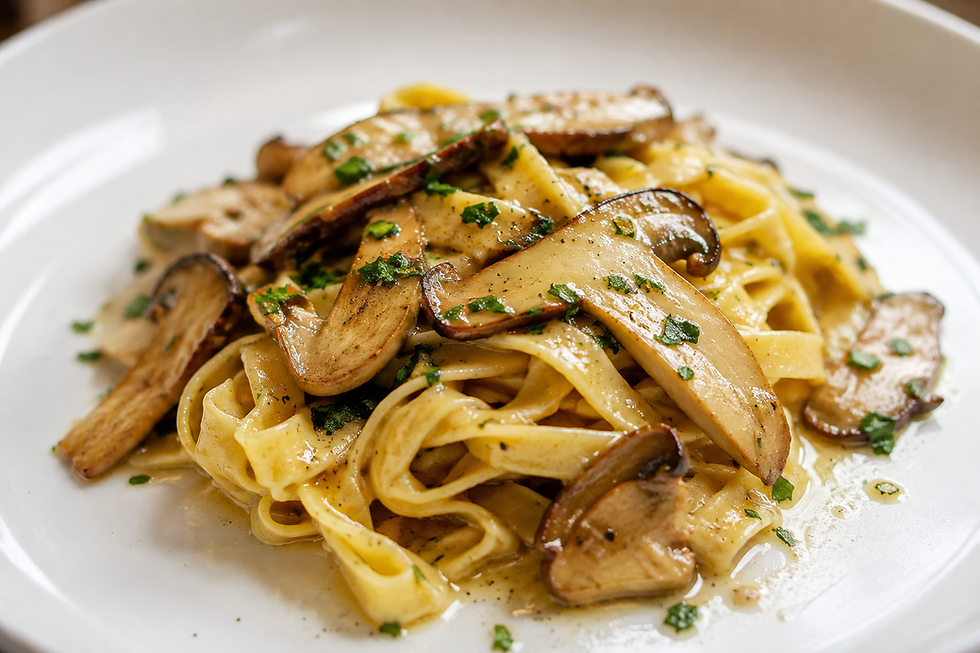
Serve in warm, shallow bowls, heated to about 140°F (60°C), because fresh pasta cools quickly and the emulsion tightens as it cools. Twist each portion with a carving fork and a ladle into a loose, high nest in the center of the bowl, so the ribbons keep their volume and show their wide, flat surface.
Place the reserved slices of seared cap on top of each nest, golden side up, spoon the last of the sauce from the pan around them and finish with a thread of raw Tuscan olive oil, a turn of black pepper and a few parsley leaves. The guest eats with a fork, folding the wide ribbons around the pieces of porcini.
Professional Technique
The key ratio is between pasta and sauce. For 4 servings, about 1 1/4 lb (570 g) of fresh pappardelle need about 1 lb (450 g) of fresh porcini and 1/2 oz (15 g) of dried ones. With less mushroom, the wide ribbons dominate and the dish tastes of pasta; with more, the sauce becomes a side of mushrooms with pasta underneath. The dried porcini are measured carefully: more than 3/4 oz (20 g) for this quantity makes the sauce bitter and dark.
The hidden variable is the water: the water inside the fresh porcini, the soaking liquid and the pasta water. Fresh porcini must lose their surface water in the sear, or the sauce turns thin and gray. The soaking liquid carries the deepest aroma of the dish and must be filtered to remove sand. The pasta water carries starch and salt, and it is the binder of the emulsion; never pour it away before the pasta is in the pan.
The doneness test for the pasta is the bite: a ribbon folded between the teeth should offer a short, elastic resistance, with no white line of raw dough at the center. The sauce is right when, shaking the pan, it moves with the pasta as one glossy mass and leaves no clear oil on the bottom.
Emulsion and Sauce Control
The emulsion is what replaces butter and cheese in this vegan version. Olive oil and water do not mix on their own, but the starch released by the pasta, together with the fine particles of the mushrooms and the tomato, holds tiny droplets of oil in suspension. Movement is essential: tossing the pasta vigorously in the pan breaks the oil into small droplets and spreads the starch, which is why Italian cooks shake the pan rather than stir.
Temperature controls the stability of the emulsion. It forms best at a gentle simmer, between about 180 and 195°F (82 and 90°C). At a hard boil the water evaporates too quickly and the oil separates; off the heat the sauce thickens and clings, which is why the raw oil and the parsley are added at the very end, off the heat, to finish the sauce without breaking it.
Salt must be controlled across the whole dish. The pasta water is well salted, the porcini are salted after the sear and the soaking liquid concentrates as it reduces. Taste the sauce before the pasta goes in and season it lightly; correct the final salt only after the pasta water has been added, because that water brings its own salt into the pan.
Professional Mise en Place
The sauce can be prepared up to the point where the tomato has simmered, and kept warm; the pasta is cooked and tossed only at the moment of service.
Equipment and tools
Pasta machine or long rolling pin, chef's knife or fluted pastry wheel, ruler
Soft mushroom brush, paring knife, cutting board
Wide skillet of 12 inches (30 cm), large pot of at least 6 quarts (5.7 l)
Tongs, carving fork, ladle, paper coffee filter and strainer
Prepared ahead
Pappardelle cut and kept in semolina-dusted nests, up to 4 hours ahead, covered with a towel
Dried porcini soaked, chopped, and the liquid filtered
Fresh porcini cleaned and sliced, caps and stems apart, on paper towels
Sauce cooked to the end of the tomato stage, kept warm or reheated
Service setup
Pasta water at a rolling boil, salted
Bowls warmed to about 140°F (60°C)
Reserved cap slices warm on a small plate
Tuscan olive oil in a jug, pepper mill, parsley leaves at the pass
Chef Tips
Dry fresh pappardelle for longer if you prepare them in the morning. Leave the nests uncovered for 1 hour, turning them once, then cover them with a towel. A drier surface keeps the ribbons separate in the pot and gives them a firmer bite.
Toast the dried porcini briefly before soaking them. Warm them in a dry pan over low heat for 1 minute, until they smell nutty; this deepens their aroma and gives the sauce a light roasted note.
If you cannot find fresh porcini, sear 1 lb (450 g) of king oyster mushrooms sliced lengthwise, which keep a firm, meaty texture close to porcini stems, and increase the dried porcini to 3/4 oz (20 g) to bring the aroma back.
For a sauce without tomato, the Tuscan in bianco version, replace the tomato with an extra 1/4 cup (60 ml) of porcini liquid and add the zest of half a lemon at the end. The dish becomes lighter and more fragrant, closer to a trifolato tossed with pasta.
Common Mistakes
Skipping the rest of the dough. Semolina that has not hydrated tears when rolled and stays chalky after cooking. Rest the dough for at least 30 minutes.
Washing the porcini. Wet porcini boil instead of browning, and the sauce turns thin. Clean them with a brush and a damp cloth only.
Using unfiltered soaking water. Dried porcini release fine sand that ends up in the sauce. Strain the liquid through a paper filter.
Too much tomato. A red sauce covers the delicate porcini aroma. Use only a small amount, for roundness and color.
Overcooking fresh pasta. Fresh semolina pappardelle cook in 2 to 3 minutes and keep cooking in the pan. Drain them while still firm.
Draining all the pasta water. Without starchy water the sauce cannot emulsify and the ribbons stay dry. Keep at least 1 1/2 cups (360 ml).
Adding the parsley too early. Cooked parsley turns dark and loses its fresh aroma. Add it off the heat at the end.
Wine Pairing
Chianti Rufina DOCG: Sangiovese from the cool hills northeast of Florence, with red cherry, violet and a firm, lively acidity. Its freshness balances the olive oil and the tomato, and its earthy notes echo the porcini. Serve it at about 60°F (16°C).
Vino Nobile di Montepulciano DOCG: The Sangiovese of Montepulciano, in the province of Siena, with dark cherry, plum and a fine structure. Its depth matches the concentrated flavor of fresh and dried porcini together. Serve it at about 62°F (17°C).
Brunello di Montalcino DOCG: The great Sangiovese of Montalcino, with ripe red fruit, leather, forest floor and a long finish. Its tertiary aromas of undergrowth make it a classic partner for porcini; choose a bottle with some age. Serve it at about 64°F (18°C), after 30 minutes in the glass.
Bolgheri Sassicaia DOC: From the Tuscan coast, a Cabernet-based red of great elegance, with blackcurrant, herbs and fine tannins. For a special occasion, its structure and herbal notes give the dish a long, refined finish. Serve it at about 64°F (18°C).
Storage & Reheating
Refrigerator: the finished pasta keeps for 1 day in an airtight container, but the ribbons absorb the sauce and soften. The porcini sauce alone, without pasta, keeps for 3 days. Uncooked pappardelle can be dried completely on a tray for 24 hours and kept in a paper bag for up to 1 week, or frozen in nests for up to 1 month and cooked from frozen, adding 1 minute to the cooking time.
Reheat the finished pasta in a skillet over medium heat with 2 to 3 tbsp (30 to 45 ml) of hot water and 1 tsp (5 ml) of olive oil, tossing for 2 to 3 minutes until the sauce is glossy again. Reheat the sauce alone gently in a skillet, then toss it with freshly cooked pasta and its water as in the recipe; this gives a result close to the original.
Nutrition
Per serving, based on 4 servings:
Calories: 610 kcal
Total Fat: 25 g
Saturated Fat: 4 g
Trans Fat: 0 g
Unsaturated Fat: 21 g
Cholesterol: 0 mg
Sodium: 690 mg
Total Carbohydrates: 80 g
Fiber: 6 g
Total Sugars: 4 g
Added Sugars: 0 g
Protein: 18 g
Principal micronutrients: niacin, riboflavin, thiamin, selenium, copper, potassium
These figures are estimates, calculated on the quantities listed and rounded to the nearest whole number, assuming that only part of the pasta water salt is absorbed. They vary with the water content of the porcini and the amount of sauce served.



Comments