
Traditional Italian Calabrian Baked Pasta and Potatoes | Pasta e Patate Ara Tijeddra

Pasta e patate ara tijeddra is what Calabria does when there is almost nothing in the house. Potatoes, onion, a little tomato, a handful of short pasta, grated pecorino and stale bread turned into crumbs, all layered into an earthenware dish and pushed into the oven until the top sets into a dark crust and the bottom catches slightly against the clay. There is no sauce made separately and no pot of boiling water at the end. Everything finishes in the same dish it is served from.
The name carries the whole method. Tijeddra is the Calabrian word for the shallow terracotta pan, a cousin of the Pugliese tiella and a descendant of the Roman testum, and the dish is named for the vessel rather than for what goes into it. Change the vessel and you change the result: porous clay draws moisture from the top layers while holding heat evenly against the bottom ones, which is how the crust forms while the potatoes underneath stay soft.
Done properly this is not a pasta bake in the northern sense. There is no bechamel, no mozzarella, no cream. The starch of the potatoes and the starch left on the pasta do all the binding, the tomato is there for acidity rather than volume, and the pecorino supplies salt and fat in the same gesture. Every element has a structural job.
Yield: 4 generous servings. Prep: 30 minutes. Cook: 45 minutes. Rest: 10 minutes. Total: about 1 hour 25 minutes. Difficulty: intermediate. Course: primo piatto. Region: Calabria, the Cosenza and Crotone hinterland.
The Story
The dish belongs to the inland villages rather than to the Calabrian coast. In the hill country behind Cosenza and across the Sila plateau, potatoes have been the second staple after bread since the early nineteenth century, when they took hold in soils that would carry little else reliably. Pasta arrived in those kitchens as a dry pantry good bought in small quantities, so stretching it with potatoes was not a stylistic choice but arithmetic.
The oven decided the format. Few houses had one, so dishes were carried to the communal village oven after the bread came out, when the chamber was still falling slowly through its heat. A covered terracotta pan left in that declining oven cooks the way this recipe still asks it to cook: strongly at first, then gently for a long stretch.
The Crotone side of the region gives the dish its cheese. Pecorino crotonese, made from the milk of sheep grazed on the Marchesato uplands, is sharper and more mineral than the Roman pecorino most people know, and when it is aged past six months it grates to a dry powder that melts without going stringy. That behaviour matters here: a young elastic cheese would pull into threads between the layers, while the crotonese simply dissolves into the potato starch and holds it together.
Ingredients
For the layers
Mezzi rigatoni, 10 oz (280 g)
Yellow potatoes, waxy variety, 1 1/2 lb (680 g)
Red onion of Tropea, large, 1
Ripe plum tomatoes, peeled and crushed, 1 cup (240 g)
Aged pecorino crotonese, finely grated, 3 1/2 oz (100 g)
Extra virgin olive oil, 1/3 cup (80 ml)
Dried oregano, 1 tsp (1 g)
Calabrian chilli flakes, 1/2 tsp (1 g)
Coarse sea salt for the pasta water, 2 tbsp (30 g)
Fine sea salt, 1 1/2 tsp (9 g)
Freshly ground black pepper, to taste
Hot water or reserved pasta water, 1 1/4 cups (300 ml)
For the crust
Dry breadcrumbs from stale country bread, 1/2 cup (55 g)
Aged pecorino crotonese, grated, 1 oz (30 g)
Extra virgin olive oil, 2 tbsp (30 ml)
Flat leaf parsley, chopped, 1 tbsp
Preparation
Step 1
Slice the potatoes and draw off their surface starch. Peel the potatoes and cut them into rounds a scant 1/8 inch (3 mm) thick, using a mandoline if you have one, because uneven slices finish at different moments and some stay firm while the rest collapse. Drop them into cold water as you go, then drain and rinse them once briefly. You are removing only the loose starch on the cut faces, which would otherwise scorch against the clay, while leaving the starch inside the slices for later. Pat them properly dry.
Step 2
Soften the onion without colouring it. Slice the red onion into thin half moons. Warm 3 tablespoons of the olive oil in a wide pan over low heat, add the onion with a pinch of the fine salt and cook it for 10 to 12 minutes, stirring often, until it is translucent and sweet with no brown edges at all. Colour here would read as bitterness after 45 minutes in the oven. Add the crushed tomatoes, the oregano and the chilli and cook for 5 minutes only, just long enough to lose the raw edge. It should stay loose and pourable.
Step 3
Undercook the pasta deliberately. Bring 4 quarts (3.8 litres) of water to a rolling boil and add the coarse salt. The water should taste openly salty, because this is the only point at which the pasta takes on seasoning from inside. Add the mezzi rigatoni and cook them for exactly half the time printed on the package. They will be rigid at the centre and that is correct: they finish in the oven, drinking the tomato and potato liquid. Reserve 1 1/4 cups (300 ml) of the water and drain without rinsing.
Step 4
Build the layers in the tijeddra. Brush a shallow terracotta dish of about 10 inches (25 cm) with olive oil. Lay in a third of the potato slices in overlapping rounds, season lightly, then spoon over a third of the onion and tomato mixture and a third of the grated pecorino. Add half the drained pasta, pressing it level rather than heaping it. Repeat with potatoes, onion mixture and cheese, then the remaining pasta, and finish with potatoes arranged neatly on top, since this face becomes the crust.
Step 5
Add the liquid and judge the level. Pour the reserved pasta water down the side of the dish rather than over the surface, which would wash the cheese off the top layer. The liquid should rise to just below the uppermost potatoes, visible between them but not covering them. Too little and the pasta at the centre stays chalky; too much and the dish steams into a soup that never sets. Press the surface gently with the back of a spoon to settle it and check the level before it goes near the oven.
Step 6
Dress the surface and bake covered. Mix the breadcrumbs with the remaining pecorino, the parsley and 2 tablespoons of olive oil until the crumbs are evenly damp, then scatter them over the top in a thin continuous sheet. Cover the dish with foil or its own lid and bake at 400°F (200°C) for 25 minutes. Under cover the trapped steam cooks the potatoes through and finishes the pasta, and the crumbs stay pale, which is what you want before the heat is allowed at them.
Step 7
Uncover, crust and rest. Remove the cover and return the dish to the oven for 18 to 20 minutes, until the crumbs are deep gold, the edges are bubbling and the liquid has been absorbed almost entirely. If the top colours faster than the centre dries, drop the oven to 375°F (190°C) and give it the extra minutes anyway. Let the dish stand for a full 10 minutes. This rest is not optional: the starch needs that time to set, and a portion lifted immediately will slump instead of holding its layers.
Plating
This is a dish that is carried to the table in its own pan, and it should be. Set the tijeddra on a wooden board and cut it into squares with a sharp knife before serving, so the layers separate cleanly instead of tearing. Use a flat spatula rather than a spoon and lift each portion straight up, keeping the crust facing upward all the way to the plate.
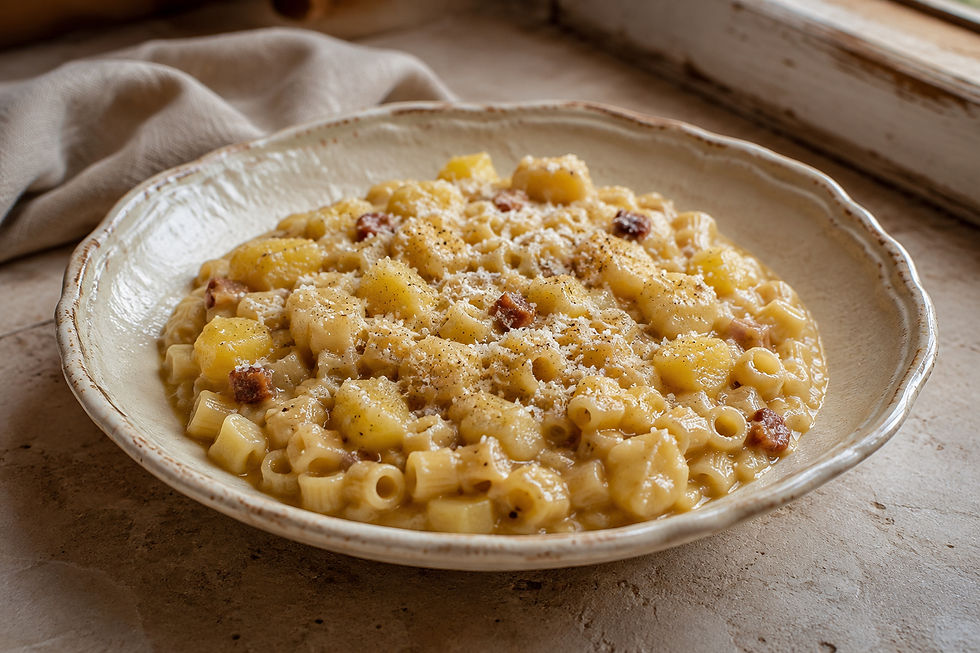
Serve on warm plates, around 130°F (55°C), never hot ones, since a scorching plate keeps cooking the underside and dulls the oregano. A finished portion should show a dark crisp lid, a pale band of potato and pasta bound together, and a thin line of darker caramelised material where the layers met the clay. Add a last grating of pecorino and one thread of raw olive oil over the cut face.
Professional Technique
The controlling technique here is hydration budgeting, and it is the reason the dish either works or fails. Three components compete for the same liquid: pasta boiled for half its time that still needs to absorb roughly its own weight in water, potato slices that release moisture as their cells break down, and breadcrumbs that must end up dry. The 1 1/4 cups of reserved pasta water is calculated against the first two, and it is pasta water specifically because the dissolved starch thickens the liquid as it is taken up, so the dish sets rather than pooling.
The covered and uncovered sequence is the second half of the same idea. With the cover on, moisture that leaves the potatoes cannot escape the dish, so it condenses and is driven back down into the pasta, cooking it evenly from every side. The moment the cover comes off the direction reverses: evaporation pulls the remaining free liquid upward, the crumb layer dries, and the onion sugars and the milk solids in the pecorino brown. Skipping the covered stage leaves a scorched lid over chalky pasta.
Texture and Moisture Control
Four textures have to coexist in a single dish: a brittle crumb lid, potatoes soft enough to give under a fork but still sliceable, pasta at the firm side of al dente, and a binding that is creamy without any cream in it. The binding is pure starch chemistry. Potato granules swell and burst at around 150°F (65°C), releasing amylose into the liquid, where the starch from the pasta water joins it. What reads as creaminess is that gel holding oil and cheese fat in suspension. Rinsing the potatoes too thoroughly, or using floury baking potatoes, destroys it in opposite directions.
Moisture also has to be controlled by geometry, not just by volume. Pasta layers go in the middle of the dish, never at the top or against the base, because a tube exposed to dry oven air dries into something hard and glassy while a tube pressed against the hot clay scorches. Potatoes take both positions and tolerate them. The liquid sits low, so the upper potatoes cook in steam and the lower ones almost braise. If the surface looks dry under cover, add nothing: the liquid is where it should be, underneath.
Professional Mise en Place
Almost everything can be staged in advance. The only step with real timing pressure is the layering, which has to happen while the pasta is still hot and pliable.
Equipment and tools
Shallow terracotta or earthenware dish, about 10 inches (25 cm), with a lid or foil
Mandoline or a steady hand and a thin bladed knife for the potatoes
Wide low sided pan for the onion and tomato
Large pot for the pasta, plus a measuring jug for the reserved water
Flat serving spatula and a sharp knife for portioning
Prepared ahead
Onion and tomato mixture, cooked and cooled, up to 2 days ahead, refrigerated
Breadcrumb and pecorino topping, mixed dry and kept in a sealed jar, up to 3 days
Pecorino grated the same day, kept covered so it does not dry to dust
Potatoes sliced no more than 30 minutes ahead and held in cold water, then dried
Service setup
Oven brought to full temperature at least 20 minutes before the dish goes in
Reserved pasta water measured into a jug and kept hot
Layering components lined up in the order they go into the dish
Plates warm but not hot, and the resting timer set for 10 minutes
Chef Tips
Choose waxy yellow potatoes and ignore anything sold for baking. High starch varieties fall apart into a paste once they meet acid and forty five minutes of heat, and the layers vanish. A firm yellow potato holds its outline, gives up starch slowly, and lets you cut a clean square at the table.
If you cannot find pecorino crotonese, use a well aged Sardinian pecorino rather than a young Roman one. What matters is dryness, not region: a cheese old enough to grate into powder melts into the starch, while a moist young pecorino turns elastic and pulls into strings between the layers.
For a version suitable for vegetarians, look for a pecorino made with microbial rennet, now produced by several Italian dairies and clearly marked on the label. Everything else in the dish is already meatless, and this single substitution changes nothing about the way it cooks or the way it tastes.
If you only own a metal baking dish, compensate for it. Metal conducts far faster than clay, so drop the oven by 25°F (15°C), add five minutes to the covered stage, and use a low rack. You will not get the same base crust, but you will avoid burning it.
Common Mistakes
Boiling the pasta to al dente before assembling. It then spends 45 minutes absorbing liquid in the oven and arrives at the table swollen and soft. Half the package time is the correct figure, and the pasta should still be visibly rigid when it goes into the dish.
Using plain water instead of reserved pasta water. Plain water contributes no starch, so nothing thickens as it is absorbed and the layers sit in a thin liquid that never sets. The cloudy water from the pot is a working ingredient, not a leftover.
Covering the potatoes completely with liquid. The dish then steams throughout, the crumb lid goes soggy from below, and the surface never browns. The liquid should remain visible between the top potatoes without rising over them.
Browning the onion. Caramelised onion sugars turn frankly bitter over a long bake, and that bitterness spreads through every layer. Cook the onion slowly until translucent and stop there, even if it looks underdone in the pan.
Cutting into it straight from the oven. The starch gel has not set yet, so the portion collapses and the liquid runs out across the plate. Ten minutes of rest is the difference between a slice and a spoonful.
Wine Pairing
Cirò Bianco DOC: The local white and the most straightforward answer. Made from Greco Bianco on the Ionian side of Calabria, it carries a firm citrus acidity and a faintly saline finish that cuts through the olive oil and the fat of the aged pecorino without erasing them. Its modest weight is an advantage against a dish already heavy with potato starch.
Melissa Bianco DOC: From the hills immediately north of Cirò, and a slightly softer proposition. The Greco fruit is riper here and there is a gentle bitter almond note on the close that answers the toasted breadcrumb crust directly. Serve it around 50°F (10°C), cool enough to keep the acidity alert against the oregano and the chilli.
Bivongi Bianco DOC: A small denomination from the Stilaro valley, usually built on Greco with Malvasia and Guardavalle in support, which gives it more aromatic lift than its neighbours. That floral edge works well with the sweetness the slow cooked red onion brings, while the underlying acidity handles the tomato. Worth seeking out if you want the pairing to feel specific.
Cirò Rosso Classico DOC: The Gaglioppo red for anyone who wants one with a baked primo. It has high acidity, dusty rather than grippy tannin and a dried herb character that runs alongside the oregano. Serve it at 60°F (16°C) and choose an unoaked bottling, since oak and pecorino crotonese collide badly.
Etna Bianco DOC: A step across the strait and the most mineral option on the list. Carricante grown on volcanic soil gives a taut lemon and wet stone profile with real length, and that precision lifts a dish whose flavours are all soft and rounded. It is the choice when the pecorino is very old and needs cutting rather than accompanying.
Storage & Reheating
This dish keeps better than most baked pasta because the starch has already set. Cover the cooled tijeddra tightly or move portions to an airtight container and refrigerate for up to 3 days. Do not leave it at room temperature longer than two hours after baking, since a dense layered dish cools slowly through the middle.
Reheat it in the oven and nowhere else. Set the portion in a small dish, add a tablespoon of water at the side rather than over the crust, cover loosely with foil and warm it at 350°F (175°C) for 15 to 18 minutes, then uncover for the last 4 minutes to bring the crumb back. A microwave turns the crust to leather and a stove pan burns the base before the centre is warm.
It freezes acceptably in portions for up to 2 months, wrapped closely and then bagged. Thaw overnight in the refrigerator, never reheat from frozen, because the outside dries long before the centre is warm. The potatoes will be softer afterwards. Rebuild the crust with a fresh spoonful of oiled breadcrumbs during the uncovered minutes.
Nutrition
Per serving, based on 4 generous portions:
Calories: 620 kcal
Total Fat: 27 g
Saturated Fat: 8 g
Trans Fat: 0 g
Unsaturated Fat: 18 g
Cholesterol: 25 mg
Sodium: 780 mg
Total Carbohydrates: 78 g
Fiber: 6 g
Total Sugars: 7 g
Added Sugars: 0 g
Protein: 20 g
Lactose: 0.4 g
Principal micronutrients: potassium, vitamin C, calcium, phosphorus, vitamin B6, iron
These figures are estimates. Most of the salt used for the pasta water is poured away, so the sodium depends far more on how salty the pecorino is than on the seasoning added at the layering stage.




Comments