
Italian Sardinian Mutton with Potatoes and Onions | Pecora in Cappotto alla Barbaricina

Pecora in cappotto is what the Barbagia does with a sheep that has finished its working life. An adult ewe, five or six years old and past milking, is cut up and put into a tall pot with cold water, potatoes and onions, and left there for hours over the gentlest heat.
Nothing is browned and nothing is thickened. The coat that gives the dish its name is the vegetables themselves, and the reward for the waiting is a broth that sets to jelly overnight.
Yield: 6 servings. Prep: 30 minutes. Cook: 3 hours 30 minutes. Rest: 20 minutes. Total: about 4 hours 20 minutes. Difficulty: intermediate. Course: secondo piatto. Region: Sardinia, the Barbagia and the highlands around Nuoro.
The Story
The Barbagia is the mountain interior of Sardinia, the country of Nuoro, Fonni, Orgosolo, Gavoi and Mamoiada, and its shepherding has never been about meat. The island carries more sheep than people, and nearly all of them are milk animals. A flock there exists to make milk, and the milk becomes Fiore Sardo and Pecorino Sardo, cheeses that paid the rent for centuries. A ewe earns her keep while she lambs and milks, and somewhere around her fifth or sixth year she stops. That animal is not a roast and was never treated as one. She is a pot of food for a family, and pecora in cappotto is the dish written around her.
The name means sheep in a coat, and Sardinian households disagree pleasantly about which coat is meant. Some say it is the layer of potatoes and onions heaped over the meat, which buries it and stops the surface drying out. Others say it is the lid and the blanket of steam trapped under it. Both readings describe the same method. The pot went onto the embers at the edge of the hearth, or into the ash beside the fire in the pinnette, the stone and juniper huts of the high pastures, and then it was left alone. This is a recipe built for a cook who had a flock to mind and could not stand over a stove.
It is still served in two acts. The broth comes first, poured over pane carasau or with a handful of fregola dropped into it, and the meat follows with its potatoes and onions, coarse salt and pepper on the table. Nothing is wasted at either end: what is left of the broth goes into the next day's pasta or is eaten cold, set, straight from the bowl. In the villages of the interior the dish belongs to the cold months and to the long Sunday, while porceddu on the spit takes the feast days.
That division tells you something true about the island. Roasting is for occasions and for guests, and it is what visitors are shown. The boiled pot is what the house actually ate, week after week, and it is the older of the two methods by a long way. Mountain Sardinia cooked by water and embers far more than by grill, and pecora in cappotto is that cooking in its plainest and most complete form.
Ingredients
Ask the butcher for adult sheep, not lamb and not hogget, bone in, from the shoulder, neck, breast and leg together. The mixture of cuts is what gives the broth its body.
For the sheep
Adult mutton, bone in, cut into large pieces, 3 1/2 lb (1.6 kg)
Cold water, 3 qt (2.8 L)
Coarse sea salt, 1 tbsp (18 g), plus more to finish
Bay leaves, 2
Black peppercorns, 8
For the cappotto
Waxy potatoes, peeled and cut into large chunks, 1 3/4 lb (800 g)
Yellow onions, peeled and quartered, 14 oz (400 g)
Celery stalks, cut in half, 2
Carrot, cut into thick rounds, 1 medium
Ripe plum tomatoes, halved, 2, or peeled tomatoes, 1/2 cup (120 g)
Garlic cloves, unpeeled, 2
Wild fennel fronds, a small handful, or 1 tsp (2 g) fennel seed
For finishing
Extra virgin olive oil, 3 tbsp (45 ml)
Flat leaf parsley, chopped, 2 tbsp (6 g)
Freshly ground black pepper, to taste
Coarse sea salt, for the table
Pane carasau or crusty bread, to serve
Preparation
Step 1
Trim and portion the sheep. Cut the meat into pieces of roughly 4 oz (115 g), keeping every bone in place, and leave the tendons and the silverskin alone: they are collagen and they are working for you. Take off only the hard external fat, which carries most of the mutton smell people object to, and leave the marbling and the soft fat inside the muscle. Rinse the pieces in cold water and drain them well.
Step 2
Start in cold water and skim. Put the meat into a tall heavy pot, cover it with the 3 qt (2.8 L) of cold water and set it over low heat. A cold start draws the soluble proteins out slowly so they rise as a grey foam instead of setting into the broth as cloud. Bring it to 190°F (88°C) over about 30 minutes and skim the surface with a ladle every few minutes until the foam stops forming.
Step 3
Set the simmer and forget it. Add the bay leaves and the peppercorns and hold the pot between 185°F and 195°F (85°C and 90°C), a heat where a bubble breaks the surface every second or two and the water never rolls. Set the lid slightly ajar and cook for 2 hours. A rolling boil at this stage agitates the fat into the liquid and tightens the muscle fibre, and both faults are permanent.
Step 4
Salt the pot and add the aromatics. At the 2 hour mark add the tablespoon of coarse salt, the celery, the carrot, the garlic, the tomatoes and the wild fennel. Salting late is deliberate: early salt draws moisture out of muscle that has not yet begun converting its collagen, and the meat tightens. The tomatoes go in now too, since an hour and a half is all their acidity needs.
Step 5
Build the coat. After another 45 minutes the meat should be tender at the edges and still gripping the bone. Lay the quartered onions over it, then the potato chunks on top of the onions so the potatoes sit in steam rather than in liquid. Do not stir any of it in. This is the cappotto: the onions collapse into the broth and sweeten it while the potatoes cook through and hold their shape. Cover the pot properly now and cook 35 to 45 minutes more.
Step 6
Skim the fat and check the meat. Adult sheep releases a great deal of fat and it all collects on top. Draw it off with a wide shallow spoon, tilting the pot, and take most but not all of it: a thin film keeps the surface of the broth from cooling. Test a thick piece with a skewer, which should enter with no resistance while the meat stays attached to the bone in one piece. Mutton does not overcook, it simply falls apart, so err long.
Step 7
Rest the pot off the heat. Slide the pot off the burner, cover it and leave it alone for 20 minutes. The broth stops moving, the remaining fat rises clear and comes off in a second pass with the spoon, and the meat reabsorbs liquid as it drops below serving temperature. The potatoes finish cooking here on residual heat, which is the safest way to get them soft without collapse. Correct the salt only now.
Plating
Serve it in two acts, the way the Barbagia does. Ladle the strained broth into warm bowls first, over a broken sheet of pane carasau, with a thread of olive oil and nothing else. The broth is the reason the dish took four hours and it deserves to be met on its own.
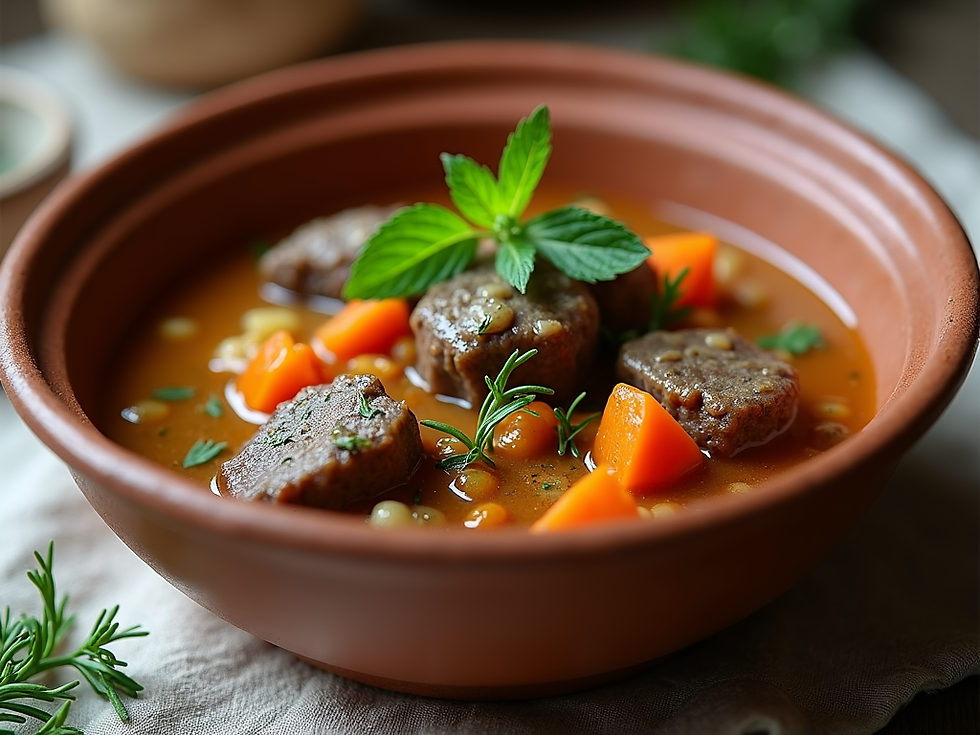
Then the meat, on a warm platter or in wide shallow bowls with a little broth spooned around it rather than over it. Two pieces per person, bone included, the onions beside them and the potatoes on top where they can be seen. Finish with chopped parsley, black pepper and raw olive oil, and put coarse sea salt on the table so each person seasons the meat directly. No sauce and no garnish: this dish looks like what it is.
Professional Technique
Everything difficult about this recipe comes from the age of the animal. A five year old ewe has spent those years walking mountain pasture, and her muscle is bound by connective tissue that is both far more abundant and chemically tougher than a lamb's. Collagen keeps building cross links between its fibrils as an animal ages, and those mature cross links are what make old sheep resist every shortcut: no marinade and no acid will touch them. Lamb is the opposite case. Tender at 145°F (63°C), lean and low in collagen, it dries out long before any conversion could begin, so the pot that rescues an ewe would ruin her lambs.
Collagen becomes gelatin by hydrolysis, a slow reaction that needs water, temperature and time together. It begins in earnest around 160°F (71°C) and runs usefully between 180°F and 195°F (82°C and 90°C), which is the band this recipe holds for three and a half hours. Higher heat does not help: above a rolling boil the fibres contract and squeeze out the water the reaction needs, and the fat emulsifies into the broth. Old cross linked collagen simply needs more hours in that band than young meat does, so time, not temperature, is the variable you are allowed to increase.
The broth tells you when the conversion has happened, and it says so in three ways. Dip a ladle and watch the liquid sheet off it rather than run off in drops. Press your lips together after a spoonful and feel a faint tackiness, which is dissolved gelatin. Then chill a spoonful in a saucer: in twenty minutes a properly converted broth sets to a soft jelly. Gelatin in the broth means gelatin between the muscle fibres, and that is where the tenderness and the moisture come from.
Texture and Moisture Control
There is no Maillard reaction anywhere in this dish and it is important not to miss that. No searing, no browning, no fond in the pot. Every bit of savour is extracted rather than created, which means the water does the work and the seasoning arrives at the end.
The meat stays moist for a counterintuitive reason: it has lost a great deal of water by the time it is done, and what makes it eat as juicy is the gelatin now sitting between the fibres, holding liquid in a soft matrix that reads as moisture on the palate. Anything that drives the fibres to contract harder costs you that, which is the real argument against the boil. Fat is a separate problem: adult sheep renders a lot of it, and fat left on the broth is what makes people call mutton strong.
Potatoes are the most fragile thing in the pot. Use a waxy variety, cut the chunks large, keep them above the onions and out of the liquid, and never stir after they go in. A floury potato left in simmering broth for 40 minutes dissolves at the edges and thickens everything into starchy porridge. Onions are meant to do the opposite: they are the sweetness that balances a strongly flavoured meat.
Professional Mise en Place
This is a four hour dish with almost no active work, so the mise en place is mostly about timing the additions and having the skimming tools within reach.
Equipment and tools
Tall heavy pot or earthenware casserole with a lid, 8 qt (7.5 L)
Probe thermometer, to hold the pot below a simmer
Wide shallow skimming spoon and a ladle
Fine mesh sieve for straining the broth
Metal skewer for testing the meat
Prepared ahead
Meat cut, hard fat removed, rinsed and drained, the day before
The whole dish cooked a day ahead, which improves it and makes the fat easy to lift
Vegetables peeled and cut, potatoes held in cold water, up to 4 hours ahead
Broth strained and chilled separately if you are serving in two courses
Service setup
Broth held hot and tasted for salt at the last moment
Bowls and the meat platter warmed, since this dish cools quickly
Pane carasau broken and kept dry away from steam
Olive oil, coarse salt, pepper and parsley on the table
Chef Tips
Cook it the day before. The fat lifts off the cold broth in a solid sheet, the meat reabsorbs liquid overnight, and onion and fennel settle into each other. Reheat gently and add fresh potatoes.
Blame the hard fat, not the meat, for the mutton smell. The strong flavour people associate with old sheep sits in the external fat and in the broth it has emulsified into. Trim generously, skim twice, and the meat tastes deep and clean.
Ask for a mixture of cuts and insist on the bones. Neck and shoulder bring collagen, the breast brings fat, the leg brings meat that holds together. One cut alone gives you either a thin broth or meat that shreds into nothing.
Wild fennel is the Sardinian note and it is worth hunting for. Fresh fronds go in with the aromatics, and out of season a teaspoon of seed crushed in a mortar does the same job.
Common Mistakes
Using lamb instead of adult sheep. The recipe is engineered around old collagen, and three and a half hours will reduce lamb to dry shreds in a watery broth. This is not the dish to make with it.
Letting the pot boil. A rolling boil contracts the muscle, emulsifies the fat and turns the broth cloudy, and none of the three can be corrected afterwards. Hold it where a bubble surfaces every second or two.
Salting at the start. Salt added before the collagen begins to convert draws water out of the muscle and tightens it. Add the coarse salt at the 2 hour mark and season only at the very end.
Floury potatoes, or stirring them in. They disintegrate into the broth and thicken it into starchy soup. Use waxy potatoes, cut them large, lay them over the onions and leave the pot alone.
Skimming only once, or not at all. Adult sheep renders far more fat than any other braise, and fat left on the surface is what makes the dish taste heavy. Skim during cooking and again after the rest.
Wine Pairing
Cannonau di Sardegna DOC: The wine of the Barbagia itself and the pairing this dish grew up beside. Cannonau carries warm red fruit with a dried herb and undergrowth edge that answers the wild fennel directly, while its tannin, ripe rather than gripping, cuts the rendered sheep fat without adding hardness to a dish that has no acidity of its own. Look for a bottling from Nuoro province and serve it at 61°F (16°C).
Campidano di Terralba DOC: Made from Bovale in the southern plains, and the lighter Sardinian answer for anyone who finds Cannonau heavy against a boiled dish. Brisker acidity, a leaner frame and a faintly savoury finish: that acidity refreshes the palate between mouthfuls of gelatinous broth in a way a fuller red cannot. Serve it cool, around 59°F (15°C).
Alghero DOC: The red bottlings of this northwestern appellation, Cagnulari above all, are firmer in tannin and darker in fruit than Cannonau. That structure suits the meat rather than the broth, so pour it with the second course when the mutton and potatoes arrive. Its slightly peppery finish works with the black pepper and the coarse salt applied at the table.
Cirò Rosso Classico DOC: A mainland alternative that shares the right anatomy. Gaglioppo is pale but sharply savoury, with high acidity, moderate tannin and a bitter herbal finish, and it behaves with long simmered lamb and mutton across the south for exactly that reason. It handles the fat by acidity instead of tannin, which keeps the palate clean without ever overpowering the vegetables.
Storage & Reheating
Keep the meat and vegetables in their broth in a covered container in the refrigerator for up to 3 days. The fat sets into a firm disc and lifts off in one piece, which is the most thorough skimming you will ever do, and the broth underneath should be a soft jelly.
Reheat on the stove over low heat, covered, about 20 minutes from cold. Never let it boil again and never microwave the meat, which drives water out of fibres that have no reserves left. If the potatoes have gone too soft, lift them out and cook fresh ones in the hot broth.
It freezes for up to 3 months, meat and broth together and never the meat dry, but leave the potatoes out since they turn grainy on thawing. The broth alone freezes beautifully in portions.
Nutrition
Per serving, based on 6 servings with the fat skimmed twice:
Calories: 620 kcal
Total Fat: 34 g
Saturated Fat: 14 g
Trans Fat: 0.3 g
Unsaturated Fat: 18 g
Cholesterol: 150 mg
Sodium: 780 mg
Total Carbohydrates: 28 g
Fiber: 4 g
Total Sugars: 5 g
Added Sugars: 0 g
Protein: 48 g
Lactose: 0 g
Principal micronutrients: iron, zinc, vitamin B12, selenium, phosphorus
These are estimates: how thoroughly you skim the fat changes the calorie count by a wide margin.




Comments