
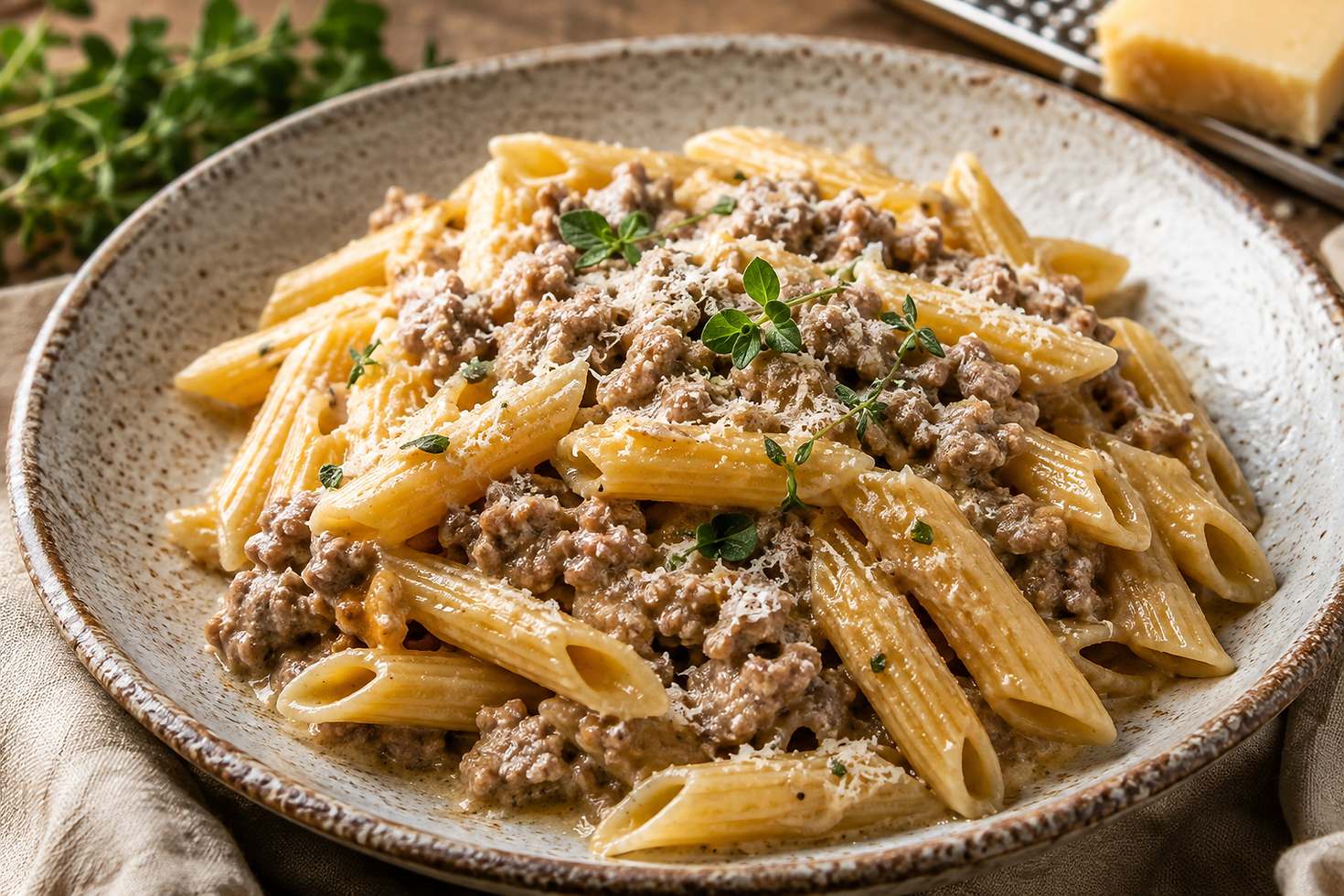
Italian Penne with Umbrian Sausage, Black Truffle and Pecorino di Norcia | Penne con Salsiccia Umbra, Tartufo Nero e Pecorino di Norcia

Norcia sells three things to the rest of Italy and has done for centuries: cured pork, black truffles and sheep cheese. This plate of penne is what happens when a cook stops treating them as separate luxuries and puts them in one pan. Crumbled Umbrian sausage renders its fat, grated tartufo nero goes into that warm fat rather than onto the finished plate, and aged Pecorino di Norcia melts into the starch at the end.
Penne are the right tube here for a reason that has nothing to do with fashion. This is not a coating sauce, it is a sauce of small solid pieces, and those pieces need somewhere to go. The hollow centre of a penna traps crumbs of sausage and flecks of truffle instead of letting them fall to the bottom of the bowl, and the diagonal cut gives the fat a wide opening.
The difficulty sits entirely in temperature discipline. Black truffle gives everything at around body heat and nothing once fried, and aged pecorino turns stringy against a pan that is too hot. Almost every instruction below exists to keep the heat lower than instinct suggests.
Yield: 4 servings. Prep: 20 minutes. Cook: 25 minutes. Total: about 45 minutes. Difficulty: intermediate. Course: primo piatto. Region: Umbria, the Valnerina and the plateaus around Norcia.
The Story
Norcia sits at the edge of the Sibillini mountains at around 2,000 feet, in a corner of Umbria that has butchered pigs for so long that the Italian word for a pork butcher, norcino, is the name of the town turned into a trade. Men from the Valnerina travelled to Rome and Florence every winter to cure the pigs of households with no one skilled enough to do it. Umbrian sausage descends from that trade: coarsely ground, heavily salted, perfumed with black pepper, garlic and often wild fennel, and never sweet.
The black truffle is the other half of the local economy and a different creature from the famous white one of Alba. Tuber melanosporum grows under the oaks of these limestone slopes through winter, and unlike the white truffle it is not ruined by heat. It wants heat. Warm fat opens it and releases an aroma of damp earth, cocoa and iron that stays shut if it is shaved cold over a plate. Norcia has known this for generations.
Pecorino di Norcia completes the set. Sheep have grazed the Castelluccio plateau above the town for as long as pigs have been cured below it, and their cheese is drier and more savoury than the pecorini of Sardinia or Lazio, with a lactic sharpness that cuts pork fat cleanly. Putting the three together is not a chef invention. It is what a Valnerina family eats when the men come back from the hills.
Ingredients
For the pasta
Penne rigate, bronze die, 14 oz (400 g)
Water for boiling, 5 quarts (4.7 litres)
Coarse sea salt, 2 tbsp (35 g)
For the sauce
Umbrian pork sausage, casings removed, 10 oz (285 g)
Fresh black truffle, tartufo nero, 1 oz (28 g)
Extra virgin olive oil, 3 tbsp (45 ml)
Unsalted butter, cold, 2 tbsp (28 g)
Garlic clove, peeled and left whole, 1
Dry white wine, 1/3 cup (80 ml)
Anchovy fillet in oil, 1 small
Freshly ground black pepper, 1/2 tsp (1 g)
For finishing
Pecorino di Norcia, aged, finely grated, 2 1/2 oz (70 g)
Reserved pasta cooking water, about 1 cup (240 ml)
Fresh black truffle for shaving at the table, 1/4 oz (7 g)
Flat leaf parsley, chopped very fine, 1 tsp
Extra virgin olive oil, a few drops per plate
Preparation
Step 1
Clean and divide the truffle. Brush it under a thin trickle of cold water, working into every fold, then dry it completely. Never soak it. Grate the larger 1 oz (28 g) piece on a fine microplane and keep the smaller 1/4 oz (7 g) piece whole for shaving at the table. The grated portion goes into hot fat and builds aroma into the sauce, the whole piece goes onto the plate raw and gives perfume.
Step 2
Infuse the fat. Put the olive oil, the whole garlic clove and the anchovy fillet into a wide sauté pan over low heat for 4 or 5 minutes, pressing the anchovy until it dissolves and leaves no visible trace. It is not there to taste of fish: it adds glutamate that makes pork and pecorino read deeper, and one fillet across four portions is undetectable as itself. Discard the garlic once pale gold.
Step 3
Render the sausage. Raise the heat to medium and add the sausage, breaking it into rough hazelnut sized pieces rather than crumbling it to powder, so the texture survives being tossed with pasta. Cook for 6 to 8 minutes without stirring constantly, letting the pieces take colour on one face before you move them. The fat that comes out is the body of the sauce, so pour none of it away.
Step 4
Deglaze with white wine. Pour in the wine and raise the heat so it bubbles hard, scraping the base of the pan to lift every brown spot the sausage has left. That residue is concentrated pork flavour and belongs in the sauce. Reduce until the pan is almost dry, about 2 minutes. Grind in the black pepper, then take the pan off the heat and let it stand.
Step 5
Boil the penne and keep the water. Bring the water to a rolling boil and salt it with the full 2 tbsp (35 g), so it tastes distinctly of the sea: this sauce carries little salt of its own. Drop the penne, stir once, and set a timer for 2 minutes less than the shortest time on the box. Before draining, ladle 1 cup (240 ml) of the cloudy water into a jug and keep it by the stove. Its starch binds pork fat to sheep cheese.
Step 6
Marry pasta and sauce. Return the pan to medium heat. Lift the penne straight from the pot with a spider, bringing a little water with them, and add a ladle of the reserved water. Toss hard and continuously for 90 seconds to 2 minutes so the starch works. The liquid goes from thin and watery to glossy and slightly thick. Finish the cooking here, so the pasta absorbs pork fat instead of plain water.
Step 7
Add truffle, butter and pecorino off the heat. Take the pan off the stove and wait 20 seconds for the surface to stop bubbling. Add the cold butter, the grated truffle and two thirds of the pecorino, tossing continuously and adding cooking water a spoonful at a time. The pause and the cold butter keep the cheese from seizing, and the lower temperature keeps the truffle aroma in the pan rather than up the extractor hood. Taste, correct the salt, serve within a minute.
Plating
Warm the bowls properly. A cold bowl drops the temperature of a starch and cheese emulsion within seconds and turns a glossy sauce dull before it reaches the table. Run them under hot water or hold them in a low oven, then dry them. Use wide shallow bowls, so the penne sit in one layer.
Portion into a low mound in the centre rather than spreading the pasta flat. Toss the pan again between portions, because the sausage sinks and the fourth bowl will otherwise be all pasta and no pork. Scrape the pan out: every remaining spoonful of that emulsion is worth more than a garnish.
Finish at the table and finish quickly. Shave the reserved raw truffle over each bowl so the slices land almost transparent, scatter the remaining pecorino, add the parsley and a few drops of olive oil, and carry them out at once. The minute between pan and first mouthful is when this dish is at its best.
Professional Technique
The controlling technique here is the split treatment of one ingredient. Black truffle carries two categories of aromatic compound: heavy, earthy, sulphur bearing molecules that need fat and warmth to be released, and light volatile ones that vanish the moment they meet heat. Grating one portion into warm pork fat builds the first group into the sauce. Shaving the second raw at the table delivers the other straight to the nose. Do only one and the dish loses half its range, which is why truffle merely shaved over plain pasta smells expensive and tastes of little.
The second technique is an emulsion built on pork fat rather than butter or cream. Rendered sausage fat is largely oleic and palmitic and behaves unlike dairy fat: it sets hard as it cools and resists binding with water unless starch mediates. That is why the cooking water goes in by stages with violent agitation. Each addition holds a little more fat in suspension, and the energy of tossing keeps breaking it into droplets small enough to stay there.
The third is the cheese window. Pecorino di Norcia is a hard, aged, low moisture sheep cheese whose protein network tightens sharply above about 150°F (65°C), expelling fat into the stringy clumps every cook recognises. Taking the pan off, waiting twenty seconds and adding cold butter alongside the cheese drops it into the narrow band where casein melts smoothly. It is the physics behind cacio e pepe, applied to a sauce already carrying fat of its own.
Texture and Moisture Control
Three textures have to arrive together: the pasta firm, the sausage yielding but distinct, the sauce glossy and mobile. The pasta is easiest to get wrong because it keeps cooking in the pan. Pulling the penne a full 2 minutes early feels premature and is correct: those minutes finish the starch while the tube absorbs pork fat and salted water.
The sauce should coat the back of a spoon and slide, never sit. If it pools at the bottom of the pan it has too much water and not enough agitation, so keep tossing over gentle heat. If it looks tight, dull and pasty it has too much starch, and a spoonful of hot cooking water rescues it at once. Both corrections happen in the pan, never in the bowl.
Moisture inside the sausage matters as much as moisture in the sauce. Cook the pieces past about 10 minutes and they dry into hard granules that rattle against the penne. Take them off while the centres are juicy, remembering they sit in a hot pan through the deglazing and again through the final toss. The pause after the wine reduces lets them relax and reabsorb the juice they pushed out.
Professional Mise en Place
The last four minutes run continuously and leave no time to fetch anything, so everything below is in place before the pasta water boils.
Equipment and tools
Heavy based sauté pan, 12 inches (30 cm)
Large pot for the pasta and a spider or slotted scoop
Fine microplane for grating and a truffle slicer for shaving
Soft brush for the truffle and a heatproof jug for the cooking water
Wooden spoon and warmed shallow bowls
Prepared ahead
Truffle brushed, dried and divided into grated and whole portions, on the day
Sausage removed from its casings and broken into hazelnut sized pieces
Pecorino grated fine and split into the two thirds and one third portions
Anchovy, garlic and olive oil measured into the pan
Wine measured, pepper ground, parsley chopped
Service setup
Pasta water salted and boiling before the sausage goes in
Cooking water jug beside the stove
Cold butter cut and waiting on the board
Bowls warm and dry, truffle slicer on the pass
All four bowls going out together, with no holding time
Chef Tips
Buy the truffle by smell, never by looks. A good winter tartufo nero is heavy for its size, firm under the thumb and smells clearly of wet earth and cocoa. If it smells of nothing across the counter it will taste of nothing on the plate, whatever the price ticket says. One gone soft at either end is past use.
If genuine Umbrian sausage is out of reach, buy coarse ground pork and season it yourself with salt, cracked black pepper and a pinch of crushed wild fennel seed. That gets far closer than a supermarket sweet Italian sausage, which carries sugar and herbs that fight the truffle. Avoid anything labelled spicy: chilli heat flattens truffle aroma completely.
Keep a truffle refrigerated in absorbent paper inside a sealed jar and change the paper daily. Rice is the traditional storage medium and a poor one: it pulls moisture out too hard and ends up more perfumed than the truffle. Use it within four days.
Grate the pecorino yourself on the day and grate it fine. Preground sheep cheese carries anti caking agents that refuse to melt into the starch and leave a chalky residue. A fine grate melts in seconds at a lower temperature, which is the margin this sauce depends on.
Common Mistakes
Frying the grated truffle in a hot pan. Black truffle tolerates warmth but not real heat. A pan above 200°F (95°C) drives off the aromatics in seconds and leaves something that tastes vaguely of mushroom.
Adding the pecorino while the pan is on the flame. Above about 150°F (65°C) the proteins in an aged sheep cheese contract and expel fat, giving stringy clumps and an oily film. Count twenty seconds off the heat first.
Draining the pasta and discarding the water. Without starch rich cooking water there is nothing to bind pork fat to cheese and the sauce separates into grease and dry pasta. Reserve a full cup before draining.
Cooking the penne to the time on the packet. The pasta finishes in the sauté pan and gains the equivalent of 2 minutes there. Pull it early, firmly al dente with a pale core, and let the pan do the rest.
Washing the truffle under running water. Soaking waterlogs the flesh, dilutes the aroma and shortens an already short life. A soft brush is all it needs.
Using cream to make the sauce cling. Cream buries truffle, masks the sheep cheese and appears nowhere in the Umbrian repertoire. Starch and agitation do the job and leave the flavours legible.
Wine Pairing
Torgiano Rosso Riserva DOCG: The Umbrian red made for this table. Sangiovese led and long aged, it brings sour cherry fruit, dried tobacco and a tannin firm without being abrasive, which is what strips rendered pork fat from the palate between mouthfuls. Its leather and forest floor notes run parallel to the earthy side of the truffle instead of competing with it.
Montefalco Sagrantino DOCG: The most tannic red in Italy, and a bottle that needs a dish this rich to make sense. Sagrantino carries extraordinary polyphenol levels, and against sausage fat and sheep cheese that structure finally has something to bind to. Choose one with six or seven years behind it: a young bottling scours the palate and buries the truffle.
Orvieto Classico DOC: The Umbrian white answer, built on Grechetto and Trebbiano grown on volcanic tufa near the Tiber. Dry, it brings a stony bitterness and brisk acidity that lifts the pork fat without adding weight, while a faint green almond note echoes the savoury edge of the pecorino.
Alto Adige DOC Pinot Nero: An outsider on an Umbrian table and the most sympathetic wine here for the truffle itself. Mountain grown Pinot Nero is light in colour, high in acidity and low in tannin, with red berry fruit over a mushroomy undergrowth note that meets tartufo nero on its own terms. Serve at around 57°F (14°C).
Cesanese del Piglio DOCG: From the Lazio hills just south of the Umbrian border, a red whose peppery, faintly floral profile picks up the black pepper worked into the sausage. Its acidity runs higher than the soft dark fruit suggests, keeping the plate from turning heavy, and the tannin stays fine grained enough to leave the truffle audible.
Storage & Reheating
Dressed pasta stores badly and this one worse than most: the truffle aroma is largely gone within hours and the pecorino emulsion breaks once it chills. Refrigerate leftovers for no more than 24 hours in a shallow airtight container, spread thin rather than heaped.
Reheat in a sauté pan, never in a microwave. Put the pasta in a cold pan with 2 tbsp (30 ml) of water, cover, and warm over low heat for 3 or 4 minutes, shaking rather than stirring, until the sauce loosens and coats again. A microwave boils the fat out of the cheese and leaves the tubes scorched at the edges and cold inside. Add fresh pecorino at the end and, if you have it, a few shavings of raw truffle.
The sausage base freezes well alone. Render it, deglaze it, cool it and freeze it flat for up to 2 months, then thaw overnight in the refrigerator and add truffle, butter and pecorino fresh on the day. Never freeze the finished dish: the pasta turns mealy and the emulsion cannot be brought back.
Nutrition
Per serving, based on 4 servings:
Calories: 760 kcal
Total Fat: 38 g
Saturated Fat: 15 g
Trans Fat: 0 g
Unsaturated Fat: 21 g
Cholesterol: 85 mg
Sodium: 980 mg
Total Carbohydrates: 74 g
Fiber: 4 g
Total Sugars: 3 g
Added Sugars: 0 g
Protein: 31 g
Lactose: 0.6 g
Principal micronutrients: calcium, phosphorus, selenium, zinc, vitamin B12, thiamine, niacin
These figures are estimates. Most of the salt in the pasta water is poured away rather than eaten, and the final sodium depends on how the sausage was cured and how generous the last handful of pecorino is.


Comments