
Italian Penne with White Wild Boar Ragù, Juniper and Tuscan Pecorino | Penne con Ragù Bianco di Cinghiale, Ginepro e Pecorino Toscano

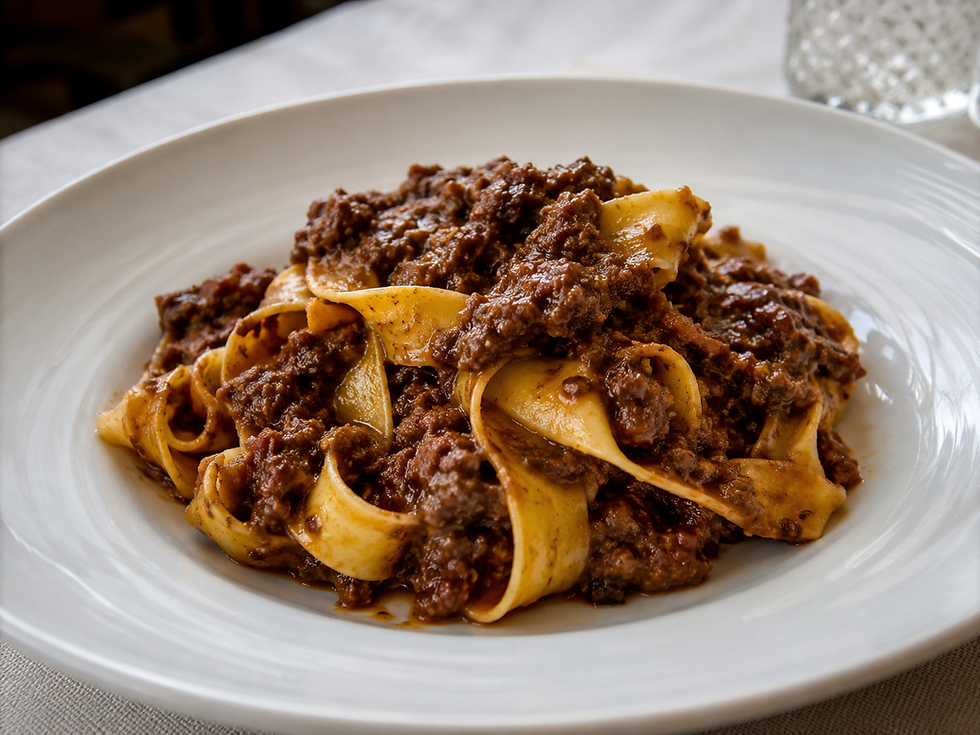
Almost every wild boar sauce in Tuscany is dark: red wine, tomato, a long sullen braise that turns everything the colour of wet earth. This one refuses all of it. The boar is soaked in white wine, cooked with milk and juniper, and finished with Pecorino Toscano, and what arrives in the bowl is the colour of parchment. Strip away the tomato and the animal has nowhere to hide: you taste the boar, the resin of the juniper and the sheep cheese, in that order.
That is also why the method is unforgiving. Boar is leaner and far more strongly flavoured than pork, and a red sauce can bury both faults under acidity and sugar. A pale sauce cannot. The soak, the milk and the crushed juniper are not flourishes, they are the three tools that make an assertive wild animal worth a second bowl.
Penne rigate carry it better than any long noodle. This is a chunky, dry finished sauce with small pieces of meat rather than a silky one, and those pieces need somewhere to go. Ridged tubes trap them at the mouth and hold sauce along the flutes, so a forkful comes up loaded instead of bare. On tagliatelle the same ragù simply falls to the bottom of the plate.
Yield: 4 servings. Prep: 30 minutes plus overnight soaking. Cook: 2 hours 45 minutes. Total: about 3 hours 20 minutes plus the soak. Difficulty: intermediate. Course: primo piatto. Region: Tuscany, the Maremma and the Colline Metallifere.
The Story
Wild boar has been the meat of the Tuscan interior for as long as anyone has written the food down. The animal thrives in the macchia, the dense scrub of holm oak and juniper that covers the Maremma inland from Grosseto, and the autumn braccata, the driven hunt, still empties villages on winter Sundays. A boar is not bought, it is divided: the hunting party splits the animal and every household ends the week with shoulder to cook and a reason to cook it slowly.
The white version is the older habit. Tomato entered Tuscan kitchens seriously only in the nineteenth century, and before that a hunter's sauce meant meat, wine, lard and whatever grew on the hillside. Juniper grows there in quantity, and its berries were used for function rather than elegance: their resinous oils sit directly on top of the muskiness of old boar. Cooks in the Maremma still call the dark version ragù di cinghiale and the pale one in bianco, and they are treated as two different sauces rather than variations.
Pecorino Toscano closes it because the same countryside makes it. The sheep of the Val d'Orcia and the Crete Senesi have grazed alongside the boar for centuries, and the cheese from their milk is gentler and sweeter than Roman or Sardinian pecorino, with a nutty rather than a sharp finish. That mildness matters: a fierce cheese would wrestle the juniper for control of the plate.
Ingredients
For the soak
Boneless wild boar shoulder, 1 3/4 lb (800 g)
Dry white wine, 2 cups (480 ml)
Juniper berries, lightly crushed, 8
Bay leaves, 2
Black peppercorns, 8
Yellow onion, quartered, 1/2
For the white boar ragù
Extra virgin olive oil, 3 tbsp (45 ml)
Pancetta, finely diced, 2 oz (55 g)
Yellow onion, finely diced, 1 medium, about 5 oz (140 g)
Carrot, finely diced, 1 small, about 2 oz (60 g)
Celery, finely diced, 1 stalk, about 2 oz (60 g)
Garlic cloves, lightly crushed, 2
Fresh sage leaves, 6
Fresh rosemary sprig, 1 short
Juniper berries, freshly crushed, 6
Whole milk, 3/4 cup (180 ml)
Dry white wine, fresh, 1/2 cup (120 ml)
Light chicken or game broth, hot, 2 cups (480 ml)
Fine sea salt, 1 1/2 tsp (9 g), divided
Freshly ground black pepper, 1/2 tsp
For the pasta and the finish
Bronze die penne rigate, 14 oz (400 g)
Water, 5 quarts (4.7 liters)
Coarse sea salt, 2 tbsp (35 g)
Pecorino Toscano, aged, finely grated, 2 1/2 oz (70 g)
Unsalted butter, cold, 1 tbsp (14 g)
Extra virgin olive oil, 1 tbsp (15 ml)
Fresh sage leaves, torn, 4
Preparation
Step 1: Soak the boar overnight in white wine
Cut the shoulder into large chunks and submerge them in the white wine with the crushed juniper, bay, peppercorns and quartered onion. Cover and refrigerate 12 to 18 hours. A red wine marinade would stain the meat purple and defeat a pale ragù before it starts, while white wine does the same job of drawing off the strongest gamey compounds without colouring anything. Discard the soaking liquid entirely.
Step 2: Dry and hand chop the meat
Lift the boar out and pat every surface bone dry with paper. Then cut it by hand into pieces of about 1/3 inch (8 mm), a touch larger than you would for pork, because boar shrinks more during braising. A knife rather than a grinder keeps the low fat meat from compacting into a dense pellet. Season it with half the salt and all the pepper.
Step 3: Render the pancetta and build the base
Warm the olive oil in a heavy pot over medium low heat and cook the pancetta for 5 minutes until it gives up its fat but stays pale. Add the onion, carrot, celery and garlic with a pinch of salt and sweat them 12 to 15 minutes until soft and sweet. Boar carries almost no fat of its own, and this rendered pork fat carries everything else. Take out the garlic once it turns fragrant.
Step 4: Colour the meat lightly, not deeply
Push the vegetables aside, raise the heat and add the boar in two batches. Let each batch sit untouched for a minute, then stir until roughly a third of the pieces have taken a light blond colour. Stop there. Boar browns faster than pork and a hard sear pushes it into liver and iron territory that no amount of cheese will soften, besides turning a white sauce grey.
Step 5: Cook the milk in first
Pour the milk over the meat and let it bubble gently, stirring, until it has almost entirely disappeared and the pot looks dry and creamy, about 12 minutes. The milk goes in before the wine, never after, because acid added first would curdle it into visible flecks. The surface may look slightly split here, which is normal.
Step 6: Add the wine, juniper and herbs, then braise
Add the fresh white wine and let it reduce hard for 3 minutes. Stir in the freshly crushed juniper, the sage and the rosemary, then enough hot broth to come two thirds of the way up the meat. Bring it to the barest simmer, cover with the lid slightly ajar and cook 2 hours 15 minutes to 2 hours 30 minutes, topping up with hot broth as needed. It is ready when the boar shreds under a spoon and the sauce is thick and ivory. Remove the rosemary sprig and taste for salt.
Step 7: Cook the penne and reserve the water
Bring the water to a rolling boil and add the coarse salt: aim for water that tastes seasoned rather than briny, since the pancetta and the pecorino are both salty. Drop the penne, stir for 30 seconds, and cook them 2 minutes short of the box time. Snap one in half: a thin pale line should remain at the core. Scoop out 1 1/2 cups (360 ml) of the cooking water and keep it hot before you drain.
Step 8: Finish in the pan with pecorino and sage
Transfer the ragù to a wide sauté pan, slacken it with a ladle of pasta water and tip in the drained penne. Toss briskly for about 2 minutes, adding water in small amounts, until every tube is coated inside and out. Off the heat, work in the cold butter and the olive oil, then the grated Pecorino Toscano in two additions and the torn sage. Serve at once, straight from the pan into warm bowls.
Plating
This is a rustic plate and it should look like one. Serve it in warm shallow bowls, heaped rather than arranged, with pasta and meat visibly mixed. A pale sauce spooned on top reads as unfinished.
Finish with a light snow of Pecorino Toscano, one torn sage leaf per bowl and a thin stream of green olive oil across the surface. Resist parsley, and never use a whole juniper berry as decoration: it is bitter and unpleasant to bite.
Professional Technique
The defining technique is the milk stage, borrowed from Bolognese practice and far more important here than it is there. Wild boar shoulder is very lean, and the casein and calcium in milk work on it in two ways: they bind and carry off some of the volatile compounds responsible for the gamey note, and they help break down the muscle protein so the pieces shred rather than tighten. The order is not negotiable. Milk before acid disappears into the meat; milk after wine splits into curds that never reintegrate.
The second is how the juniper is handled, and it is a timing question. Juniper flavour is carried by volatile terpenes, mostly pinene and myrcene, that evaporate quickly once crushed and even faster in an open pot. That is why the berries appear twice: bruised in the overnight soak, where they work slowly on the raw meat, then freshly crushed at the start of the braise for the resinous top note. Crushing everything at the beginning would leave the finished sauce smelling of pine needles and tasting of nothing.
Texture and Moisture Control
A white boar ragù fails in one of two directions and both are visible before you serve it. Too wet and it slides off the penne into a puddle at the base of the bowl, because there is no tomato pulp to give it grip. Too dry and the lean meat turns to sawdust, since boar has almost no internal fat to keep it juicy. The safe zone is a sauce that mounds on a spoon but still glistens: add the broth hot, in small amounts, never flooding the pot.
The last two minutes are where it comes together. Starch from the pasta water, gelatin from the shoulder and fat from the pancetta, butter and oil emulsify only under constant movement, so the pan is tossed rather than stirred. The pecorino goes in off the heat, in two additions, because Pecorino Toscano is softer and higher in moisture than aged Roman pecorino and clumps rather than melts if it hits a hot pan at once.
Professional Mise en Place
This recipe spans three days if you let it, and it should: soak on day one, braise on day two, serve on day three.
Equipment and tools
Deep non reactive container or a glass bowl for the overnight soak
Heavy braising pot with a lid, 4 to 5 quarts
Mortar and pestle for the juniper, or the flat of a heavy knife
Wide sauté pan, large pasta pot and a heatproof jug for the water
Fine grater for the Pecorino Toscano
Prepared ahead
Boar soaking in white wine, 12 to 18 hours, refrigerated
Ragù braised up to 3 days ahead and refrigerated in its own fat
Soffritto and pancetta diced and kept covered, up to 1 day ahead
Broth portioned, ready to bring up to temperature
Pecorino grated on the day and kept covered
Service setup
Ragù warm over the lowest heat, loosened with a splash of broth
Pasta water boiling and salted, timer set 2 minutes short
Reserved cooking water hot in a jug beside the pan
Butter, oil, cheese and sage portioned within reach
Bowls warming so the sauce does not seize on contact
Chef Tips
Ask the butcher how old the animal was. A young boar under two years needs the overnight soak and nothing more; an older one wants a full 24 hours and two extra juniper berries. If the meat smells strongly in the raw state, it will smell strongly on the plate, and no technique fully erases that.
Crush the juniper for the braise with the flat of a knife rather than grinding it to powder. You want them split so the oils escape into the fat, not dust that turns the sauce bitter. Six berries is the right number for 1 3/4 lb (800 g) of meat, and eight is already too many.
Farmed boar and pork shoulder both work if wild is unavailable, but adjust. Farmed boar is milder and needs only 6 hours of soaking; pork shoulder needs no soak at all and about 40 minutes less braising. Keep the juniper at the same level either way.
Let the finished ragù rest at least overnight before you use it. Juniper and sage need time to settle into the fat, and a sauce eaten straight from the pot tastes sharper and less integrated. This is the rare ragù that is genuinely better on day three.
Common Mistakes
Marinating the boar in red wine. It is the Tuscan reflex and it ruins this dish, staining the meat a dull purple that survives every later step. A white ragù needs a white soak, and white wine draws off the same gamey compounds just as effectively.
Adding the wine before the milk. Acid hitting dairy curdles it into flecks that will not reintegrate over two hours of simmering, leaving a grainy sauce. The milk always goes in first and must be almost fully absorbed before any wine appears.
Searing the boar hard. Lean game browns much faster than pork and tips into an iron, liver like flavour that dominates the plate, quite apart from turning a pale sauce grey. Colour about a third of the pieces blond and stop.
Grinding the juniper to powder. Pulverised berries release everything at once and turn the sauce bitter and vaguely medicinal. Split them open with the flat of a knife so the oils leach slowly into the fat.
Wine Pairing
Chianti Rufina DOCG: The coolest and highest of the Chianti zones, northeast of Florence, and the one that keeps its acidity in warm years. That sour cherry cut is what a fatty, cheese bound sauce needs, and the pine and dried herb edge of Rufina Sangiovese runs parallel to the juniper rather than fighting it. Firm but not heavy, which suits a white ragù far better than a big oaked red.
Carmignano DOCG: The small zone west of Florence where Sangiovese has been blended with Cabernet since long before anyone called it a Super Tuscan. The Cabernet fraction adds a leafy, faintly green note that answers the sage and the juniper directly, while the Sangiovese keeps the acidity high enough to reset the palate.
Vino Nobile di Montepulciano DOCG: Made from Prugnolo Gentile, the local Sangiovese clone, in the same southern Tuscan hills the boar runs through. It is rounder and softer in tannin than Chianti, with dried plum and tobacco depth that flatters long braised meat. Choose a straightforward annata rather than a Riserva, which would out muscle a sauce with no tomato in it.
Rosso di Montalcino DOC: Brunello grapes in a younger, brighter format, and the better option here precisely because it has not spent years in wood. Fresh red fruit and a fine grained tannin scrub the pancetta fat from the palate without imposing oak on a delicate pale sauce. Serve it at around 61°F (16°C).
Vernaccia di San Gimignano DOCG: The Tuscan white, and a genuine option rather than a curiosity, because this ragù carries no tomato and no dark braising flavours to overwhelm it. Vernaccia has unusual structure and a bitter almond finish that picks up the pecorino, and its acidity cuts through milk and rendered pork with real precision.
Storage & Reheating
The ragù keeps in an airtight container in the refrigerator for 4 days, and it improves for three of them. Cool it fast in a wide shallow container rather than the deep pot, and leave the fat layer on top as a seal until you reheat it.
It freezes very well for up to 3 months, but freeze it before any cheese has touched it, in flat portions that thaw fast. Thaw overnight in the refrigerator. Rewarm it in a saucepan over low heat with 3 tablespoons of broth or milk stirred in, since a lean game sauce sets solid when cold and will catch on the base if heated dry.
Dressed pasta holds sealed and refrigerated for 2 days. Reheat it in a wide pan with a splash of water and a little oil, tossing for 2 minutes until it loosens. Avoid the microwave, which dries the boar and breaks the emulsion. Leftovers are also excellent baked: spread them in a dish, cover with more Pecorino Toscano and give them 15 minutes at 400°F (200°C).
Nutrition
Per serving, based on 4 servings:
Calories: 790 kcal
Total Fat: 31 g
Saturated Fat: 12 g
Trans Fat: 0 g
Unsaturated Fat: 17 g
Cholesterol: 140 mg
Sodium: 1020 mg
Total Carbohydrates: 78 g
Fiber: 4 g
Total Sugars: 6 g
Added Sugars: 0 g
Protein: 50 g
Lactose: 2.6 g
Principal micronutrients: iron, zinc, vitamin B12, niacin, selenium, phosphorus, calcium
These are estimates. Wild boar varies enormously in fat with the season, and most of the salt in the pasta water is discarded rather than eaten.


Comments