
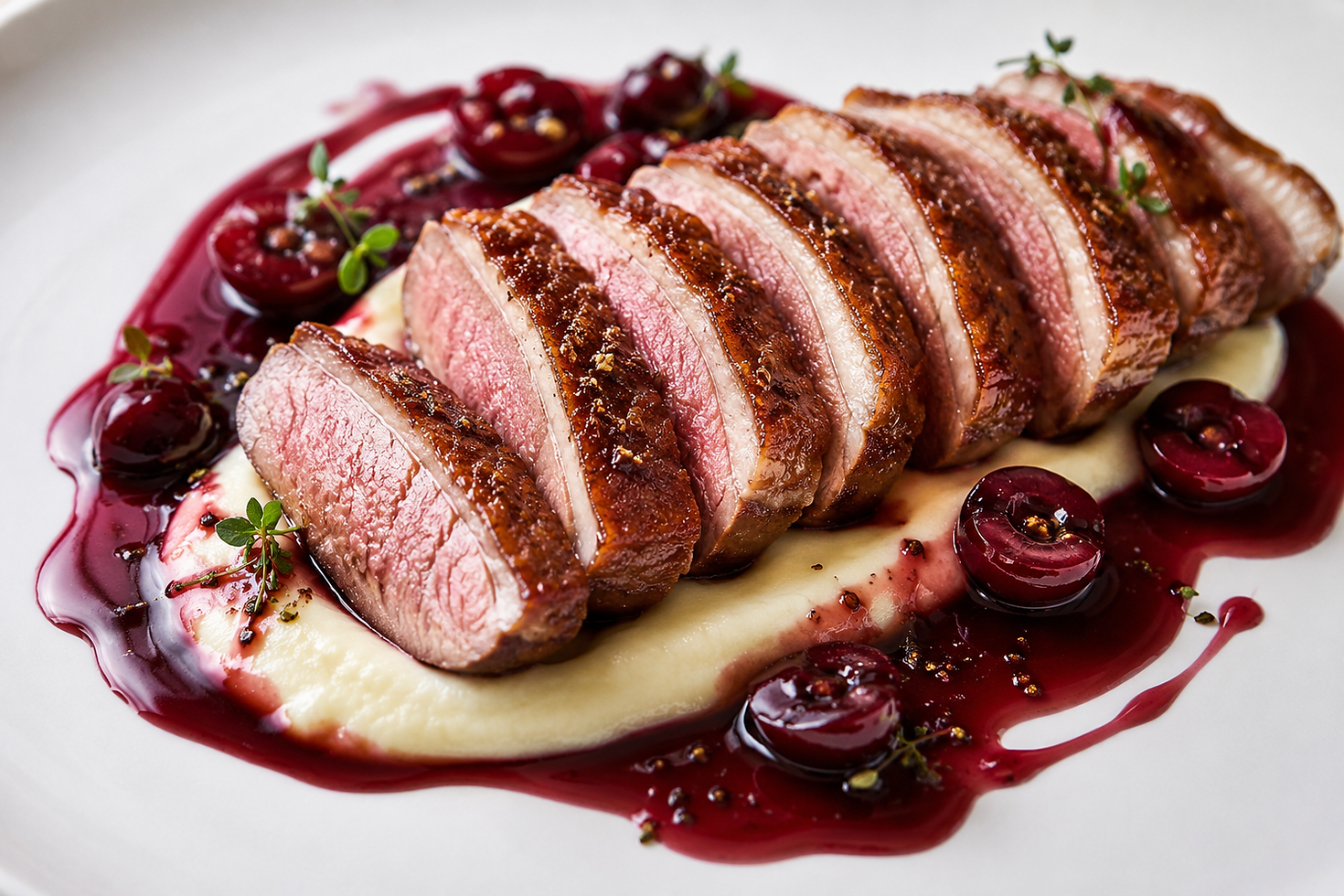
Italian Seared Duck Breast with Cannonau, Cherries and Sichuan Pepper | Petto d'Anatra con Cannonau, Ciliegie e Pepe di Sichuan

A duck breast is really two ingredients joined at a seam. Above it sits a thick pad of fat under a tough skin, below it a dark, lean, almost beef like muscle that is ruined by the time the fat has melted. Every good method for cooking duck breast solves that contradiction, and the one used here is the simplest: the breast goes skin side down into a completely cold pan, and the heat comes up slowly underneath it.
The sauce is built in the same pan afterwards from a dry Sardinian red, fresh cherries and Sichuan pepper. Cherry is not there to sweeten the plate but to supply acidity and a dark stone fruit note that runs parallel to the duck, and the Sichuan pepper is there for its citrus aroma and its faint numbing tingle, which lifts a sauce that could otherwise sit heavy. A celery root puree underneath keeps the whole thing anchored and slightly earthy.
Yield: 4 servings. Prep: 30 minutes. Dry the skin: 4 hours or overnight. Cook: 35 minutes. Rest: 10 minutes. Total: about 1 hour 20 minutes plus drying. Difficulty: intermediate to advanced. Course: secondo piatto. Style: contemporary Italian.
The Story
This is a modern plate and there is no point pretending otherwise. It belongs to the generation of Italian cooking that came out of the restaurant kitchens of the last thirty years, where a classical technique is kept intact and the seasoning around it is allowed to travel. The technique is European, the fruit is local, and the one element that came a long way is a spice that is not a pepper at all.
Sichuan pepper is the dried husk of the berry of a prickly ash, a Zanthoxylum, and it contains no piperine and no capsaicin. What it does contain is hydroxy alpha sanshool, which produces the light buzzing numbness on the lips, and a set of aromatic compounds closer to lemon peel and rose than to black pepper. On rich dark meat it behaves like a squeeze of citrus that never turns the sauce sour, which is exactly what a wine and fruit reduction needs.
Duck and cherry is an older pairing and a genuinely Italian one, from the same instinct that puts mostarda beside boiled meats and grapes beside game birds in the north. What matters is that the cherry stays savoury: the fruit is cut with vinegar and the sauce finished with stock and butter rather than sugar, so it reads as a sharp dark sauce with fruit in it and never as a glaze.
Ingredients
For the duck
Duck breasts, skin on, 4, about 7 oz (200 g) each
Coarse sea salt, 2 tsp (12 g), for drying the skin
Sichuan peppercorns, 2 tsp (4 g)
Black peppercorns, 1/2 tsp (1 g)
Fine sea salt, to season before cooking
For the Cannonau and cherry reduction
Cannonau di Sardegna or another dry Grenache, 1 1/4 cups (300 ml)
Fresh dark cherries, pitted and halved, 7 oz (200 g)
Shallot, finely chopped, 1 large
Dark chicken or duck stock, 1 cup (240 ml)
Red wine vinegar, 1 tbsp (15 ml)
Honey, 1 tsp (7 g)
Bay leaf, 1
Cold unsalted butter, cubed, 2 tbsp (30 g)
Fine sea salt and ground Sichuan pepper, to taste
For the celery root puree
Celery root, peeled and diced, 1 lb 5 oz (600 g)
Whole milk, 1 cup (240 ml)
Water, 1 cup (240 ml)
Unsalted butter, 2 tbsp (30 g)
Fine sea salt, 1 tsp (6 g)
For finishing
Fresh cherries, halved, 8, held back from the reduction
Extra virgin olive oil, a few drops per plate
Flaky sea salt, a pinch per portion
Preparation
Score and dry the skin.
Trim any ragged fat from the edges and score the skin in a diamond about 1/2 inch (1 cm) apart, cutting through the fat but stopping short of the meat. If the blade reaches the muscle, juices run out and stop the fat browning. Rub the coarse salt over the skin only, set the breasts on a rack skin side up and refrigerate uncovered for at least 4 hours, preferably overnight. Brush the salt off and pat the skin bone dry before cooking.
Toast and grind the pepper.
Warm the Sichuan peppercorns in a dry pan over low heat for about a minute, shaking constantly, until they smell of lemon peel rather than dust, then tip them out at once. Sift out the small black seeds inside the husks, which are gritty and bitter, and grind the husks with the black peppercorns to a medium powder. Grind them the same day, since the aromatic oils fade quickly once the husk is broken.
Make the celery root puree.
Simmer the diced celery root with the milk, water and half the salt for about 20 minutes, until a knife passes through without resistance. Drain, keeping the liquid, and blend with the butter and enough of that liquid to reach a thick, spoonable, smooth consistency. Sieve it, check the salt and hold it warm over a low bain marie.
Render the skin from a cold pan.
Season the skin with fine sea salt and lay the breasts skin side down in a heavy pan that is completely cold, then set it over low heat. Nothing should sizzle for the first minute or two. Render for 12 to 15 minutes, spooning the fat into a bowl every few minutes so the skin is never frying in a pool, and pressing gently on any part that lifts away. The skin is ready when it is deep amber, rigid and about a third of its original thickness.
Finish and rest the duck.
Raise the heat to medium, turn the breasts and give the flesh side 90 seconds to 2 minutes, just to colour it. A thermometer in the thickest part should read 128°F (53°C) for a rosy medium rare, since it climbs about 5 degrees while resting. Move them to a warm plate skin side up, never under foil, which traps steam and softens the skin. Rest them a full 10 minutes.
Build the reduction.
Pour off all but a tablespoon of fat, set the pan over medium heat and soften the shallot for 2 minutes, scraping up the browned residue. Add the vinegar and let it evaporate, then the wine and bay leaf, and reduce by two thirds until syrupy and no longer smelling of alcohol. Add the stock, reduce again by half, then add most of the cherries and the honey and cook 3 minutes more, until the fruit softens but holds its shape.
Finish the sauce.
Off the heat, remove the bay leaf and whisk in the cold butter a cube at a time, moving the pan constantly so the sauce thickens and turns glossy without breaking. Season with salt and a pinch of the ground Sichuan pepper, tasting as you go: it should tingle faintly at the lips, not burn. Add any juices collected under the resting duck, and keep the sauce warm without letting it boil again.
Plating
Warm the plates properly, since duck fat sets on a cold plate within a minute and turns waxy. Spoon a broad band of celery root puree off centre and drag the back of the spoon through it once.
Slice each breast across the grain into five or six pieces about 1/2 inch (1.5 cm) thick, cutting with the skin facing up so the knife does not drag and tear it. Fan the slices along the puree with the pink faces turned toward the diner, and finish with a pinch of flaky salt on the cut surfaces only.
The sauce goes around and under, never across the skin, which it would soften instantly. Spoon the cherries and a little reduction beside the meat, add the reserved raw cherry halves for colour and fresher acidity, and finish with a few drops of good olive oil.
Professional Technique
The cold pan start is the whole technique and it is worth understanding rather than following blindly. Duck skin is a layer of fat held in a mesh of connective tissue, and it can only crisp once that fat has melted out and left the mesh behind. A hot pan browns the outer surface in seconds and seals the fat beneath, leaving a rubbery layer over a soft greasy one. Starting cold lets pan and breast rise together, the fat runs out gradually, and browning begins only once most of it has gone.
Pouring the fat off as it accumulates matters more than most recipes admit. Left in the pan it rises around the breast and effectively deep fries it, cooking the meat from the outside in while the skin sits insulated in liquid. Removing it keeps skin and metal in direct contact, which is where the crisping happens. Keep what you pour off: it is the best cooking fat in the kitchen.
The reduction is a classic gastrique adapted to a savoury finish. Vinegar goes in before the wine so that its harsh volatile edge cooks off first, leaving only the acidity. The wine is reduced until it is syrupy and alcohol free before stock is added, because alcohol reduced in the presence of stock strips flavour and leaves a thin metallic taste. The butter goes in off the heat: the emulsion that gives the sauce its gloss and body breaks above about 190°F (88°C), and a broken sauce cannot be brought back.
Texture and Moisture Control
Dry skin is the single precondition for crisp skin. Water on the surface has to evaporate before the temperature can rise past the boiling point, and while it does the skin steams instead of rendering. The uncovered overnight rest in the refrigerator draws moisture out of the surface and dries it further in the cold air, which is why it is worth the wait and why patting the skin dry immediately before cooking is not optional.
Inside the meat, the target is a genuine medium rare. Duck breast is dark muscle with very little intramuscular fat, so it behaves like beef rather than chicken: past about 145°F (63°C) it contracts, squeezes out its juices and turns grey and livery. Pulling it at 128°F (53°C) and resting 10 minutes lets carryover finish the work and lets the fibres relax and reabsorb their juices.
The rest must happen uncovered and skin side up, since foil traps steam against the skin and softens it within minutes. The sauce has its own rule: finished with butter it is held warm and never allowed back to a simmer, and if it tightens too far, a spoonful of stock whisked in off the heat brings it back.
Professional Mise en Place
The duck is the only thing cooked to order here. Everything else can be finished in advance, which is what makes the dish workable for four plates at once.
Equipment and tools
Heavy stainless or cast iron pan, wide enough to hold four breasts without crowding
Instant read thermometer, essential rather than optional
Blender and a fine mesh sieve for the puree
Small bowl for the rendered fat, whisk for mounting the sauce
Sharp slicing knife and a rack for resting
Prepared ahead
Breasts scored, salted and drying uncovered on a rack, overnight
Sichuan pepper toasted, sifted and ground, on the day
Celery root puree made and held warm, up to 4 hours ahead
Wine reduced to the syrupy stage and the stock reduced separately, up to 1 day ahead
Cherries pitted and halved, with eight held back raw for the plates
Service setup
Pan cold and empty at the start of the sequence, never preheated
Plates warming, bowl for the rendered fat within reach
Butter cubed and cold in the refrigerator until the last moment
Duck resting skin side up and uncovered while the sauce is finished
Chef Tips
Buy the breasts whole, with the skin intact and a good thickness of fat under it. A thin fat layer renders away to nothing and leaves papery skin with no crunch, the usual problem with supermarket portions trimmed for appearance.
Taste the ground Sichuan pepper on its own before you season the sauce with it. Batches vary enormously in strength, and the tingle builds a few seconds after the flavour arrives, so it is easy to add three times too much while tasting quickly.
If fresh cherries are out of season, use frozen dark cherries and add them 2 minutes later than the recipe says, since they collapse faster. Avoid cherries in syrup entirely: they carry far too much sugar and turn the reduction into a glaze.
Cook the breasts in one pan only if they genuinely fit with space between them. Crowded, they steam in their own rendering fat and the skin never crisps. Two pans, or two batches with the first kept warm on a rack, is always better.
Common Mistakes
Putting the duck into a hot pan. This browns the outside of the skin before the fat beneath has melted, leaving a chewy layer over a soft greasy one. Start in a cold dry pan over low heat.
Scoring through to the meat. Cuts that reach the muscle let juices run into the rendering fat, where they steam the skin from below. Score only through the fat, in a diamond about 1/2 inch (1 cm) apart.
Leaving the rendered fat in the pan. The breast ends up frying in a pool rather than in contact with the metal, so the meat overcooks while the skin stays soft. Spoon the fat out every few minutes and save it.
Covering the duck to rest it. Foil traps steam against the skin and softens it within a minute or two. Rest the breasts uncovered and skin side up on a warm plate for the full 10 minutes.
Sweetening the sauce. A teaspoon of honey balances the vinegar, but sugar beyond that turns a savoury reduction into a fruit glaze and flattens both wine and pepper. Correct with vinegar and salt instead.
Boiling the sauce after the butter. The emulsion breaks above roughly 190°F (88°C) and separates into oil and liquid, and it will not come back. Mount the butter off the heat and hold the sauce warm, never simmering.
Wine Pairing
Cannonau di Sardegna DOC: The wine in the pan and the natural one in the glass, provided you pour a young unoaked bottling. Its soft tannin will not fight the tingle of the Sichuan pepper, which sharper tannins exaggerate uncomfortably, and its warm dried herb and red fruit character restates what is already in the sauce. Serve it at 61°F (16°C).
Etna Rosso DOC: Probably the most interesting glass here. Nerello Mascalese from the volcanic slopes gives high acidity, fine sandy tannin and a red cherry fruit that lands exactly on the fruit in the reduction, while its ash and iron savour picks up the caramelised skin. Its acidity cuts the rendered fat more cleanly than any softer red.
Alto Adige DOC Pinot Nero: The classic answer to duck breast. Pinot Noir grown at altitude keeps its acidity and stays light in tannin, which suits meat served rosy rather than braised, and its morello cherry and forest floor notes mirror the sauce without adding weight. The safest choice if you are unsure how strong your pepper is.
Cerasuolo di Vittoria DOCG: Sicilian, and built on Frappato, whose perfume is almost literally cherry. Blended with Nero d Avola it gains just enough structure to stand beside dark meat while staying bright and low in tannin. Serve it cool, around 59°F (15°C), when the pepper is used generously.
Ruche di Castagnole Monferrato DOCG: The wild card, and a very good one for anyone who enjoys aromatic reds. Ruche smells of rose petal, black pepper and dried herbs, and that floral spice runs directly alongside the citrus and rose notes in the Sichuan husk. Its tannin is moderate and its finish dry and faintly bitter, which keeps the fruit of the sauce in check.
Storage & Reheating
Cooked duck breast keeps refrigerated for up to 3 days in an airtight container, but store it whole: slices dry at the cut faces overnight and lose their colour. The sauce keeps separately for 3 days and the puree for 4, both sealed. Strained duck fat keeps for several months.
To reheat the duck without cooking it further, bring it to room temperature for 20 minutes, then put it skin side down in a dry pan over medium heat for 2 minutes to recrisp the skin and warm it through from one side only. Never microwave it and never reheat it in the sauce, which cooks the meat grey. Slice it after reheating, not before.
Warm the sauce gently over low heat, whisking, and stop the moment it is hot. If it has separated in the refrigerator, take it off the heat and whisk in a teaspoon of cold butter to bring the emulsion back. The puree reheats over a bain marie with a splash of milk. Do not freeze either, since both separate on thawing.
Nutrition
Per serving, based on 4 servings:
Calories: 590 kcal
Total Fat: 31 g
Saturated Fat: 13 g
Trans Fat: 0.4 g
Unsaturated Fat: 16 g
Cholesterol: 175 mg
Sodium: 680 mg
Total Carbohydrates: 24 g
Fiber: 4 g
Total Sugars: 13 g
Added Sugars: 2 g
Protein: 42 g
Lactose: 2.5 g
Principal micronutrients: iron, zinc, vitamin B12, niacin, selenium, potassium, vitamin K
These figures are estimates and assume most of the rendered fat is poured off rather than eaten.




Comments