
Italian Sausage Meatballs with Friarielli and Provola | Polpette di Salsiccia e Friarielli con Cuore di Provola

Naples has been eating sausage and friarielli together for so long that the pairing has stopped being a recipe and become a reflex. It fills the sandwiches sold from the fryers of the Quartieri Spagnoli and it is the winter filling in half the calzoni in the city. This dish rolls it into a meatball, with a cube of smoked provola at the centre.
What separates it from every other polpetta is where the mixture starts. Not ground pork, but fresh Italian sausage slipped out of its casing: a meat a butcher has already seasoned, balanced and worked. Almost every decision here follows from that single fact, and most of them are decisions to leave something out.
The friarielli are cooked first in oil with garlic and chilli, then chopped very fine and folded in cold. The provola goes in at the portioning stage. The meatballs are browned in olive oil and finished in the same pan with wine and stock, so their own juices reduce into the sauce they are served in.
Yield: 4 servings, about 16 meatballs. Prep: 35 minutes. Cook: 30 minutes. Chill: 20 minutes. Total: about 1 hour 25 minutes. Difficulty: intermediate. Course: secondo. Region: Campania, Naples and the Vesuvian hinterland.
The Story
Friarielli are not broccoli and they are not spinach, and the confusion follows them into every translation. They are the flowering tops of a brassica grown almost entirely in the hinterland of Naples, cut young between November and March, once frost has taken the harshness out and left a clean bitterness. The name comes from the Neapolitan verb for frying, because the tops were never boiled: they went into a pan with oil, garlic and chilli until they collapsed. That method has not changed in a century.
The sausage beside them is the salsiccia napoletana, sold by norcini coiled by the metre rather than in links, coarsely ground, seasoned with black pepper and very often with fennel seed or crumbled chilli. It was a butchers shop product long before it was a restaurant ingredient, and the pairing belongs to the same economy: cheap pork and a green that grew everywhere, cooked in one pan and eaten inside bread.
The provola is the third Neapolitan element. Provola affumicata comes from the dairies of the Monti Lattari and the Agro Nocerino, smoked over damp straw, and Campanian cooks have hidden it inside things for generations: gattò di patate, frittata di maccheroni, parmigiana. Putting it inside a polpetta is no invention. The polpetta itself is Naples at its most frugal, the Sunday dish where leftover meat, stale bread and grated cheese became something worth waiting for.
This version takes the three of them out of the sandwich and puts them on a plate as a secondo, without losing the reason the combination worked. The bitterness of the greens keeps the pork from being heavy. The smoke of the provola ties the two together.
Ingredients
For the meatballs
Fresh Italian pork sausage, coarse ground, 1 1/2 lb (680 g)
Stale country bread, crusts removed, 2 oz (55 g)
Whole milk, 1/3 cup (80 ml)
Pecorino Romano, finely grated, 1 oz (30 g)
Large egg, 1
Garlic clove, grated, 1
Freshly ground black pepper, to taste
For the friarielli
Friarielli or cime di rapa, trimmed, 1 lb (450 g)
Extra virgin olive oil, 3 tbsp (45 ml)
Garlic cloves, sliced, 2
Dried Neapolitan chilli, crumbled, 1 small
Fine sea salt, 1/4 tsp (1.5 g)
For the provola heart
Provola affumicata, cut into 1/2 inch (12 mm) cubes, 4 oz (115 g)
For browning and the pan sauce
Extra virgin olive oil, 1/4 cup (60 ml)
Dry white wine, 1/2 cup (120 ml)
Light chicken or pork stock, 1/2 cup (120 ml)
Bay leaf, 1
For finishing
Extra virgin olive oil, a few drops per plate
Pecorino Romano, for grating at the table, 1/2 oz (15 g)
Freshly ground black pepper, to taste
Preparation
Cook the friarielli and chop them fine
Wash the friarielli and strip away any stem that does not bend. Heat the 3 tablespoons of oil in a wide pan with the garlic and chilli until the garlic is pale gold, then add the greens still wet, with the salt. Cover and let them collapse over medium heat for 10 to 12 minutes, turning twice. Uncover, raise the heat and cook off every trace of liquid. Tip onto a board, cool, then chop very finely. The oil they cooked in belongs in the mixture.
Skin the sausage and cook a test patty
Slit each sausage lengthways and peel the casing away. Break the meat into a bowl with your fingers, not a fork, keeping the coarse grain visible. Flatten a walnut sized piece and cook it in a dry pan over medium heat about 2 minutes a side. Taste it hot. You are reading three things: how salty the sausage is, how peppery, and whether there is fennel seed or chilli you did not expect. Everything you add is decided by that mouthful.
Soak the bread and bring the mixture together
Tear the crustless bread up, pour the milk over it and leave it 10 minutes, then press it between your palms so it is damp rather than dripping. Add it to the sausage with the Pecorino, the egg, the garlic and a grinding of pepper, and the cold chopped friarielli last. Fold with a flexible spatula, cutting down and turning over, no more than 30 seconds. Stop while you can still see separate grains of pork. Refrigerate 20 minutes.
Portion and seal the provola inside
Wet your hands with cold water. Divide the mixture into 16 portions of about 1 1/2 oz (45 g). Flatten one in your palm, set a cube of provola in the middle, bring the edges up and roll it closed between both palms until the surface is smooth and shows no seam. Run a fingertip over each one: any opening you can feel is one the cheese will use. Set them on an oiled tray, not touching, and keep them cold.
Brown them in olive oil
Heat the quarter cup of oil in a wide sauté pan over medium heat, not high. Lay the meatballs in with space between them and leave them alone 3 to 4 minutes, until the underside is deep brown and releases without sticking. Turn them with tongs and repeat on two or three more faces, about 10 minutes in total. Moderate heat matters: a pan driven too hard scorches the outside long before the middle is up to temperature, and a scorched crust turns bitter against greens that are bitter already.
Finish in wine and stock
Pour off all but a tablespoon of the fat, add the wine and let it bubble hard for a minute while you scrape the base of the pan clean. Add the stock and bay leaf, lower the heat, cover and cook 10 to 12 minutes, rolling the meatballs once halfway. Probe one: you want 160°F (71°C). Lift them onto a warm plate, reduce the pan to a glossy few spoonfuls, remove the bay leaf, return the meatballs and roll them in it. Rest 3 minutes.
Plating
Warm the plates. This is a dish with a molten centre and a reduced pan sauce, and both stiffen visibly on cold china. Shallow bowls work better than flat plates, because the sauce is thin enough to run and you want it gathered around the meatballs rather than spread under them.
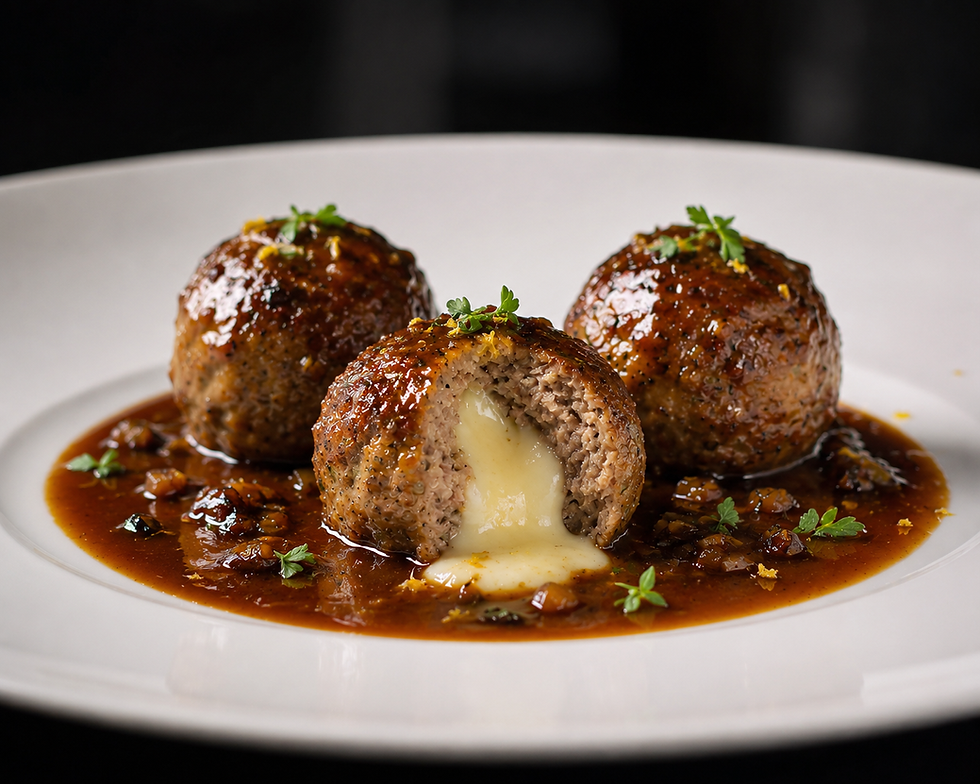
Serve four meatballs per person, set close together rather than spaced out, and spoon the reduced pan juices over them so they are coated and glossy. Grate a little Pecorino over the top, add a few drops of raw olive oil and a grinding of black pepper. If you want a contorno, keep it plain: boiled potatoes, or bread. Cut one meatball open at the table, not in the kitchen, because the provola is at its best in the first minute.
Professional Technique
The technique that defines this recipe is that the mixture begins with sausage rather than ground meat, and that changes what kind of material you are holding. Ground pork is neutral: you season it, you bind it, you decide everything. Sausage is not. A norcino has already fixed the fat, usually around 25 percent, the salt, around 1.5 percent of the weight, the pepper, and in Campania often fennel seed or chilli. You are not building a seasoning, you are inheriting one.
That inheritance has three consequences at the bench. First, you do not salt the mixture, and you do not judge it raw, because raw pork tells you nothing and salt reads differently at 40°F than at 160°F. You cook a flattened piece, taste it hot, and only then decide. Here the Pecorino is the only salt added, and only because the test patty allowed it. Second, you add no further fat, no oil, no pancetta, no butter: at a quarter fat the sausage is at the upper end of what a meatball holds without weeping. Third, you add no spice until you know what is in there, or you get two fennel notes competing and a heat you cannot place.
A fourth consequence is the one most cooks miss. Sausage has been mechanically worked already, forced through a plate and pushed into a casing, so part of its myosin is extracted and the meat arrives tacky and half bound. You are not starting the binding, you are finishing one. Thirty seconds of folding is enough, and every extra turn pushes the mixture toward the springy texture of a boiled sausage instead of the open crumb of a polpetta.
The friarielli follow the same restraint for a structural reason. They must be cooked first, so they release their water in the pan and not inside the meat, then chopped genuinely fine, almost to a paste. Left in the long strands they come out of the pan in, they lie flat inside the meatball and act as fracture planes that it separates along under the pressure of the melting cheese.
Texture and Moisture Control
Two things happen inside these meatballs at once, on different clocks. The pork has to reach 160°F (71°C) and stop there, because past that point the meat contracts and pushes the rendered fat and juices out through whatever gap it finds. The provola softens from about 130°F (55°C) and is molten by 150°F (65°C), so the cheese is ready before the meat and sits under pressure at the end.
Moisture control starts with the greens. Friarielli hold a great deal of water and any left in the pan ends up inside the meat, where it turns to steam and forces the mixture apart. Cook them until the pan is dry. The bread does the opposite: soaked in milk and pressed to a damp crumb, it holds the rendered fat in suspension and keeps the interior open. Squeeze it too hard and it stops working; leave it dripping and the mixture will not hold a shape.
The three minute rest matters more than it looks. Straight off the heat it collapses under a fork; after three minutes the fat has partly reset while the provola is still molten. Past five, the cheese tightens and pulls into strings instead of flowing.
Professional Mise en Place
The natural break sits just before browning: rolled meatballs hold well in the refrigerator and seal better cold.
Equipment and tools
Wide lidded sauté pan that holds 16 meatballs without crowding
Second wide pan for the friarielli
Large heavy knife and a board for chopping the greens fine
Instant read probe thermometer
Lightly oiled tray, tongs, flexible spatula, bowl of cold water
Prepared ahead
Friarielli cooked, cooled and chopped fine, up to 2 days ahead
Bread soaked in milk and pressed, on the day
Provola cut into cubes and kept cold and covered, on the day
Meatballs rolled and sealed on the oiled tray, up to 8 hours ahead
Stock measured out and kept warm, bay leaf and wine to hand
Service setup
Meatballs brought out cold as the pan comes up to heat
Pan at steady medium heat, never high, oil shimmering but not smoking
Probe thermometer beside the pan
Plates warm, Pecorino grated, pepper mill and oil within reach
Serve within three to five minutes of the pan coming off the heat
Chef Tips
Buy the sausage from a butcher who will tell you what is in it. A plain salsiccia of salt and pepper gives the most control; one carrying fennel and chilli is excellent but you need to know first. Avoid anything cured or smoked, and any lean supermarket sausage extended with water and starch.
If friarielli are out of season, cime di rapa are the right substitute and broccoli rabe is the same plant under an American name. Ordinary broccoli is not: sweeter, wetter, without the bitterness the dish needs. Frozen friarielli work, but give them longer in the pan.
Cut the provola cubes slightly smaller than feels right. A half inch cube disappears into the centre and stays there; anything larger sits too close to the surface, and that distance is what contains it.
Cook one meatball ahead of the rest as a second test, for structure rather than seasoning. If it leaks, the seal is the problem and you can reroll the other fifteen. If it splits, the friarielli are too coarse. Both faults are cheap to fix now, impossible later.
Common Mistakes
Salting the mixture. The sausage is already salted at around 1.5 percent, the Pecorino brings more, and the pan sauce concentrates it further. Taste the test patty hot and add salt only if it asks, which it usually will not.
Adding the friarielli raw or wet. Raw greens release water inside the meat and the steam pushes the mixture apart. Cook them until the pan is dry, cool completely, then fold them in.
Leaving the greens in long strands. Coarse pieces lie flat inside the meatball and become fracture planes it splits along once the cheese melts. Chop almost to a paste.
Working the mixture like ground meat. Sausage is already partly bound from being forced through the plate and stuffed. Thirty seconds of folding is the whole job; more gives the springy bounce of a poached sausage.
Browning over high heat. High heat scorches the crust while the centre is cold, and burnt pork fat turns acrid against bitter greens. Medium heat and 10 patient minutes give the same colour without harshness.
Wine Pairing
Lacryma Christi del Vesuvio DOC: The red version, built mostly on Piedirosso from the volcanic slopes above Naples, and the bottle this dish was designed around. Soft tannin and high acidity are the shape you want against rendered pork fat: enough cut to clean the palate, not enough grip to collide with the bitterness of the friarielli. A dusty mineral edge from the lava soils sits beside the smoke of the provola. Serve at 59°F (15°C).
Aglianico del Taburno DOCG: The choice when you want structure rather than refreshment. Aglianico from Monte Taburno keeps firm tannin and dark sour cherry fruit, and that tannin binds the fat of the sausage in a way lighter Campanian reds cannot. The risk is the greens: a young bottle amplifies their bitterness, so find one with a few years behind it.
Falanghina del Sannio DOC: The white answer, and better than it sounds. Falanghina has brisk citrus acidity and a faintly bitter almond finish, and that finish is why it works: it runs alongside the friarielli instead of fighting them, while the acidity cuts the pork fat as cleanly as any red. Enough body for a smoked cheese. Serve near 54°F (12°C).
Etna Rosso DOC: The outsider on the list and worth the detour. Nerello Mascalese from Etna gives high acidity, fine sandy tannin and a smoky volcanic character that meets the provola affumicata head on. Its lighter weight keeps the plate from turning heavy and the sour red fruit picks up the chilli. Serve around 57°F (14°C).
Storage & Reheating
Cooked meatballs keep in an airtight container with their sauce for up to 3 days in the refrigerator, and the second day is genuinely good, once the fennel and chilli have worked through the greens. What does not survive is the molten centre: chilled provola softens again on reheating but never flows the way it did.
Reheat in a covered pan over low heat with a splash of stock, turning every couple of minutes, about 8 minutes. Never a microwave: it drives the fat out and turns the cheese rubbery. Raw rolled meatballs freeze better than cooked ones, on a tray until solid then bagged, up to 2 months. Brown them from frozen and add 5 minutes to the covered stage, checking for 160°F (71°C).
Nutrition
Per serving, based on 4 servings of 4 meatballs each:
Calories: 690 kcal
Total Fat: 53 g
Saturated Fat: 19 g
Trans Fat: 0 g
Unsaturated Fat: 32 g
Cholesterol: 160 mg
Sodium: 1290 mg
Total Carbohydrates: 15 g
Fiber: 4 g
Total Sugars: 4 g
Added Sugars: 0 g
Protein: 38 g
Lactose: 2 g
Principal micronutrients: calcium, vitamin K, vitamin C, folate, iron, zinc, selenium, thiamine, vitamin B12
These figures are estimates. Sodium in particular varies a great deal, because it comes almost entirely from the sausage and the Pecorino, and both differ from producer to producer.



Comments