
Veal Meatballs Stuffed with Smoked Scamorza and Marsala Sauce | Polpette di Vitello Ripiene di Scamorza Affumicata con Salsa al Marsala
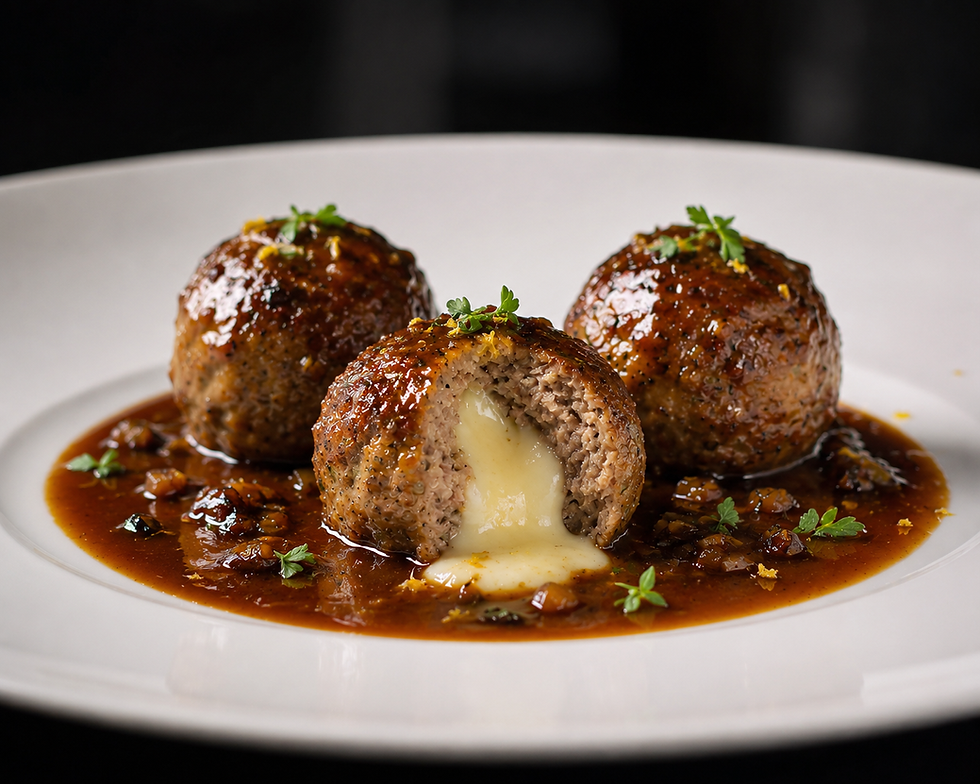
Ground veal is the most flattered and least understood meat in the Italian butcher's case. Pale, mild and expensive, it carries an assumption of delicacy that sends cooks straight towards a polpetta made of nothing else. The result is reliably the same: correct in flavour, grey inside, faintly granular on the tongue. The cook blames the pan or the timing. The pan is rarely the problem.
The problem is arithmetic. Ground veal from the shoulder runs between five and eight percent fat, and a polpetta that eats as juicy needs closer to twenty. That gap of twelve points or more is not a question of seasoning or of technique, and no amount of careful cooking closes it. It has to be filled deliberately, and the whole architecture of this recipe follows from that.
Once the fat is right, the rest falls into place. A cube of smoked scamorza goes into the centre of each polpetta, the browned polpette finish in a Marsala sauce built on their own fond, and the plate comes together in the time it takes four bowls to warm.
Yield: 4 servings, 12 polpette. Prep: 35 minutes. Rest: 30 minutes. Cook: 30 minutes. Total: about 1 hour 35 minutes. Difficulty: intermediate. Course: secondo. Region: central Italy, with Abruzzese cheese and Sicilian Marsala.
The Story
The polpetta is a dish of the household, not the restaurant, and its history is a history of making expensive protein go further. In the Italian domestic kitchen a meatball was never a way of eating more meat; it was a way of eating less. Bread, milk, egg and cheese were bulk, and the meat was whatever had come off the bone the day before. That logic is why every region has polpette and why almost none of them agree on the meat.
Veal enters the story through the dairy belt. In Lombardy, Piedmont and the Veneto, where herds were kept for milk and for cheese, young male calves had no productive future, and their meat became the everyday butchery of those provinces rather than a luxury. That is the origin of the enormous veal repertoire of northern Italy, and why veal polpette are a northern and central habit rather than a southern one, where pork and beef dominate.
The scamorza comes from elsewhere. It is a pasta filata cheese of Abruzzo, Molise and northern Campania, cousin to mozzarella but drained and dried far harder, and the smoked version was born of transhumance and of markets that were days away on foot. Smoke over straw or wood shavings bought the cheese time in a hot climate and gave it the resinous edge it still has.
Marsala arrives last and from furthest away. Fortified in western Sicily for the English trade from the late eighteenth century, it reached Italian professional kitchens through hotel cooking, where a wine that kept for weeks after opening was worth more to a brigade than a table wine that did not. Its use in savoury reductions is barely two centuries old, a modern habit by Italian standards and a borrowed one. This dish is three regions in one pan.
Ingredients
For the forcemeat
Ground veal, shoulder, 1 lb 2 oz (500 g)
Ground pork, from the belly or shoulder, 9 oz (250 g)
Pancetta, chopped by hand, 2 oz (55 g)
Stale country bread, crust removed, 2 oz (55 g)
Whole milk, 1/2 cup (120 ml)
Parmigiano Reggiano, finely grated, 2 oz (55 g)
Egg, large, 1
Garlic clove, grated, 1
Flat leaf parsley, chopped, 2 tbsp (6 g)
Freshly grated nutmeg, 1/8 tsp
Fine sea salt, 1 1/4 tsp (7 g)
Freshly ground black pepper, 1/2 tsp
For the filling
Smoked scamorza, well chilled, 5 oz (140 g), cut into 12 cubes
For cooking
Extra virgin olive oil, 3 tbsp (45 ml)
Unsalted butter, 1 tbsp (14 g)
All purpose flour, 2 tbsp (16 g), for dusting
For the Marsala sauce
Shallot, finely diced, 1 medium
Dry Marsala Superiore, 3/4 cup (180 ml)
Veal or brown chicken stock, 1 1/4 cups (300 ml)
Thyme sprigs, 2
Bay leaf, 1
Unsalted butter, cold and diced, 1 1/2 tbsp (20 g)
Fine sea salt and black pepper, to taste
For finishing
Flat leaf parsley leaves, small, 12
Extra virgin olive oil, a few drops per plate
Freshly ground black pepper, to taste
Preparation
Soak the bread into a panade
Tear the bread small, put it in a bowl and pour the cold milk over it. Leave it 10 minutes, until the crumb has swollen and collapsed, then break it up with a fork so no dry pockets remain. Do not squeeze it out: a panade wrung dry is simply bread.
Chill and cube the scamorza
Cut the scamorza into twelve cubes of about 1/2 inch (1.5 cm) and return them to the refrigerator, uncovered, on a small plate. Cold cubes hold their shape while you close the meat around them, where room temperature ones smear. Leave them there until you shape.
Combine the meats and the fat
Put the ground veal, the ground pork and the hand chopped pancetta in a wide cold bowl and break them apart with your fingertips until evenly distributed. Chop the pancetta rather than grinding it: you want discrete pieces of fat through the mix, not fat smeared into the lean.
Season and mix the forcemeat
Add the panade, Parmigiano, egg, grated garlic, parsley, nutmeg, salt and pepper. Mix with an open hand, lifting and folding rather than kneading, for no more than 45 seconds, and stop as soon as it looks uniform. Worked further, the salt draws out myosin and the polpette turn springy and sausage like.
Fry a test polpetta
Flatten a teaspoon of the mixture and cook it in a little olive oil for a minute a side. Taste it for salt and above all for succulence. If it reads dry even now, before any sauce, add another ounce of chopped pancetta and mix briefly again.
Shape and fill the polpette
Divide the mixture into twelve portions of about 2 1/2 oz (70 g). Flatten each into a disc in a damp palm, set a cold scamorza cube at the centre, bring the edges up and over, then roll gently between both palms until no seam shows. Dust very lightly with flour and refrigerate 30 minutes.
Brown the polpette
Heat the olive oil and butter in a wide heavy sauté pan over medium heat, not high. Lay the polpette in with space around them and brown 6 to 8 minutes, turning three or four times. An aggressive pan sets a crust before the added fat begins to render, and the render is the point. Lift them onto a plate.
Build the Marsala sauce
Pour off all but a tablespoon of fat, lower the heat and cook the shallot 3 minutes until translucent. Add the Marsala, scrape the fond from the base with a wooden spoon and reduce by half. Add the stock, thyme and bay, reduce by about a third until the sauce coats a spoon thinly, then correct the salt.
Finish the polpette in the sauce
Return the polpette, spoon sauce over them, cover and simmer very gently 8 to 10 minutes, turning once. A thermometer pushed into the meat, avoiding the cheese, should read 160°F (71°C). Lift them out, discard the herbs, take the pan off the heat and whisk in the cold butter piece by piece until glossy. Rest 4 minutes.
Plating
Warm four shallow bowls rather than flat plates. The sauce is deliberately loose, and a rimmed bowl keeps it gathered around the polpette instead of letting it run to the edge and cool into a film.
Spoon a pool of sauce into each bowl and set three polpette into it, spaced so the sauce shows between them. Spoon another tablespoon over each so the browned surfaces gleam rather than drown. Finish with three small parsley leaves, a few drops of olive oil and a turn of black pepper.
Serve at once, and serve them whole: a polpetta cut in the kitchen loses its interior to the board. The useful contorni are the plain ones that take sauce, soft polenta, mashed potato or good bread. Nothing acidic or crunchy belongs on the same plate.
Professional Technique
The whole recipe rests on one number. Ground veal from the shoulder or the breast is lean, typically five to eight percent fat. A forcemeat that eats as tender and juicy sits near twenty. Everything people dislike about veal polpette, the dryness, the pale grey interior, the grain under the teeth, is the consequence of that twelve point deficit, and it cannot be cooked away.
So the fat is added rather than hoped for. The simplest route is ground pork, itself twenty to thirty percent fat, at between one third and one half of the total meat weight: the 500 g of veal to 250 g of pork here lands the mixture in the high teens, and the pancetta takes it to roughly twenty while adding cured depth. Lardo or plain back fat does the same job with no flavour of its own.
What that fat does is physical before it is gustatory. Solid fat sits in the raw mixture as discrete particles, and as it melts it leaves small voids and slick channels between the bundles of protein. Those gaps stop the fibres contracting into one dense mass as they set. A lean forcemeat has nothing holding its proteins apart, so they knit, tighten and expel water, while a properly fatted one cannot fully compact.
This is why pouring olive oil into the mixture does not work, though many cooks try it first. Oil is already liquid, so it never occupies space as a particle and never leaves a void behind. It lubricates the mix instead of structuring it, and most of it runs out in the first minutes in the pan. Solid fat melts inside the meat, at temperature, where the structure needs it. Liquid fat simply leaves.
The panade works on a different principle and belongs alongside the fat, not instead of it. Bread soaked in milk carries water into the forcemeat held inside a swollen starch matrix, trapped mechanically and released slowly under heat rather than expelled at once. Fat keeps the structure open; the panade keeps water in the structure.
Texture and Moisture Control
Three temperatures govern the texture. The forcemeat must stay below about 50°F (10°C) while you work, because warm fat smears into the lean instead of remaining as particles. The browning runs at medium heat so the fat renders before the surface seals. The finish is a bare simmer to an internal 160°F (71°C), past which the proteins begin squeezing out the water the panade is holding.
Then the rest. Four minutes out of the sauce lets the interior relax and the melted fat and released juices redistribute instead of running out at the first fork. It also lets the cheese firm from liquid towards soft, which keeps the filling where it was put.
The sauce has its own logic. It is finished off the heat with cold butter whisked in piece by piece, building a temporary emulsion of butterfat in the reduced stock. Held over a flame it breaks, and goes from glossy to thin with a slick of fat on top. Keep it below 175°F (80°C).
Professional Mise en Place
Almost everything here can be staged in advance, and the shaped polpette improve for a rest in the refrigerator. Only the browning, the sauce and the final simmer belong to service.
Equipment and tools
Wide heavy sauté pan with a lid, big enough for twelve polpette
Instant read thermometer, the only reliable check on a stuffed meatball
Digital scale, for weighing the fat and portioning at 2 1/2 oz (70 g)
Wide mixing bowl kept cold, plus water for damp hands
Fine grater for the Parmigiano, the garlic and the nutmeg
Prepared ahead
Scamorza cubed and refrigerated uncovered, up to 1 day ahead
Panade soaked and broken up, up to 4 hours ahead, kept cold
Forcemeat mixed and the test polpetta tasted, up to 1 day ahead
Polpette shaped, floured and refrigerated, 30 minutes to 8 hours
Stock measured and warm, Marsala measured, herbs tied together
Service setup
Polpette straight from the refrigerator to the pan
Butter for the sauce diced and cold until the last second
Bowls warming, thermometer wiped and within reach
Parsley picked, finishing oil and pepper mill on the pass
Chef Tips
Ask the butcher for the two grinds separately and refuse a premixed veal and pork blend, since you cannot know its ratio. Veal shoulder coarse ground, pork belly coarse ground, and a piece of pancetta you chop yourself: three things you can weigh.
Weigh the fat rather than estimating it. The difference between eight and twenty percent in a batch this size is about 4 oz (115 g) of pork, far more than it looks in a bowl. Cooks working by eye almost always underfat.
Use a dry Marsala Superiore and check the label, because the sweet bottlings turn the sauce cloying against smoked cheese. If only the sweet is available, cut the quantity by a third and lengthen it with extra stock.
Make the forcemeat the day before if you can. An overnight rest lets the salt penetrate evenly and the cold mixture shapes far more cleanly. Run the test polpetta again before shaping the batch.
Common Mistakes
Using ground veal on its own. No cooking method rescues it. At five to eight percent fat there is nothing in the mixture holding the proteins apart as they set. Add pork, pancetta or lardo until you are near twenty.
Pouring olive oil in instead. Liquid fat coats proteins rather than separating them, contributes no structure, and drains out during browning. The raw mix feels richer and the cooked polpetta is no juicier at all.
Squeezing the panade dry. The soaked crumb exists to carry water into the forcemeat and hold it there under heat. Wrung out, it becomes a binder and nothing more, and you lose one of the two mechanisms keeping the polpette moist.
Mixing until the forcemeat is smooth. Salt plus prolonged working dissolves myosin into a continuous elastic network, which you want in a sausage and never here. Forty five seconds with an open hand, then stop.
Boiling the sauce after the butter goes in. That emulsion is held together by temperature alone. Past about 175°F (80°C) it separates, and a broken sauce cannot be whisked back to gloss once the polpette are already in their bowls.
Wine Pairing
Alto Adige DOC Pinot Nero: The most precise match on the list. Alpine Pinot Nero has fine grained tannin that meets veal without overwhelming its mildness, and a cool red fruit line that keeps twenty percent fat from settling on the palate. Its faint smoky edge runs alongside the scamorza.
Valpolicella Classico DOC: The everyday choice, and a good one. Corvina gives sour cherry, moderate alcohol and enough acidity to cut a Marsala reduction that still carries nutty concentration for all its dryness. Light structure is the advantage: the wine refreshes rather than adding weight.
Etna Rosso DOC: The Sicilian answer to a Sicilian sauce. Nerello Mascalese is savoury rather than fruity, with high acidity and a volcanic saltiness that picks up the browned fond directly. Its austere tannin handles the pancetta and the Parmigiano, and its ashy note suits smoked cheese.
Cerasuolo d'Abruzzo DOC: The regional pairing for the cheese, from where scamorza affumicata belongs. A serious rosato of Montepulciano has real extract and a bitter almond finish. Served cool at around 54°F (12°C) it scrubs the fat, with no tannin to clash with the melted interior.
Offida Pecorino DOCG: For anyone who would rather drink white with veal, and the only white with the body for this plate. Pecorino is broad and faintly waxy, with a sapid finish and yellow fruit weight that stands up to both Marsala and smoke. Serve it barely chilled.
Storage & Reheating
Cooked polpette keep refrigerated in their sauce, in a shallow airtight container, for 3 days, and they are better on the second day than the first: the Marsala works into the meat and the smoke spreads through the sauce. Keep them submerged, since any polpetta sitting proud of the liquid dries at the crown.
To reheat, bring them to room temperature for 20 minutes, then warm them covered over low heat with a tablespoon of stock, turning once, for 8 minutes. Never use a microwave: it drives the interior past 175°F (80°C) in seconds and forces out the moisture the fat and the panade were holding. Shaped raw polpette freeze on a tray, then in a bag for 2 months, and brown from frozen with three extra minutes.
Nutrition
Per serving, based on 4 servings of 3 polpette each:
Calories: 640 kcal
Total Fat: 44 g
Saturated Fat: 18 g
Trans Fat: 0.5 g
Unsaturated Fat: 24 g
Cholesterol: 205 mg
Sodium: 1080 mg
Total Carbohydrates: 13 g
Fiber: 1 g
Total Sugars: 4 g
Added Sugars: 0 g
Protein: 45 g
Lactose: 2 g
Principal micronutrients: vitamin B12, zinc, selenium, iron, phosphorus, calcium
These figures are estimates. The fat total moves most, since a good part of the rendered fat is poured off before the sauce is built and never reaches the plate.


Comments