
Italian Seared Amberjack with Chickpea Cream, Red Onion and Capers | Ricciola Scottata con Ceci, Cipolla Rossa e Capperi
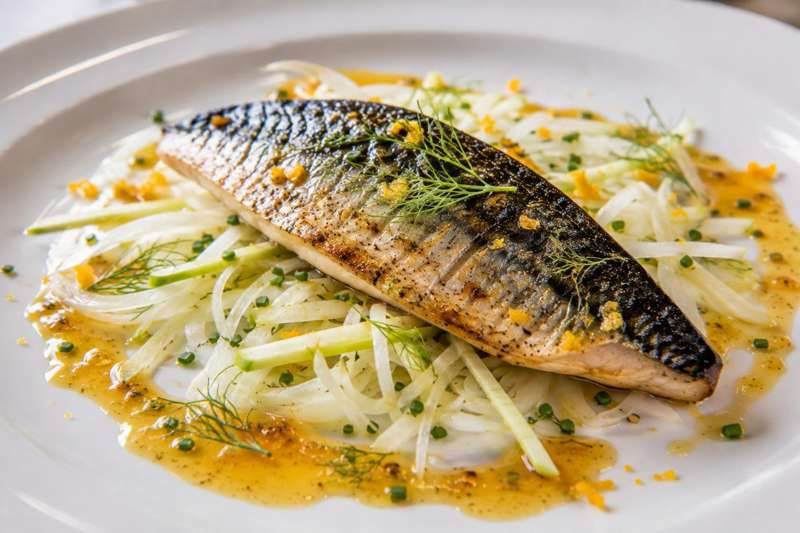
Ricciola looks like a large white fish on the slab and is nothing of the kind. The loin is rosy, dense and slightly sweet, with a dark strip of muscle down the flank. The greater amberjack is a pelagic hunter that swims fast and almost without stopping, and its muscle is closer to a tuna's than to a cod's.
Seared in a very hot dry pan for ninety seconds a side, a thick portion comes out with a golden crust over a centre still pink. Under it sit warm chickpea cream, red onion cooked in vinegar and sugar, and salted capers with oil and lemon zest spooned around rather than over.
There is no technique here beyond timing and a thermometer, and every component but the fish is made in advance. What matters is that you trim the loin honestly, dry it well, and take it out of the pan before you think it is ready.
Yield: 4 main course servings. Prep: 30 minutes. Soak: overnight. Cook: 1 hour 20 minutes. Rest: 5 minutes. Region: Sicily and Calabria.
The Story
Ricciola belongs to the open water between Sicily and Calabria. The Strait of Messina and the seas around the Aeolian islands are among the richest Italian grounds for it, and the fish arrives with the warm months. It has always been taken by trolling and longline rather than netted, so it reached the market a few fish at a time and was sold in thick slices from the bone like tuna. On these coasts it was the fish of a good day, cooked directly over charcoal with oil, salt and lemon.
The chickpeas come from the other half of the southern kitchen, the one built on legumes rather than on fish. Ceci grow across the inland south, from Cicerale in the Cilento hills to the black chickpeas of the Murgia, and for centuries they were what a coastal family ate on the days when there was no catch worth cooking. The old combinations put the two together out of arithmetic, a little fish stretched by a lot of chickpea, and this plate simply inverts the proportion.
The sharp elements are Sicilian by instinct. Capers grow on the volcanic islands, Salina and Pantelleria above all, packed in sea salt rather than vinegar. Cooking onion with vinegar and sugar belongs to the agrodolce habit Sicilian cooking inherited from Arab and Spanish kitchens.
Ingredients
For the amberjack
Amberjack loin, centre cut, skinless, 1 1/2 lb (680 g) after trimming
Extra virgin olive oil, 2 tbsp (30 ml)
Fine sea salt, 1 tsp (6 g)
Freshly ground black pepper, to taste
For the chickpea cream
Dried chickpeas, 7 oz (200 g), soaked overnight
Water, 6 cups (1.4 L)
Garlic clove, peeled, 1
Bay leaf, 1
Rosemary sprig, small, 1
Extra virgin olive oil, 3 tbsp (45 ml)
Fine sea salt, 3/4 tsp (5 g)
Lemon juice, 1 tsp (5 ml)
Freshly ground white pepper, to taste
For the sweet and sour red onion
Red onion, medium, 1
Red wine vinegar, 1/3 cup (80 ml)
Water, 1/3 cup (80 ml)
Granulated sugar, 1 tbsp (13 g)
Fine sea salt, 1/2 tsp (3 g)
For the caper dressing
Capers packed in salt, 2 tbsp (20 g)
Extra virgin olive oil, 1/4 cup (60 ml)
Finely grated lemon zest, from 1 lemon
Flat leaf parsley, chopped, 1 tbsp (4 g)
Red wine vinegar, 1 tsp (5 ml)
Freshly ground black pepper, to taste
For finishing
Extra virgin olive oil, a few drops per plate
Flaky sea salt, a pinch per plate
Flat leaf parsley or fennel fronds, small, 8 to 12
Lemon wedges, 4, served separately
Preparation
Step 1
Cook the chickpeas. Simmer the drained soaked chickpeas with the water, garlic, bay leaf and rosemary for 60 to 80 minutes, until one crushes with no resistance at the centre. Salt in the last 10 minutes. Underdone chickpeas never blend smooth. Discard the herbs and keep 1 cup (240 ml) of the cooking liquid before draining.
Step 2
Blend and pass the cream. Blend the chickpeas with the olive oil, lemon juice, salt and half the reserved liquid, adding more until it pours like thick cream. Pass it through a fine mesh sieve: the skins survive any blade and they are why a home puree feels grainy. Season with white pepper and hold it warm, never boiling.
Step 3
Cook the red onion in vinegar and sugar. Cut the onion into petals, separating the layers so each piece keeps its curve. Bring the vinegar, water, sugar and salt to a bare simmer, add the petals, cook 45 seconds only, then cool them in the liquid for 30 minutes. They must stay bright with a bite left. Drain them hard before plating.
Step 4
Make the caper dressing. Rinse the salted capers and soak them 10 minutes. Pat dry, chop half and leave the rest whole. Mix with the olive oil, lemon zest, parsley, vinegar and pepper and leave at room temperature 30 minutes. Add no salt, the capers carry plenty.
Step 5
Trim and dry the amberjack. Cut away the dark red strip of muscle along the flank completely, following the line in one pass with a very sharp knife, then trim the thin tail end and any grey surface. Cut four portions about 1 1/4 inches (3 cm) thick. Pat every face dry and leave them uncovered on a rack in the refrigerator for 20 minutes.
Step 6
Sear the portions. Bring them out 15 minutes ahead and salt them as the pan heats, never earlier: salt pulls moisture to the surface and that moisture prevents a crust. Heat a heavy cast iron pan, add the oil, and lay the portions in with space between them. Do not move them for 60 to 90 seconds, turn once, the same again, then 15 seconds on each short side.
Step 7
Check the temperature and rest. Probe the thickest portion from the side and take the fish out at 112°F to 115°F (44°C to 46°C). Rest it on a warm plate, uncovered, for 5 minutes, while carry over heat brings the centre to about 118°F (48°C). Never tent it with foil, which steams the crust soft.
Plating
Taste the four elements separately first and correct them. Vinegar is already in two components, so resist squeezing lemon over the fish and put a wedge on the side instead.
Use a wide warm plate, not hot. Spoon about 3 tablespoons of chickpea cream slightly off centre and pull the back of the spoon through it once to spread it into an oval. Slice each portion across the grain so the pink centre shows and set it partly over the cream.
Arrange four or five onion petals beside the fish and never on top, where their liquid would run into the crust. Spoon the dressing around the cream and over the onion. Finish with a few drops of raw olive oil, a pinch of flaky salt on the cut surface and two or three parsley leaves. Serve at once: the contrast between warm crust and cool pink centre lasts about four minutes.
Professional Technique
Everything difficult here is anatomical. Ricciola is a pelagic predator that swims fast and continuously in open water, and a fish with that life needs a constant oxygen supply to its swimming muscle. It stores that oxygen in myoglobin, the pigment that makes beef red, and it carries far more of it than any coastal white fish. That is why a fresh loin is rosy and faintly translucent rather than opaque, and why the rule about cooking fish until it flakes is the wrong rule here. Amberjack behaves like tuna.
The whole window is defined by one number: about 118°F (48°C) at the centre, where the flesh is still pink and silky and the fibres have barely begun to tighten. Above roughly 130°F (55°C) two things happen and neither reverses. The myoglobin denatures and the colour turns from rose to a flat grey brown, and the fibres contract hard enough to squeeze out their own water. The liquid pooling under an overcooked piece is moisture that should have stayed inside, and what is left is the dry stringy texture people wrongly think normal for this fish. Pull it at 112°F to 115°F (44°C to 46°C) and let the rest finish it.
The dark muscle along the flank is the second point, and the one most cooks miss because it looks like nothing more than a bloody patch. That strip is the aerobic swimming muscle, and it holds the most myoglobin and the most unsaturated fat in the fish. The two oxidise fast together, so within a day of cutting it darkens towards brown and develops a metallic bitterness no oil, salt or lemon covers, and that bitterness bleeds into the pale flesh beside it once heat is applied. Cut it away entirely and accept the loss in yield.
The sear is the third, and on a loin this lean it is purely a question of surface water and heat. Water has to boil off before the surface can pass about 300°F (150°C), where browning begins, and the centre keeps cooking while it does, so on a wet portion the middle is grey before the outside has colour. Dry the faces thoroughly, use a pan hot enough that the oil shimmers at once, leave the piece completely still, then take it off the heat. The pan holds far more energy than the fish needs, and once the crust is built every extra second there pushes the centre past the only temperature that matters.
Texture and Moisture Control
Three textures have to arrive together and each fails in its own direction. The crust needs a dry surface and an uncrowded pan, and it softens within a minute of meeting anything wet. The cream has to stay loose enough to spread under the back of a spoon, and it tightens as it stands, so hold it warm and covered and slacken it with the reserved cooking liquid rather than water. The onion petals must be drained hard immediately before plating, since the brine on them thins the dressing into a pink smear.
Assembly order controls how that moisture moves. Cream goes down first and the fish over it, so the liquid released during the rest meets the cream instead of bare porcelain. The dressing goes around and over the onion, never over the crust: acid sitting on a crust dissolves it in seconds and cures the outer millimetre of flesh, turning it opaque exactly where the colour should be deepest.
The temperature spread is deliberate. Cream at about 140°F (60°C), fish rested to 118°F (48°C), onions and dressing at room temperature, plates warm rather than hot, since a hot plate keeps cooking the underside.
Professional Mise en Place
Three of the four components are made in advance, which leaves about three minutes at the end for the fish and the plating.
Equipment and tools
Instant read probe thermometer, not optional here
Blender and a fine mesh conical sieve
Heavy cast iron pan, wide enough for four portions
Medium saucepan for the chickpeas, small one for the onions
Very sharp filleting knife
Fish spatula and spoons for the cream and the dressing
Prepared ahead
Chickpeas soaked overnight, cooked and blended 1 day ahead
Cream sieved, cooking liquid kept separately
Onion petals cooked and cooled in their liquid, 2 days ahead
Caper dressing made 4 hours ahead, at room temperature
Amberjack trimmed and portioned, uncovered on a rack
Service setup
Cream warm and covered, reserved liquid beside it
Onions draining in a sieve, dressing stirred and within reach
Fish dry, out of the refrigerator 15 minutes, salted as the pan heats
Pan on high heat, thermometer beside the stove
Warm plates and garnishes lined up before the fish goes in
Chef Tips
Buy a centre cut piece and look at it properly. Good ricciola is clean rose pink, glossy and firm, with the dark strip still crimson rather than brown. Brown edges or a dull matte surface mean the fish has been cut for too long. Ask for the centre rather than the tail, which tapers and cannot be portioned evenly.
Farmed amberjack is common now and perfectly good, but it is fatter than a wild fish of the same size and reaches temperature faster, so check the probe at 60 seconds a side rather than 90.
Cook the chickpeas the day before and overcook them rather than under: one with a firm dot at the centre leaves the cream grainy however fine the sieve. Keep the cooking liquid for adjusting the cream.
If you have no probe thermometer, buy one before you buy the fish. There is no reliable visual cue for 118°F (48°C) in a piece this thick, and by the time you cut it open the decision is made.
Common Mistakes
Cooking it like a white fish. Waiting for amberjack to turn opaque and flake takes it to about 145°F (63°C): the myoglobin has gone grey and the fibres have expelled their water. Cook to 118°F (48°C) and accept that it stays pink.
Leaving the dark muscle on the loin. That strip is rich in both myoglobin and unsaturated fat, and it oxidises into a metallic bitterness that spreads into the pale flesh beside it as soon as heat is applied. Cut it away completely before portioning.
Searing a wet surface. Surface water must boil off before browning starts, and the centre keeps cooking while it does, so a damp portion comes out grey inside and pale outside. Pat dry, then air dry on a rack for 20 minutes.
Slicing straight out of the pan. Without the 5 minute rest the centre has not come up by carry over and the juices have not settled, so they run onto the board the moment the knife goes through. Rest uncovered, never under foil.
Pouring lemon or vinegar over the crust. Acid dissolves the crust in seconds and cures the outer millimetre of flesh, turning it opaque just where the colour should be deepest. Dress around the fish and serve lemon separately.
Wine Pairing
Etna Bianco DOC: Carricante grown on volcanic ash carries high acidity and a saline mineral finish that handles the vinegar in the onions without being flattened by it, and a good bottle has extract enough to carry the fat of the cream.
Grillo Sicilia DOC: The everyday Sicilian bottle, from the waters this fish swims in. Ripe citrus and white peach over firm acidity, with a herbal bitterness on the finish that picks up the capers and the parsley directly. It has more body than most southern whites, which suits the density of seared amberjack.
Cirò Bianco DOC: Greco Bianco from the Calabrian side of the Ionian and a genuinely local pairing. Dry, mildly aromatic and notably savoury, with a sea salt edge that meets the capers head on. Its acidity is bright without being piercing, which suits a plate that already carries its own sourness.
Vermentino di Gallura DOCG: Grown on decomposed granite in northern Sardinia. The citrus attack is firm and the finish carries a bitter almond note that works against the sweetness of the chickpea puree, keeping it from reading as heavy.
Etna Rosso DOC: For anyone who wants a red with fish, and it works because amberjack eats like meat. Nerello Mascalese is pale, high in acidity and light in tannin, with red cherry and volcanic earth rather than weight. Serve it at 57°F (14°C): the acidity handles the agrodolce onion and the low tannin leaves the pink flesh alone.
Storage & Reheating
The components keep far better than the finished plate, so never assemble this dish in advance. The chickpea cream keeps airtight in the refrigerator for 3 days and freezes for up to 1 month. The onion petals keep in their liquid in a sealed jar for 5 days. The caper dressing keeps 5 days, though the parsley darkens and is best refreshed.
Rewarm the cream over low heat or in a bain marie, stirring, and stop the moment it is warm to the finger, loosening it with the warmed chickpea liquid. Raw trimmed amberjack keeps 24 hours at most, uncovered on a rack in the coldest part of the refrigerator so the surface stays dry.
Seared amberjack does not reheat. Every method takes the centre past the temperature the recipe is built around, and a microwave turns the pink flesh grey in seconds. Eat leftover portions cold the next day, sliced thin across the grain with olive oil and lemon zest. Do not freeze cooked amberjack: the ice crystals rupture the fibres and the texture collapses on thawing.
Nutrition
Per serving, based on 4 main course portions:
Calories: 520 kcal
Total Fat: 26 g
Saturated Fat: 4 g
Trans Fat: 0 g
Unsaturated Fat: 21 g
Cholesterol: 85 mg
Sodium: 620 mg
Total Carbohydrates: 28 g
Fiber: 7 g
Total Sugars: 7 g
Added Sugars: 3 g
Protein: 44 g
Lactose: 0 g
Principal micronutrients: omega 3 fatty acids, vitamin B12, selenium, potassium, folate, iron, magnesium, phosphorus
These figures are estimates. Most of the salt on the capers and in the onion brine is rinsed or drained away rather than eaten, so the real sodium depends on how hard the onions are drained.


Comments