
Italian Amaretti Semifreddo with Espresso and Dark Cocoa Sauce | Semifreddo agli Amaretti con Salsa al Caffè e Cacao

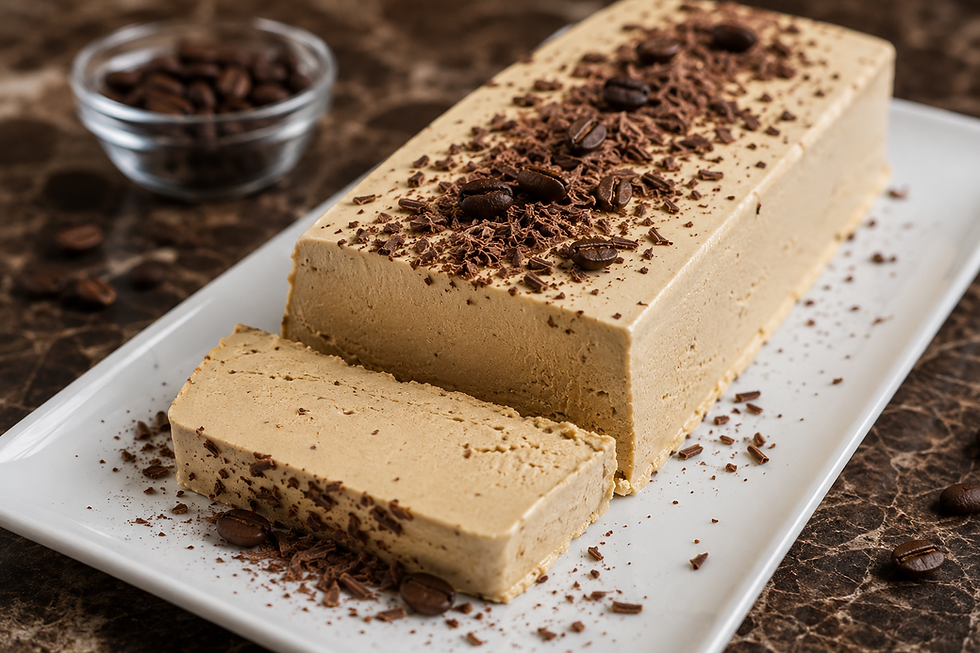
A semifreddo is a frozen cream that never meets an ice cream machine. Whipped yolks, whipped cream and a night in the freezer lock air inside sugar, so the slice eats soft instead of icy. Crushed amaretti add bitter almond and a faint sandy grain, and a dark espresso and cocoa sauce, built to stay fluid on frozen cream, runs across it.
Yield: 8 portions. Prep: 35 minutes. Freeze: 6 hours minimum. Difficulty: intermediate. Course: dessert. Region: Lombardy and Piedmont.
The Story
The bitter note in a crisp amaretto comes from apricot kernels, which carry the same aromatic compound as bitter almonds in a far more insistent concentration. The biscuit that made that flavour famous belongs to Saronno, a small city northwest of Milan, where the Lazzaroni firm has baked since 1888. The town tells a founding story about a young couple who improvised a sweet from egg white, sugar and crushed kernels when the Cardinal of Milan announced a visit. The date usually given is 1718. The document is missing, the biscuit is not. The paired biscuits, twisted in tissue paper and set alight so the wrapper lifts into the air, remain a small ritual of Lombard cafés, and a reminder that this biscuit was made to be enjoyed with coffee.
Saronno is only half the map. Sassello, in the Ligurian hinterland behind Savona, makes the soft kind: domed, pale, with a chew instead of a crack, and recognised as a traditional food product of Liguria. Mombaruzzo in the Monferrato has its own soft version, tied to a Savoy pastry cook. The two styles are not interchangeable, and the argument between them is old. For anything frozen the crisp Saronno type wins outright, because soft biscuits bound with almond paste turn gummy at freezer temperature instead of staying brittle. Lombardy, Piedmont and Liguria each defend their own biscuit, and this recipe follows the crisp northern tradition.
Crushing amaretti into cream is a northern habit of long standing. Piedmont scatters them over baked stuffed peaches and folds them into bonet, the cocoa and rum custard of the Langhe. Lombardy tucks them inside pumpkin ravioli, where the bitterness cuts the squash. A semifreddo simply applies the same logic in colder form, and the tradition of making it ahead suits a dessert that rewards patience. It asks for nothing beyond a whisk and a freezer, and a loaf made two days early leaves the host free at the table.
Coffee completes the picture. Italy drinks its espresso short and bitter, and its desserts have long borrowed that bitterness to keep sugar from cloying, from tiramisù to the affogato. Bitter almond, roasted coffee and unsweetened chocolate share a family of aromatics, so putting all three on one plate is less a contrast than a chord, and it is how amaretti have been eaten in Lombard and Piedmontese cafés for generations.
Ingredients
Use crisp amaretti secchi and a chocolate you would happily eat on its own, since a frozen dessert hides no flaws. Take the yolks out of the refrigerator early, because room temperature yolks whip higher, and keep the cream cold until the moment it is whipped.
For the amaretti semifreddo
Crisp amaretti biscuits, amaretti secchi, crushed, 5 oz (140 g)
Large egg yolks, 4
Granulated sugar, 1/2 cup (100 g)
Water, 2 tbsp (30 ml)
Heavy whipping cream, very cold, 1 3/4 cups (420 ml)
Pure vanilla extract, 1 tsp (5 ml)
Amaretto liqueur, 1 tbsp (15 ml)
Fine sea salt, 1 pinch
For the espresso and dark cocoa sauce
Fresh espresso, strong, 1/3 cup (80 ml)
Heavy cream, 1/2 cup (120 ml)
Dark chocolate, 70 percent, chopped, 3 oz (85 g)
Unsweetened cocoa powder, 2 tbsp (12 g)
Granulated sugar, 1/3 cup (65 g)
Light corn syrup, 1 1/2 tbsp (30 g)
Unsalted butter, 1 tbsp (14 g)
Fine sea salt, 1 pinch
Fresh espresso, 1 tsp (5 ml), extra, to loosen the sauce at service
For the mould
Plastic wrap, 2 long sheets
Neutral oil, 1 tsp (5 ml), to rub on the pan
Hot water, 2 cups (480 ml), for the knife and the bain marie
For finishing
Whole crisp amaretti, 4 to 5
Unsweetened cocoa powder, for dusting, 1 tsp (2 g)
Toasted blanched almonds, chopped, 2 tbsp (18 g)
Preparation
Cook the syrup and whip the yolks
Put the sugar and water in a small heavy saucepan with a probe thermometer clipped in. Boil without stirring and brush down any crystals on the sides with a wet pastry brush, because one stray crystal can turn the syrup grainy. Meanwhile, in the mixer bowl, whip the yolks with the salt on medium high speed until pale and thick. At 244°F (118°C) take the syrup off the heat and pour it in a thin thread down the inside wall of the bowl, clear of the whisk. Keep whipping 6 to 8 minutes, until the foam has tripled, holds a ribbon and the bowl is no longer warm. Cool foam matters, because warm foam melts the cream in the next step.
Crush the amaretti and let them rest
Set the 4 or 5 garnish biscuits aside first. Pulse the rest three or four times, aiming for two thirds fine crumb and one third fragments the size of a lentil. Fold them into the yolk foam with the vanilla and Amaretto. Leave the bowl alone for 10 minutes so the crumb drinks a little moisture and releases its aroma into the base. Cold blunts aroma, so this rest is where the flavour is built, and it cannot be replaced by extra biscuit later.
Whip the cream and fold it in
Whip the cold cream in a chilled bowl to soft peaks only: the trail holds a second, then sinks. Stir a quarter into the base to slacken it, then fold in the rest in two additions, cutting down through the centre, sweeping the bottom and turning the mixture over. About 25 strokes, stopping at the last white streak. It should mound on the spatula and look like weak caffè latte freckled with biscuit. Work quickly, so the cream stays cold.
Fill the mould and freeze
Line a 9 by 5 inch (23 by 13 cm) loaf pan with plastic wrap. Spoon the mixture in, pressing it into the corners so no air pockets show on the cut face. Level it with an offset spatula, rap the pan twice on a folded cloth, fold the wrap over and press a second sheet on the surface. Freeze at least 6 hours, ideally overnight. Individual moulds set in about 4 hours.
Cook the espresso and cocoa sauce
Warm the espresso, cream, sugar and corn syrup to a steaming 175°F (80°C), without boiling. Whisk in the sifted cocoa until every lump is gone, since lumps will not clear later. Off the heat add the chocolate, wait a full minute, then stir from the centre outwards until glossy. Finish with the butter and salt. It should fall from a spoon in a slow ribbon. Cool it, cover it and hold it until service. It will thicken as it cools, which is intended.
Temper, unmould and slice
Move the loaf to the refrigerator for 15 minutes, taking it from about 0°F (18°C below zero) to 10°F (12°C below zero). Invert it onto a chilled board and peel off the wrap. Cut 8 slices about 1 1/4 inches (3 cm) thick with a long blade dipped in hot water and wiped dry between cuts, in one steady stroke. Return slices to a cold tray in the freezer until plating, so they hold the edge.
Plating
Chill the plates in the refrigerator, never the freezer, and never warm them. A warm plate slumps the underside of a tempered slice within a minute and ruins the clean edge you cut for. A chilled plate keeps the slice at its cutting temperature and stops the sauce from sliding away. Wipe the rim clean before serving.
Lay one slice slightly off centre so the biscuit flecked face stays visible. Warm the sauce to about 104°F (40°C) and pour about 2 tablespoons beside and partly under the slice, leaving the top uncovered.
Crumble the reserved amaretti and scatter the toasted almonds over the slice, dust the rim with cocoa through a fine sieve, and send it at once, carrying the plate level. In about five minutes the sauce warms the cream where they touch and the crumbs begin to soften.
Professional Technique
The technical problem of this dish is the sauce. Poured onto a slice at 10°F (12°C below zero), an ordinary chocolate sauce chills in seconds, thickens from the bottom and sets into a brittle crust that cracks under the spoon. So the sauce is calculated to stay fluid on contact with cold, which makes it more concentrated and far less watery than a sauce meant for a hot plate.
The numbers are these. The recipe gives about 14 oz (400 g) of sauce, of which roughly 40 percent is water, about 5.5 oz (160 g), and roughly 60 percent is dissolved and suspended solids. Sugars alone, from sucrose, corn syrup and the chocolate, come to about 4.5 oz (125 g), so the water phase carries around 45 percent sugar, nearly one part sugar to every 1.3 parts water. Dissolved sugar lowers the freezing point and raises viscosity, and corn syrup also blocks crystal growth, so what little ice does form stays too fine to feel. On the slice the sauce thickens into a glossy fudge that still flows. A sauce at 15 percent sugar would freeze near 28°F (minus 2°C) and set at once.
That is also why espresso is reduced to 1/3 cup (80 ml) and not diluted with milk. Serve the sauce at about 104°F (40°C): fluid enough to pour, cool enough not to melt the slice. Pour it at the plate, never earlier, and never from a jug that has been sitting on a cold counter. Sitting on a cold plate it skins and stiffens, and sitting on the slice it starts dissolving the very texture you built.
Texture and Moisture Control
Four textures must survive: cream soft and cold, biscuit grain, glossy sauce, crisp crumb on top. Each fails in a different direction. In the cream the enemy is water. With only four yolks, it is the 1 3/4 cups (420 ml) of cream that carries the structure, and a lighter cream shows visible ice crystals within a day. In the biscuit the risk is the reverse: amaretti ground to powder pull moisture from the cream and turn it pasty.
Air is held by two structures. The yolk foam keeps bubbles in a protein film stabilised by sugar, and is robust once cool. The whipped cream keeps them in a fragile fat network that can be over developed: at stiff peaks it is already close to butter, and the folding finishes the job, which is why the fault shows up as chalkiness instead of collapse.
Serving temperature is the last variable. At 0°F (18°C below zero) this dessert eats like a cold brick, because aromatics are locked and fat is hard. At 10°F (12°C below zero) the same slice is soft against the palate, the bitter almond comes forward and the cut edge stands. Temper it in the refrigerator, not on the bench, since a warm room softens the outside long before the centre moves.
Professional Mise en Place
Almost nothing here happens at service. The loaf is made a day ahead, the sauce while it freezes, and the last quarter hour holds only tempering, slicing and garnish.
Equipment and tools
Stand mixer, a chilled second bowl and a probe thermometer
Loaf pan, plastic wrap, food processor or rolling pin
Fine sieve, offset spatula, long thin knife, jug of hot water
Small saucepan and bain marie for the sauce, chilled serving plates
Prepared ahead
Semifreddo frozen, overnight and up to two weeks
Sauce made, cooled and refrigerated in a sealed jar, up to a week
Almonds toasted and chopped, garnish biscuits kept sealed at room temperature
Slices cut and stacked on parchment on a cold tray, up to three days
Service setup
Loaf in the refrigerator exactly 15 minutes before the first plate
Sauce warming over a bain marie to 104°F (40°C), loosened with espresso if tight
Plates chilled, knife in hot water, cocoa, crumbs and almonds within reach
Sieve ready for the cocoa, and one spoon per plate for the sauce
Chef Tips
Buy amaretti secchi that snap rather than bend, ideally Saronno style, since cold mutes aroma and you want the loudest biscuit available. Soft Sassello types turn gummy here.
Keep the Amaretto to one tablespoon. Alcohol lowers the freezing point and keeps the loaf softer, but two tablespoons will not set firm enough to hold a clean edge.
Taste the base before the cream goes in. It should read a shade sweeter and more almond scented than the finished dessert, because freezing flattens both.
Toast the almonds three or four minutes in a dry pan, then tip them onto a cold plate. Left in the hot pan they turn bitter in under a minute.
Slice with a long thin blade and never saw. Run it under hot water, wipe it dry, draw it through once and repeat, so the biscuit fragments stay in the slice and the cut face stays clean and sharp.
Common Mistakes
Pulverising all the amaretti. Powder throws away the texture that makes this version worth making and pulls moisture from the cream. Keep a third in lentil sized fragments.
Pouring syrup onto the moving whisk. It spins into hard threads on the wires and never reaches the yolks. Pour a thin thread down the bowl wall.
Whipping the cream past soft peaks. The fat is already coalescing, folding finishes it, and the slice tastes chalky. You cannot unwhip cream.
Pouring the sauce early. On a cold plate it skins and stiffens, and on the slice it melts the cream. Pour at the plate, at about 104°F (40°C).
Serving straight from the freezer. At 0°F (18°C below zero) it tastes of almost nothing. Fifteen minutes in the refrigerator is not optional.
Garnishing ahead. Crumbs on a frozen surface soften within ten minutes and the cocoa dusting goes patchy. Garnish at the plate.
Using a warm plate. It undercuts the slice from below and the base slumps before the first spoonful. Chill the plates as carefully as the bowl.
Wine Pairing
Moscato d'Asti DOCG: The Piedmontese default with almond biscuits, and the gentlest option. At about 5.5 percent alcohol, with soft bubbles and musk and orange blossom aromas, it sits just sweeter than the semifreddo, and the fizz scrubs cream fat from the palate. Use it when the sauce is served sparingly.
Brachetto d'Acqui DOCG: A sweet, lightly sparkling red from the Monferrato hills, low in alcohol and almost free of tannin, with strawberry and rose perfume. That fruit runs beside dark chocolate instead of fighting it. Serve it cold, around 46°F (8°C), in a small glass.
Recioto della Valpolicella DOCG: The serious choice when the sauce is generous. Made from Corvina grapes dried on racks, with dried cherry fruit and a cocoa note of its own, it meets a 70 percent chocolate sauce as an equal. Its residual sugar matters, because sweetness reads lower on a cold plate.
Sangue di Giuda dell'Oltrepò Pavese DOC: The Lombard bottle for a Lombard biscuit, from the hills south of Pavia. Sweet, softly sparkling, with blackberry and violet fruit and enough acidity to stay clean against the cream. A livelier, grippier cousin of Brachetto, poured at the same temperature.
Vin Santo del Chianti Classico DOC: The Tuscan classic with almond biscuits. Aged in small barrels, it shows roasted hazelnut, dried apricot and caramel that echo the amaretti, while its acidity keeps the finish clean. Choose the sweeter style for this dessert and pour it small and lightly chilled.
Storage & Reheating
Wrapped tightly, with film pressed onto every cut face, the semifreddo keeps up to two weeks at 0°F (18°C below zero). After that the biscuit fragments soften and the almond aroma fades. Keep it away from savoury food, since aerated cream absorbs odours quickly. Label the loaf with the date, and freeze it flat, away from the door.
Slices can be cut ahead, stacked between parchment and covered for up to three days. Temper single slices about 8 minutes instead of 15. Do not refreeze a slice that has softened.
The sauce keeps a week refrigerated in a sealed jar and sets firm when cold. Warm it over a bain marie, stirring, and loosen it with a teaspoon of espresso rather than water. Do not freeze it. Keep garnish amaretti in an airtight tin at room temperature.
Nutrition
Per portion, 8 portions per loaf, one slice with about 2 tablespoons of sauce:
Calories: 520 kcal
Total Fat: 36 g
Saturated Fat: 20 g
Trans Fat: 0.5 g
Unsaturated Fat: 15 g
Cholesterol: 170 mg
Sodium: 95 mg
Total Carbohydrates: 43 g
Fiber: 3 g
Total Sugars: 34 g
Added Sugars: 28 g
Protein: 7 g
Lactose: 3 g
Micronutrients: calcium, iron, magnesium, vitamin A, B12
These figures are estimates based on standard ingredient values and vary with brands and portion size.


Comments