
Italian Coffee and Mascarpone Semifreddo | Semifreddo al Caffè e Mascarpone
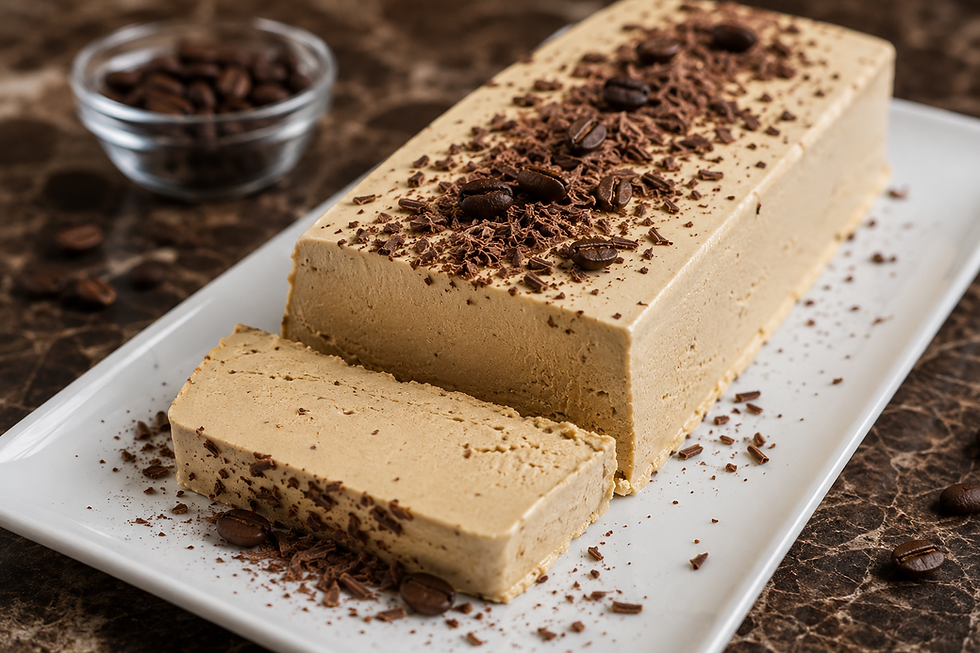
Mascarpone and coffee want opposite things from a frozen dessert. One is close to a quarter butterfat and pulls the base towards a firm block that cuts cleanly. The other is water with flavour in it, and it pulls the same base towards softness. This semifreddo lives where the two settle against each other, and that point is found by weighing them.
Get it right and the slice stands upright on the plate while the first spoonful is already melting. Miss it either way and you lose one of the two.
Yield: 8 servings from a 9 by 5 inch (23 by 13 cm) loaf mould. Prep: 50 minutes. Cook: 25 minutes. Freeze: 6 hours minimum, better overnight. Difficulty: advanced. Course: dolce. Region: Lombardy and Veneto.
The Story
Mascarpone is a Lombard product and a young one by Italian standards. It comes from the dairy country of the lower Po valley, the Lodigiano and the flat land between Abbiategrasso and Lodi, where cream was warmed and turned with tartaric or citric acid rather than set with rennet, then hung in cloth to drain. Before refrigeration it was a winter cheese, because cream soured slowly in cold weather and the finished product kept for days rather than weeks. It travelled only as far as a cart could go before it turned. Its fat, close to a quarter of its weight, is why it behaves on the whisk like cream and not like a cheese, and why it can carry a frozen dessert on its own.
Tiramisù, the dish this semifreddo descends from, is younger still. Credit belongs to Treviso in the Veneto in the late 1960s and the 1970s, and it spread so quickly through Italy and then the world that most people now assume it is ancient. Restaurant kitchens took its four flavours, mascarpone, espresso, egg and savoiardi, and rebuilt them in formats that survive a service. The frozen version became common in Italian dining rooms through the 1980s, because a terrine holds in the freezer for days and can be cut to order without collapsing. Savoiardi themselves are older than the dessert by centuries, court biscuits from Savoy, still baked in Piedmont and in Sardinia.
The coffee belongs to a third Italy again. Trieste has been the country's coffee port since its years as a Habsburg free harbour, and a large share of the green beans that reach Italy still land there, which is why several of the major roasters grew up around that gulf. Naples supplied the dark short roast and the habit of drinking it in two mouthfuls. What matters for this recipe is what espresso means in Italian practice: a very small volume of very concentrated liquid, never a mug of filter coffee. That single cultural fact is what makes a coffee semifreddo possible at all.
Ingredients
For the espresso reduction
Freshly brewed espresso, strong, 1 cup (240 ml)
Granulated sugar, 1 tsp (4 g)
For the cooked yolk base
Egg yolks, large, 6 (about 4 oz or 110 g)
Granulated sugar, 1/2 cup (100 g)
Fine sea salt, 1 small pinch
For the Italian meringue
Egg whites, large, 3 (about 3 1/4 oz or 90 g)
Granulated sugar, 2/3 cup (135 g)
Water, 3 tbsp (45 ml)
Lemon juice, 1/4 tsp (1 ml)
For the mascarpone cream
Mascarpone, cold, 9 oz (255 g)
Heavy cream, 36 percent fat, cold, 1 1/4 cups (300 ml)
Vanilla extract, 1/2 tsp (2.5 ml)
For the savoiardi layer
Savoiardi, dry ladyfinger biscuits, 6
Brewed espresso, cooled, 1/3 cup (80 ml)
Marsala Superiore Dolce, 1 tbsp (15 ml), optional
For finishing
Unsweetened cocoa powder, for dusting, 2 tsp (4 g)
Coffee beans, chocolate coated, 8
Heavy cream, whipped soft, 1/3 cup (80 ml), optional
Preparation
Reduce the espresso
Pour the espresso into a small wide pan with the teaspoon of sugar and set it over medium heat. Bring it to a simmer and let it fall to 1/3 cup (80 ml), which takes 8 to 10 minutes in a pan wide enough to give the water somewhere to go. Swirl rather than stir and keep the heat moderate: pushed hard, the last spoonfuls scorch and turn acrid. Cool to room temperature.
Line the mould and chill it
Line the loaf tin with clingfilm, pressing it flat into the corners and leaving a generous overhang on both long sides. A second sheet laid crosswise covers the short ends. Smooth the wrinkles out, because every crease prints itself onto the cut face. Slide the tin into the freezer while you work: a cold mould sets the first layer on contact.
Cook the yolks over a bain marie
Whisk the yolks, the 1/2 cup (100 g) of sugar and the pinch of salt in a bowl set over barely simmering water, the base not touching the liquid. Keep the whisk moving for 8 to 10 minutes until the mixture triples, pales and reaches 165°F (74°C), which pasteurises it. The ribbon should hold its shape for a second as it falls. Whisk 3 minutes more off the heat.
Whip the Italian meringue
Cook the 2/3 cup (135 g) of sugar with the water to 244°F (118°C) without stirring. Meanwhile bring the whites with the lemon juice to soft peaks. Pour the syrup down the inside of the bowl in a thin steady stream with the mixer running, then whip until the bowl feels only just warm, about 6 minutes. A correctly cooked syrup holds every bubble through freezing.
Loosen the mascarpone with the reduction
Put the cold mascarpone in a wide bowl and work it with a spatula until smooth. Add the cooled espresso reduction in three additions, folding each one in completely before the next goes in, then the vanilla. The mixture looks thin after the first addition and comes back together after the second. Adding all the liquid at once leaves lumps that no later beating will recover.
Whip the cream and combine
Whip the cold cream to soft peaks only, the stage where it holds a lazy fold and still moves in the bowl. Fold the cooled yolk base into the coffee mascarpone, then a third of the meringue to slacken the mass, then the rest of the meringue, then the cream. Cut down through the middle, turn the bowl a quarter, repeat. Stop when the colour is even.
Soak and set the savoiardi
Mix the cooled espresso with the Marsala in a shallow dish. Pour half the base into the frozen mould and level it. Dip each savoiardo for one second per side, no longer, and lay them in a single close row. Cover with the remaining base, level the top with an offset spatula and tap the tin twice on the counter to release trapped air.
Freeze and temper before slicing
Fold the clingfilm over the surface, wrap the tin in a second layer and freeze for at least 6 hours, preferably overnight. Before serving, move the terrine to the refrigerator for 15 to 20 minutes, then unwrap, invert onto a chilled board and peel the film away. Cut with a long thin knife warmed in hot water and wiped dry between slices.
Plating
Serve on chilled plates, never warm ones, and bring them out at the last moment. A slice of about 1 1/4 inches (3 cm) is right for eight portions and shows the savoiardi seam running through the middle, which is the visual point of building the terrine in two layers. Set the slice slightly off centre and leave the rest of the plate empty.
Dust the cocoa through a small fine mesh sieve directly over the slice, immediately before the plate leaves the kitchen. Cocoa dusted in advance draws moisture from the surface and turns from matte powder to a damp brown film within a couple of minutes. Finish with one chocolate coated coffee bean at the base of the slice and, if you want it, a spoonful of softly whipped cream on the side rather than on top.
Professional Technique
The whole recipe is a negotiation between two ingredients that pull the structure in opposite directions, and the professional way to settle it is arithmetic rather than instinct. Mascarpone is firm, fatty and cohesive: it stiffens the frozen mass and holds the shape of a cut. Coffee is liquid: it softens the same mass and rounds the edges off a slice. Neither can be judged on its own, only as a share of the finished base.
Weigh the base and the numbers become clear. The yolk mixture, the meringue, the mascarpone and the cream come to roughly 2 lb 7 oz (1100 g). The 9 oz (255 g) of mascarpone is about 23 percent of that, and the useful window runs from 20 to 25 percent. Below 20 the terrine tastes of cream and nothing else. Above 30 the dessert turns dense and pasty and leaves a coating on the palate that the coffee cannot cut through. The 1/3 cup (80 ml) of reduction is about 7 percent, and that window is narrower still, 6 to 8 percent. Past 10 percent the slice slumps within a minute of reaching the plate.
This is exactly why the espresso is reduced instead of used as it comes. A cup of espresso poured straight in would put the same flavour into the base at roughly 22 percent by weight, three times the ceiling the structure tolerates. Boiling it down to a third removes the water and leaves the coffee solids, so the flavour arrives at full strength while the liquid load stays inside the window. Reduction here is not a matter of concentration for its own sake. It is the only way to have both the taste and the slice.
Texture and Moisture Control
Three separate structures carry this dessert and each is lost at a different moment. The cooked yolk base supplies body, the Italian meringue supplies the fine bubbles that keep the frozen mass light, and the soft whipped cream supplies the melting quality on the tongue. Whip the cream past soft peaks and it turns grainy in the fold and the slice eats buttery. Fold too long and the meringue collapses, leaving a dense terrine that eats heavy and cold.
Moisture management is mostly about the savoiardi. One second per side is the working figure: the biscuit should absorb enough to soften in the freezer but not so much that it releases liquid back into the base. An oversoaked row leaves a wet grey seam and ice crystals along its edges. Keep the soaking espresso cool, because warm liquid enters a dry biscuit far faster.
Temperature at the table matters as much as anything done in the bowl. Straight from the freezer at 0°F (minus 18°C) the fat is hard and the coffee is mute. The 15 to 20 minute rest brings the centre to around 21°F (minus 6°C), where the surface yields to a spoon and the aromatics come forward.
Professional Mise en Place
The folding stage runs continuously once it starts, so everything is weighed and within reach before the cream goes on the whisk.
Equipment and tools
Loaf tin, 9 by 5 inches (23 by 13 cm), and two sheets of clingfilm
Stand mixer for the meringue plus a second bowl and whisk for the cream
Digital probe thermometer and a small heavy pan for the sugar syrup
Large flexible spatula, offset spatula, fine mesh sieve for the cocoa
Long thin slicing knife and a jug of hot water
Prepared ahead
Espresso reduction, up to 3 days ahead, refrigerated in a sealed jar
Soaking espresso measured and cooled, on the day
Mould lined and held in the freezer, at least 30 minutes ahead
Mascarpone and cream weighed out and kept cold until used
Terrine assembled and frozen, 1 day ahead at least
Service setup
Terrine moved from freezer to refrigerator 20 minutes before service
Plates chilled, cocoa in the sieve, garnishes portioned
Knife in hot water with a dry cloth beside it for wiping between cuts
Cut slices held on a chilled tray, covered, for no more than 10 minutes
Chef Tips
Brew the espresso specifically for the reduction and use a dark roast. A medium roast reduces into something sour and thin, because the acids concentrate along with everything else and there is no roast character behind them. A stovetop moka pot beats any filter method.
Open the mascarpone cold and check it. A tub near its expiry has already begun to separate, and you will see a rim of whey around the edge. That whey is water you did not budget for, so pour it off before weighing.
Weigh the reduction rather than reading the level in the pan. A tablespoon either side of 1/3 cup (80 ml) moves the coffee share by a full percentage point, and that shows in the cut. Reduce slightly past the mark, then bring it back with a teaspoon of water.
For a stronger coffee note without touching the structure, add 1/2 teaspoon of finely ground espresso to the yolk base while it is still warm. It carries aroma and colour with almost no water attached, which is the one lever left once the percentages are fixed.
Common Mistakes
Using espresso without reducing it. This is the single failure that ruins the dessert. The coffee tastes right in the bowl and the terrine never firms, because the liquid load lands at three times the share the structure can hold. There is no recovery: the base has to be rebuilt.
Whipping the cream to firm peaks. Soft peaks fold in smoothly and keep the slice tender. Firm peaks break into grains during the fold, and those grains read as a waxy texture once the terrine is frozen. Stop while the cream still moves in the bowl.
Drowning the savoiardi. A biscuit left in the espresso for five seconds gives the liquid up again inside the mould. You get a wet seam, ice crystals along the biscuit row and a slice that falls apart at the middle. One second per side, then straight into the tin.
Slicing straight from the freezer. At freezer temperature the fat is hard, the coffee is flat and the knife compresses the layers instead of cutting them. Twenty minutes in the refrigerator and a warmed knife give a clean face and a dessert that tastes of what is in it.
Wine Pairing
Vin Santo del Chianti Classico DOC: The most complete answer on the list. Years in small casks under a partial fill give it an oxidative depth of dried fig, walnut skin and caramel that runs alongside roasted coffee rather than competing with it. The sweetness sits on very firm acidity, and that acidity lifts the mascarpone fat off the palate.
Marsala DOC: Take the Superiore Dolce, and take it cool. Fortification leaves enough alcohol to cut through 23 percent mascarpone, which an unfortified wine of the same sweetness cannot manage, and its burnt sugar and toasted almond profile echoes the espresso reduction almost note for note.
Recioto di Soave DOCG: Garganega dried on the plant into a sweet wine of unusual delicacy, all candied citrus peel and bitter almond, with acidity high enough for the cream. It lightens the dessert instead of deepening it, and the almond note lands squarely on the savoiardi.
Moscato di Scanzo DOCG: A rare red passito from the hills above Bergamo, a Lombard wine for a Lombard cheese. Dried rose, sage and sour cherry sit over a real tannic frame, and that tannin is why it works: it grips the butterfat as no white dessert wine can, while the sweetness answers the coffee.
Malvasia delle Lipari DOC: The Aeolian bottle, moderately sweet, with dried apricot, orange peel and a salty volcanic edge underneath. Lighter than the Vin Santo and fresher, it suits a smaller portion at the end of a long meal, and its saline finish makes the cocoa taste more of chocolate.
Storage & Reheating
The terrine keeps in the freezer for up to 3 weeks if it is double wrapped in clingfilm and sealed in a rigid container or a bag with the air pressed out. Contact with freezer air is what does the damage: the surface dries, takes on the smell of everything else in there and grows crystals. It is at its best between one and four days after it is made, once the savoiardi have equalised with the base.
Cut slices do not store. Once a face is exposed it dries within hours, so wrap the cut end tightly against the remaining block and return it to the freezer at once. There is no reheating here and no refreezing either: a terrine that has softened out of shape comes back coarse and crystalline, so serve what you have thawed. The espresso reduction keeps on its own, refrigerated, for 3 days.
Nutrition
Per serving, based on 8 slices from one loaf terrine:
Calories: 425 kcal
Total Fat: 28 g
Saturated Fat: 17 g
Trans Fat: 0 g
Unsaturated Fat: 9 g
Cholesterol: 205 mg
Sodium: 65 mg
Total Carbohydrates: 36 g
Fiber: 0.4 g
Total Sugars: 32 g
Added Sugars: 30 g
Protein: 6 g
Lactose: 2.6 g
Principal micronutrients: calcium, vitamin A, vitamin B12, riboflavin, selenium, phosphorus
These figures are estimates and move with the fat of the mascarpone and cream you buy. The optional whipped cream adds about 35 kcal.


Comments