
Italian Coffee Semifreddo | Semifreddo al Caffè

This is the dessert an Italian kitchen makes when it wants the flavour of the espresso that closes the meal and the texture of ice cream, without owning a machine. A concentrated coffee reduction goes into a cooked egg and sugar base, cold whipped cream goes in after it, and the freezer does the rest.
What follows is the full method, plus the reason a coffee semifreddo behaves differently in the freezer from every other flavour on the list.
Yield: 8 servings from one 9 by 5 inch terrine. Prep: 40 minutes. Cook: 15 minutes. Freeze: at least 6 hours, better overnight. Total: about 7 hours. Difficulty: intermediate. Course: dolce. Region: central and northern Italy, the coffee bar tradition.
The Story
Coffee reached Italy through Venice, where the first public coffee houses in Europe opened under the arcades of Piazza San Marco in the middle of the seventeenth century. From there it moved inland and became an institution in Turin, a city that built an entire café architecture around it and still serves bicerin, the layered glass of coffee, chocolate and cream, in the same rooms. Italian coffee never settled into being only a drink. Almost as soon as it was affordable it started appearing in the pastry kitchen, first as a flavouring for creams and custards, then as a sorbet, then in the frozen desserts of the nineteenth century.
Semifreddo as a named category belongs to that later period, when Italian pasticceria had cooked egg bases and reliable ice in the same building but not yet the churning machines that spread through commercial gelaterie. A frozen cream that needed no churn was a practical answer for a restaurant kitchen, and it is still the reason semifreddo survives on trattoria menus where gelato does not: it can be made two days ahead in a bread tin and cut to order.
Coffee was the flavour that made the format popular rather than merely useful. Espresso was already the fixed ending of an Italian meal, so a frozen dessert built on it did not have to persuade anyone. In Naples the same instinct produced granita di caffè and caffè leccese; in Turin it produced the coffee semifreddi and the marquise cakes; in Milan it produced the coffee and cream tortes of the tea rooms. The dessert on this page sits in that family, and it belongs to the whole peninsula rather than to one province, which is unusual for an Italian sweet and says something about how completely coffee was absorbed.
Ingredients
For the coffee reduction
Freshly brewed espresso, pulled short and ristretto, 1 cup (240 ml)
Instant espresso powder, 2 tsp (4 g)
Granulated sugar, 1 tbsp (13 g)
For the pate a bombe
Egg yolks, large, 5
Granulated sugar, 2/3 cup (135 g)
Water, 3 tbsp (45 ml)
Fine sea salt, 1 generous pinch
Coffee liqueur, 2 tbsp (30 ml)
For the cream
Heavy cream, at least 35 percent fat, very cold, 1 3/4 cups (420 ml)
Confectioners sugar, 1 tbsp (8 g)
For finishing
Dark chocolate, 70 percent, 1 oz (30 g)
Unsweetened cocoa powder, 2 tsp (4 g)
Chocolate coated coffee beans, 8
Heavy cream, for the plate, 1/4 cup (60 ml)
Coffee reduction reserved from above, 2 tbsp (30 ml)
You also need a 9 by 5 inch (23 by 13 cm) loaf tin, a sheet of plastic wrap large enough to line it with overhang, and a probe thermometer that reads to 260°F (127°C).
Preparation
Step 1
Reduce the coffee. Pull the espresso short, stir in the instant espresso powder and the tablespoon of sugar while it is hot, then pour it into a small wide saucepan. Simmer over low heat until only 1/3 cup (80 ml) remains, which takes 8 to 10 minutes and leaves a liquid with the viscosity of maple syrup. Reserve 2 tbsp for the plate and cool the rest to room temperature. Never add more liquid to correct the strength: everything this dessert needs from coffee has to arrive in as little water as possible.
Step 2
Whip the cream. Put the cold cream and the confectioners sugar in a chilled bowl and whip only to soft peaks, the stage where the whisk leaves a trail that closes slowly and the cream still slumps when the beater lifts. Stop there and refrigerate it. Cream taken to stiff peaks has already begun to break into butter grains, and it will fold in as lumps rather than folding in at all.
Step 3
Cook the sugar syrup. Combine the 2/3 cup of sugar with the water in a small heavy saucepan, wash any crystals down the sides with a wet brush and bring it to a boil without stirring. Cook to 250°F (121°C) on the probe, the firm ball stage. While it climbs, start the yolks: whip them with the salt on medium speed until they are pale and doubled in volume.
Step 4
Build the pate a bombe. With the mixer running, pour the syrup down the inside wall of the bowl in a thin steady stream, never onto the whisk, which would fling it in threads against the cold sides and set it. Keep whipping for 6 to 8 minutes, until the bowl is cool to the palm and the mixture holds a ribbon that sits on the surface for a count of three. This is the only heat the eggs receive, and 250°F syrup is what makes them safe.
Step 5
Add the coffee. Whisk the cooled coffee reduction and the coffee liqueur into the pate a bombe in two additions, on low speed, and stop the moment the colour is even. The base will loosen noticeably: that is the reduction doing what it is supposed to do and not a fault. Taste it now. It should be assertively bitter, because the cream that follows will mute it by roughly a third.
Step 6
Fold and fill. Lighten the coffee base with a quarter of the whipped cream, working briskly with a spatula, then fold in the rest in two additions, cutting down the centre and turning the bowl a quarter each time. Stop while a few pale streaks are still visible. Scrape into the lined tin, tap it firmly on the counter three times to release trapped pockets, smooth the top and fold the overhanging wrap over it.
Step 7
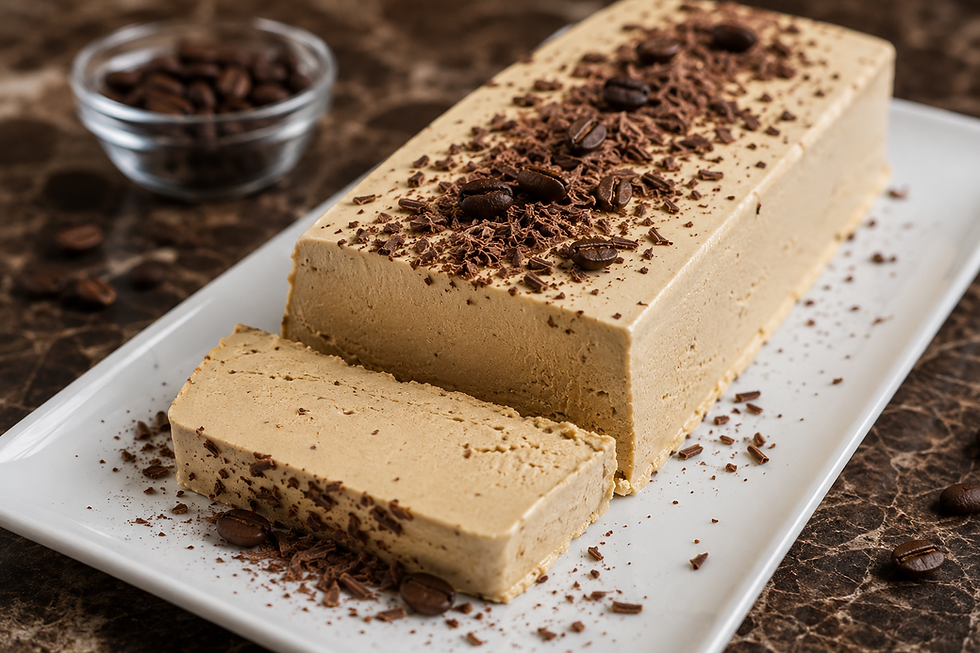
Freeze and slice. Freeze for at least 6 hours, preferably overnight, on a level shelf away from the door. To serve, lift the block out by the wrap, peel the wrap back and slice with a long knife dipped in hot water and wiped dry between cuts. Cut slices about 1 1/4 inch (3 cm) thick, straight from the freezer, and let them stand 3 to 4 minutes on the plate before serving.
Plating
Use cold plates, straight from the refrigerator, and plate one slice at a time rather than lining up eight. Set the slice slightly off centre, with the cut face towards the diner so the pale interior and the darker set surface both read.
Pour the reserved coffee reduction into a small spoon and lay two short lines of it on the plate, alongside the slice and never over it, where it would slide down the cut face and streak. Whip the 1/4 cup of cream to very soft peaks, barely thickened, and place one loose spoonful beside the semifreddo as a cold counterweight to the bitterness.
Shave the dark chocolate over the slice with a peeler, dust a light pass of cocoa across one side of the plate only, and finish with a single chocolate coated coffee bean set against the base. Nothing else. A coffee semifreddo that arrives under a pile of garnish has already lost the contrast it was built for.
Professional Technique
The technique that defines this recipe is the one nobody mentions: concentrated coffee lowers the freezing point of the mixture. Sugars and the soluble solids of a ristretto espresso, the melanoidins, the acids, the caffeine, behave in the freezer exactly like antifreeze in a radiator. Every dissolved molecule depresses the temperature at which the water around it can organise itself into ice. A coffee semifreddo therefore never freezes as hard as a vanilla one made with the same amount of sugar and cream, and at a domestic freezer temperature of around 0°F (18°C below zero) it holds a fraction of its water still unfrozen.
That is the reason this dessert cuts cleanly and eats creamy straight from the freezer while a plain vanilla semifreddo often needs ten minutes of tempering first. It also explains the two rules that govern the coffee itself. The coffee has to be reduced rather than brewed longer, because a longer brew gives you the same solids carried in far more water, and that extra water has nothing dissolved in it to hold it back: it freezes first, and it freezes into crystals you feel on the tongue as grit. Reducing a strong espresso to a third of its volume concentrates the solids and removes the liability at the same time.
The second rule concerns where the coffee goes. It belongs in the pate a bombe, not in the cream. The egg and sugar base is an aqueous phase that will accept a syrupy acidic liquid without complaint, while cream is a fat emulsion held together by a fragile protein and phospholipid film. Adding acidic coffee concentrate directly to cream, whipped or not, destabilises that film and gives you a grainy curdled mass. Put the coffee where the water already is, then bring the cream to the finished base.
Texture and Moisture Control
The whole textural question here is a ratio: how much water is in the mixture against how much dissolved matter is there to keep it from freezing. Coffee brought in as a reduction pushes that ratio in your favour. Coffee brought in as a cup of ordinary espresso pushes it the wrong way and no amount of careful folding will repair it, because the excess water leaves during freezing and reappears as ice.
Fat is the second control. Cream below 35 percent fat does not contain enough of it to coat the palate against the cold, and a semifreddo made with it tastes thin and icy even when the coffee is right. The tablespoon of coffee liqueur is working on the same problem from the other side, since alcohol depresses the freezing point further, but 2 tbsp is the ceiling: past that the block will not set firmly enough to slice.
Serving temperature finishes the job. Cut the slices frozen, because a tempered block tears under the knife, then give the plated slice 3 to 4 minutes. The surface warms to around 21°F (6°C below zero), which is where the fat softens and the coffee aromatics become volatile enough to smell. Serve it colder and the flavour is mute; serve it warmer and the slice slumps at the base.
Professional Mise en Place
Everything except the final slicing happens the day before, which is the practical argument for this dessert in a working kitchen.
Equipment and tools
Stand mixer with whisk, or hand mixer and a stable bowl
Small heavy saucepan and a probe thermometer reading to 260°F (127°C)
Small wide saucepan for reducing the coffee
Loaf tin 9 by 5 inch (23 by 13 cm), plastic wrap, large flexible spatula
Long thin slicing knife and a jug of hot water
Prepared ahead
Coffee reduction, up to 3 days ahead, refrigerated in a sealed jar
The finished block, frozen and wrapped, up to 2 weeks ahead
Chocolate shavings, held in a covered container in the refrigerator
Plates chilled in the refrigerator, not the freezer, which fogs them
Service setup
Block kept in the freezer until the moment of the first cut
Hot water and a clean cloth beside the board, knife wiped between slices
Reduction and soft cream in small containers over ice
Cocoa in a fine sieve, coffee beans counted out one per plate
Chef Tips
Use coffee you would drink on its own. Reduction amplifies every defect in the cup, so a dark roast pushed to the edge of burnt becomes acrid. A medium roast with body is safest, and the instant espresso powder is there for colour and solids, not flavour.
Line the tin with one large sheet of wrap rather than two overlapping pieces. Overlaps trap air, air makes a crease, and the crease shows on the side of every slice.
If the syrup reaches 250°F before the yolks are pale and doubled, take the pan off the heat: it holds above 240°F for a minute or two, which is long enough. Syrup past the firm ball stage cannot be rescued with water, so start it again.
Freeze the block on a level shelf and check it after twenty minutes. A tin sitting on a bag of peas sets at an angle, and an angled semifreddo yields wedges for the whole service.
Common Mistakes
Using brewed coffee instead of a reduction. This is the failure behind almost every icy coffee semifreddo. A cup of espresso carries the right solids in far too much water, and that surplus freezes into crystals you can feel.
Pouring the coffee into the cream. The concentrate is acidic, and acid breaks the protein film that holds a whipped cream emulsion together. The result is grainy and cannot be fixed by folding harder. The coffee belongs in the pate a bombe.
Whipping the cream to stiff peaks. Stiff cream has already started separating into butter grains, and it folds into the base as visible lumps that freeze hard. Soft peaks is the only correct stage for any semifreddo.
Skipping the thermometer. Syrup judged by eye lands anywhere between 230°F and 265°F (110°C and 130°C). Below the firm ball stage the base weeps in the freezer; above it the sugar seizes into threads the second it meets the yolks.
Slicing a tempered block. Left on the counter to soften, the semifreddo tears under the knife and the cut face goes dull. Cut it frozen with a hot wiped knife and let the plated slice stand instead.
Wine Pairing
Vin Santo del Chianti Classico DOC: The most exact match on the list, because it is built from the same flavour family. Long oxidative ageing in small barrels gives it roasted hazelnut, dried fig and a caramel edge that meets the roasted notes of the coffee reduction directly rather than contrasting with them. Its acidity stays high under all that sugar, which is what keeps the palate moving against a mixture that is a third cream by weight.
Marsala DOC: Choose a Superiore Dolce and serve it in a small glass at around 57°F (14°C). The fortification carries alcohol warmth that reads as a counterweight to the cold of the semifreddo, and its burnt sugar and walnut character extend the bitterness of the coffee instead of trying to sweeten it away. The tannin picked up from wood also gives the pairing some grip, which a straight sweet white would not.
Recioto della Valpolicella DOCG: The sweet red option, and the one to pour if the plate carries the dark chocolate garnish. Dried grapes give it black cherry and bitter almond depth over soft ripe tannin, and that tannin is the point: it finds the cocoa and the coffee solids and holds onto them. Serve it at 61°F (16°C), cool enough that the residual sugar does not turn syrupy against the cream.
Moscato di Scanzo DOCG: A small production passito from the hills outside Bergamo, made from a red Moscato and dried on racks before pressing. It is lighter in sugar than the others here and distinctly aromatic, with rose, dried strawberry and a fine bitter finish. That lift makes it the choice when the semifreddo is served plain, since it perfumes the coffee rather than piling more weight on top of it.
Storage & Reheating
The finished block keeps in the freezer, wrapped in its own plastic and then sealed inside a freezer bag or rigid container, for up to 2 weeks with no loss of texture. The double wrapping matters here, because a cream and egg mixture picks up freezer odours quickly and coffee makes them obvious.
Cut slices do not keep. Once a face is exposed it dehydrates and greys within a day, so cut only what is going out and rewrap the block tightly against the fresh cut. Never refreeze a slice that has softened on a plate: the melted water returns as coarse crystals.
Nothing here is reheated. The coffee reduction holds 3 days in the refrigerator and can be loosened with a teaspoon of hot espresso. Do not refrigerate the semifreddo to soften it, since the outside collapses long before the centre yields.
Nutrition
Per serving, based on 8 slices from one terrine:
Calories: 385 kcal
Total Fat: 27 g
Saturated Fat: 16 g
Trans Fat: 0 g
Unsaturated Fat: 9 g
Cholesterol: 185 mg
Sodium: 45 mg
Total Carbohydrates: 29 g
Fiber: 0.5 g
Total Sugars: 27 g
Added Sugars: 25 g
Protein: 4 g
Lactose: 2.5 g
Principal micronutrients: calcium, vitamin A, riboflavin, selenium, potassium
These figures are estimates and move with the fat content of the cream.



Comments