
Italian Sweet Apple Focaccia | Focaccia Dolce alle Mele
Updated: Sep 14
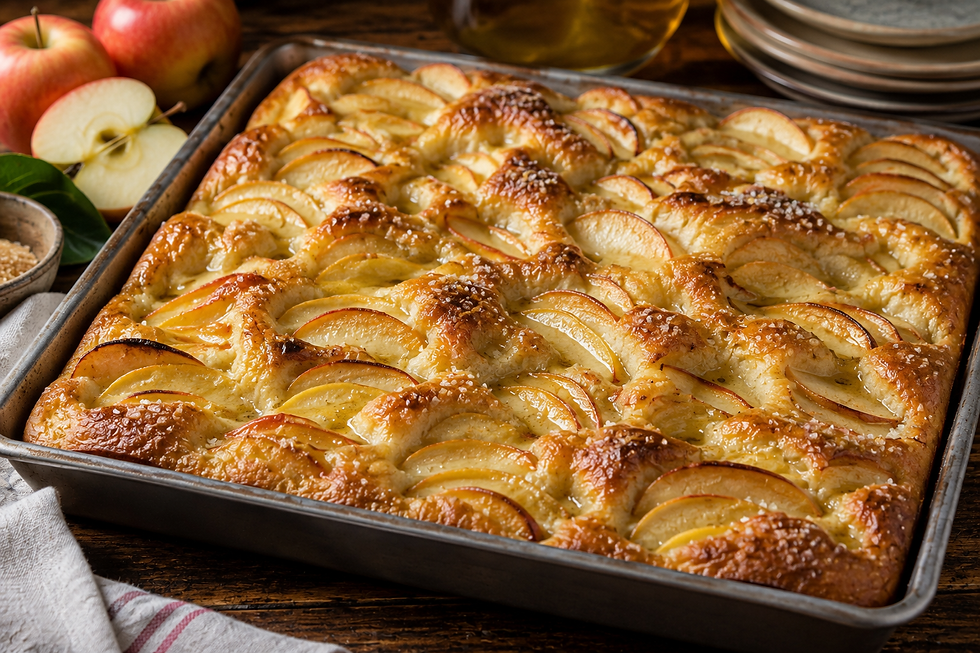
Focaccia dolce alle mele is what happens when a baker looks at a tray of focaccia and decides that sugar, butter and fruit belong there as much as salt and rosemary. The base is a real focaccia dough, soft, wet and slowly fermented at sixty eight percent hydration with a very small dose of yeast and a long cold rest. It is not a cake batter and it must never behave like one.
What separates it from savoury focaccia is the finish rather than the dough. Apple slices are macerated in sugar and lemon, then pressed into the dimples so they sit half submerged. The syrup they give up caramelises against the olive oil and glazes the surface, while the crumb underneath stays open and elastic. It reads as bread with fruit baked into it, which is exactly what it is.
The variety of apple decides the outcome more than any other choice. A firm tart apple holds its shape and its acidity through a hot oven and keeps the whole thing from turning sweet and flat. A soft eating apple collapses into wet pulp and waterlogs the crumb beneath it. Everything else in the method is ordinary focaccia work, done gently.
Yield: one 9 by 13 inch pan, 12 pieces. Prep: 30 minutes. Fermentation: 14 to 20 hours, mostly cold. Bake: 25 minutes. Total: about 16 to 22 hours. Difficulty: intermediate. Course: dessert, breakfast or merenda. Region: northern Italy, Liguria and the Veneto.
The Story
Focaccia is Ligurian by reputation and Genoese by law, but the sweet versions belong to a much wider and older habit. Across northern Italy the same bread dough that fed the household was routinely enriched at the end of a bake with whatever fruit the season gave, because the oven was already hot and the dough was already there. In the Veneto and Friuli this produced fugassa with grapes at harvest, in Liguria focaccia dolce dusted heavily with sugar, and in the apple growing valleys of Trentino and Piedmont the version made with mele.
Apples are the point of contact. Italy grows a great deal of fruit but the Val di Non in Trentino and the Valtellina in Lombardy are apple country in a way the rest of the country is not, and in those valleys apples arrive in every form the kitchen can manage: strudel in the German speaking north, frittelle, torta di mele, and this, the plainest of the lot. It is a domestic recipe, made on baking day, eaten at merenda in the afternoon or at breakfast the next morning with coffee.
The technique itself is unchanged from savoury focaccia. The long cold fermentation that modern Italian bakers use to build flavour without adding yeast is the same one behind focaccia genovese, and the dimpling is the same gesture. Only the salt and rosemary step aside.
Ingredients
For the focaccia dough
Bread flour or Italian tipo 0, 3 1/2 cups (450 g)
Water, lukewarm, 1 1/4 cups plus 2 tbsp (310 ml)
Instant dry yeast, 1/2 tsp (1.5 g)
Granulated sugar, 3 tbsp (38 g)
Extra virgin olive oil, 3 tbsp (45 ml)
Fine sea salt, 1 1/2 tsp (9 g)
Finely grated lemon zest, 1 tsp
For the apple topping
Firm tart apples such as Granny Smith or Renetta, 3 medium, about 1 1/3 lb (600 g)
Granulated sugar, 1/4 cup (50 g)
Fresh lemon juice, 2 tbsp (30 ml)
Ground cinnamon, 1/2 tsp, optional
Unsalted butter, cold and cubed, 2 tbsp (28 g)
For the pan and finishing
Extra virgin olive oil for the pan, 3 tbsp (45 ml)
Turbinado or demerara sugar, 2 tbsp (25 g)
Unsalted butter, melted, 1 tbsp (14 g)
Apricot jam, warmed and sieved, 2 tbsp (40 g), optional glaze
On the apples: Renetta is the classic Italian choice, dense, tart and almost never sold outside Italy, and Granny Smith is the closest widely available match. Braeburn and Pink Lady both work. Red Delicious, Gala and McIntosh do not, because they carry too much water and too little acid and will steam the crumb they sit on.
Preparation
Mix the dough and autolyse
Whisk the flour, sugar and yeast in a large bowl, add the water and mix with a wet hand or a dough whisk until no dry flour remains. It will look shaggy and far too wet. Cover and leave 30 minutes. This rest hydrates the flour and starts gluten forming with no work from you, which matters because a dough this wet is unpleasant to knead.
Add the salt, oil and zest
Sprinkle the salt and lemon zest over the dough, pour on the olive oil, and squeeze the mass through your fingers for about 2 minutes until the oil disappears and the dough turns cohesive and slightly glossy. It will still be sticky. Do not add flour to correct that: the stickiness is what gives you an open crumb.
Fold the dough four times
Over the next 2 hours, with the bowl covered, do four sets of folds at 30 minute intervals. Wet your hand, reach under one side of the dough, stretch it up and fold it over the center, then turn the bowl a quarter and repeat, four times per set. The dough goes from slack to smooth and springy across the sets. This replaces kneading.
Cold ferment overnight
Cover the bowl tightly and refrigerate for 12 to 18 hours. The cold slows the yeast almost to a stop while the enzymes keep breaking starch into sugars, and that gap is where the flavour of a good focaccia comes from. The dough should roughly double and be visibly bubbled at the sides of the bowl. Anything less than 12 hours tastes noticeably flat.
Pan and rest the dough
Pour 3 tablespoons of olive oil into a 9 by 13 inch (23 by 33 cm) metal pan and spread it to every corner. Tip the cold dough in without deflating it, turn it once to coat both faces, and press it gently toward the corners. It will resist and spring back; leave it, cover, and rest at room temperature 2 to 3 hours until relaxed, puffy and nearly filling the pan.
Macerate the apples
About 30 minutes before baking, peel, quarter and core the apples and slice them about 1/8 inch (3 mm) thick. Toss them with the sugar, lemon juice and cinnamon and leave them at room temperature. They will soften slightly and release a thin syrup. Drain them just before topping and keep the syrup, which becomes the glaze.
Dimple and top
Heat the oven to 425°F (220°C) with a rack in the lower third. Oil your fingertips and press them straight down through the dough to the base of the pan, all over, making deep dimples without tearing. Lay the drained apple slices in overlapping rows, pressing each lightly into a dimple so it sits half submerged rather than on top. Dot the cold butter between the slices and scatter the turbinado sugar over everything.
Bake
Bake 22 to 28 minutes, turning the pan once at 15 minutes, until the crust is deep gold and the apple edges have caught colour. Brush the surface with the reserved maceration syrup at that 15 minute turn and again the moment the pan comes out, which gives the top its gloss without a separate glaze.
Cool and finish
Slide a thin spatula under one corner immediately and lift the focaccia onto a rack, because left in the pan it steams and the base goes soft within ten minutes. Brush with melted butter, or with warmed sieved apricot jam for a lacquered finish. Cool at least 20 minutes before cutting.
Plating
Cut with a serrated knife using a long sawing stroke rather than pressure, which would compress the open crumb and push the apple slices sideways. Twelve squares is the usual division for this pan, or nine generous ones. Cut only what you are serving; the exposed crumb dries quickly.
This is not a plated restaurant dessert and should not be dressed as one. Serve the squares slightly warm on a board or a plain white plate, apple side up. For breakfast it needs nothing at all. For a dessert service, a spoonful of mascarpone loosened with cream, or plain unsweetened whipped cream, sits well beside it, since the focaccia is already sweet enough.
Professional Technique
The controlling technique is the long cold fermentation, doing two jobs at once. The first is flavour: at refrigerator temperature the yeast produces very little gas while amylase enzymes keep breaking starch into simple sugars, so a dough left 16 hours in the cold develops a depth no amount of yeast at room temperature can imitate. The second is handling, since cold dough at this hydration is firm enough to lift into a pan in one piece.
The second technique is deep dimpling, and it is specific to a topped focaccia. In savoury focaccia the dimples exist to hold oil and salt. Here they are structural: each one is a well that a slice of apple sits down into, so the fruit is anchored by dough on both sides instead of perched on a rising surface. Press right through to the base of the pan. Shallow dimples close during the oven spring and push the apples up and off, leaving a flat bread with fruit sliding around on top of it.
The third is the maceration, a moisture control device disguised as a flavour step. Sugar draws water out of the apple slices by osmosis over thirty minutes; that water leaves as syrup, which you drain and later brush on as glaze, and the drier slices left behind will not flood the crumb. Skip it and the same water is released in the oven, straight down into the dough.
Texture and Moisture Control
The target is an open airy crumb with large irregular holes, a base fried crisp by the oil in the pan, and apple slices tender but still distinct. The enemy throughout is water in the wrong place: the apples carry it, the maceration removes part of it, the deep dimples keep the rest above the crumb, and a hot oven drives off what is left.
The oil in the pan is not only for release. Three tablespoons under a wet dough at 425°F (220°C) shallow fries the base, giving a crisp golden underside against the soft interior. Use metal rather than glass, which conducts poorly and leaves the base pale, and never line it with parchment, which puts a barrier between the oil and the dough.
Temperature matters at both ends. The oven must be fully preheated 20 minutes so the crust sets before the apples can weep into it, and on the way out the transfer to a rack within the first minute is the single most important step for texture: steam trapped under a focaccia left in its hot pan undoes twenty minutes of crust in ten.
Professional Mise en Place
The schedule is long but almost entirely passive, and the only tight window is the twenty minutes between dimpling and the oven. Start the dough the day before you want to serve it.
Equipment and tools
Large bowl with a tight lid, and a dough whisk or a bowl scraper
Metal baking pan, 9 by 13 inch (23 by 33 cm), light coloured rather than dark
Mandoline or a sharp knife for even 1/8 inch (3 mm) apple slices
Digital scale, pastry brush, cooling rack, serrated knife
Prepared ahead
Dough mixed, folded and cold fermenting, 12 to 18 hours ahead
Dough transferred to the oiled pan and resting, 3 hours before baking
Apples sliced and macerating, 30 minutes before baking and no longer
Oven preheated a full 20 minutes with the rack in the lower third
Service setup
Reserved maceration syrup in a small bowl with a brush, for the two glazing passes
Cooling rack cleared and ready before the pan comes out of the oven
Butter melted or apricot jam warmed and sieved at the moment of finishing
Serrated knife and a board, cutting only what is being served
Chef Tips
Weigh the flour and the water rather than measuring by volume. At this hydration a cup of flour packed differently shifts the dough by five percent either way, which is the difference between an open crumb and a tight one.
Slice the apples on a mandoline if you have one. Even thickness matters more than it sounds, because thick slices stay raw at the center while thin ones dry to leather in the same oven, and a tray with both is what makes a homemade version look homemade.
If the dough tears when you dimple it, stop and give it another 20 minutes at room temperature. Tearing means the gluten is still tight from the cold, and forcing it damages the structure you spent sixteen hours building.
Save the maceration syrup even if you plan to use apricot glaze. Brushed on halfway through the bake it caramelises into the crust, and the flavour is apple and lemon rather than the generic sweetness of jam. The apricot, if you use it, goes on afterwards and only for shine.
Common Mistakes
Using a soft eating apple. Gala, Red Delicious and McIntosh break down into wet pulp in a hot oven and release their water directly into the crumb beneath them. Choose a firm tart variety: Granny Smith, Renetta, Braeburn or Pink Lady.
Adding flour to the sticky dough. Sixty eight percent hydration feels alarming in the hands, and the reflex is to flour it back to something manageable. That reflex costs you the open crumb entirely. Wet your hands instead and use a scraper.
Skipping the cold fermentation. A three hour warm rise produces bread that is technically risen and tastes of nothing much. The 12 to 18 cold hours are where the flavour is made.
Dimpling too shallowly. Dimples that stop halfway through close during oven spring and push the apple slices upward, so they finish sitting on a flat surface and slide off when cut. Press all the way to the base of the pan.
Baking in a glass dish. Glass conducts heat poorly and leaves the oiled base pale and soft rather than crisp. A light metal pan is what makes the underside work.
Leaving it in the pan to cool. Steam trapped under a hot focaccia turns the crisp base soft within ten minutes. Lift it onto a rack in the first minute out of the oven, every time.
Wine Pairing
Moscato d'Asti DOCG: The default for Italian fruit baking and hard to better here. Gentle sweetness, low alcohol and grapey aroma sit beside the baked apple without piling sugar on sugar, and the light frizzante lifts the olive oil off the palate. Serve at 46°F (8°C).
Recioto di Soave DOCG: Dried Garganega from the Veneto, honeyed and considerably more concentrated, with almond and candied peel behind the sweetness. The firm acidity underneath is what keeps it from swamping a bread based dessert, and the almond note runs neatly alongside caramelised apple and butter.
Ramandolo DOCG: A Verduzzo from the hills of Friuli, golden and only moderately sweet, with quince, dried apricot and a slightly tannic grip unusual in a white. That grip stands up to the caramelised sugar crust rather than dissolving into it.
Colli Orientali del Friuli Picolit DOCG: The luxury option, rare and expensive, from a variety that naturally sets very few berries. Delicate rather than powerful, with acacia honey, peach and a long clean finish, it suits a lighter less sugared version and is wasted on a heavily glazed one.
Vin Santo del Chianti Classico DOC: For a version leaning on cinnamon and butter. Long ageing in small sealed barrels brings dried fruit, walnut and an oxidative note that matches caramelisation directly, and Tuscans have been dipping baked goods into it for centuries, which is the whole argument.
Storage & Reheating
Eat it the day it is baked if you can, because focaccia is at its best in the first six hours and this one carries fruit that keeps releasing moisture. Wrapped loosely in a clean cloth at room temperature it holds for 2 days. Do not refrigerate it: cold accelerates starch retrogradation and the crumb goes stale and dry in a way that room temperature does not.
It freezes well in portions. Cool completely, wrap each square tightly in plastic and then foil, and freeze up to 2 months. Thaw still wrapped at room temperature for about an hour, so condensation forms on the wrapping rather than the crust.
Reheat in an oven, never a microwave, which turns the crumb tough and the apples rubbery within seconds. Give squares 6 to 8 minutes at 350°F (175°C) directly on a rack, or 10 to 12 minutes from frozen. The base crisps again and the apple warms through. A brief pass under a broiler for 30 seconds restores the shine on a glaze that has dulled.
Nutrition
Per serving, based on 12 squares from one 9 by 13 inch pan:
Calories: 265 kcal
Total Fat: 8 g
Saturated Fat: 2.5 g
Trans Fat: 0 g
Unsaturated Fat: 5.5 g
Cholesterol: 8 mg
Sodium: 300 mg
Total Carbohydrates: 44 g
Fiber: 2.5 g
Total Sugars: 14 g
Added Sugars: 10 g
Protein: 5 g
Lactose: 0.1 g
Principal micronutrients: iron 2.2 mg, selenium 22 mcg, potassium 155 mg, vitamin C 4 mg, folate 60 mcg, manganese 0.4 mg
These figures are estimates. They move with the sugar and water content of the apples, the oil the dough absorbs from the pan, and whether the apricot glaze is used. The recipe contains wheat and milk, and no eggs, nuts or soy. Replacing both quantities of butter with olive oil makes it dairy free.


Comments