Vegan Gluten-Free Chickpea Tagliatelle with Porcini, Reinterpreted | Tagliatelle Rivisitate di Ceci Senza Glutine ai Porcini

These tagliatelle are fresh pasta made without wheat and without any animal ingredient: a dough of chickpea flour, rice flour and tapioca starch, bound with psyllium husk and water, rolled thin and cut into ribbons by hand. Classic tagliatelle ai porcini use a soft wheat dough made with eggs, with butter and often Parmigiano Reggiano in the sauce; this version is a reinterpretation. They are tossed with a sauce of fresh and dried porcini, garlic, thyme and olive oil, finished with the dark broth of the dried mushrooms so the ribbons turn glossy and deeply savory. The recipe is written for guests who cannot eat gluten, and it is built to stand on its own: the nutty taste of chickpea flour and the woodland depth of porcini are a natural pair. Every step explains how to handle a dough without gluten.
Yield: 4 servings. Prep: 50 minutes, plus 30 minutes resting. Cook: 25 minutes. Rest: 30 minutes for the dough. Course: primo piatto. Region: none, a modern Italian recipe.
The Story
This is not a traditional regional dish, and it does not pretend to be one. It is a reinterpretation, a modern Italian answer to a modern need. Classic tagliatelle, the long ribbons of Emilia-Romagna, are made from a dough of soft wheat flour and eggs, and they owe their elasticity to gluten, the network of proteins that forms when wheat flour is kneaded with liquid. For a guest with celiac disease or a medical gluten intolerance, that network is exactly what must be avoided. This recipe keeps the shape, the width and the way of serving tagliatelle, and rebuilds the dough from ingredients that contain neither gluten nor anything of animal origin.
The main flour comes from a legume that Italy knows well. Chickpea flour is the base of some of the oldest street foods of the peninsula: farinata in Liguria, cecina in coastal Tuscany, panelle in Palermo, all made only from chickpea flour, water, olive oil and salt. These preparations prove that chickpea flour can carry an entire dish with its own flavor, slightly sweet and nutty. In pasta it brings protein, which gives the dough strength, and a golden color close to that of classic tagliatelle, with no animal ingredient.
The sauce comes from the woods. Porcini, Boletus edulis and its close relatives, are the most prized wild mushrooms of the Italian Apennines and Alps, gathered in late summer and autumn and dried for the rest of the year. In the upper valley of the Taro, in the province of Parma, the Fungo di Borgotaro is protected by a PGI, a sign of how central these mushrooms are to the cooking of the Apennine hills. Tagliatelle ai porcini is one of the great autumn plates of central and northern Italy, and its classic version is dressed with butter and often Parmigiano Reggiano, which this recipe leaves out.
Italy has a strong culture of gluten-free cooking. Pharmacies and supermarkets carry dedicated pasta, restaurants train their staff to keep gluten-free dishes apart, and the Italian Celiac Association works with them on safe preparation. This recipe follows the same spirit at home. It respects the principle of fresh Italian pasta, a thin, even ribbon that holds a sauce, and adds the precision a gluten-free dough needs: the right blend of flours, a binder that replaces gluten, a full rest and a gentle cooking.
Ingredients
Use only flours and starches that are certified gluten free: naturally gluten-free grains and legumes can be contaminated with wheat during milling. Chickpea flour should be fine, pale yellow and fresh, because old chickpea flour tastes bitter. Choose white rice flour ground very fine, sometimes sold as superfine; coarse rice flour gives a sandy dough. Psyllium husk powder is the binder: it forms a gel with water that holds the dough together where gluten would. For the sauce, buy fresh porcini in season, firm and heavy for their size, or replace them with cremini or king oyster mushrooms, and use whole dried porcini slices of a pale color, which have the best aroma.
For the gluten-free tagliatelle
Chickpea flour, certified gluten free, 1 cup (120 g)
Superfine white rice flour, certified gluten free, 2/3 cup (100 g)
Tapioca starch, 1/2 cup (60 g)
Psyllium husk powder, 2 tbsp (14 g)
Fine sea salt, 1/2 tsp (3 g)
Lukewarm water, 3/4 cup plus 2 tbsp (210 ml)
Extra virgin olive oil, 1 tbsp (15 ml)
Rice flour or tapioca starch, for dusting
For the porcini sauce
Dried porcini, 1 oz (30 g)
Hot water, for soaking, 2 cups (475 ml)
Fresh porcini, or cremini and king oyster mushrooms, 14 oz (400 g)
Extra virgin olive oil, 1/4 cup (60 ml)
Garlic, 2 cloves, peeled and lightly crushed
Shallot, 1 small, finely chopped, 1 1/2 oz (40 g)
Fresh thyme, 4 sprigs
Dry white wine, 1/4 cup (60 ml)
Fine sea salt and freshly ground black pepper, to taste
For the finish
Cultured plant butter, 1 tbsp (14 g)
Flat leaf parsley, finely chopped, 2 tbsp (8 g)
Lemon zest, finely grated, 1/4 tsp
Extra virgin olive oil, mild, to finish
Flaky sea salt, 1 pinch
Preparation
Step 1

Make the dough. In a bowl, whisk the chickpea flour, rice flour, tapioca starch, psyllium powder and salt until perfectly even, because pockets of psyllium form hard lumps. Add the lukewarm water and the olive oil and stir with a spatula until the dough comes together. It will look wet at first: wait 2 minutes, then knead it on a work surface dusted with rice flour for 3 to 4 minutes, until it is smooth, slightly tacky and holds a thumbprint without cracking. The psyllium absorbs water slowly and forms a gel that binds the starches, giving the elasticity gluten gives in wheat dough. Wrap the dough tightly in plastic film.
Step 2

Rest the dough and soak the porcini. Leave the dough at room temperature for 30 minutes. During the rest the flours hydrate completely and the psyllium gel sets, so the dough becomes firmer and much easier to roll. At the same time, put the dried porcini in a bowl, cover them with 2 cups (475 ml) of hot water, about 175°F (80°C), and leave them for 30 minutes. Water that is too hot extracts bitterness; hot water below the boil draws out the aroma and the savory compounds into the liquid, which becomes the broth of the sauce.
Step 3

Roll and cut the tagliatelle. Divide the dough into four pieces and keep three covered. Roll one piece between two sheets of parchment paper with a rolling pin, turning it often, to a thickness of about 1/16 inch (1.5 mm), or pass it through a pasta machine on a middle setting, dusting it well. Gluten-free dough is not elastic and tears if it is stretched or rolled too thin, so roll it gently and stop at a slightly thicker sheet than for wheat pasta. Dust the sheet with rice flour, roll it up loosely and cut it into ribbons about 1/4 inch (6 mm) wide with a sharp knife. Unroll the ribbons at once and lay them in loose nests on a tray dusted with rice flour.
Step 4

Prepare the mushrooms. Lift the soaked porcini out of their liquid with your fingers, squeezing them gently over the bowl, and chop them coarsely. Strain the liquid through a fine strainer lined with a paper towel to remove any sand, and keep it warm: you need about 1 1/2 cups (350 ml). Clean the fresh mushrooms with a soft brush and a damp cloth, never under running water, which makes them soggy. Trim the base of the stems and cut the mushrooms into slices about 1/4 inch (6 mm) thick, keeping the caps and stems in proportion so they cook evenly.
Step 5

Sear the fresh mushrooms. Heat 3 tbsp (45 ml) of olive oil in a wide skillet over high heat until it shimmers. Add the sliced mushrooms in a single layer, working in two batches if needed, and leave them untouched for 2 minutes, until the underside is golden. Turn them, add salt, and cook for 2 minutes more. Crowding the pan makes the mushrooms release their water and stew instead of browning; a single layer over high heat drives off the water fast and lets the Maillard reaction build flavor. Move them to a plate.
Step 6

Build the sauce. Lower the heat to medium, add the remaining 1 tbsp (15 ml) of olive oil, the garlic, the shallot and the thyme, and cook for 2 minutes until the shallot is soft and the garlic fragrant and pale gold. Add the chopped dried porcini and stir for 1 minute. Pour in the white wine and let it evaporate almost completely, about 1 minute. Add 1 cup (240 ml) of the porcini broth and simmer for 5 minutes, until reduced by about one third. Return the seared mushrooms, remove the garlic and thyme stems, season with pepper and keep the sauce at a bare simmer.
Step 7

Cook the pasta and toss. Bring 3 quarts (2.8 l) of water to a boil, salt it with 1 1/2 tbsp (25 g) of coarse salt and lower it to a lively simmer, not a rolling boil, because turbulence breaks gluten-free ribbons. Shake the excess flour off the tagliatelle and slide them in. Stir gently with a pasta fork and cook for 2 1/2 to 4 minutes, until they are tender but still hold a slight bite; taste one ribbon after 2 minutes. Lift them into the skillet with a slotted spoon, add the plant butter and a splash of the remaining porcini broth, and toss over low heat for 1 minute, shaking the pan rather than stirring, until the sauce turns glossy and coats the ribbons. Finish with parsley and lemon zest.
Plating
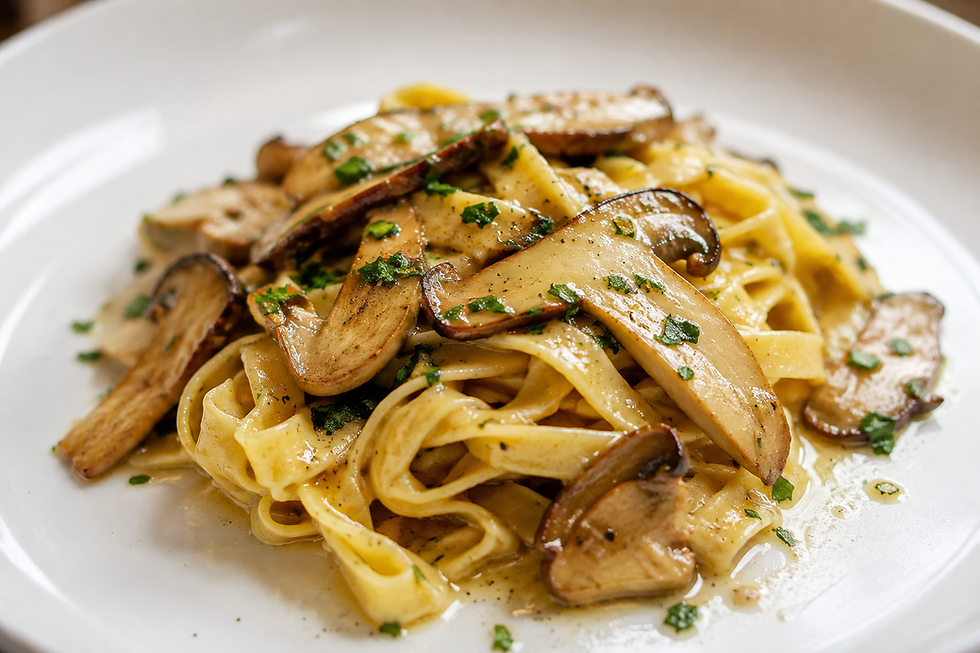
Serve in warm, shallow bowls, heated to about 140°F (60°C). Twist each portion into a loose nest with a carving fork, lifting it gently, because gluten-free ribbons are more fragile than wheat pasta when hot. Arrange the largest slices of porcini on top and around the nest so they are clearly visible, and spoon over any sauce left in the skillet.
Finish each plate with a thin thread of mild olive oil, a few flakes of sea salt, a turn of black pepper and two or three thyme leaves. The guest eats it with a fork, and each bite should carry ribbon, mushroom and a little of the dark, glossy broth, with the nutty taste of the chickpea dough under the deep aroma of the porcini.
Professional Technique
The key ratio is water to dry ingredients. For about 10 oz (280 g) of flours and starches, about 7 fl oz (210 ml) of water gives a hydration of 75 percent, much higher than a classic tagliatella dough. Gluten-free flours absorb a great deal of liquid, and the psyllium needs water to form its gel. A dough that is too dry cracks at the edges when rolled; a dough that is too wet sticks to the parchment. Adjust with a teaspoon of water or rice flour at a time, never more.
The hidden variable is the rest. Psyllium gels slowly, and the starches go on hydrating for at least 20 minutes. A dough rolled at once tears and crumbles; the same dough rolled after 30 minutes stretches into a smooth sheet. If the dough stays more than 2 hours, keep it in the refrigerator and bring it back to room temperature for 15 minutes before rolling.
The doneness test is taste and touch. Gluten-free pasta passes from firm to soft in less than a minute, and it does not keep its bite as wheat pasta does. Lift a ribbon after 2 minutes and bite it: it should be tender throughout with a slight resistance and no raw, floury taste at the center. Take the pasta out at that moment, because it continues to soften in the sauce.
Dough and Starch Control
Without gluten, structure comes from three sources working together. The chickpea flour brings protein that sets during cooking and gives the ribbon firmness. The rice flour brings a neutral starch that makes the dough smooth and pale. The tapioca starch brings stretch and a slight chew when cooked. The psyllium ties them together into a dough that can be rolled and cut. Change one of them and the balance changes: more chickpea flour gives a stronger taste and a more fragile ribbon, more tapioca a gummy one.
Gluten-free pasta releases more starch into the cooking water than wheat pasta, and the surface turns sticky if the ribbons touch while hot. This is why the water should be plentiful for the quantity, simmering rather than boiling hard, and why the pasta goes straight into the sauce. The released starch is useful in the skillet: a splash of porcini broth and the movement of the pan turn it into a light binding that coats the ribbons.
Moisture also matters before cooking. Fresh gluten-free tagliatelle dry quickly at the edges and crack. Keep the nests dusted and covered with a clean cloth if they wait more than 15 minutes, and cook them within 1 hour of cutting. For longer storage, freeze them on the tray and cook them from frozen, adding 1 minute to the time.
Professional Mise en Place
The dough can be made and rested while the porcini soak, so the whole recipe fits into about 1 hour 30 minutes. In a kitchen that also cooks with wheat, the gluten-free work must be kept completely apart.
Equipment and tools
Clean bowl, whisk, spatula, rolling pin, parchment paper or a pasta machine used only for gluten-free dough
Sharp knife or pasta cutter, tray dusted with rice flour, clean cloth
Wide skillet, fine strainer and paper towel, soft mushroom brush
Pot for 3 quarts (2.8 l) of water, slotted spoon or pasta fork
Prepared ahead
Dough mixed, rested and wrapped, up to 4 hours ahead, refrigerated
Dried porcini soaked and the broth strained, up to 1 day ahead, refrigerated
Fresh mushrooms cleaned and sliced, up to 3 hours ahead
Tagliatelle cut and nested, within 1 hour of service, or frozen
Service setup
Pot of salted water at a lively simmer, used only for gluten-free pasta
Sauce in the skillet at a bare simmer, warm porcini broth beside it
Bowls warmed to about 140°F (60°C)
Parsley, lemon zest, mild oil, flaky salt and pepper mill on the pass
Chef Tips
Keep everything that touches the pasta free of wheat: a board, a pot or a strainer used for ordinary pasta can carry enough gluten to make a sensitive guest ill. Wash them well or keep a separate set, and use fresh water for every batch.
If the sheet tears while rolling, do not fight it. Press the pieces back together, fold the sheet in half and roll again: gluten-free dough has no memory and does not shrink, so it can be repaired as many times as needed.
Toast the chickpea flour in a dry skillet over low heat for 4 to 5 minutes, stirring, until it smells nutty, and let it cool before mixing. It loses the raw, slightly beany note some guests notice and gives the ribbons a deeper golden color.
Use the porcini soaking liquid with care. It is concentrated and slightly salty, and a few spoonfuls change the whole sauce. Add it in stages, taste, and keep any left over in the refrigerator for a risotto or a soup within 2 days.
Common Mistakes
Using flours that are not certified gluten free. Rice and chickpea flour can be milled on lines shared with wheat. For a guest with celiac disease, choose only certified products.
Skipping the psyllium. Without a binder the dough crumbles and the ribbons break in the water. Psyllium husk powder replaces the structure that gluten gives.
Rolling the dough at once. An unrested dough tears and cracks. Let it rest for 30 minutes so the flours hydrate and the psyllium gel sets.
Rolling too thin. Gluten-free sheets thinner than about 1/16 inch (1.5 mm) break during cooking. Keep them slightly thicker than wheat pasta.
Boiling hard. A rolling boil breaks the fragile ribbons. Cook them in water at a lively simmer and stir gently.
Crowding the mushrooms. Too many mushrooms in the pan stew in their own water and turn gray and rubbery. Sear them in a single layer over high heat, in batches.
Overcooking the pasta. Gluten-free tagliatelle turn soft very quickly. Taste after 2 minutes and move them to the sauce the moment they are tender.
Wine Pairing
Roero Arneis DOCG: The white of the sandy hills of Roero, in Piedmont, with pear, white flowers and a gentle almond finish. Its soft acidity and medium body suit the nutty chickpea dough and do not cover the delicate perfume of the porcini. Serve it at about 50°F (10°C).
Gavi DOCG: Cortese from southeastern Piedmont, with citrus, green apple and a fine mineral line. Its freshness refreshes the palate after the olive oil and the savory broth and lifts the thyme. Serve it at about 48 to 50°F (9 to 10°C).
Rosso di Montalcino DOC: A younger, fresher Sangiovese from Montalcino, with red cherry, dried herbs and a light earthy note. Its moderate tannins and bright acidity meet the earthy depth of the porcini without overpowering a pasta dish. Serve it at about 60 to 62°F (16 to 17°C).
Chianti Classico DOCG: Sangiovese from the hills between Florence and Siena, with violet, sour cherry and forest floor. Its earthy notes echo the mushrooms, and its acidity cuts the richness of the seared porcini. Serve it at about 62°F (17°C).
Storage & Reheating
Refrigerator: the cooked dish keeps for 1 day in an airtight container, but gluten-free pasta firms up and loses its texture when cold, so it is best eaten at once. The raw dough keeps for 1 day, tightly wrapped, and the porcini sauce without the pasta keeps for 3 days. Freezer: freeze the cut, uncooked tagliatelle in nests on a tray, then in a bag, for up to 1 month; cook them from frozen. The sauce freezes for up to 2 months. Do not freeze the cooked pasta, which turns crumbly.
Reheat leftovers in a skillet over low heat with 2 to 3 tbsp (30 to 45 ml) of water or porcini broth per portion, covered for 2 minutes, then uncovered while tossing gently for 1 minute more, until hot and glossy. Avoid the microwave, which dries the ribbons and makes them brittle. Reheat the sauce alone until simmering before adding freshly cooked pasta.
Nutrition
Per serving, based on 4 servings:
Calories: 480 kcal
Total Fat: 20 g
Saturated Fat: 3 g
Trans Fat: 0 g
Unsaturated Fat: 16 g
Cholesterol: 0 mg
Sodium: 620 mg
Total Carbohydrates: 62 g
Fiber: 10 g
Total Sugars: 4 g
Added Sugars: 0 g
Protein: 14 g
Principal micronutrients: folate, manganese, copper, potassium, riboflavin, niacin, selenium
These figures are estimates, calculated on the quantities listed and rounded to the nearest whole number, assuming that only part of the cooking salt stays in the pasta. They vary with the brands of flour, the type of fresh mushrooms and the amount of broth absorbed.



Comments