
Italian Soft Chocolate and Hazelnut Nougat | Torrone Aquilano Tenero al Cioccolato e Nocciole
Updated: Sep 14

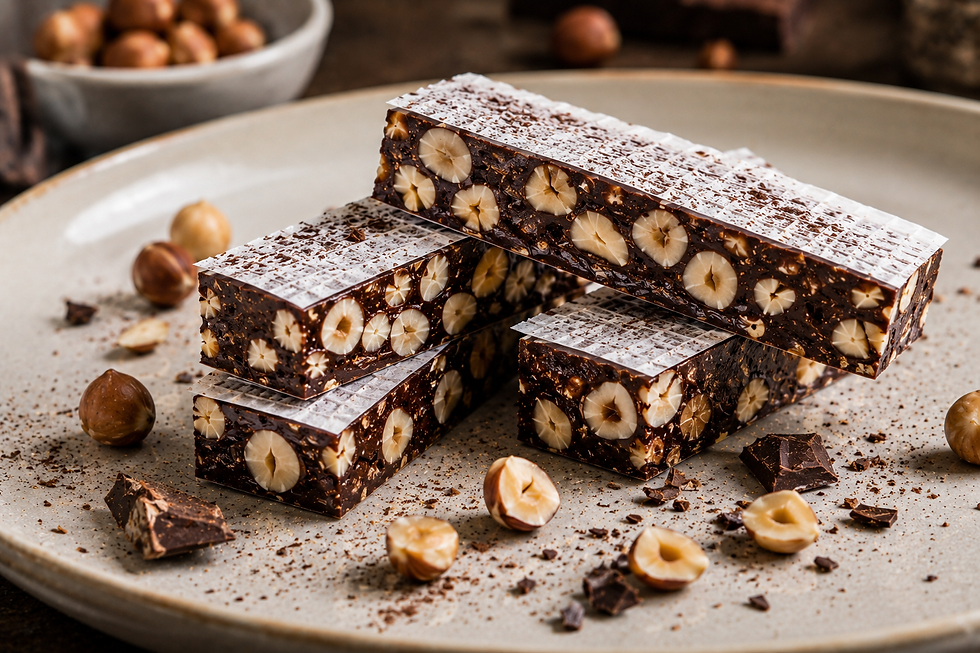
Torrone Aquilano Tenero is the softest nougat in Italy and the one that tastes least like nougat. It is cocoa brown rather than ivory, it is cut with a knife instead of broken with the hands, and it carries whole roasted hazelnuts instead of almonds. Where the bars of Cremona and Benevento are built to shatter, this one is built to yield, and the whole recipe is organised around keeping it that way.
Three things make it tender: the sugar syrup stops at firm ball rather than hard crack, the honey is concentrated only far enough to lose its raw water, and dark chocolate brings cocoa butter into a confection that once held no fat beyond the nuts. The flavour should read hazelnut and honey first, chocolate second.
Yield: about 24 pieces, roughly 2 lb (900 g). Prep: 45 minutes. Cook: 40 minutes. Setting: 8 hours or overnight. Total: about 9 hours 30 minutes. Difficulty: advanced. Course: confectionery. Region: Abruzzo, L'Aquila.
The Story
L'Aquila has made nougat for centuries, but the bar the city is known for today is barely more than a hundred years old. In 1835 Ulisse Nurzia opened a confectionery workshop in the mountain town, and it was his descendants, working in the early twentieth century, who took the hard pale torrone Abruzzo had inherited from the medieval sugar trade and folded chocolate into it. The result was a nougat nobody had eaten before: dark, soft, sliceable, tasting as much of cocoa and hazelnut as of honey. The family name is still on the box, and in L'Aquila the sweet is often simply called torrone Nurzia.
A tradition does not need six hundred years behind it to be real. It becomes real when a place makes a thing, eats it every Christmas and recognises itself in it, and by that standard the torrone tenero is as Aquilano as the Gran Sasso behind the city. After the 2009 earthquake it became one of the products the city rebuilt its commercial identity around.
The choice of hazelnut over almond is the other departure, and it is geographic. Abruzzo is a mountain region with cold winters and no almond groves of its own, while hazelnuts travelled easily along the trade routes from central Italy. Roasted hard, they stand up to seventy percent chocolate in a way a sweet Avola almond never could.
Ingredients
For the nougat base
Wildflower honey, 1 cup (340 g)
Granulated sugar, 3/4 cup (150 g)
Water, 1/4 cup (60 ml)
Egg whites, large, at room temperature, 2 (70 g)
Fine sea salt, 1/4 tsp (1.5 g)
For the chocolate
Dark chocolate couverture, 70 percent, finely chopped, 5 oz (140 g)
Unsweetened cocoa powder, sifted, 2 tbsp (12 g)
Pure vanilla extract, 1 tsp (5 ml)
For the nuts and the mould
Whole hazelnuts, toasted and skinned, 2 cups (280 g)
Edible wafer paper, ostie, sheets, 2
Neutral oil, for the spatula, 1 tsp (5 ml)
Oven temperature for toasting the nuts: 325°F (165°C). Honey target: 240°F (116°C). Sugar syrup target: 255°F (124°C). Melted chocolate holding temperature: 115°F (46°C). Setting room: 64°F to 66°F (18°C to 19°C).
Preparation
Toast and skin the hazelnuts
Roast the hazelnuts at 325°F (165°C) for 15 to 18 minutes, until the skins blister and split and the kitchen smells strongly of roasted nut. Tip them into a coarse towel and rub hard. The few skins that cling do no harm, but pick out anything blackened, because burnt hazelnut reads clearly through chocolate. This bar wants a genuinely dark roast: a timid nut disappears entirely against seventy percent cocoa. Hold them warm at about 150°F (65°C).
Melt the chocolate and prepare the frame
Chop the chocolate to the size of coarse gravel so it melts evenly, set it over barely simmering water, bring it to 115°F (46°C) and hold it there. Not one drop of water may reach the bowl or it seizes on contact. Sift the cocoa now, since dry cocoa will never disperse into a stiff nougat later. Line a 9 by 9 inch (23 by 23 cm) frame with parchment, lay one wafer sheet on the base, trim the second for the top.
Cook the honey to 240°F (116°C)
Warm the honey in a heavy pan over low heat until it simmers, skim the foam, and concentrate it to 240°F (116°C). That is about ten degrees below what a hard bar takes, and every extra degree firms the slab, so the thermometer decides here, not the clock. Expect 12 to 15 minutes and watch the last two closely: honey goes from concentrated to scorched inside a very short window.
Whip the whites and pour in the honey
Whip the two room temperature whites with the salt in a degreased bowl to firm glossy peaks that still bend at the tip. Pour the hot honey in a thin thread down the inside wall of the bowl with the mixer at medium, never onto the whisk itself. Run it three or four minutes until the mass is dense, warm and satiny, like a thick ivory marshmallow. No chocolate goes near it yet.
Cook the sugar syrup to 255°F (124°C)
Boil the sugar and water in a clean pan, stirring only until the sugar dissolves and then not at all, washing crystals off the walls with a wet brush. Take it to 255°F (124°C), firm ball, and no further. This number is the whole difference between torrone tenero and torrone duro: at 300°F (150°C) the bar shatters, at 255°F it yields under a knife for weeks. The syrup should still be water clear.
Beat the syrup into the meringue
Pour the syrup into the honey meringue in a thin thread down the side of the bowl and whip at medium high for four to five minutes, no longer. The mass thickens and turns matt but should still fall from the whisk in a heavy ribbon rather than in sheets. Stop deliberately short of the stiffness a hard nougat wants: the chocolate will thicken it considerably on its own.
Fold in the chocolate and the cocoa
Move the bowl over barely simmering water and hold the mass between 130°F and 140°F (54°C and 60°C), warm enough that cocoa butter stays fluid, cool enough that the honey does not darken. Add the melted chocolate at 115°F (46°C) in three additions, folding each through with a wooden spoon before the next. All at once, or too cold, and the fat sets in streaks that show as pale marbling on the cut face. Sift the cocoa over, fold to an even brown, beat in the vanilla.
Add the hazelnuts and press the slab
Fold in the warm hazelnuts by hand, turning the mass over on itself just until every nut is jacketed. It will be heavy, glossy and noticeably softer than a white nougat at this stage, which is correct. Scrape it onto the wafer paper, spread with a lightly oiled spatula, lay the second sheet over, cover with parchment and press evenly from the centre outward to a uniform 1 inch (2.5 cm).
Set at 64°F to 66°F, then cut
Weight the slab and leave it at 64°F to 66°F (18°C to 19°C) for six to eight hours or overnight. Temperature matters in both directions: above 72°F (22°C) the cocoa butter never firms and the bar slumps, while a refrigerator gives grey bloom within a day. An unheated room in December is exactly what this sweet was designed around. It is ready when a fingernail pressed into the centre leaves a mark that holds without going through.
Plating
Cut the set slab into pieces of about 1 1/4 by 2 1/4 inches (3 by 6 cm), which gives roughly 24. A soft nougat is cut, never sawn. Use a thin bladed knife rather than a serrated one, dip it in very hot water, wipe it dry, and press straight down through the slab in one confident stroke, cleaning and reheating the blade between every cut. Dragging smears cocoa butter across the face and leaves a dull grey streak that no amount of polishing removes.
The cut face is the selling point, dark cocoa nougat studded with whole blond hazelnuts, so lay the pieces cut side up rather than stacking them flat. Pale marble or light stoneware reads warm behind the brown; dark slate turns it muddy. Serve at 64°F to 66°F (18°C to 19°C), since straight from a cold room the chocolate is waxy and mute, and above 72°F (22°C) the pieces slump and mark the plate.
Two pieces per person with an espresso is the Aquilan way, at the end of a long Christmas meal beside the sweet wine. For a plated dessert this bar takes company a hard torrone cannot: a quenelle of unsweetened whipped cream or a spoon of mascarpone against the bitterness, and a few extra toasted hazelnuts. Skip fruit sauces, which fight the cocoa, and anything frozen, which numbs the honey.
Professional Technique
The technical heart of this recipe is a meringue that has to accept two hot sugars and then a fat, in that order, without breaking. Egg white protein unfolds and sets around air bubbles when hot syrup hits it, and each addition cooks it a little further. Honey goes first because it is the gentler of the two, at 240°F (116°C) and carrying invert sugars that keep the network flexible. The harder syrup at 255°F (124°C) follows and does the structural work. Reverse that order and the whites tighten before the honey can be absorbed, leaving a grainy mass that no further whipping will smooth.
Adding cocoa butter to a set protein foam is the second problem, and temperature is the only tool for it. Fat is a foam destroyer by nature: it coats the protein film and collapses the bubbles. This works only because the nougat is held at 130°F to 140°F (54°C to 60°C), where the sugar phase is fluid enough to receive the fat as a dispersion rather than a separate layer. Chocolate below 120°F (49°C) seizes into hard flecks; a nougat above 150°F (65°C) splits the fat out as an oily film that never recombines. Crystal control in the sugar is the third concern: stirring a boiling syrup or leaving crystals on the pan wall seeds grain growth and turns the bar sandy, while the invert sugar in the honey physically blocks sucrose crystals from lining up.
Texture and Moisture Control
Softness is engineered from three directions and it helps to know which lever does what. The syrup at 255°F (124°C) leaves more residual water in the sugar network than a hard bar does, and that is the largest single factor. The honey, reduced only to 240°F (116°C) and supplying more than a third of the total sugar, contributes invert sugars that resist crystallisation and hold moisture. The 5 oz (140 g) of chocolate delivers roughly 1 1/2 oz (42 g) of cocoa butter that interrupts the sugar matrix and stays plastic at room temperature. Push any one of them further and the bar goes firm; pull any one back and it will not hold a cut edge.
The cocoa powder pulls the other way: two tablespoons absorb a little free water and deepen the colour, but more makes the nougat chalky rather than more chocolatey. Humidity matters as much as temperature, since honey and invert sugar are hygroscopic and a damp kitchen leaves the wrapped pieces tacky. Because there is no long steam dry in this method, the bar carries more water than a white torrone and is at its best in the first two weeks. The softness that makes it worth eating is the same property that shortens its life.
Professional Mise en Place
Three temperatures run at the same time in this recipe and the window where they overlap is short, so everything is measured, chopped and positioned before the first pan goes on the heat.
Equipment and tools
Two heavy saucepans, one for the honey and one for the sugar syrup
Two probe thermometers plus an instant read for the nougat mass itself
Stand mixer with the whisk, and a strong wooden spoon for the chocolate stage
Heatproof bowl over a bain marie for the chocolate, kept absolutely dry
Frame 9 by 9 inches (23 by 23 cm), parchment, pressing board and a flat weight
Thin bladed knife and a jug of very hot water for cutting
Prepared ahead
Hazelnuts roasted, skinned and held warm at about 150°F (65°C)
Chocolate chopped fine and melting gently to 115°F (46°C)
Cocoa sifted, vanilla measured, salt weighed with the egg whites
Egg whites at room temperature in a degreased bowl
Frame lined and both wafer sheets cut to size
Service setup
Setting room identified and checked at 64°F to 66°F (18°C to 19°C) before you start
Board, parchment and weight laid out beside the frame
Cellophane or waxed paper squares cut for wrapping the finished pieces
Airtight tin ready and kept away from coffee and spices
Chef Tips
Use a real couverture at seventy percent, not a baking bar padded with vegetable fat. The cocoa butter is doing structural work and a substitute fat sets differently and tastes waxy. There is no need to temper it, since the sugar mass carries the fat, but keeping the setting room below 68°F (20°C) stops grey bloom appearing.
Choose wildflower honey. Its slight bitterness suits cocoa and it has the aromatic weight to be heard through dark chocolate. Acacia is too delicate and vanishes; chestnut goes the other way and turns the bar medicinal. Buy it liquid rather than crystallised.
A tablespoon of dark rum or a teaspoon of instant espresso powder folded in with the cocoa lifts the chocolate without announcing itself, and both are traditional in Abruzzo workshops. Make the bar a day or two before you serve it: the flavour is markedly rounder on the second day, once the cocoa has settled into the honey. If the nougat tightens too fast at the chocolate stage, a minute back over the steam relaxes it enough to keep folding.
Common Mistakes
Cooking the syrup to hard crack out of habit. At 300°F (150°C) you have made a chocolate version of a Cremona bar, and no quantity of cocoa butter will soften it back. The thermometer comes off at 255°F (124°C) and the pan comes off the heat immediately, because residual heat carries it several degrees further.
Adding chocolate to a mass that is too hot or too cold. Above about 150°F (65°C) the cocoa butter splits out as an oily film that never re emulsifies. Below 120°F (49°C) it seizes into hard flecks. Hold the nougat between 130°F and 140°F (54°C and 60°C) and check it with a probe rather than by feel.
Letting water into the chocolate bowl. A single drop of condensation from the bain marie stiffens melted chocolate into a grainy paste. Wipe the base of the bowl every time you lift it, and never cover it over the steam. Pale under roasted hazelnuts are the related failure: they have nothing to say against seventy percent cocoa.
Setting the slab in the refrigerator. The cold pushes cocoa butter into an unstable crystal form and gives grey bloom on the cut faces, plus condensation and a tacky surface on the way back to room temperature. A cool room at 64°F to 66°F (18°C to 19°C) is the only correct answer.
Cutting with a serrated knife or a sawing motion. Both smear cocoa butter across the cut face and leave dull grey streaks. Use a thin blade, hot and dried, and press straight down in one stroke, cleaning it between cuts. Then wrap each piece at once, because exposed faces dull within hours.
Wine Pairing
This bar brings honey sweetness, roasted hazelnut and cocoa bitterness at once. It needs a dessert wine with real concentration, because a light one disappears beside cocoa and nuts, and sweetness at least equal to its own or the confection turns the wine sour.
Montefalco Sagrantino Passito DOCG: The most powerful match here. Sagrantino keeps substantial tannin even as a passito, and drying the grapes builds enough sweetness, black fruit and spice to meet dark chocolate head on, while the cocoa butter in the nougat softens the tannic grip. Serve at 54°F to 58°F (12°C to 14°C) in a small pour.
Moscato di Scanzo DOCG: A rare Lombard red passito with rose, dried berry and spice. Its sweetness matches the honey load exactly while the perfume brings air to a dense mass of chocolate and nut, and it is far less tannic than the Sagrantino, so the hazelnut stays legible. Serve at 54°F to 57°F (12°C to 14°C).
Vin Santo del Chianti Classico DOC: Built for nuts. Oxidative ageing in small barrels gives toasted almond, dried fig and caramel that mirror the roasted hazelnut and honey rather than contrasting with them, with enough acidity to stop the pairing cloying. Ask for the sweet version, not the secco, and serve at 54°F to 57°F (12°C to 14°C).
Recioto della Valpolicella DOCG: The classic Italian answer to chocolate. Dried Corvina gives cherry, dried plum and a bitter almond edge on the finish that runs alongside the cocoa instead of fighting it, with enough residual sugar to stay ahead of the honey. Serve at 57°F (14°C) in a small glass.
Malvasia di Bosa DOC: The outlier and the most interesting choice. Aged under a film of yeast, it develops almond, dried fruit and a saline finish that echoes roasted hazelnut while stopping the honey feeling sticky. Take the sweet expression and serve it at 52°F to 56°F (11°C to 13°C), cooler than the reds above.
Storage & Reheating
Wrap every piece individually in cellophane or waxed paper as soon as it is cut, and keep the wrapped pieces in an airtight tin at 60°F to 66°F (16°C to 19°C). They are at their best for about two weeks and remain good for a month, firming gradually as the last free moisture leaves them. That is a shorter window than a hard white torrone allows, and it is simply the price of the softness.
Do not refrigerate. The cold pushes cocoa butter into an unstable crystal form and gives grey bloom on the cut faces within a day or two, and condensation on the way back to room temperature leaves the surface tacky. Keep the tin away from coffee and spices, because cocoa butter absorbs odours faster than any other fat in the pantry. A whole uncut slab freezes for two months wrapped in film and then foil, thawed still sealed over 24 hours. There is no reheating step: warming only slumps the bar and dulls the honey, and half an hour at room temperature is all a firm piece needs.
Nutrition
Per piece, based on 24 pieces of about 1 1/3 oz (38 g):
Calories: 195 kcal
Total Fat: 10 g
Saturated Fat: 2.5 g
Trans Fat: 0 g
Unsaturated Fat: 7 g
Cholesterol: 0 mg
Sodium: 15 mg
Total Carbohydrates: 24 g
Fiber: 2 g
Total Sugars: 21 g
Added Sugars: 19 g
Protein: 3.5 g
Lactose: 0.2 g
Principal micronutrients: vitamin E, magnesium, copper, iron, manganese, cocoa flavanols
These figures are estimates. Saturated fat runs higher than in a white torrone because of the cocoa butter, but the bulk of the fat still comes from hazelnuts and is largely monounsaturated. The confection contains tree nuts and egg white, most commercial couverture carries traces of dairy, and wafer paper may be wheat or potato starch, so check the packet if coeliac disease is a concern.



Comments