
Italian Dark Chocolate and Hazelnut Nougat | Torrone al Cioccolato Fondente e Nocciole
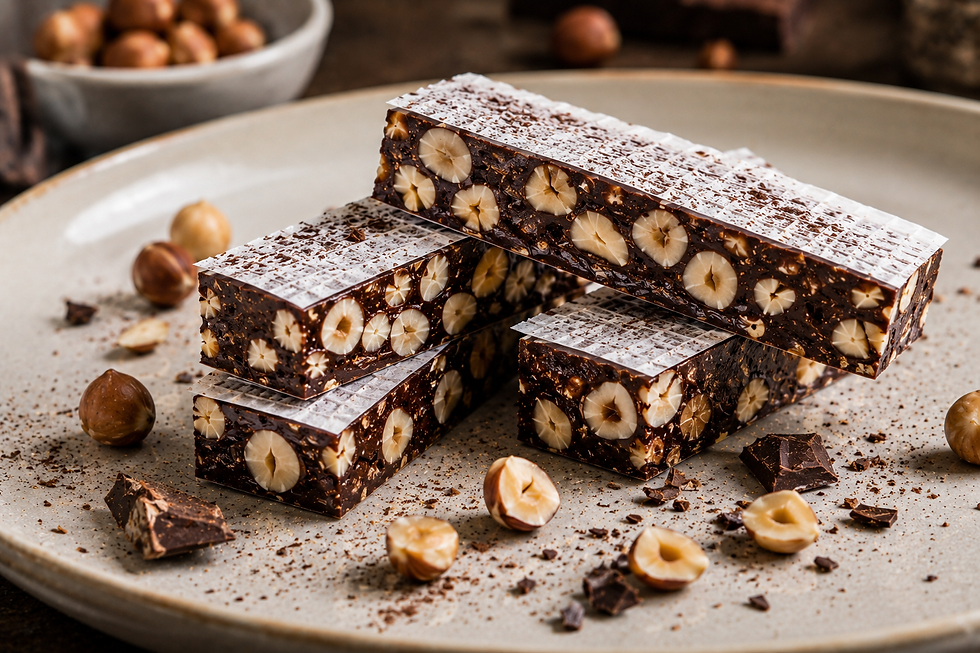
Torrone al cioccolato fondente e nocciole is nougat built for a cold room. Dark chocolate goes into the hot nougat mass at the end, whole hazelnuts go in after it, and the bar sets dark, tender and faintly bitter instead of white and sweet. It is the bar Italian confectioners put in the window in November and take out again in April.
Everything below follows from that one fact, from the order the ingredients enter the bowl to the shelf the finished bar is allowed to sit on.
Yield: about 30 pieces, one frame of roughly 8 by 6 inches (20 by 15 cm). Prep: 45 minutes. Cook: 30 minutes. Cure: 24 hours. Total: about 25 hours 15 minutes. Difficulty: advanced. Course: dolce. Region: Abruzzo, L'Aquila.
The Story
Chocolate nougat is not the ancestral Italian torrone but a nineteenth century invention with a single address: L'Aquila, in the mountains of Abruzzo. The Nurzia family opened their confectionery there in 1835, and it was Ulisse Nurzia who worked cocoa into a soft nougat base and created the torrone tenero al cioccolato the city has sold ever since. Before that, Italian torrone was a white sweet of honey, egg white and almonds, hard enough to break with a hammer in Cremona and a little softer in Benevento. The Aquilano version broke with both. It was dark, it was tender enough to bite cleanly, and it tasted of cocoa first and honey second. Within two generations it had stopped being a local curiosity and become the thing visitors carried home from Abruzzo.
The geography explains more than the family name. L'Aquila sits at about 2,300 feet (700 m) in a basin ringed by the Gran Sasso, and its winters are long and genuinely cold. A confectioner working there could keep a chocolate sweet on display through the entire season without watching it slump, which a confectioner in Palermo or Naples could not. That is why the chocolate branch of the torrone family grew in the Apennines while the honey and almond branch stayed in the south. The hazelnut arrived by the same logic. Abruzzo is not hazelnut country, but inland trade brought Piedmontese and later Campanian nuts cheaply over the mountains, and hazelnut has an affinity with cocoa that almond does not: the two carry the same roasted, slightly bitter register and read on the palate as one flavour rather than two.
The trade was seasonal and still is. Chocolate torrone appears in Abruzzo around the feast days of late autumn, runs through Christmas and the Epiphany fairs, and vanishes from the counters in the first warm week of spring. Nobody chose that calendar out of respect for tradition. It is a rule the ingredient wrote, and the old shops obeyed it for a century before anyone could explain why. When the 2009 earthquake destroyed much of the historic centre and the workshops with it, the reopening of the torrone makers was read locally as proof the city was still working. That is the sweet this recipe belongs to: a dark, soft, hazelnut heavy bar from a cold mountain town, eaten in winter and gone by April.
Ingredients
Weigh everything before you light the stove. Once the syrup is moving there is no time to measure.
For the hazelnuts
Whole raw hazelnuts, Piedmont or Campania, 10 oz (285 g)
For the nougat base
Acacia or mild wildflower honey, 1/2 cup (170 g)
Granulated sugar, 1 1/4 cups (250 g)
Glucose syrup, 1/3 cup (115 g)
Water, 1/4 cup (60 ml)
Egg whites, from 2 large eggs, 2 1/2 oz (70 g)
Fine sea salt, 1/4 tsp (1.5 g)
For the chocolate
Dark chocolate, 70 percent cocoa, chopped very fine, 5 oz (140 g)
Unsweetened cocoa powder, sifted, 2 tbsp (12 g)
For the frame
Baking parchment, 2 sheets cut to the frame
Neutral oil for the parchment, 1 tsp (5 ml)
For finishing
Unsweetened cocoa powder for dusting, 1 tbsp (6 g)
Flaky sea salt, 1 very small pinch
Preparation
Step 1
Prepare the frame and the nuts. Line a shallow frame or a loaf tin of roughly 8 by 6 inches (20 by 15 cm) with oiled parchment, base and sides, and set a second oiled sheet beside it. Spread the hazelnuts on a tray and give them 12 minutes at 325°F (165°C), until the skins crack and loosen. Rub them in a coarse towel, discard what skin comes away, and leave the rest. Keep the nuts warm in the switched off oven. Cold nuts dropped into hot nougat chill it locally and leave hard seams through the bar.
Step 2
Whip the whites. Put the egg whites and the salt in the bowl of a stand mixer fitted with the whisk and start on medium speed only once the syrups are already on the heat. You want firm peaks at the same moment the sugar is ready, not ten minutes earlier: whites held too long begin to weep, and a weeping meringue will not carry the weight of nuts and chocolate coming. If they get there first, drop to the lowest setting and keep them turning.
Step 3
Cook the honey. Warm the honey alone in a small heavy saucepan over medium heat and take it to 250°F (121°C) on a digital probe. Stir it just enough to keep it moving. With the mixer on medium, pour the hot honey down the inside wall of the bowl in a thin steady stream, never directly onto the whisk. The mass will loosen, deflate slightly and then rebuild itself into a pale glossy foam. This is normal. Leave it whipping while you deal with the sugar.
Step 4
Cook the sugar and finish the base. Combine the sugar, glucose syrup and water in a second saucepan, stir once to wet the sugar and then leave it alone, brushing the sides down with a wet pastry brush. Take it to 295°F (146°C) and pour it into the running mixer in the same thin stream down the wall of the bowl. Raise the speed and whip for 6 to 8 minutes, until the mass is thick, matte and pulls away from the whisk in a heavy ribbon.
Step 5
Cool the mass, then add the chocolate. Stop the mixer and let the nougat sit for 4 to 6 minutes, until a probe pushed into the centre reads about 150°F (65°C). Only now add the chopped chocolate and the sifted cocoa, and fold them in with a sturdy spatula or the paddle attachment on low. Chocolate stirred into the mass straight off the syrup separates: the cocoa butter is driven out of suspension and rises as an oily film. At this cooler temperature it melts smoothly and stays where it belongs, and the mass turns from pale to deep brown in under a minute.
Step 6
Fold in the nuts, press and cure. Add the warm hazelnuts and fold them through in as few strokes as you can manage, because the mass stiffens as it cools and is at its most workable right now. Scrape it into the lined frame, lay the second oiled sheet on top and press it flat and level with a small board, pushing well into the corners. Leave it below 64°F (18°C) for 24 hours, then turn the slab out, peel the parchment and cut.
Plating
Cut cold and serve cool. Chill the slab for 20 minutes before portioning, warm a long thin blade under hot water, dry it and cut in one decisive stroke rather than sawing, wiping the blade between cuts. Bars of about 3 by 1 inch (7.5 by 2.5 cm) are the traditional format; a diagonal cut across the slab gives a longer face and shows more of the hazelnut section.
Present it on cool ceramic, slate or a marble board, never on a warmed plate and never near a candle. Dust the board lightly with cocoa, not the bars themselves, and add the smallest pinch of flaky salt at one end of each piece. Two or three bars per person is a serving, with small unsalted hazelnuts scattered between them and an espresso or a small glass of sweet wine alongside.
Professional Technique
The single technical fact that governs this recipe is that chocolate lowers the temperature ceiling of the finished product. A plain torrone of sugar, glucose and honey is a sugar glass holding nuts, and sugar glass is stable in a warm room: it stays firm at 86°F (30°C) and beyond, which is why white torrone survives a September market stall. The moment cocoa butter enters the formula the weakest component is no longer the sugar but the fat. Cocoa butter softens above 79°F to 82°F (26°C to 28°C) and is fully liquid by 93°F (34°C), so a bar carrying 5 oz (140 g) of chocolate deforms, sweats and marks the fingers at temperatures a white bar ignores completely.
This is not a defect to engineer away. It is the identity of the sweet, and it dictates the handling from the frame onward. Cure below 64°F (18°C), store below 64°F (18°C), cut it cold, and keep it out of a sunlit display case, which reaches 100°F (38°C) behind the glass and turns the bar into a soft smear inside an hour. The seasonal calendar of Abruzzo chocolate torrone is simply this number, obeyed long before anyone could measure it.
The second point is when the chocolate goes in. Nougat leaves the syrup stage at around 230°F (110°C), and chocolate added at that temperature does not melt into the mass, it breaks. The emulsion holding cocoa butter, cocoa solids and sugar together cannot survive that heat in a high sugar, low water medium: the fat is expelled, floats up as a dull grey oil, and no further mixing brings it back. Waiting until the mass drops to about 150°F (65°C) is enough, well above the melting point and well below the point of separation.
Texture and Moisture Control
The texture target here is tender, not brittle. Aquilano chocolate torrone is a soft nougat, the kind you bite rather than snap, and three things put it there: the glucose syrup, which interferes with sugar setting hard; the relatively low final syrup temperature; and the cocoa butter itself, which stays semi solid at room temperature and keeps the whole matrix pliable. Push the sugar syrup past 300°F (149°C) and you will get a bar that cracks like glass and pulls at fillings, which is a different sweet altogether.
Fat, not water, is what moves in this bar. The nougat base is almost dry, so little moisture migrates into the hazelnuts and the nuts stay firm for weeks. What does migrate is cocoa butter, slowly, toward the surface, where it recrystallises as a pale grey bloom. Bloom is harmless and purely cosmetic, but it is a direct record of temperature swings: a bar kept at a steady 57°F (14°C) looks better in a month than one moved daily between a cold pantry and a warm kitchen. Cocoa powder is also strongly hygroscopic, so leave the dusting until service and keep cut bars sealed rather than open on a board.
Professional Mise en Place
Two syrups, a meringue and a fold all happen inside about fifteen minutes, so nothing can be prepared during the process. It is all prepared before.
Equipment and tools
Stand mixer with whisk and paddle attachments, and a sturdy heatproof spatula
Two small heavy saucepans and a digital probe thermometer reading to 350°F (175°C)
Shallow frame or loaf tin of about 8 by 6 inches (20 by 15 cm)
Long thin slicing knife and a small flat board for pressing
Prepared ahead
Hazelnuts roasted, rubbed and held warm in the switched off oven
Chocolate chopped very fine and cocoa sifted, waiting in one bowl
Frame lined with oiled parchment and a second sheet cut and oiled
Sugar, glucose and water combined in their pan, honey weighed into its own
Service setup
Curing room or larder below 64°F (18°C), away from any oven
Sealed container and parchment squares for storing the cut bars
Serving boards and plates cool, never warmed
Chef Tips
Choose chocolate by cocoa butter content, not only by percentage. A couverture at 70 percent with 38 percent fat folds in smoothly and sets with a clean bite; a supermarket bar of the same percentage but lower fat and added vegetable fat goes grainy in the mass and dull on the surface.
Use a mild honey. Acacia, wildflower or orange blossom all let the cocoa lead. Chestnut and forest honeys are strong enough to fight the chocolate, and the two bitternesses together produce something genuinely unpleasant.
Work with a helper the first time. One person pours syrup, the other watches the second pan, and nothing overshoots while your back is turned.
Make this in winter, in an unheated room if you have one. Cool ambient air is not a nicety in this recipe: at 75°F (24°C) the mass never firms properly in the frame and the bar will not hold a cut edge.
Common Mistakes
Adding the chocolate to the hot mass. Fold it in above about 175°F (80°C) and the cocoa butter separates out as a grey oily film that will not reincorporate. Wait for 150°F (65°C) on the probe, no hotter and no cooler.
Storing the bar at room temperature. A kitchen at 72°F (22°C) is already above the softening point of cocoa butter. The bars round off at the edges, stick to each other and mark the fingers. Keep them below 64°F (18°C) and they stay sharp for weeks.
Pouring syrup onto the whisk. It throws molten sugar up the sides of the bowl where it sets instantly into unusable shards and robs the meringue of a third of its sugar. Always pour down the inside wall.
Using cold hazelnuts. Nuts straight from the cupboard chill the nougat wherever they touch it, leaving hard glassy seams running through an otherwise tender bar. Hold them warm until the moment they go in.
Sawing through the slab. A serrated blade dragged back and forth shatters the edges and tears the nuts out. Chill the slab, warm a thin knife and cut in one stroke.
Wine Pairing
Recioto della Valpolicella DOCG: The reference match for dark chocolate. Corvina dried on racks gives real residual sugar over a genuine tannic frame, and both matter: the sugar must sit above the bitterness of 70 percent cocoa or the wine tastes sour beside it, while the tannin meets the chocolate's astringency instead of vanishing into it. Serve at 61°F (16°C).
Montefalco Sagrantino Passito DOCG: The most tannic red grape in Italy, dried and fermented sweet, and the boldest pairing here. Where a softer dessert wine is swallowed up by the cocoa, Sagrantino passito pushes back with blackberry, bitter cherry and a firmly drying finish. It suits the hazelnut too, since both end on a faintly bitter note.
Moscato di Scanzo DOCG: A tiny sweet red from the hills east of Bergamo, dried on cane mats before pressing. Its perfume of rose, dried fig and sage lifts the hazelnut rather than the chocolate, a fragrant register the heavier passiti do not offer. Very low tannin, so cut the bar thin. Serve at 57°F (14°C).
Marsala DOC: Choose a Superiore Dolce and it becomes the technical pairing here. The fortifying alcohol dissolves cocoa butter on the palate and clears the fat between bites, which no unfortified wine manages, while its oxidative walnut, caramel and dried apricot notes echo the roasted hazelnut directly. Serve at 54°F (12°C).
Vin Santo del Chianti Classico DOC: The lightest option, for anyone who finds passito reds heavy after a rich bar. Malvasia and Trebbiano dried in the lofts keep unusually high acidity under the sweetness, and that acidity is what cuts the nut fat and the cocoa butter between pieces. Its almond finish sits naturally with hazelnut.
Storage & Reheating
This is a sweet that is stored, never reheated. Keep the cut bars in an airtight container with parchment between the layers, in a larder or cellar between 54°F and 64°F (12°C and 18°C), and they hold their texture and flavour for 3 weeks. Warmer than that and they soften and stick together; the refrigerator is the wrong answer in the other direction, since the bars pick up moisture on the way out and the surface turns tacky.
If a refrigerator is the only cool place you have, wrap the container tightly and let it come back to room temperature fully sealed, so condensation forms on the plastic and not on the chocolate. The uncut slab keeps better than cut bars, so portion only what you will serve. The slab also freezes well for up to 3 months, double wrapped: thaw it sealed overnight in the refrigerator, then move it to the larder. Never microwave or warm it to soften it for cutting, chill it and warm the knife instead.
Nutrition
Per piece, based on 30 pieces from one frame:
Calories: 165 kcal
Total Fat: 9 g
Saturated Fat: 2.5 g
Trans Fat: 0 g
Unsaturated Fat: 6.5 g
Cholesterol: 0 mg
Sodium: 25 mg
Total Carbohydrates: 20 g
Fiber: 1.5 g
Total Sugars: 18 g
Added Sugars: 15 g
Protein: 2.5 g
Lactose: 0 g
Principal micronutrients: vitamin E, magnesium, copper, manganese, iron, potassium
These figures are estimates and move with the cocoa percentage of the chocolate and the size of the cut.


Comments