Vegan Grilled Eggplant Parmigiana Towers, Reinterpreted | Tortini di Parmigiana Vegana alla Griglia Rivisitati

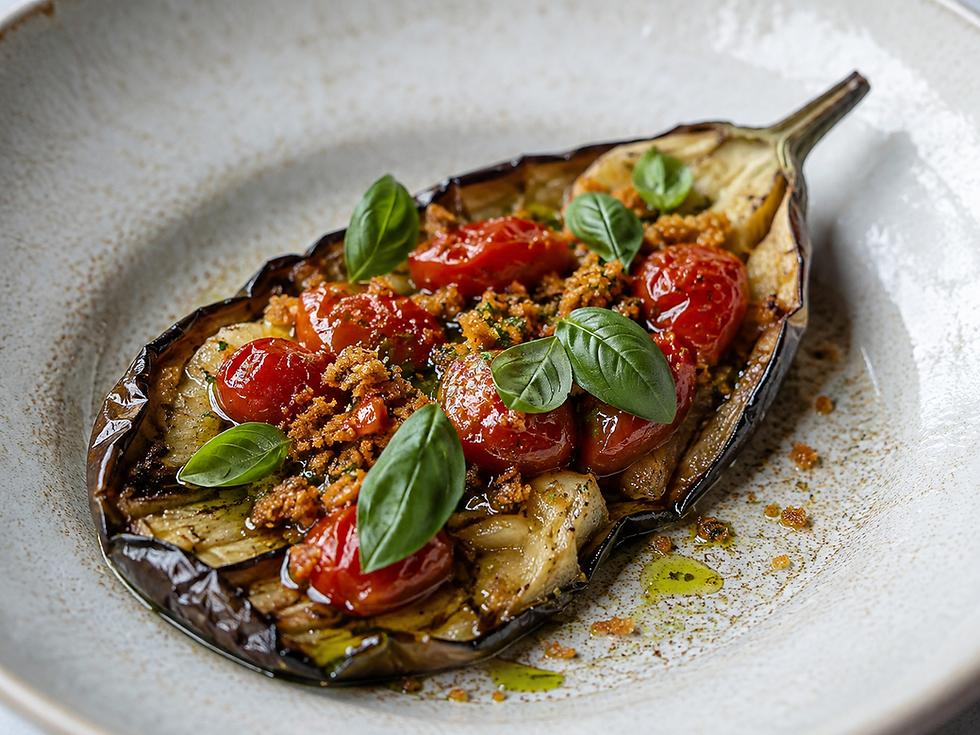
These individual parmigiana towers take the flavors of the classic eggplant parmigiana and turn them into a light, elegant antipasto. The classic parmigiana di melanzane layers fried eggplant with tomato, basil, mozzarella and grated Parmigiano Reggiano; this recipe is a vegan reinterpretation of it. The eggplant is grilled rather than fried, so it keeps a clean, smoky taste; it is stacked in rounds with a quick sauce of cherry tomatoes, a silky cashew cream and basil, baked briefly in rings and finished with a bright basil oil and a crumb of toasted pine nuts. Each tower holds its shape on the plate and reveals its layers at the first cut. It is the eggplant parm of the Italian-American table and the parmigiana of the Italian south, reimagined as a refined, completely plant-based first course.
Yield: 6 towers. Prep: 50 minutes, plus 4 hours soaking the cashews. Cook: 45 minutes. Rest: 15 minutes. Course: antipasto. Region: a modern version inspired by the parmigiana of southern Italy.
The Story
Outside Italy, many people know the parmigiana as eggplant parmesan, the name it took in the Italian-American restaurants of the United States. There it is often a generous plate of breaded, fried eggplant under tomato sauce and melted cheese, served with spaghetti. In Italy, parmigiana di melanzane is a layered bake of fried eggplant, tomato sauce, basil and cheese, claimed by Campania, Sicily and Emilia, whose name may come from the city of Parma, from its cheese, or from the Sicilian word parmiciana, the overlapping slats of a shutter. No source settles the debate.
Both versions share the same soul: eggplant, tomato and basil, the summer trio of the Italian south. The eggplant, introduced to Sicily during the Arab period of the Middle Ages, found in the warm south its ideal climate, while the tomato, arrived from the Americas, became the essential sauce of Naples by the nineteenth century. Basil, grown in pots on every southern balcony, ties them together with its sweet, peppery aroma.
Grilling eggplant is an old habit of the Italian summer. Across the south, slices of eggplant are cooked over embers or on a hot iron plate and dressed with olive oil, garlic, mint or oregano, eaten as a side dish or kept under oil for the winter. A grilled parmigiana, lighter and less rich than the fried one, has become a common modern variation in Italian homes, especially in the hottest months, when nobody wants to stand over a pot of frying oil.
This recipe is a contemporary reinterpretation, not a traditional dish. It uses grilled eggplant for lightness, shapes the parmigiana into individual towers with a ring mold for a restaurant presentation, and replaces the dairy with plant ingredients: a cashew cream for the creamy, milky note of mozzarella, and a crumb of toasted pine nuts, breadcrumbs and nutritional yeast for the savory finish of grated Parmigiano Reggiano. It keeps the flavors and balance of the parmigiana in a form suited to the start of an elegant meal.
Ingredients
Choose long, slender eggplants, about 2 1/2 inches (6 cm) in diameter, so the rounds fit the ring molds without trimming; they should be firm, glossy and heavy for their size. Use ripe, sweet cherry tomatoes, such as the Pomodorino del Piennolo del Vesuvio DOP when you can find it in jars, or any flavorful cherry tomatoes in season. Raw cashews make the smoothest cream. Choose fresh, pale pine nuts: they turn rancid quickly, so taste one before using them.
For the grilled eggplant
Long, slender eggplants, 2 lb (900 g), about 3
Fine sea salt, 1 1/2 tsp (9 g)
Extra virgin olive oil, 1/4 cup (60 ml)
For the cherry tomato sauce
Cherry tomatoes, 1 1/2 lb (680 g)
Extra virgin olive oil, 3 tbsp (45 ml)
Garlic, 2 cloves, thinly sliced
Fresh basil, 6 leaves
Fine sea salt, 3/4 tsp (4 g)
Dried chili flakes, 1 small pinch
For the cashew cream
Raw cashews, soaked 4 hours, 1 cup (140 g) before soaking
Cold water, 1/2 cup (120 ml)
Fresh lemon juice, 1 tbsp (15 ml)
Extra virgin olive oil, mild, 1 tbsp (15 ml)
Fine sea salt, 3/4 tsp (4 g)
Garlic, 1/2 small clove
For the basil oil
Fresh basil leaves, 1 1/2 cups (30 g), loosely packed
Extra virgin olive oil, mild, 1/2 cup (120 ml)
Fine sea salt, 1 pinch
For the pine nut crumb
Pine nuts, 1/3 cup (45 g)
Dry breadcrumbs, 1/3 cup (20 g)
Nutritional yeast flakes, 1 tbsp (4 g)
Extra virgin olive oil, 1 tbsp (15 ml)
Grated lemon zest, 1/2 tsp (1 g)
Fine sea salt, 1 pinch
Preparation
Step 1

Slice, salt and grill the eggplant. Trim the eggplants and cut them crosswise into rounds 3/8 inch (1 cm) thick; you need about 30 rounds, five per tower. Lay them on a tray, sprinkle both sides with the salt and leave them for 20 minutes, then pat them dry. Heat a ridged grill pan or an outdoor grill to high, about 450°F (230°C), brush the rounds lightly with olive oil and grill them for 3 to 4 minutes per side, turning them a quarter turn halfway for crossed marks, until tender right through and deeply marked. Grilling cooks the eggplant with dry heat: the surface caramelizes, the flesh softens and the light smoky note replaces the richness of frying.
Step 2

Make the cherry tomato sauce. Halve the cherry tomatoes. In a wide skillet, warm the olive oil with the garlic and chili over medium heat for 1 minute, until fragrant. Add the tomatoes cut side down and the salt and cook for 3 minutes without stirring, then press them with a spoon and simmer for 12 to 15 minutes, until they have broken down into a thick, chunky sauce. Pass it through a food mill or press it through a coarse sieve to remove the skins, then tear in the basil. Cherry tomatoes have more sugar and less water than large tomatoes, so they give a sweet, concentrated sauce in a short time.
Step 3

Make the cashew cream. Drain and rinse the cashews and blend them with the cold water, lemon juice, olive oil, salt and garlic for 2 to 3 minutes, until perfectly smooth and thick, like a thick plant yogurt. Taste and adjust the salt and lemon. Transfer to a piping bag or a small bowl and refrigerate. The cream must be thick enough to hold its shape between the layers; if it is too loose, blend in 1 more tablespoon of soaked cashews.
Step 4

Make the basil oil. Bring a small pot of water to a boil and prepare a bowl of ice water. Blanch the basil leaves for 10 seconds, then transfer them at once to the ice water. Squeeze them very dry, chop them roughly and blend them with the olive oil and salt for 1 minute. Strain through a fine sieve lined with a paper coffee filter, without pressing, for 20 minutes. Blanching fixes the green chlorophyll and stops the enzymes that turn cut basil black; filtering gives a clear, brilliant green oil.
Step 5

Toast the pine nut crumb. In a dry skillet over medium low heat, toast the pine nuts for 3 to 4 minutes, shaking the pan, until pale gold; transfer them to a board and chop them roughly. In the same pan, toast the breadcrumbs with the olive oil for 3 minutes, until golden. Mix the crumbs with the pine nuts, nutritional yeast, lemon zest and salt and let cool. Pine nuts burn very quickly because of their high oil content: watch them constantly and take them off the heat as soon as they turn color.
Step 6

Build the towers. Heat the oven to 375°F (190°C). Place six ring molds, about 3 inches (7.5 cm) in diameter and 2 inches (5 cm) high, on a parchment lined sheet pan and brush the insides with a little oil. In each ring, layer a round of grilled eggplant, 1 tablespoon of tomato sauce, a teaspoon of cashew cream and a small basil leaf; repeat until you have five rounds of eggplant, pressing each layer gently. Finish with a spoonful of sauce on top. Pressing removes air and lets the layers bond in the oven.
Step 7

Bake, rest and unmold. Bake the towers for 15 minutes, until hot through and the sauce bubbles slightly at the top. Let them rest in the rings for 15 minutes. Then lift each tower with a wide spatula onto its plate, run a thin knife around the inside of the ring and lift the ring straight up. The rest allows the cashew cream to firm slightly and the eggplant to absorb the juices, so the tower stands upright when the ring comes off.
Plating
Use warm plates, about 120°F (50°C): the towers are best served warm rather than hot, when the flavors of basil and tomato are most open. Place each tower in the center of a wide, flat plate, preferably white, so the layers stand out.
Top each tower with a small spoonful of cashew cream, a generous pinch of pine nut crumb and a tiny basil leaf. Draw a few drops and a thin circle of basil oil around the base, and add two or three drops of the reserved tomato sauce for color. The guest eats the tower with a fork and knife, cutting from top to bottom so every bite holds all the layers, the crunch of the pine nuts and the herbal brightness of the basil oil.
Professional Technique
The key number is the thickness of the eggplant: 3/8 inch (1 cm). Thinner rounds dry out on the grill and turn leathery, thicker ones need so long to cook through that the surface burns. At this thickness, 3 to 4 minutes per side on a very hot grill gives deep marks and a creamy center at the same time.
The hidden variable is the heat of the grill. A grill pan that is not hot enough steams the eggplant instead of searing it: the rounds turn gray and stick. Heat the pan for at least 5 minutes over high heat before the first round goes on, and do not move the rounds until they release by themselves; that release is the sign that the surface has caramelized.
The doneness test is threefold: each eggplant round must be soft when pressed with a finger, with no white, spongy flesh; the towers must be hot in the center, about 150°F (65°C) on an instant-read thermometer; and after the rest, the tower must stand upright with straight sides when the ring is lifted.
Structure and Balance Control
A tower depends on balance between its layers. Every layer of sauce should be thin, about 1 tablespoon, and the cashew cream even less: too much sauce makes the tower slide when unmolded, too much cream turns it into a soft stack. The eggplant gives the structure, the sauce gives moisture and flavor, the cream gives richness. Keep the proportions and the tower will stand.
The diameter of the eggplant matters for the same reason. Rounds that fill the ring almost completely give a stable tower with straight sides; small rounds leave gaps that fill with sauce and collapse. Choose slender eggplants of even width, and use the largest rounds at the base and the smallest at the top if they vary.
Flavor balance completes the structure. Grilled eggplant is smoky and mild, cherry tomato is sweet and acidic, cashew cream is rich and slightly tangy, basil oil is green and fresh, the pine nut crumb is toasted and savory. Taste each element alone before assembling: each must be correctly seasoned on its own, because there is no way to adjust a tower once it is built.
Professional Mise en Place
This antipasto is ideal for entertaining because every element can be prepared ahead, and the towers can be built in the morning and baked just before serving.
Equipment and tools
Sharp knife, ridged grill pan or outdoor grill, pastry brush, tongs
Wide skillet and food mill or coarse sieve for the sauce
High speed blender, piping bag, small pot, bowl of ice water
Fine sieve and paper coffee filter for the basil oil
Six ring molds, 3 inches (7.5 cm) wide, sheet pan, parchment, wide spatula, thin knife
Prepared ahead
Cashews soaked for 4 hours, cashew cream made up to 3 days ahead
Eggplant grilled up to 1 day ahead, covered and refrigerated
Tomato sauce made up to 3 days ahead
Basil oil made up to 2 days ahead, refrigerated, brought to room temperature before service
Pine nut crumb toasted up to 3 days ahead, airtight
Service setup
Towers assembled in their rings on the sheet pan, oven at 375°F (190°C)
Warm plates, basil oil in a squeeze bottle, cashew cream in a piping bag
Pine nut crumb, small basil leaves and reserved sauce at the pass
Chef Tips
Build the towers up to 6 hours ahead and keep them in the refrigerator in their rings, covered. Add 5 minutes to the baking time. This is how a restaurant kitchen serves a dish like this to many guests at once.
For a more pronounced smoky flavor, grill the eggplant over a wood or charcoal fire. The embers give a deeper aroma than a grill pan, and the towers become a perfect antipasto for a summer dinner outdoors.
Turn the towers into a main course by serving two per person on a bed of the cherry tomato sauce, with a side of roasted potatoes with rosemary. Or make a single large parmigiana with the same elements in a small baking dish, baking it for 30 minutes.
Do not discard the grill-marked eggplant trimmings. Chopped and mixed with the remaining tomato sauce, a few capers and some basil, they make an excellent topping for bruschetta.
Common Mistakes
Using a cold grill pan. The eggplant steams, sticks and turns gray. Heat the pan for at least 5 minutes on high before grilling.
Cutting the rounds too thin. Thin rounds dry out and turn leathery on the grill. Cut them 3/8 inch (1 cm) thick.
Undercooking the eggplant. Raw, spongy centers stay chewy and bitter in the tower. Grill until soft right through.
Using too much sauce. Excess sauce makes the tower slide apart when unmolded. Use 1 tablespoon per layer.
Skipping the blanching of the basil. Unblanched basil oil turns brown within hours. Blanch the leaves for 10 seconds and shock them in ice water.
Burning the pine nuts. Pine nuts go from gold to bitter in seconds. Toast them over medium low heat and watch them constantly.
Unmolding too soon. A hot tower collapses when the ring is lifted. Rest it 15 minutes first.
Wine Pairing
Etna Bianco DOC: From the volcanic slopes of Etna, mainly Carricante, a white with citrus, white flowers and a sharp mineral backbone. Its freshness and saline finish suit the smoky eggplant and the sweet cherry tomatoes. Serve it at about 50°F (10°C).
Falanghina del Sannio DOC: A Campanian white with notes of lemon, apple and herbs and a lively acidity. It refreshes the palate after the rich cashew cream and lifts the basil oil. Serve it at about 50°F (10°C).
Lambrusco di Sorbara DOC: The palest and most delicate Lambrusco, from Emilia, dry and sparkling, with notes of wild strawberry and a crisp acidity. Its bubbles and fruit make it a joyful partner for an antipasto of tomato and grilled vegetables. Serve it at about 50°F (10°C).
Cerasuolo di Vittoria DOCG: Sicily's red of Nero d'Avola and Frappato, with cherry, pomegranate and soft tannins. Light enough for a first course, it matches the smoky notes of the grill and the sweetness of the tomato. Serve it slightly cool, at about 59°F (15°C).
Storage & Reheating
Refrigerator: baked towers keep for up to 2 days, covered, in the refrigerator; the components keep separately for 2 to 3 days, as listed in the mise en place. Freezer: not recommended, because grilled eggplant turns watery on thawing and the cashew cream loses its smoothness; the tomato sauce alone freezes well for 3 months. Cool the towers at room temperature for no more than 2 hours before refrigerating.
Reheat the towers in their rings, or on a sheet pan if already unmolded, in the oven at 325°F (165°C) for 12 to 15 minutes, until warm through. In the microwave, heat one tower at 50 percent power for 1 1/2 minutes and rest it 1 minute. Add fresh basil oil and pine nut crumb just before serving.
Nutrition
Per serving, based on 6 towers:
Calories: 390 kcal
Total Fat: 33 g
Saturated Fat: 5 g
Trans Fat: 0 g
Unsaturated Fat: 28 g
Cholesterol: 0 mg
Sodium: 560 mg
Total Carbohydrates: 20 g
Fiber: 6 g
Total Sugars: 9 g
Added Sugars: 0 g
Protein: 8 g
Principal micronutrients: vitamin E, vitamin K, magnesium, manganese, potassium, copper
These figures are estimates, calculated on the quantities listed and rounded to the nearest whole number, assuming that about half of the basil oil is used for plating and that most of the salting salt is removed with the eggplant water. They vary with the size of the eggplants.


Comments