Warm Vegan Marsala Zabaglione with Roasted Figs, Reinterpreted | Zabaglione Vegano Caldo al Marsala con Fichi Arrosto Rivisitato

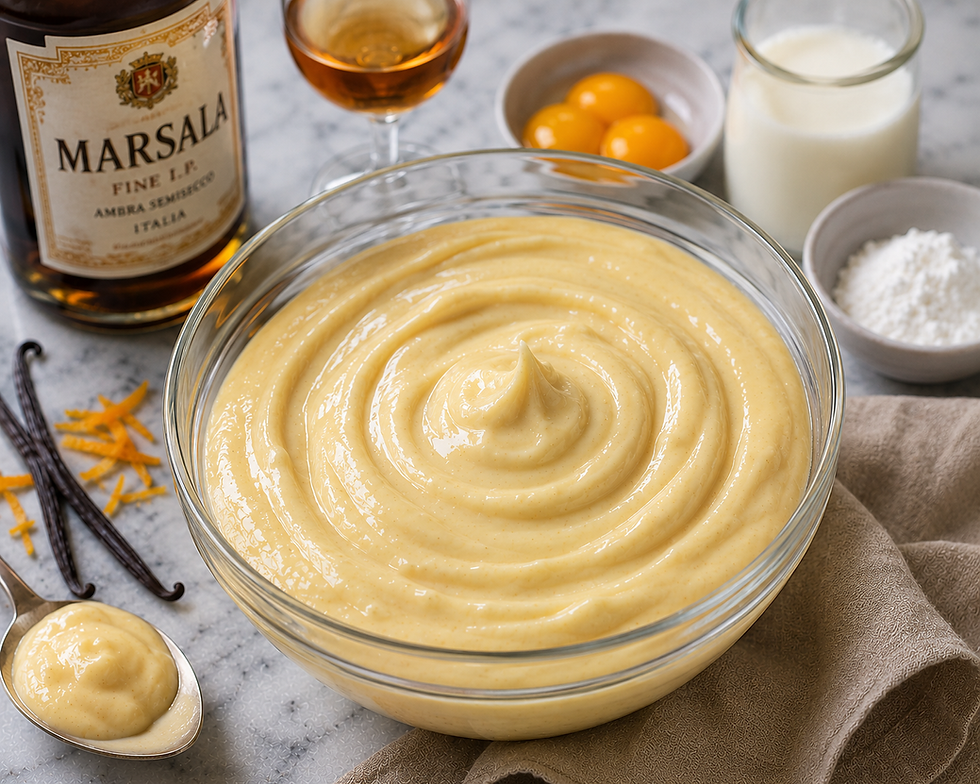
Zabaglione is one of the great spoon desserts of Italy: a warm, trembling foam of sugar and Marsala, whisked over gentle heat until it doubles in volume and holds the shape of the whisk. The classic is built entirely on egg yolks, sugar and Marsala, so this recipe is a vegan reinterpretation that rethinks its structure from the inside. A short custard of Marsala, water, sugar and starch, scented with saffron, provides the body and the golden color; aquafaba, the cooking liquid of chickpeas, whipped to soft peaks, provides the air. Folded together while the custard is still warm, they give a zabaglione that is light, glossy and fragrant with Marsala, served tepid over figs roasted with orange and thyme. It is the warm version; a separate chilled Moscato mousse is a different recipe.
Yield: 6 servings. Prep: 25 minutes. Cook: 30 minutes. Rest: 5 minutes. Course: dessert. Region: Northern Italy, with Sicilian Marsala.
The Story
Zabaglione, or zabaione, is a dessert of Northern Italy, and its exact birthplace is disputed. Piedmont claims it most strongly, and in Turin it has long been served warm in cafés, sometimes with biscuits for dipping. A popular Piedmontese tradition links the name to San Pasquale Baylón, a sixteenth century Spanish Franciscan whose name sounds, in dialect, like sanbajon, one of the local words for the dessert; it is a charming legend, not a documented origin. The dish appears in the great Italian cookbooks of the nineteenth century, including Pellegrino Artusi's La scienza in cucina e l'arte di mangiar bene, published in 1891.
In the classic recipe, the key ingredient besides the egg yolks is Marsala, the fortified wine of western Sicily, made around the town of Marsala in the province of Trapani and protected as a DOC. Marsala owes part of its history to English merchants, who in the late eighteenth century began shipping the local wine, fortified for the voyage, to Britain. Its aromas of dried fruit, toasted nuts, caramel and spice are what make zabaglione unmistakable, and the classic home rule calls for a little sugar and twice as much Marsala for each egg yolk.
Zabaglione was long considered a restorative. Italian grandmothers whisked it for convalescents, for children before school and for anyone who needed strength, and it was served at the end of winter meals as a warm comfort. In restaurants it became an elegant dessert, whisked at the table in a copper bowl, spooned over berries, figs or peaches, or used as a base for creams and semifreddi.
The traditional recipe is not vegan: its entire structure depends on the proteins and natural emulsifiers of the egg yolks, which trap air and thicken with heat. This reinterpretation replaces each function separately and honestly. Cornstarch gives the thickening that heat gives to the egg yolks in the original; a spoonful of cashew butter gives the richness of their fat; saffron gives the golden color; and aquafaba, whose proteins and starches trap air when whipped, gives the foam. What remains unchanged is the soul of the dessert: Marsala, sugar, warmth and lightness.
Ingredients
Choose a Marsala Superiore or Marsala Fine of good quality, preferably dry or semi-dry rather than sweet, so the dessert is fragrant without being cloying; if you follow a strict vegan diet, look for a producer that declares a vegan fining process. Aquafaba should come from unsalted canned chickpeas or from chickpeas cooked at home and reduced until it has the consistency of a light syrup. Buy ripe figs that are soft at the stem and intact, with no cracks. Use saffron threads rather than powder, for color and aroma you can trust.
For the figs
Fresh figs, ripe, 12, about 1 1/2 lb (680 g)
Organic sugar, 2 tbsp (25 g)
Orange zest, finely grated, 1 tsp (2 g)
Fresh orange juice, 1/4 cup (60 ml)
Marsala, 2 tbsp (30 ml)
Fresh thyme, 4 small sprigs
Extra virgin olive oil, mild, 1 tbsp (15 ml)
For the Marsala custard
Marsala, 2/3 cup (160 ml)
Water, 1/3 cup (80 ml)
Organic sugar, 1/3 cup (65 g)
Cornstarch, 2 tbsp (16 g)
Cashew butter, smooth, 1 tbsp (16 g)
Saffron threads, 1 small pinch, about 10 threads
Fine sea salt, 1 small pinch
Pure vanilla extract, 1/2 tsp (2.5 ml)
For the aquafaba foam
Aquafaba, chilled, 1/2 cup (120 ml)
Cream of tartar, 1/4 tsp (1 g)
Organic powdered sugar, 3 tbsp (24 g)
Preparation
Step 1

Roast the figs. Heat the oven to 400°F (200°C). Cut the figs in half lengthwise and arrange them cut side up in a baking dish just large enough to hold them in a single layer. Sprinkle with the sugar and orange zest, pour the orange juice and 2 tbsp (30 ml) of Marsala around them, add the thyme and drizzle with the olive oil. Roast for 15 to 18 minutes, until the figs are soft, glossy and lightly caramelized at the edges, and the juices have reduced to a light syrup. Heat concentrates the sugars of the figs and softens their skin, while the orange and Marsala build a sauce that will meet the zabaglione on the plate.
Step 2

Infuse the saffron. Crush the saffron threads lightly between your fingers and put them in a small saucepan with 2 tbsp (30 ml) of the Marsala measured for the custard. Warm over the lowest heat until just steaming, then take off the heat and leave for 10 minutes. Saffron releases its color and aroma best in a warm liquid, and alcohol extracts some aromatic compounds that water does not. The result is a deep golden infusion that will give the custard the warm color of a classic zabaglione and a subtle, floral note without dominating the Marsala.
Step 3

Cook the Marsala custard. In a small heavy saucepan, whisk the sugar and the cornstarch together, then whisk in the water and the remaining Marsala until no lumps remain. Add the saffron infusion, the cashew butter and the salt. Cook over medium heat, whisking constantly, until the mixture comes to a gentle boil and turns from cloudy to glossy and thick, about 4 to 5 minutes. Let it bubble for 1 minute more while whisking: cornstarch thickens fully only when it reaches about 203°F (95°C), and stopping too early leaves a raw, chalky taste and a weak structure. Off the heat, whisk in the vanilla and transfer to a wide bowl.
Step 4

Cool the custard to the right point. Let the custard cool, whisking from time to time, until it reaches about 120°F (49°C), warm to the touch but no longer hot, about 8 to 10 minutes. Check with an instant-read thermometer. This is the most important temperature of the recipe. Hotter, the custard would deflate the aquafaba foam and make it collapse; colder, it would set into a firm gel and refuse to blend smoothly. At this point it is still loose and silky and will flow into the foam.
Step 5

Whip the aquafaba. While the custard cools, put the chilled aquafaba and the cream of tartar in a perfectly clean, grease-free bowl. Whip with an electric mixer on medium speed until foamy, about 1 minute, then on high speed, adding the powdered sugar a spoonful at a time, until the foam is white, glossy and forms soft peaks that bend at the tip, about 5 to 7 minutes. Cream of tartar is acidic and stabilizes the foam by strengthening the network of proteins around each air bubble. Stop at soft peaks: a stiffer foam is harder to fold and gives a less creamy zabaglione.
Step 6

Fold the zabaglione. Whisk the warm custard briefly to loosen it. Add one third of the aquafaba foam and whisk it in energetically to lighten the custard. Then add the remaining foam and fold it in gently with a large spatula, cutting down through the center, sweeping along the bottom and turning the mixture over, while rotating the bowl. Stop as soon as no white streaks remain. The zabaglione should be pale gold, airy and soft, flowing slowly from the spatula in thick ribbons, exactly like a classic one just whisked from the stove.
Step 7

Warm it gently and serve. Set the bowl over a pan of barely simmering water, without letting the bottom touch the water, and fold gently for 1 to 2 minutes, just until the zabaglione is tepid throughout, about 105 to 110°F (40 to 43°C). Do not heat it further: aquafaba foam loses volume when it gets hot. Leave it for 5 minutes off the heat while you plate the figs. The short warming brings back the traditional sensation of a zabaglione served warm, and the rest lets the foam settle into a light, spoonable cream.
Plating
Serve in wide, shallow glass coupes or small bowls at room temperature; warm bowls would deflate the foam and cold ones would chill it too quickly. Place four roasted fig halves in the bottom of each bowl, cut side up, and spoon over a little of their roasting syrup, without the thyme stems.
Spoon the warm zabaglione generously over the figs, letting it fall in soft folds so some of the fruit remains visible at the edges. Finish with a few thyme leaves, a little grated orange zest and, if you like, a few crushed toasted hazelnuts or almonds. The guest eats it with a spoon, at once, while the zabaglione is warm and airy, and every spoonful should carry foam, fig and syrup together.
Professional Technique
The key ratio is between custard and foam. About 1 cup (240 ml) of cooked Marsala custard folded into the foam of 1/2 cup (120 ml) of aquafaba gives a zabaglione that is light but still has body and the full flavor of Marsala. More custard makes it dense like a pudding; more foam makes it airy but thin in taste. The custard carries the flavor and the color; the foam carries the lightness. Neither works alone.
The hidden variable is the concentration of the aquafaba. Liquid from canned chickpeas varies from brand to brand, and liquid from home cooked chickpeas is often too thin. Good aquafaba should be slightly viscous, like egg white. If yours is watery, simmer it in a small pan until it is reduced by about one third, then chill it completely before whipping. Thin aquafaba never reaches stable peaks.
The doneness test is the ribbon. Lift the spatula above the bowl: the zabaglione should fall in a thick ribbon that rests on the surface for a moment before sinking. If it runs off immediately, the custard was too hot or the foam was overmixed; if it falls in clumps, the custard was too cold and should be folded a little longer over the warm water.
Temperature and Foam Control
Temperature governs every stage of this dessert. The custard must boil to activate the starch, cool to about 120°F (49°C) to be folded, and then be warmed only to about 105 to 110°F (40 to 43°C) for service. Each threshold has a reason: starch thickens only at high temperature, aquafaba foam weakens above a moderate warmth, and the dessert must be tepid to give the pleasure of a traditional zabaglione.
Fat is the enemy of the foam. A trace of oil in the bowl or on the whisk prevents the aquafaba proteins from forming a stable network around the air bubbles. Wash and dry the bowl and the beaters carefully, and keep the cashew butter in the custard, where it is already emulsified with starch and does not disturb the foam once the two are folded together.
Time is the last control. A vegan zabaglione is at its best within 10 minutes of folding. After that, the foam slowly releases air and the cream settles. For a dinner party, prepare the figs and the custard in advance, keep the custard warm in a water bath and whip and fold the aquafaba only at the moment of serving.
Professional Mise en Place
The figs and the custard can be prepared before the meal; the foam must be made at the last moment. Organize the station so the custard is at the right temperature when the guests finish their main course.
Equipment and tools
Baking dish for the figs, small heavy saucepan, small whisk
Electric mixer or stand mixer with whisk, perfectly clean and grease-free bowl
Large flexible spatula, instant-read thermometer
Saucepan for the water bath that holds the mixing bowl
Prepared ahead
Aquafaba measured and chilled for at least 2 hours
Figs roasted, up to 3 hours ahead, kept at room temperature in their syrup
Saffron infused in Marsala
Marsala custard cooked, up to 1 hour ahead, kept warm over a water bath and whisked from time to time
Service setup
Coupes or bowls at room temperature
Figs plated in their syrup
Water bath barely simmering for the final warming
Thyme leaves, orange and microplane, toasted nuts on the pass
Chef Tips
Reduce the aquafaba from home cooked chickpeas. After cooking chickpeas, simmer their liquid until it is reduced by about a third, cool it and freeze it in measured portions. Frozen aquafaba keeps for 3 months and whips as well as fresh once thawed and chilled.
Change the fruit with the seasons. In summer, spoon the zabaglione over fresh berries or roasted peaches; in winter, over poached pears or sautéed apples with a little cinnamon. The Marsala custard suits almost every ripe fruit.
For a lighter alcohol note, simmer the Marsala for the custard for 2 minutes before using it. Part of the alcohol evaporates and the taste becomes rounder, more like dried fruit and caramel, while the aroma of the wine remains.
Serve with crisp plant-based biscuits, such as vegan cantucci or thin almond tuiles, for dipping. The contrast between the warm, airy cream and a dry, crunchy biscuit is part of the pleasure of zabaglione in the Turin cafés.
Common Mistakes
Using thin aquafaba. Watery liquid never forms stable peaks. Reduce it by a third and chill it thoroughly before whipping.
Whipping in a greasy bowl. Traces of fat stop the foam from forming. Use a perfectly clean, dry bowl and beaters.
Undercooking the custard. Starch that has not boiled leaves a chalky taste and a weak cream. Let the custard bubble for a full minute while whisking.
Folding the custard while it is hot. Heat collapses the aquafaba foam. Cool the custard to about 120°F (49°C) first.
Letting the custard cool too much. A cold custard sets into a gel and leaves lumps. Fold it while it is still warm and loose.
Overheating the finished zabaglione. The foam deflates above a moderate warmth. Warm it only until tepid over barely simmering water.
Making it too far ahead. The foam slowly loses air. Fold and serve within 10 minutes.
Wine Pairing
Marsala DOC: The natural partner, the same wine that perfumes the dessert. A Marsala Superiore semi-sweet or a Vergine served in small glasses repeats the notes of dried fruit, caramel and walnut and makes the whole pairing seamless. Serve it at about 54 to 57°F (12 to 14°C).
Passito di Pantelleria DOC: From the volcanic island between Sicily and Tunisia, a sweet wine from sun-dried Zibibbo grapes, with apricot, candied orange and fig. Its intensity matches the roasted figs and the orange syrup. Serve it at about 54°F (12°C).
Moscato di Noto DOC: A Sicilian Moscato from the Noto area in the southeast of the island, with floral, citrus and peach notes. Lighter than a passito, it refreshes the palate and lifts the saffron and orange. Serve it at about 50°F (10°C).
Malvasia delle Lipari DOC: The sweet Malvasia of the Aeolian Islands, with notes of dried apricot, caper flower and Mediterranean herbs. Its gentle sweetness and long, aromatic finish suit the thyme and the warm Marsala cream. Serve it at about 54°F (12°C).
Storage & Reheating
Refrigerator: the finished zabaglione is a dessert of the moment and does not keep its foam; leftovers can be refrigerated for 1 day and eaten cold as a soft cream, but they lose volume. The roasted figs keep for 3 days in their syrup, and the Marsala custard for 2 days, covered with plastic wrap pressed on the surface. Freezer: leftover zabaglione can be frozen in a covered container for up to 1 month and eaten as a soft semifreddo; it cannot be warmed again.
Do not reheat the finished zabaglione, because heat collapses the foam. To serve it warm again, gently rewarm the refrigerated custard in a water bath, whisking until smooth and about 120°F (49°C), whip fresh aquafaba and fold them together as in the recipe. Warm the figs in a 325°F (165°C) oven for 6 to 8 minutes.
Nutrition
Per serving, based on 6 servings:
Calories: 230 kcal
Total Fat: 4 g
Saturated Fat: 1 g
Trans Fat: 0 g
Unsaturated Fat: 3 g
Cholesterol: 0 mg
Sodium: 60 mg
Total Carbohydrates: 43 g
Fiber: 3 g
Total Sugars: 35 g
Added Sugars: 20 g
Protein: 2 g
Principal micronutrients: potassium, calcium, magnesium, vitamin K, copper, manganese
These figures are estimates, calculated on the quantities listed and rounded to the nearest whole number, including the Marsala's own sugar and assuming that only a small part of its alcohol evaporates during cooking. They vary with the type of Marsala, the ripeness of the figs and the concentration of the aquafaba.


Comments