
Italian Peach Gelato | Gelato alla Pesca
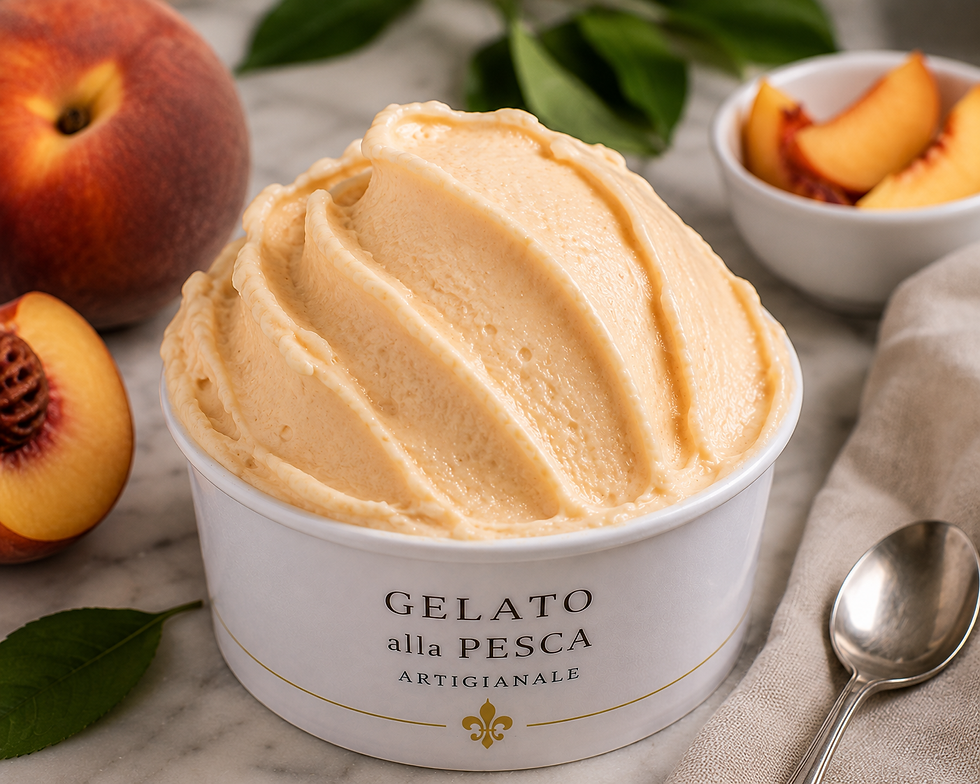
A perfect peach in the hand can be a disappointment once it is frozen. The scent fades, the sweetness goes flat, and the texture turns coarse and icy. This gelato answers that problem by cooking, sieving and concentrating the fruit, then rebuilding its body inside a light milk base, so every spoonful is silky, fragrant and unmistakably peach.
Yield: about 1 quart (950 ml), 6 servings. Prep: 40 minutes. Cook: 25 minutes. Chill: 6 hours. Churn and freeze: 3 hours 30 minutes. Difficulty: intermediate.
The Story
The peach reached Italy long before anyone thought of freezing it. Roman writers knew it as the Persian apple, mala persica, and Pliny the Elder recorded it growing in Italian orchards in the first century, along with the rumour that it was poisonous in its country of origin. The rumour did the fruit no harm. By the Renaissance the peach was a fruit of villa gardens and monastery walls, and today Italy is among the largest peach producers in Europe.
The great orchards lie in Emilia Romagna, where the local peach and nectarine carry protected status, around Verona, in the Cuneo foothills of Piedmont, on the Campanian plain and in Sicily, where the late peaches of Leonforte arrive in September. Each region grows a different fruit. Yellow fleshed peaches are firm, acidic and generous with perfume, which makes them the choice for cooking. White fleshed ones are floral, low in acid and so fragile they bruise in the crate. The Venetians built a famous drink on them, the Bellini, first poured at Harry's Bar around 1948 and named for the painter Giovanni Bellini.
Gelato has a history of its own. Iced desserts were already served at the Medici court in Florence, and the craft of freezing sweetened milk spread through Italian cities over the centuries that followed. The gelateria as we know it, with a glass counter of fruit flavours that change with the calendar, belongs to the last hundred years. Its unwritten rule is simple: a fruit flavour appears only when the fruit is in season.
Peach gelato belongs to that seasonal counter. In July and August the gelatiere waits for the fruit, tastes it, and decides how much sugar, milk and stabilizer the batch will need, because no two crates behave alike. Many shops make it in a light milk base without egg yolks, the style known as fior di latte, so that nothing competes with the peach. This recipe follows that tradition and adds one discipline the best shops share: the fruit is never simply blended and frozen.
In small towns the summer evening walk, the passeggiata, still ends at the gelateria, and peach is the flavour that marks high summer, pale gold and softly perfumed, gone from the counter with the first days of autumn. That impermanence is part of its charm.
Ingredients
Buy peaches that smell of peach at the stem end and give slightly under a thumb. Dextrose and locust bean gum are sold by pastry supply shops and online, and both are worth having for a smooth result. Whole milk and heavy cream give the base a modest amount of fat, enough for creaminess without hiding the fruit. Acacia honey is chosen for its neutral flavour, since a stronger honey would speak louder than the peach. If you cannot find locust bean gum, leave it out and add one more tablespoon of milk powder, accepting a slightly icier result.
For the peaches
Ripe yellow freestone peaches, 3 lb (1.35 kg), of which 1 lb 10 oz (740 g) peeled and pitted flesh goes into the gelato
Granulated sugar, 2 tbsp (25 g)
Fresh lemon juice, 1 tbsp (15 ml)
For the milk base
Whole milk, 1 1/2 cups (360 ml)
Heavy cream, 1/2 cup (120 ml)
Granulated sugar, 1/3 cup (65 g)
Dextrose, 3 tbsp (35 g)
Nonfat dry milk powder, 3 tbsp (20 g)
Acacia honey, 1 tbsp (21 g)
Locust bean gum, 1/4 tsp (1 g)
Fine sea salt, 1/8 tsp (0.5 g)
For finishing
Fresh lemon juice, 1 tsp (5 ml), for the final adjustment
Ripe yellow peach, 1 small, cut into thin wedges at the moment of serving
Preparation
Step 1: Blanch and peel the peaches
Bring a large pot of water to a rolling boil and set out a bowl of ice water. Score a shallow X in the base of each peach, lower them in for 30 to 40 seconds, then move them to the ice water. The skins slip off by hand. Halve the fruit, remove the stones and cut the flesh into 1 inch (2.5 cm) chunks. Weigh out 1 lb 10 oz (740 g) and keep one small peach whole for serving.
Step 2: Cook the fruit until soft
Put the chunks in a medium saucepan with 2 tablespoons of sugar and the tablespoon of lemon juice. Cover and cook over medium low heat for 8 to 10 minutes, stirring twice, until the peaches are completely tender and sitting in their own syrup. Taste a piece: it should be sweet, fragrant and soft enough to crush against the pan with a spoon. Cooking loosens the flesh for sieving and stops the fruit from browning. Let it cool for 10 minutes.
Step 3: Purée and sieve
Blend the fruit and syrup until smooth. Set a fine mesh sieve over a bowl and press the purée through with a ladle, scraping the underside of the mesh often. Keep pressing until only dry strands remain, then discard them. Weigh what is left: you should have about 1 lb 5 oz (600 g), having lost roughly 5 oz (140 g) to the sieve.
Step 4: Concentrate the purée
Return the purée to a clean saucepan and simmer over medium heat for 5 to 6 minutes, stirring constantly, until it weighs about 1 lb 2 oz (500 g) and leaves a trail when you drag a spoon through it. Pour it into a bowl, cover and refrigerate until fully cold.
Step 5: Cook the milk base
Combine the milk, cream, milk powder and honey in a saucepan and warm to 100°F (40°C). Whisk the sugar, dextrose and locust bean gum together in a small bowl first, so the gum does not clump, then whisk them into the milk. Heat to 185°F (85°C), stirring, and hold for 2 minutes. The gum needs this heat, because below 175°F (80°C) it does not hydrate fully and the base stays thin. Add the salt.
Step 6: Cool and age the mixture
Set the pan in an ice bath and stir until the base reaches 40°F (4°C). Whisk in the cold peach purée, pour into a lidded container and refrigerate for at least 6 hours, ideally overnight. The gum finishes hydrating during this rest, and the cold mixture will churn faster and smoother.
Step 7: Taste, adjust and churn
Whisk the aged mixture and taste it cold. If the peach seems muted, stir in up to 1 teaspoon of lemon juice. Churn in a frozen ice cream machine for 20 to 25 minutes, until it looks like thick soft serve and holds a spoon upright. Listen to the motor: as the mixture thickens its sound deepens and the paddle leaves a clear track.
Step 8: Harden and temper
Transfer to a chilled container, press a sheet of parchment against the surface and close the lid. Freeze at 0°F (-18°C) for at least 3 hours. Before serving, leave the container at room temperature for 5 minutes so the gelato softens to a silky, scoopable state. Open the freezer as little as possible during the first hour, so the surface freezes evenly.
Plating
Chill glass coupes or small white bowls in the freezer for 15 minutes. Dip a scoop in warm water, shake it dry, and draw it across the surface to form one smooth oval, or make a quenelle with two warm spoons. Serve 2/3 cup (about 150 g) per person. For a dinner party, portion the scoops onto a chilled tray up to 30 minutes ahead, hold them in the freezer, and move them to the bowls with a warm spoon.
Slice the reserved peach into thin wedges only when the first bowl is ready, since cut peach darkens within minutes. Fan three wedges against the gelato so the pale flesh and the blush of the skin show. Serve at once with a small spoon, and keep any plain crisp biscuit on a separate plate.
Professional Technique
Peach fibre is invisible in a smoothie and unmistakable in gelato. Warm and liquid, the strands bend and slide past the tongue. Frozen, the water inside each filament turns to ice, the strand stiffens, and it stays in the mouth like tow until the gelato has melted around it. A blender cannot fix this, because it chops cells but leaves long vascular strands intact. The only answer is to pass the purée through a fine mesh sieve and discard the fibre.
You can recognise a fibrous peach before you work it. Cut one open: if the flesh clings to the stone in threads, if red streaks radiate from the pit, or if strings stretch and hang from the knife edge, the fruit is stringy. Pull a wedge slowly apart between your fingers, and visible strands mean the same thing. Dense, juiceless flesh and fruit stored cold for weeks are further warnings.
Expect to discard roughly one sixth by weight. In this recipe 1 lb 10 oz (740 g) of cooked fruit leaves about 1 lb 5 oz (600 g) of purée, so about 5 oz (140 g) goes into the bin. A tender, juicy peach may lose only 5 percent, while a very stringy one can lose a quarter. Always weigh the purée, not the peaches.
Sieving removes more than fibre: it takes away cell wall material and pectin that gave the pulp its body, and the gelato will taste thinner and freeze icier without it. That body must be returned elsewhere. Reducing the purée concentrates the fruit solids, the locust bean gum holds free water, the milk powder adds protein, and the cream supplies fat.
Texture and Moisture Control
A peach is about 88 percent water, and the whole recipe is a negotiation with that water. Sugar and dextrose lower the freezing point so that part of it stays liquid at serving temperature, which is what keeps the gelato soft. Too little sugar and it sets hard and icy. Too much and it never firms up. Dextrose is only about 70 percent as sweet as table sugar, so it softens the freeze without pushing the sweetness beyond the fruit.
Ice crystals decide smoothness. Small crystals feel creamy and large ones feel sandy, so the mixture goes into the machine at 40°F (4°C) and churns quickly in a bowl that is completely frozen. Gelato takes in less air than ice cream, roughly 20 to 30 percent, which is why it tastes dense and cold fruit flavours come through clearly.
Temperature at the table matters as much. Serve at about 10 to 15°F (-12 to -9°C). Colder, and the cold numbs the tongue and mutes the peach. Warmer, and it slumps. Parchment against the surface prevents a crust of ice, and repeated thawing and refreezing will always roughen the texture.
Professional Mise en Place
This gelato is made in two stages, and almost all of the work happens a day ahead. On the day of serving only the temper and the plating remain. Work in this order the day before: purée first, because it needs the longest to cool, then the base, then the combining and the overnight rest.
Equipment and tools
Kitchen scale, fine mesh sieve and ladle
Digital thermometer, ice bath bowl and heavy saucepan
Ice cream machine with the bowl frozen for 24 hours
Lidded container chilled in the freezer, and parchment
Two clean spoons and a jug of warm water for the scoop
Prepared ahead
Peach purée reduced and refrigerated, up to 2 days ahead
Milk base cooked, mixed with the purée and aged overnight
Gelato churned and hardened, up to 3 days ahead
Serving bowls chilled in the freezer
Peaches for serving kept whole and unpeeled until the last moment
Service setup
Gelato tempering on the counter for 5 minutes
Coupes chilled, warm water and a towel for the scoop
Reserved peach sliced at the last moment
Chef Tips
Ripen the peaches on a counter, stem end down and not touching, for a day or two until they smell strongly of peach. Never buy them by colour alone, since blush is a matter of variety and not ripeness.
Taste the aged mixture cold, and sweeten it a little more than feels right. Freezing dulls sweetness, and a base that tastes perfect at room temperature will taste faint frozen.
Freeze the machine bowl for a full 24 hours and pour the mixture in while the paddle is already turning, so it never sits against bare frozen metal.
Add the last teaspoon of lemon juice only after tasting. It should make the peach brighter, never sour, so start with a quarter teaspoon and stop as soon as the aroma lifts.
Chill the spoons and bowls as well as the gelato. A warm bowl melts the first scoop before it reaches the table, and the fragrance of the peach goes with it.
Common Mistakes
Using underripe peaches. Hard fruit is starchy, sour and fibrous, and no amount of sugar gives it fragrance. Wait until the fruit smells like a peach.
Skipping the sieve. The gelato will taste fine when soft and turn stringy the moment it hardens in the freezer, so the mistake shows only after it is too late.
Adding hot base to the purée. Hot milk can curdle against acidic fruit. Cool the base fully to 40°F (4°C) before combining, then age it.
Overcooking the peaches. Beyond 10 minutes the fruit loses its fresh aroma and takes on a jam flavour that no lemon can repair.
Skipping the rest. An unaged mixture churns slowly, freezes coarse and never reaches the same body. Give it at least 6 hours.
Churning too long. Past 25 minutes the fat starts to clump into tiny flecks of butter and the machine warms the mixture, so stop as soon as it holds a spoon.
Serving straight from the freezer. At 0°F (-18°C) the gelato is hard and flavourless. Five minutes on the counter brings it to its proper texture.
Wine Pairing
Choose wines sweeter than the gelato itself, or the wine will taste sharp against it. Serve them cold and in small glasses.
Moscato d'Asti DOCG: Low in alcohol at around 5 percent, with a gentle fizz that lifts the cream from the palate. Its aromas of ripe peach, sage and orange blossom echo the fruit directly, while its light sweetness never overwhelms it. It is the easiest match on the list and the best choice for a summer lunch.
Recioto di Soave DOCG: A sweet white from dried Garganega grapes, with notes of apricot, almond and honey. Its natural acidity keeps the sweetness fresh and cuts through the milk fat, and the almond finish suits the peach stone flavour. This is the wine for a slower, more serious dessert course.
Malvasia delle Lipari DOC: A golden Aeolian wine with candied apricot, orange peel and a faint saltiness from the sea. Its concentrated sweetness stands up to the cold, and its warm fruit brings out the cooked side of the peach, which the reduction in this recipe emphasizes.
Moscato di Noto DOC: A Sicilian Moscato, fuller and rounder than its Piedmontese cousin, with orange blossom, honey and ripe stone fruit. Its body matches the silky cream, and a citrus edge echoes the lemon in the mixture. Choose it when you want a warmer, more southern finish.
Pour about 2 oz (60 ml) per guest, and serve the wine at 43 to 46°F (6 to 8°C), cold enough to stay fresh next to the gelato but not so cold that the aromas close.
Storage & Reheating
Keep the gelato in an airtight container at 0°F (-18°C) with parchment pressed against the surface. It is at its best within 3 days and still good for up to 2 weeks, though the peach flavour fades and ice crystals grow. The unchurned mixture keeps 24 hours in the refrigerator. The reduced purée keeps 3 days refrigerated, or 2 months frozen. A shallow, narrow container freezes faster than a deep one and gives smaller crystals, so choose the container with that in mind.
Gelato cannot be reheated, but it can be revived. If it has hardened, temper it in the refrigerator for 10 minutes. If it has turned icy, break it into chunks and process for 20 seconds in a food processor, then refreeze for 1 hour. Never refreeze melted gelato.
Nutrition
Per serving, based on 6 servings:
Calories: 250 kcal
Total Fat: 9 g
Saturated Fat: 5.5 g
Trans Fat: 0.3 g, naturally occurring in dairy
Unsaturated Fat: 3 g
Cholesterol: 29 mg
Sodium: 80 mg
Total Carbohydrates: 39 g
Fiber: 1 g
Total Sugars: 38 g
Added Sugars: 24 g
Protein: 4.5 g
Lactose: 4.5 g
Principal micronutrients: calcium, potassium, vitamin A, vitamin C, vitamin B12
These figures are estimates and vary with the sweetness of the fruit and the exact weight of the purée.


Comments