
Italian Fior di Latte Affogato | Affogato al Fior di Latte

Affogato al fior di latte is the shortest dessert in the Italian repertoire and the least forgiving. Two ingredients, no cooking, no resting: a scoop of milk gelato and a single espresso poured over it. What decides whether it works is not skill but arithmetic, and there is nowhere to hide it, because fior di latte carries no flavour of its own to hide behind.
Yield: 4 servings. Prep: 15 minutes plus freezing. Assembly: about 1 minute per serving. Difficulty: easy to execute, exacting to measure. Course: dolce. Region: central and southern Italy.
The Story
Affogato means drowned, and the name is literal: the gelato is not garnished with coffee, it is submerged in it. The dessert belongs to the Italian bar rather than to the restaurant kitchen, and it exists largely because of an accident of furniture. In an Italian bar the espresso machine and the gelato cabinet stand within a step of one another, often on the same counter, and have done since the gelateria and the caffetteria merged into a single business in the decades after the war. Anything that could be assembled from one shot of coffee and one scoop of gelato in under a minute became a house dessert. Affogato is the version that survived, because it needed no plate, no garnish, no pastry section and no waiting.
Fior di latte, flower of the milk, is the oldest and plainest thing in that cabinet: milk, cream and sugar, with no egg yolk, no vanilla, no fruit and no flavouring of any kind. In the trade it is the reference flavour, the one an experienced customer orders first when judging a gelateria he does not know, precisely because there is nothing in it to cover a fault. Put espresso over it and you have the austere original of the dessert, the one served in Naples and across central Italy long before the versions built on vanilla, hazelnut, pistachio or chocolate started appearing on menus abroad.
In Italy this is ordered rather than cooked: gelato affogato al caffè, asked for at the counter, made in front of you and eaten standing. That is why the proportions were never written down. The barista worked with the scoop in his hand and the single shot his machine gave him, and the ratio was fixed by the equipment rather than by any recipe. When the dessert travelled it lost that constraint, and arrived abroad as two or three scoops in a bowl with coffee poured from a jug. What was lost in translation was not authenticity but scale: it is meant to be a small, cold, bitter, very short dessert, finished before the coffee has melted much more than the crown of the scoop.
Ingredients
The proportion is the recipe, so read the first two figures as measurements and not as suggestions: 2 3/4 oz (80 g) of gelato and 3/4 fl oz (25 ml) of espresso per serving. That is one generously rounded scoop and one true single shot. The gelato quantities below make about 1 qt (950 ml), which is roughly twelve portions, because there is no sense in churning less.
For the fior di latte gelato
Whole milk, 2 cups (480 ml)
Heavy cream, 1 cup (240 ml)
Granulated sugar, 1/2 cup plus 2 tbsp (125 g)
Dextrose, 2 tbsp (25 g)
Fine sea salt, 1/8 tsp (0.5 g)
For the espresso
Espresso beans, medium roast, 2 1/2 oz (72 g) whole, 18 g dosed per shot
Filtered water for the machine, soft, around 80 ppm total hardness
For serving
Small glasses or coupes, 4, about 5 fl oz (150 ml) capacity each
Teaspoons, 4
If you are buying the gelato, ask a gelateria that sells by weight for a tub rather than a cup, so that you can weigh your own portions. Supermarket vanilla is not a substitute and neither is panna: one adds an aroma that argues with the coffee, the other carries so much fat that it coats the tongue before the espresso reaches it.
Preparation
Step 1. Make the gelato base
Warm the milk with the sugar, the dextrose and the salt in a saucepan, stirring, until it reaches 185°F (85°C). Take it off the heat, stir in the cold cream, and cool the mixture over an ice bath as fast as you can. Cover it and leave it in the refrigerator for at least 4 hours, or overnight, then freeze it in an ice cream machine according to the manufacturer timings. Transfer it to a shallow container, press film onto the surface and let it firm in the freezer for 4 hours.
Step 2. Set the scale and portion ahead
Put a digital scale on the bench and leave it there for the whole service. Working straight from the freezer, scoop the gelato into rounded balls of 2 3/4 oz (80 g), checking every one on the scale, and set them on a chilled tray lined with parchment. Correct the first two or three against the reading until your hand knows the size, then keep checking anyway. Return the tray to the freezer uncovered for ten minutes so the surfaces set, then cover it. Twelve portions take five minutes and remove the one variable you cannot fix later.
Step 3. Bring the gelato to serving temperature
Gelato held at 0°F (-18°C) is too hard here: the espresso runs off it and pools underneath, and the spoon skates. Move the tray to the warmest part of the freezer, or to the refrigerator for about 8 minutes, until the gelato reads roughly 10°F (-12°C) and a spoon presses in with slight resistance. That is the gelateria serving temperature, and the point at which coffee is absorbed at the surface instead of repelled by it.
Step 4. Dose and pull a true single
Grind and dose 18 g of coffee per serving, level and tamp it, and pull the shot so that it yields 3/4 fl oz (25 ml) in the cup in roughly 25 seconds. Measure the first one in a marked shot glass rather than trusting the machine, because most domestic machines and plenty of commercial ones deliver 35 to 40 ml when asked for a single, half again as much coffee as this dessert is built around. If yours overshoots, shorten the yield rather than coarsening the grind.
Step 5. Assemble in one movement
Set a glass down, drop in one weighed scoop, and pour the espresso over it while it is still hot enough to steam. Pour steadily, in one pass, taking about three seconds. Do not spoon it over in stages and do not let the shot stand while you fetch the gelato: espresso loses its crema within thirty seconds of leaving the group and turns flat soon after. Put a spoon in and send it at once.
Step 6. Read the ratio and correct it
Taste the first serving before you make the rest. If it reads as gelato with a coffee note, the scoop is heavy or the shot is short: weigh again and measure the yield. If it reads as milky coffee, the shot is long, which is the commoner fault by a wide margin. Adjust one variable at a time, never both, and note what worked with the beans you have, because a darker roast reads stronger at the same volume.
Plating
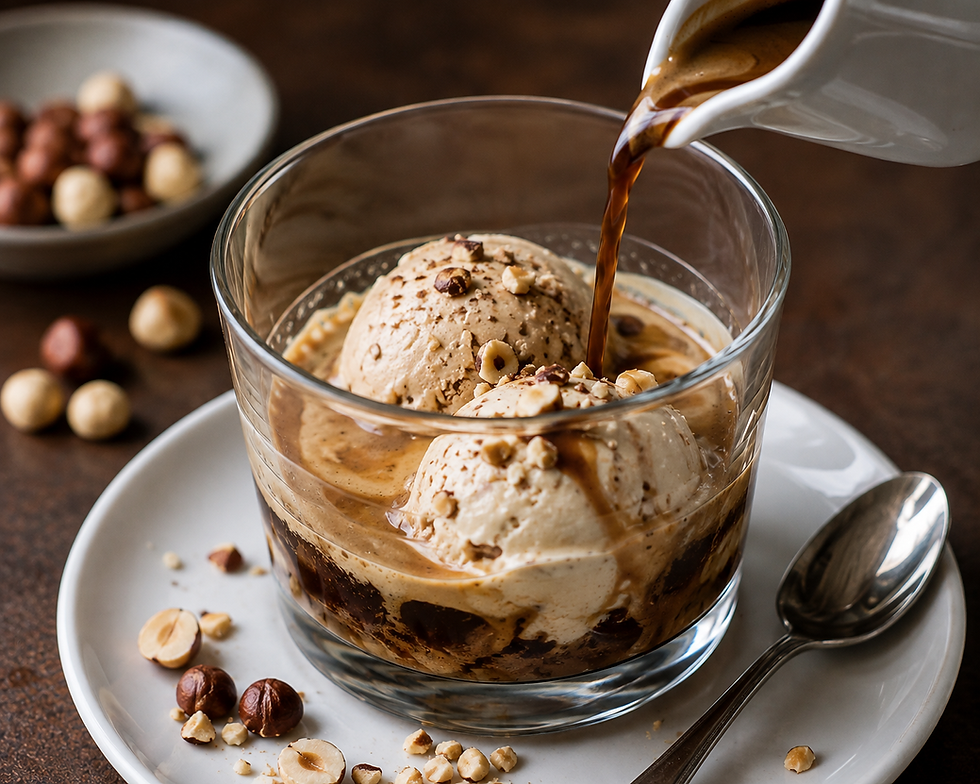
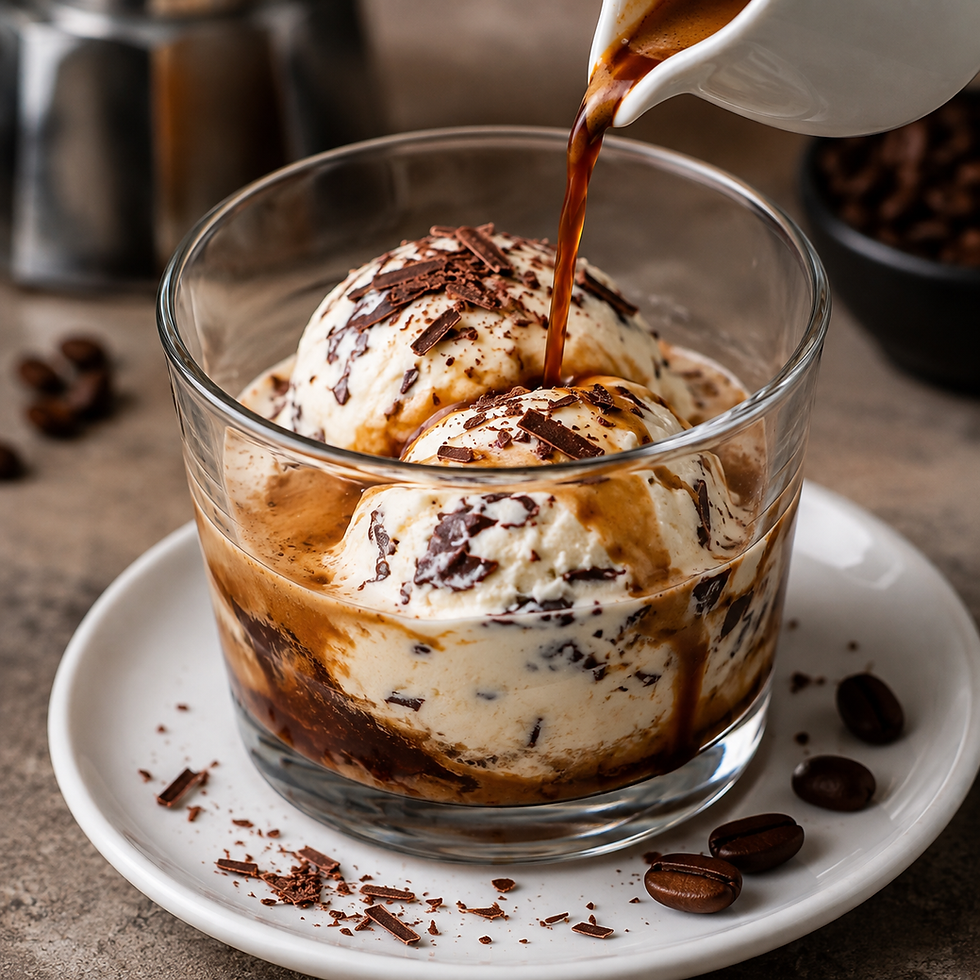
Serve it in glass, not in a bowl. A narrow glass of about 5 fl oz (150 ml) holds the scoop with the coffee gathered around its base rather than spread in a wide film, which keeps the melting surface small and lets the guest see the three layers: the white crown clear of the coffee, the softening band at the waterline, the dark liquid below. A wide coupe doubles the exposed surface and the dessert collapses while it crosses the room.
Nothing else goes on it. No cocoa powder, which floats and turns to paste; no whipped cream, which insulates the gelato from the coffee and defeats the point. If you want something alongside, put a plain cantuccio on the saucer, where it stays dry. Serve with a teaspoon rather than a sundae spoon: this is eaten in six or seven small mouthfuls and the short spoon paces them.
Professional Technique
The technique in this dessert is a ratio, and the ratio is 80 g of gelato to 25 ml of espresso, a little over three parts gelato to one part coffee by weight. Everything a cook would normally control, heat, timing, seasoning, texture, is fixed by the two components before they meet, so proportion does the work that cooking does elsewhere. The coffee must be strong enough to read through milk fat and sugar, and small enough that it cannot flood the glass. Twenty five millilitres of properly extracted espresso is both at once.
Move the ratio in either direction and you are no longer serving the same dessert. Two scoops and one shot is around six and a half to one: the coffee is used up against the first surface it meets, the second scoop never sees any, and what arrives is a bowl of gelato going soft with a coffee note in it somewhere. One scoop and a double is about one and a half to one: the gelato dissolves within half a minute and you are drinking a warm, sweet, milky caffè. Both are pleasant. Neither is affogato.
Fior di latte is what makes those errors audible. A neutral base contributes fat, sugar and dairy sweetness and no aroma at all, so the only aromatic in the glass is the coffee, and any shift in the ratio shows up at once as a change in how strong the dessert tastes. Build the same thing on pistachio or chocolate and the base brings its own aroma at fixed intensity: it reads as pistachio at three to one and still reads as pistachio at six to one, and the loose measuring vanishes behind it. That is why this version is the one professionals use to check their proportions.
Texture and Moisture Control
Three textures exist in the glass at once and each has a short life. The core of the scoop stays frozen and firm. A band perhaps an eighth of an inch thick at the waterline turns to thick cold cream where the hot coffee has worked into it, and that band is the best thing in the dessert. Below it sits espresso thinned with melted gelato, sweeter and softer than the coffee was. A well made affogato holds all three for about a minute, which is how long it takes to eat.
Serving temperature governs how fast that structure runs. At 0°F (-18°C) the scoop is glassy, the coffee cannot penetrate and no cream band forms; at 18°F (-8°C) the whole scoop slumps and the layers never separate. The window is narrow and sits around 10°F (-12°C). Sugar matters as much: the dextrose lowers the freezing point slightly and keeps the gelato scoopable there without going soupy, which is why those figures are worth weighing. Coffee temperature is the last lever, near 160°F (70°C) in the cup, because a shot that cooled on the counter melts less and tastes flatter at the same volume.
Professional Mise en Place
The whole dessert happens in the last sixty seconds, so everything except the pour is prepared before service. Scooping to order is what loses you the ratio.
Equipment and tools
Digital scale accurate to 1 g, left set up on the bench
Marked shot glass or small jug for checking the espresso yield
Ice cream scoop of about 1 1/2 fl oz (45 ml) and a shallow tray with parchment
Instant read thermometer for the gelato surface
Narrow glasses of about 5 fl oz (150 ml) and teaspoons
Prepared ahead
Gelato base made and rested, up to 2 days before churning
Gelato churned and hardened, at least 4 hours ahead
Portions weighed at 2 3/4 oz (80 g) and held covered on the tray
Espresso yield tested and the grind adjusted on a throwaway shot
Service setup
Machine at temperature and the group flushed
Portioned tray moved to the warm part of the freezer 10 minutes before service
Glasses and spoons lined up dry within reach of the machine
One shot pulled per glass, poured and sent immediately
Chef Tips
Weigh the scoop even when you think you can judge it. A scoop of fixed volume gives a different weight depending on how hard the gelato is and how much air you press out, and a rounded scoop can vary between 65 and 100 g from the same tub. That is a third of the ratio, gone before the coffee arrives.
Test your machine yield once and remember the number. Almost everyone who thinks they are pulling a single is pulling closer to 40 ml, and that one measurement explains most affogati that taste like sweet coffee instead of dessert.
Make the gelato the day before rather than the same morning. Gelato served within an hour of churning melts fast and unevenly, which ruins the cream band at the waterline. A night in the freezer makes the texture predictable.
Serve it immediately or not at all. This cannot be plated in advance for a table of eight, so pour four, send them, then pour the next four. A guest who waits ninety seconds is eating a different dish.
Common Mistakes
Using two scoops with one shot. The commonest error, and the one that quietly turns the dessert into a bowl of softening gelato, because the coffee cannot reach past the first surface. One weighed scoop of 2 3/4 oz (80 g) per single shot.
Pouring a double because the machine defaults to it. Fifty millilitres over one scoop dissolves it within thirty seconds and you are drinking milky coffee. Shorten the yield rather than rebalancing with more gelato.
Serving gelato straight from a cold freezer. At 0°F (-18°C) the surface repels the espresso, no cream band forms and the coffee collects in the bottom of the glass. Bring it to about 10°F (-12°C) first.
Letting the espresso stand before pouring. The crema collapses within half a minute and the shot turns flat and acidic. Pour while it steams, and have the gelato in the glass before extraction starts.
Using a flavoured gelato and keeping the same proportions. Vanilla, hazelnut and chocolate bring their own aroma and tolerate a looser ratio. Fior di latte does not, which is why it is worth measuring.
Wine Pairing
Vin Santo del Chianti Classico DOC: The most complete match on the list. Dried on the vine and aged oxidatively in small casks, it arrives with dried fig, walnut and caramel notes that sit in the same register as roasted coffee rather than competing with it, and its acidity stays high enough to cut the milk fat of the gelato. Serve it cool, around 54°F (12°C), in a small glass.
Marsala DOC: The Sicilian fortified wine, in a Superiore Dolce bottling, brings the same oxidative depth with more weight and more alcohol behind it. Its burnt sugar and dried apricot character reads almost as a second coffee note, and the fortification gives it enough body to be tasted against something ice cold, where lighter wines are simply numbed by the temperature.
Recioto di Soave DOCG: A lighter choice, from dried Garganega, with honeyed apricot and almond fruit and a sweetness carried on unusually firm acidity for a passito. That acidity is the reason it works here: it clears the milk fat between mouthfuls and leaves the bitter finish of the espresso intact instead of coating over it.
Moscato di Noto DOC: The deliberate contrast, and the one to pour if your coffee is roasted dark. Its orange blossom and muscat grape aromatics come with modest alcohol and gentle sweetness, so it works against the bitterness of the espresso rather than alongside it. Keep it properly cold and pour very little, since a large glass will overwhelm a dessert this short.
Storage & Reheating
There is nothing to store once the coffee is poured, and nothing to reheat. An assembled affogato cannot be held for even five minutes and must never be refrozen: the melted layer recrystallises into ice and the coffee turns bitter and metallic. If a serving is refused, discard it.
The components keep well on their own. The base holds covered in the refrigerator for up to 2 days and churns better after a night of ageing. Churned fior di latte keeps in an airtight container in the freezer for up to 2 weeks with film pressed onto the surface, though the texture is best in the first week. Weighed scoops keep on their covered tray for up to 3 days. Whole beans keep about 3 weeks in a sealed opaque container and should never go in the freezer; grind to order every time.
Nutrition
Per serving, based on one 80 g scoop and one 25 ml espresso:
Calories: 175 kcal
Total Fat: 9 g
Saturated Fat: 5.5 g
Trans Fat: 0 g
Unsaturated Fat: 3 g
Cholesterol: 32 mg
Sodium: 45 mg
Total Carbohydrates: 20 g
Fiber: 0 g
Total Sugars: 20 g
Added Sugars: 16 g
Protein: 3 g
Lactose: 4 g
Principal micronutrients: calcium, phosphorus, riboflavin, vitamin B12, potassium
These figures are estimates and move with the gelato you use, since a commercial fior di latte can carry half again as much fat as this base.



Comments