
Italian Stracciatella Affogato | Affogato alla Stracciatella
Updated: Sep 14
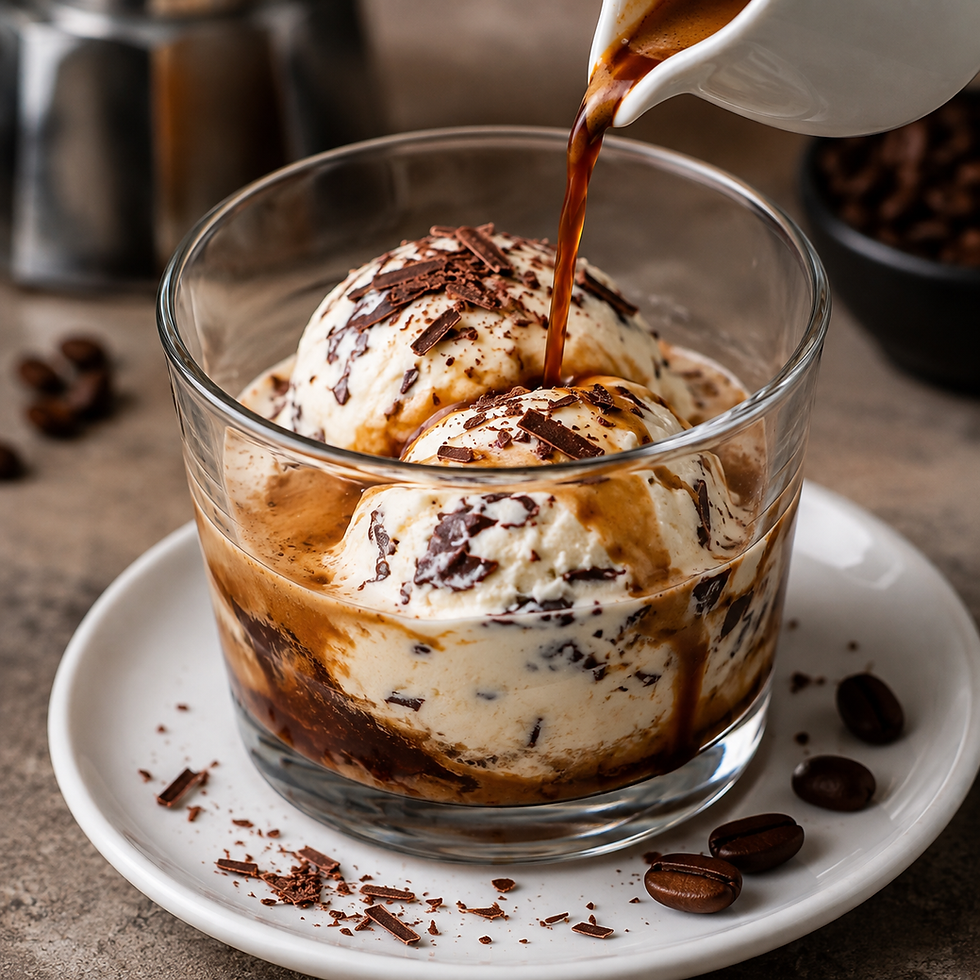
An affogato is the shortest dessert in the Italian repertoire: a scoop of gelato, a shot of espresso poured over it at the table, a spoon, nothing else. Made with stracciatella instead of plain fior di latte it becomes far more interesting, because the hot coffee does not meet one ingredient but two, and it treats the chocolate very differently from the milk.
The shards inside a real stracciatella run from tissue thin to a millimetre, and they sit at every depth of the scoop. Espresso arrives at roughly 158F (70C) and sheds that heat almost at once against gelato at 0F (minus 18C), so chocolate near the surface dissolves into the coffee, pieces just below soften into pliable ribbons, and those locked in the frozen core stay perfectly brittle. Three states of one ingredient reach the spoon together. Everything here exists to protect that gradient: the scoops are hardened in advance, the coffee is pulled short and served instantly, and the pour goes down the wall of the glass rather than onto the crown.
Yield: 4 servings. Prep: 15 minutes, plus 1 hour to harden the scoops. Assembly: under 2 minutes. Difficulty: easy in execution, demanding in timing. Course: dessert and coffee in one glass. Region: the affogato is Italian everywhere, the stracciatella is from Bergamo in Lombardy.
The Story
The affogato has no inventor and no founding date, which is unusual for an Italian dessert and tells you what it is. It began as a habit rather than a recipe, the answer gelaterie and trattorie gave a guest who wanted dessert and caffe at once and would not wait for two services. Affogato means drowned, and the name describes the act, not the dish. For most of its life nobody wrote it down, because there was nothing to write: gelato, espresso, glass.
What it drowned was almost always fior di latte or crema, the plainest flavours in the case, precisely because they carry coffee without arguing with it. Stracciatella entered only after 1961, when it was created at the Bar Ristorante La Marianna in Bergamo, and it took years to spread far enough that a barman would reach for it instead of the vanilla. When that happened the dessert changed character, because now a second ingredient in the glass reacted to heat on its own schedule. It remains a bar dessert rather than a restaurant one, poured standing up as often as sitting down, eaten in three minutes, and never garnished into something it is not.
Ingredients
For the glass
Stracciatella gelato, 10 oz (285 g), about 8 small scoops
Freshly brewed espresso, 4 oz (120 ml), two double shots
Coffee beans, medium Italian roast, 1 1/2 oz (40 g) to grind
For finishing
Dark chocolate, 70 percent cacao, 1 tbsp shaved, about 1/3 oz (10 g)
Toasted hazelnuts, finely chopped, 1 tbsp (10 g), optional
Whole roasted coffee beans, 4 to 8, for presentation
Flaky sea salt, 1 very small pinch, optional
To serve
Small glasses or coppette, 4, chilled in the refrigerator
Almond biscuits or cialde wafers, 4, optional
Preparation
Choose a true stracciatella
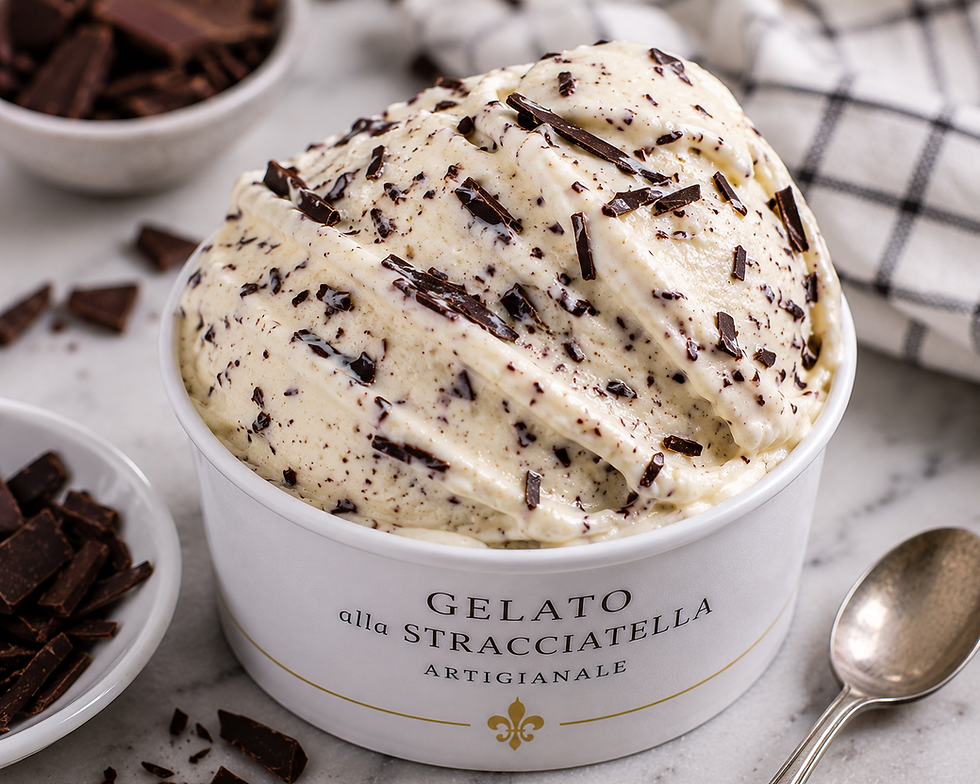
Buy or make a gelato in which the chocolate was drizzled into the churning base and torn by the paddle, not an ice cream with chips folded through. Real shards are thin, irregular and sit at every depth of the scoop, which is what produces the layered melt. Moulded chips are uniform and several millimetres thick, so they never soften and read as waxy pellets in a hot drink.
Scoop and harden the gelato
A full hour before service, scoop the 10 oz (285 g) into eight small firm balls, set them on a chilled tray and return them to the coldest part of the freezer. A ball that has re set for an hour has refrozen at the surface and keeps its dome for the two minutes the dessert lives. A scoop cut to order carries soft edges, slumps into the coffee at once and releases all its shards together.
Shave the chocolate
Fifteen minutes before service, run a vegetable peeler along the edge of the bar so the 1 tbsp comes away in broad curls. Chill the bar and the peeler for ten minutes first and the curls come off wide and intact. Never grate it to powder, which vanishes into the coffee and leaves only a muddy colour. Hold the curls in a small bowl in the refrigerator, since shavings left out go soft at the edges and clump.
Chill the glasses and toast the nuts
Put the glasses in the refrigerator, never the freezer: a frozen glass meeting espresso at brewing temperature risks thermal shock, and the frost melts into a wet saucer within a minute. If you are using hazelnuts, toast them at 350F (175C) for 7 to 8 minutes, rub the skins off in a clean towel, cool and chop fine. Both jobs finish before the machine is touched.
Grind and pull the espresso
Grind immediately before brewing, fine enough that the grounds clump slightly when pinched, dosing 18 to 20 g per double. Coffee ground even ten minutes ahead has lost the aromatics that justify making this. Brew at 198 to 201F (92 to 94C) for a 25 to 30 second extraction, about 2 oz (60 ml) per double. Cut the stream the instant it turns pale and thin, because the tail of a shot is watery and bitter and stacks on the cacao.
Drown the gelato
Set two hardened balls into each chilled glass and pour roughly 2 oz (60 ml) of espresso the moment the shot finishes. Pour down the inner wall, never onto the crown: a direct pour drills a channel through the middle and strips shards on the way down, while a pour from the side runs around the gelato and builds the sauce with the dome intact. Stop while a clear cap of gelato still stands above the coffee line.
Finish and serve at once
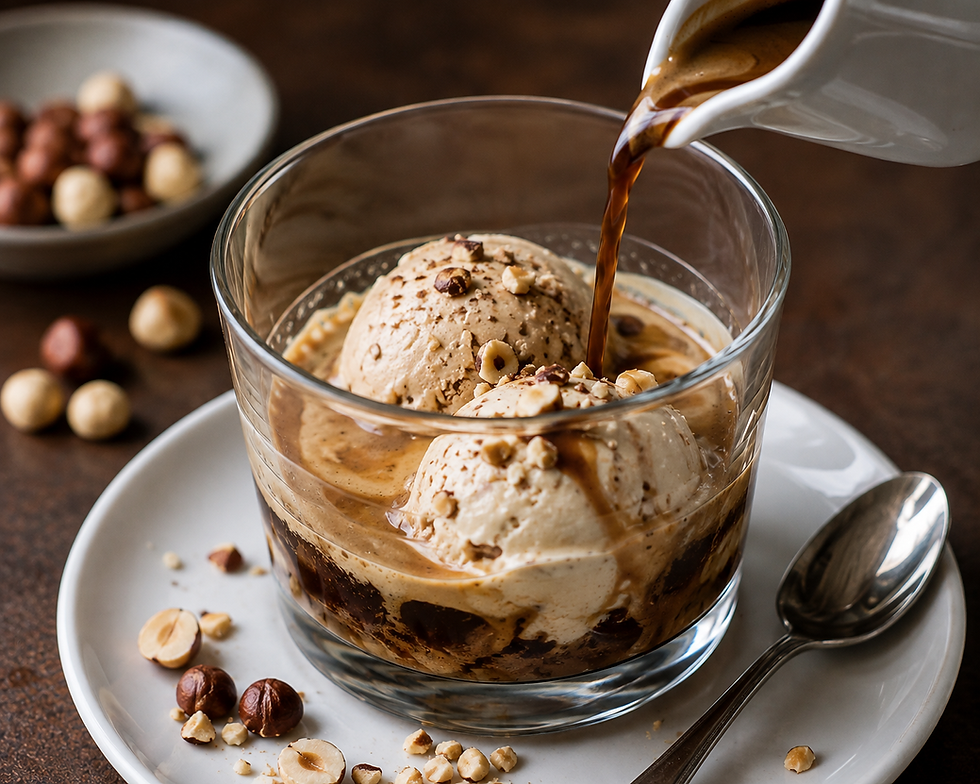
Scatter the shaved chocolate over that exposed crown immediately, add the hazelnuts if using, drop in a coffee bean or two, and add the pinch of flaky salt if you want the cacao sharpened. Carry the glass to the table without stirring it, since one turn of the spoon melts every remaining shard. The pour itself can be done in front of the guest, and the smell of hot coffee hitting cold chocolate is worth staging.
Plating
Serve on a small saucer with a teaspoon, and serve it the second it is poured. This is a dessert with a working life of two or three minutes, not one to photograph at leisure, and a glass that has waited five minutes in a pass is a different and much worse dish than the one you made.
The picture you want is a pale flecked dome standing clear above a dark pool, fresh chocolate curls catching the light on top, and the ring of hazel crema still visible against the glass wall. Because the gelato is already flecked, keep the added garnish restrained: two or three curls and a single bean read as deliberate, a heaped spoonful reads as clutter. A plain almond biscuit or a cialda on the saucer earns its place with a dry crunch against all that softness. Skip whipped cream and chocolate sauce entirely, since the dessert already contains its chocolate and more of it collapses the contrast between crisp, soft and melted that the recipe is built to create.
Professional Technique
The technique here is thermal, and every instruction above follows from it. Cocoa butter melts at around 93 to 97F (34 to 36C), just below body temperature, which is why good chocolate melts on the tongue. Espresso enters at roughly 158F (70C), far above that, but it is a small volume meeting a large frozen mass and it sheds heat within seconds. What it leaves is not a uniform temperature but a gradient running from the coffee line down into the frozen core, and the shards behave according to where they sit in it.
The pour is what protects that gradient. Espresso poured down the inner wall spreads laterally and sinks slowly around the outside of the gelato, so the heat stays at the perimeter and the core never rises above freezing. Espresso poured onto the crown behaves like water on sand: it finds a channel, drills straight down, melts shards the whole way and arrives as a warm pool that keeps working from below. Same volume, same temperature, a completely different dessert. Crema does structural work too, which is why the shot is served the instant it finishes: the fine bead of emulsified oils on a fresh shot forms a film over the gelato and slows the coffee through it. Crema collapses within thirty seconds, and a shot left standing gives a visibly flatter, faster melting glass.
Texture and Moisture Control
Two ratios govern the glass. The first is coffee to gelato, and 2 oz (60 ml) of espresso against about 2 1/2 oz (70 g) of gelato is the balance point: more coffee and the milk base is overwhelmed and the cacao turns ashy, less and there is no sauce at all. The second is chocolate to dairy, and it is the one people get wrong by being generous. A properly made stracciatella already carries 10 to 12 percent chocolate by weight, so the tablespoon of shavings is a finishing touch rather than a component. Double it and the melted cocoa butter slicks the coffee and coats the palate greasily.
Overrun decides how the glass behaves over its short life. A dense low air gelato melts slowly into a creamy sauce that holds its body to the last spoonful, while an aerated ice cream deflates on contact and turns the coffee watery within a minute, releasing all its shards at once. Temperature discipline is the rest: the gelato goes in freezer hard, the coffee brewing hot, the glass refrigerator cool. Gelato tempered on the counter, a glass left at room temperature, a shot allowed to cool while you fetch the tray, each closes that spread a little, and three small compromises give a warm brown cup with no crisp element left.
Professional Mise en Place
All the work is in the setup, because the assembly allows no margin. Once the espresso is in the cup you have perhaps fifteen seconds of useful time, so everything else must be finished and within reach.
Equipment and tools
Espresso machine or a stovetop moka pot, plus a burr grinder
Vegetable peeler for the chocolate curls and a small cold bowl to hold them
Ice cream scoop, a chilled tray, and four small glasses or coppette
Four saucers and four teaspoons, set out before you start
Prepared ahead
Gelato scooped into eight balls and hardened on a tray, 1 hour ahead
Glasses chilling in the refrigerator, 1 hour ahead, never in the freezer
Hazelnuts toasted, skinned and chopped, up to a week ahead in a sealed jar
Chocolate shaved into curls no more than 15 minutes ahead, held cold
Coffee weighed into doses but not ground
Service setup
Machine fully up to temperature and the group head flushed, 15 minutes before
Glasses lined up at the machine with the gelato tray beside them
Curls, hazelnuts, salt and whole beans in small bowls within arm's reach
Grind, brew and pour as one continuous movement, never as three tasks
For four servings, pull both doubles back to back and pour all four glasses together
Chef Tips
Taste the espresso on its own before it goes near the gelato. A sour underextracted shot or an ashy overextracted one cannot be corrected once the dessert is built, and the cacao will amplify either fault rather than hide it. It costs one shot to find out and it is always worth the cost.
Choose the coffee more carefully than for a plain affogato. There is already bitterness in the glass from 70 percent chocolate, so a medium Italian style roast with nutty and cocoa notes is what you want. Very dark oily beans stack ash on cacao and the result is harsh and flat. A little robusta in the blend is a real advantage, giving the body and thick crema that stand up to cold dairy.
A stovetop moka pot is a legitimate substitute and its heavier, less acidic cup suits chocolate well. Take it off the heat the moment it sputters and use the same 2 oz (60 ml) per glass. Drip and filter coffee are not substitutes at any volume, being far too dilute to hold their own against melting gelato.
A teaspoon of amaro or good dark rum stirred into the espresso makes an affogato corretto, and it suits stracciatella better than plain fior di latte because the herbal notes bridge coffee and cacao. Stay at 70 percent for the shavings: milk chocolate turns the glass cloying against coffee, and anything above 80 percent goes chalky the moment it meets cold dairy.
Common Mistakes
Using a chocolate chip ice cream. Moulded chips are uniform, thick and waxy, they never soften in the coffee, and the layered melt that justifies this recipe simply does not happen. If a true stracciatella is not available, make a plain fior di latte affogato rather than faking this one.
Tempering the gelato on the counter. Ten minutes at room temperature softens the whole scoop, so it collapses under the pour and dumps every shard into the coffee at the same instant. The gelato goes from freezer to glass hard, and the only rest it gets is the hour spent hardening as scooped balls.
Pouring the espresso onto the crown. A direct pour tunnels through the middle of the scoop, drains to the bottom and strips the surface shards on the way. Pour down the inner wall instead and let the coffee travel around the gelato rather than through it.
Over pouring until the gelato is submerged. Once the dome is under the coffee line there is no frozen core left to keep any chocolate brittle, and what you have is a uniform bitter sauce. Stop while a clear cap still stands proud.
Adding the shaved chocolate before the coffee. Curls scattered on first are exactly where the espresso lands, so they dissolve on contact and are wasted. They go on afterwards, onto the dry crown above the coffee line.
Letting the shot stand before pouring. Crema collapses within about thirty seconds, and here it is a working barrier that slows the coffee through the gelato. A shot that waited two minutes gives a flatter glass that melts visibly faster.
Wine Pairing
Vin Santo del Chianti Classico DOC: Years in small caratelli give dried fig, walnut and orange peel over an oxidative depth that meets roasted coffee on its own terms. It stays sweeter than the 70 percent cacao, which is the rule that keeps a dessert wine from turning sour against chocolate, and its cutting acidity clears the cold dairy between spoonfuls.
Recioto della Valpolicella DOCG: Dried on the fruttaio into concentrated cherry and cocoa, sweet but with real Corvina acidity beneath, so it never feels syrupy against cream. Its own cacao note runs alongside the chocolate shards rather than fighting them, and the light tannin gives the pairing a grip the espresso answers. Serve at 60F (16C).
Malvasia di Bosa DOC: Aged oxidatively under a film of yeast in Sardinia, it develops bruised apple, almond and dried nut notes that pick up the roasted coffee and the hazelnut garnish at once. Far drier than the others, so pour it where the guest wants savour rather than sweetness and let the gelato supply the sugar.
Brachetto d'Acqui DOCG: Low in alcohol, gently sparkling and openly aromatic with rose and wild strawberry, it lifts the glass rather than matching its weight. The bubbles scrub cocoa butter off the palate, which is what a rich affogato needs, though a very dark espresso will outmatch it, so pull the shot on the shorter side.
Storage & Reheating
The assembled dessert cannot be kept at all. It lives about three minutes from the pour, it cannot be refrigerated or refrozen, and a glass left sitting in a pass should be thrown away rather than sent. Nothing here is reheated either: the only heat arrives from the machine and is used immediately.
The components all hold. Pre scooped gelato balls keep a full day in a covered container in the freezer and are better than scooping to order. Toasted hazelnuts keep a week airtight at room temperature, chocolate curls two or three days in a sealed box in the refrigerator, and chilled glasses can simply live in the refrigerator. The stracciatella itself keeps at 0F (minus 18C) for four or five days, at the back of the freezer and never in the door, where every opening swings the temperature and coarsens the milk base. Past a week cocoa butter has bloomed, the shards have lost their snap and taken on a dull chalky surface, and in this particular dessert that removes the entire reason for making it.
Nutrition
Per serving, based on 4 glasses of two small scoops each:
Calories: 275 kcal
Total Fat: 15 g
Saturated Fat: 9 g
Trans Fat: 0 g
Unsaturated Fat: 5 g
Cholesterol: 35 mg
Sodium: 55 mg
Total Carbohydrates: 28 g
Fiber: 1.5 g
Total Sugars: 24 g
Added Sugars: 20 g
Protein: 5 g
Lactose: 6 g
Caffeine: about 80 mg per double shot
Principal micronutrients: calcium, phosphorus, riboflavin, magnesium, iron, cocoa flavanols
These figures are estimates. The hazelnuts add roughly 50 calories and 5 g of fat per serving, and the numbers move with the fat content of the gelato. The caffeine is worth remembering when this is served late.


Comments