

Italian Stracciatella Gelato | Gelato alla Stracciatella

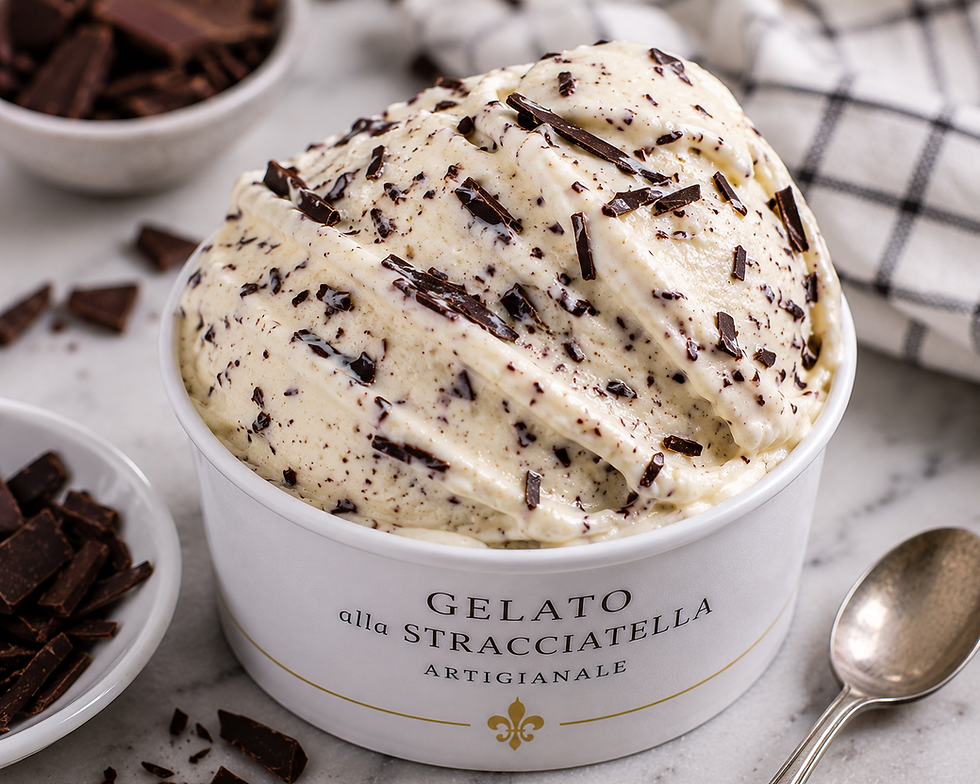
Stracciatella is a fior di latte gelato with melted chocolate poured into it while the machine is still turning. The chocolate freezes the instant it touches the cold mass, the paddle catches it and tears it apart, and what remains is not a mixture but a field of irregular dark shards suspended in white. The Italian verb stracciare means to tear or to shred, and the name describes the action rather than the result.
Everything worth making happens in about forty seconds at the end of the churn. Before that you are making a clean eggless milk base, and it must be clean, because a fior di latte hides nothing. After that you are racing the paddle: thirty seconds too long and the shards grind into specks and the batch turns grey brown. The recipe below is written for a domestic machine and gives about 1 quart (950 ml), with a hand method in the Chef Tips.
Yield: about 1 quart (950 ml), 8 servings. Prep: 25 minutes. Ageing: 4 hours minimum, overnight preferred. Churn: 25 minutes. Freeze: 2 to 3 hours. Difficulty: intermediate. Course: dessert. Region: Bergamo, Lombardy.
The Story
The flavour has a date and an address, which almost no Italian dessert does. In 1961, at the Bar Ristorante La Marianna in Bergamo, on the edge of the upper town, Enrico Panattoni poured warm melted chocolate into a vat of churning fior di latte and watched it seize into ribbons the paddle immediately broke apart. He named it after stracciatella alla romana, the soup in which beaten egg is trailed into hot broth and tears into threads, because the verb described precisely what the chocolate had just done.
La Marianna is still there and still sells it. The recipe travelled less well: stracciatella crossed Italy within a decade and was copied badly just as fast, because any producer could stir chips into vanilla and put the word on the tub. That is why most of what carries the name today is not stracciatella at all. The distinction is not pedantry. A shard torn in the machine can be thinner than a sheet of paper and melts the moment it touches the tongue, while a moulded chip cannot do that at any temperature. Bergamo gave Italy a technique, not a flavour combination.
Ingredients
For the fior di latte base
Whole milk, fresh, 2 1/2 cups (600 ml)
Heavy cream, 1 cup (240 ml)
Granulated sugar, 3/4 cup (150 g)
Skimmed milk powder, 2 tbsp (14 g), optional but recommended
Fine sea salt, 1/4 tsp (1.5 g)
Pure vanilla extract, 1 tsp (5 ml)
For the stracciatura
Dark chocolate, 60 to 70 percent cacao, 4 oz (115 g)
Neutral oil, grapeseed or sunflower, 1 tsp (5 ml)
To serve
Cialde wafers or plain almond biscuits, optional
Flaky sea salt, a very small pinch per cup, optional
Preparation
Combine the cold dairy
Pour the 2 1/2 cups (600 ml) of whole milk and the 1 cup (240 ml) of cream cold into a heavy saucepan. Use fresh milk rather than an ultra pasteurised carton, whose cooked note will sit under everything in a base this plain. The ratio lands at roughly 9 percent butterfat, deliberately lean: the chocolate has to read as a sharp contrast, and a richer base blurs the two elements into one muddy flavour.
Mix the dry ingredients and dissolve them
Whisk the 3/4 cup (150 g) of sugar, the optional 2 tbsp (14 g) of milk powder and the 1/4 tsp (1.5 g) of salt together dry first, so the salt distributes evenly and the powder does not lump. With the pan still off the heat, whisk that into the cold dairy for a full minute, until you can draw the whisk across the bottom without feeling grains drag under it. Sugar tipped into hot milk sinks and scorches, and a scorched base cannot be rescued.
Pasteurise to 185F
Bring the base to 185F (85C) over medium heat, stirring constantly with a flat edged spatula that reaches the corners of the pan, hold it 30 seconds, then take it off. This is pasteurising, not thickening: there are no yolks here, so it never visibly changes consistency and the thermometer does work your eyes cannot. The heat dissolves the sugar, hydrates the milk proteins so they hold water rather than releasing it later as ice, and burns off the raw dairy edge. Never let it boil.
Add the vanilla off the heat
Stir the 1 tsp (5 ml) of vanilla in once the pan is off the burner and the surface has stopped moving. Vanilla aromatics are volatile and evaporate out of an open pan at pasteurising temperature, so extract added earlier is largely wasted. This is a fior di latte, not a vanilla gelato, and one teaspoon is there to round the dairy rather than announce itself.
Chill and age the base
Set the pan over an ice bath and stir until the base falls below 50F (10C), then cover and refrigerate at least 4 hours, preferably overnight. With no yolk lecithin to emulsify, the density has to come from fat globules crystallising and milk proteins finishing their hydration, and both need hours. There is also a reason specific to this flavour: the base must enter the machine genuinely cold or it churns slowly, and slow churning ruins the chocolate step.
Melt the chocolate while the machine runs
Start the churn, and only then set the 4 oz (115 g) of chocolate over a bain marie with the 1 tsp (5 ml) of oil. Take it to no more than 104 to 113F (40 to 45C), barely warm on the lip. The oil is not a shortcut: it lowers the set point slightly so the frozen shards fracture cleanly instead of reading as thick and waxy against a cold tongue. Melt it earlier and it thickens in the bowl and refuses to pour as a thread.
Pour the thread and tear the chocolate
Churn 20 to 25 minutes, until the base has the density of thick soft serve and the paddle leaves a trail. With the machine still turning, pour the chocolate down the inner side of the bowl in a thread no thicker than a pencil lead, from a small jug or squeeze bottle rather than a spoon. It sets on contact and the paddle tears it apart, and that is the stracciatura. Run the machine 30 seconds more and no longer, or the shards grind to powder.
Harden in the freezer
Scrape the gelato into a chilled shallow container, folding once or twice by hand rather than stirring, which would break shards you have just made. Press parchment flat onto the surface so no air touches it, close the container and freeze 2 to 3 hours before serving. A shallow container freezes faster and more evenly than a deep one, and speed here means smaller ice crystals and a smoother finished texture.
Plating
Bring the gelato to about 10F (minus 12C) before serving, roughly 10 to 15 minutes out of a domestic freezer. Cold suppresses dairy flavour, and chocolate served too cold tastes of nothing but its own fat, so a gelato spooned straight from the freezer gives you neither of the two things you spent a day building.
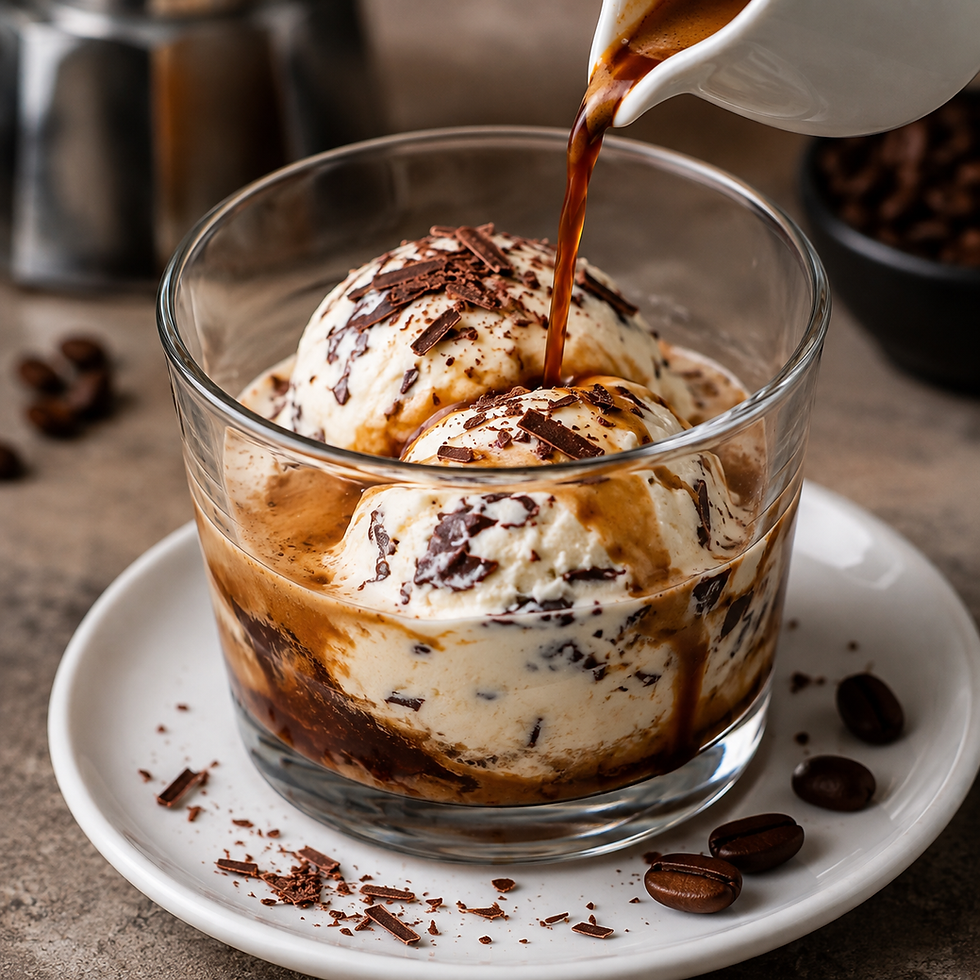
Lift it with a flat spatula and fold it into a chilled coppetta in the Italian manner rather than forcing a round scoop, which drags through the gelato and snaps the shards. The surface should show dark flecks and streaks of visibly uneven size, some as fine as a hair and some the width of a fingernail; perfectly uniform pieces are the signature of chocolate stirred in rather than torn. Serve it plainly, with a crisp cialda against the side of the cup and perhaps a very small pinch of flaky salt, which sharpens the cacao noticeably. Chocolate sauce over the top is actively harmful, laying a continuous layer of soft chocolate over a gelato whose whole character is discontinuous chocolate.
Professional Technique
The stracciatura is a thermal shock technique and it succeeds or fails on one variable: the temperature difference between the chocolate arriving and the gelato receiving it. Chocolate at 104 to 113F (40 to 45C) hitting a mass at roughly 21F (minus 6C) sets almost instantly, in a film thin enough that the paddle shatters it rather than folding it. Raise the chocolate above 122F (50C) and it carries enough heat to melt a channel before it can set, so it sinks and pools as a slab. Churn the base only to a slush and the chocolate has nothing firm to set against, with the same result.
The shape of the pour decides the shape of the shards. A thread the width of a pencil lead sets into a film a fraction of a millimetre thick, which fractures into the papery pieces the flavour is named for and melts the moment it meets the tongue. The same chocolate delivered from a spoon lands as blobs that set into thick tiles, and a tile does not melt fast enough at mouth temperature to release its cocoa, so it reads as cold and greasy. Timing is the third element: from the moment the chocolate enters, the paddle grinds the shards smaller with every rotation, so thirty seconds is plenty and two minutes is a disaster.
Texture and Moisture Control
This gelato has two textures to manage and they pull in opposite directions. The base wants to stay soft and spoonable, which argues for more sugar and a warmer serving temperature. The chocolate wants to stay brittle, which argues for cold. The resolution is not to compromise on temperature but to control water in the base, since milk is roughly 87 percent water and anything not bound by sugar or milk solids will crystallise into ice.
Sugar is doing structural work as well as sweetening. At around 17 percent of total weight it depresses the freezing point enough to keep the gelato spoonable from a home freezer, which matters more here than in other flavours: a base that freezes rock hard snaps the shards into dust as you scoop rather than letting them fracture in the mouth. If the result is still icy, add the 2 tbsp (14 g) of milk powder with the sugar rather than more cream, since it raises non fat solids and binds free water without dulling the clean dairy flavour. On the chocolate side the only variable is thickness, and after the pour the job is protecting the shards from mechanical stress: fold rather than stir, use a shallow container, press parchment to the surface, and lift with a spatula rather than a ball scoop.
Professional Mise en Place
The critical window is about forty seconds long and arrives at the end of a churn you cannot pause, so the setup matters more than the cooking. Everything below is in position before the machine is switched on.
Equipment and tools
Ice cream machine with the bowl frozen a full 24 hours, not the 4 the manual suggests
Heavy saucepan, a flat edged spatula and a digital thermometer
Small jug with a pouring lip or a squeeze bottle for the chocolate
Heatproof bowl for the bain marie and a shallow lidded container for freezing
Parchment cut to the size of the container before you start
Prepared ahead
Base pasteurised, chilled over ice and aged in the refrigerator, overnight
Churn bowl frozen 24 hours, storage container chilled in the freezer
Chocolate weighed and chopped small so it melts quickly and evenly
Sugar, milk powder and salt whisked together dry and set aside
Parchment cut, spatula and jug laid out beside the machine
Service setup
Melt the chocolate only once the base is already churning, never before
Hold it just warm over the bain marie and stir it if it starts to thicken
Pour the thread at thick soft serve density, then count 30 seconds and stop
Transfer, press parchment, close and freeze without delay
At service, temper 10 to 15 minutes and lift with a flat spatula into chilled cups
Chef Tips
Use a chocolate you would happily eat on its own, at 60 to 70 percent cacao. Below that it turns sugary against an already sweet base, and above about 75 percent it goes chalky and aggressively bitter once frozen, because cold suppresses sweetness and exposes tannin.
Taste the base cold before it goes into the machine, never warm. Cold blunts sweetness considerably, so a base that tastes balanced at room temperature will taste flat once frozen. Adjust it while it is still liquid and still in the refrigerator, because there is no correcting sweetness after churning.
If you have no machine the technique still works by hand. Freeze the aged base in a shallow metal tray, whisk it hard every 30 minutes for about three hours, and drizzle the melted chocolate in during the final whisking, while the mixture is thick and very cold and you are still working it. The shards come out slightly larger and less regular, which is not a fault. What does not work is folding chocolate into a base already frozen solid.
Make the base the day before, always. Four hours will produce acceptable gelato and an overnight rest will produce noticeably better gelato, denser on the spoon and slower to melt, because the fat globules have had time to crystallise. It also splits the work into two short sessions, which makes the tight churn window much easier to manage.
Common Mistakes
Stirring in ready made chocolate chips. This produces something that is simply not stracciatella. Chips are moulded thick and uniform, they stay waxy on the tongue at any temperature, and none of the fine papery fracture that defines the flavour can happen. The chocolate must be liquid when it enters the machine.
Pouring chocolate that is too hot. Above about 122F (50C) it carries enough heat to melt its way into the gelato before it can set, so it drills a channel and pools at the bottom of the bowl as a solid slab. Take it to 104 to 113F (40 to 45C), barely warm to the lip, and no further.
Pouring too thickly or from a spoon. A fat stream or intermittent blobs set into thick tiles rather than shards, and a tile does not melt fast enough at mouth temperature to release its cocoa. Use a jug or squeeze bottle and aim for a thread the width of a pencil lead.
Adding the chocolate too early in the churn. A base still at slush density has nothing firm enough to fracture the chocolate against, so the paddle simply grinds it into the mixture. Wait for thick soft serve, when the paddle leaves a visible trail.
Running the machine after the chocolate goes in. Every rotation makes the shards smaller. Thirty seconds distributes them, two minutes reduces them to specks and turns the batch an even grey brown. Stop early and finish by folding.
Scooping with a ball tool straight from the freezer. A hard base plus a round scoop snaps the shards before they reach the mouth and both textures are lost. Temper 10 to 15 minutes and lift with a flat spatula instead.
Wine Pairing
Moscato di Scanzo DOCG: Italy's smallest DOCG, grown on hills a few kilometres from La Marianna, which makes it the local answer in the most literal sense. Dried and aged, it gives rose, dried cherry and a faintly bitter almond finish, with fine tannin that is rare in a sweet red and works properly against cacao. Its sweetness sits above the 70 percent chocolate and its perfume lifts a base as plain as fior di latte.
Moscato d'Asti DOCG: The everyday pairing, and the one that flatters the milk rather than the chocolate. Around 5 percent alcohol, gently frizzante, full of peach and orange blossom, it refreshes between spoonfuls instead of competing. The light bubble scrubs cream off the palate and the grapey sweetness answers the sugar in the base, though against a very dark chocolate it tastes thin.
Recioto di Soave DOCG: Garganega dried on mats until the sugars concentrate, giving candied apricot, honey and almond over an acidity that stays firm through all that sweetness. That acidity is why it works, cutting the fat of a 9 percent butterfat base where a heavier dessert wine would sit on top of it. The almond note runs alongside the cacao. Serve at 50F (10C).
Ramandolo DOCG: From Verduzzo Friulano on steep Friulian slopes, and the most structured white here. Dried apricot and honey with an unusual tannic grip for a sweet white, a texture that gives the pairing something to push against when the shards arrive. Less openly floral than the Moscati, which suits anyone who finds those too perfumed next to a clean dairy base.
Storage & Reheating
Keep the gelato in a shallow airtight container with parchment pressed flat to the surface, at 0F (minus 18C), and plan to finish it within four or five days. Nothing in this recipe is ever reheated: the only heat is the pasteurising of the base and the melting of the chocolate, and both happen once. If a batch has softened past spoonable, do not refreeze it and serve it as gelato.
The base follows the short life of any fior di latte, but the chocolate adds a second clock. Cocoa butter blooms slowly in the freezer, migrating to the surface of each shard, and past a week the pieces have lost their snap and taken on a dull chalky grey. Store the container at the back of the freezer, never in the door, where every opening swings the temperature and coarsens the base into larger ice crystals. Repeated softening and refreezing is particularly destructive here, because a partial thaw welds the shards into the gelato and they never separate again. The unchurned base keeps refrigerated up to 3 days and improves over the first 24 hours.
Nutrition
Per serving, based on 8 servings of about 1/2 cup (120 ml) each:
Calories: 268 kcal
Total Fat: 14 g
Saturated Fat: 8.5 g
Trans Fat: 0 g
Unsaturated Fat: 4.5 g
Cholesterol: 32 mg
Sodium: 95 mg
Total Carbohydrates: 30 g
Fiber: 1.2 g
Total Sugars: 27 g
Added Sugars: 22 g
Protein: 5 g
Lactose: 7 g
Principal micronutrients: calcium, phosphorus, riboflavin, vitamin B12, magnesium, iron, cocoa flavanols
These figures are estimates and move with the cacao percentage of the chocolate and the fat content of the milk. Being eggless, this gelato carries considerably less cholesterol than a custard based crema, and the low overrun that makes gelato taste concentrated means a modest Italian portion satisfies where a larger scoop of aerated ice cream would not.



Comments