
Italian Gianduia Affogato | Affogato al Gianduia

An affogato is not a dessert you cook. It is a dessert you time. There are two ingredients, a scoop of gianduia gelato and one shot of espresso, and the only thing standing between a beautiful glass and a brown puddle is the distance between their temperatures.
Get that distance right and the coffee sinks, sets a thin frozen skin against the gelato and holds there long enough to be eaten with a spoon. Get it wrong and you have served a cold drink.
Yield: 4 servings. Prep: 10 minutes. Gelato base, optional: 30 minutes plus 4 hours of chilling and churning. Assembly: under 60 seconds per glass. Difficulty: easy to execute, hard to time. Course: dessert. Region: Piedmont, Turin.
The Story
Affogato means drowned, and Italian uses the verb for food without any softening: the gelato is not accompanied by the coffee, it is drowned in it. The dish belongs to the bar rather than the pastry shop, which is why it appears in almost no historical Italian cookbook. There was nothing to write down. In Piedmont the caffè and the gelateria have long occupied the same room, with the same marble counter and the same machine hissing at one end, and a customer who wanted both simply asked for one poured over the other. It became a house dessert in Turin without ever becoming a recipe, and the waiters learned to carry it fast. That speed is the whole dish.
Gianduia gave the affogato its most Piedmontese version. The paste of cocoa and hazelnut was presented in Turin during the Carnival of 1865 by the Caffarel house, working from the ideas of Michele Prochet, and it took the name of Gianduja, the Piedmontese carnival mask who stood for the ordinary man of the city streets. Cocoa at the time was scarce and heavily taxed, while the Langhe hills to the south grew the Tonda Gentile hazelnut in quantity, so the confectioners stretched one with the other. What began as an economy became the flavour the region is known for, and that hazelnut now carries an IGP of its own. Gelato makers adopted the pairing as soon as they had freezers to keep it in.
Turin had been putting coffee and chocolate in the same glass long before any of this. The bicerin, three layers of espresso, hot chocolate and cream served in a small tumbler, has been sold at the same counter beside Piazza della Consolata since the eighteenth century, and it is the reason the city treats the combination as ordinary rather than clever. An affogato al gianduia is the summer form of that habit, with the chocolate frozen instead of hot and the cream already inside the gelato. Nothing about it is new. What is new is how little time you are given to get it to the table, and the bar solved that by never assembling one in advance.
Ingredients
Two ingredients decide this dessert and the rest is garnish. Buy the best gianduia gelato you can find, or make the base below, and use coffee roasted within the last three weeks: a stale bean gives a flat shot, and in a glass with only one other component there is nothing to hide behind. Weigh the gelato rather than trusting the scoop.
For the affogato, 4 servings
Gianduia gelato, 1 lb 5 oz (600 g), about 4 generous scoops
Freshly roasted espresso beans, 2 1/2 oz (70 g), for 4 double shots
Filtered water, for the espresso machine
For the gianduia gelato base, optional, makes about 1 lb 5 oz (600 g)
Whole milk, 2 cups (480 ml)
Heavy cream, 1/2 cup (120 ml)
Granulated sugar, 1/2 cup (100 g)
Dextrose, 2 tbsp (25 g)
Skimmed milk powder, 2 tbsp (15 g)
Egg yolks, 2
Dark chocolate, 60 percent, chopped, 3 oz (85 g)
Pure hazelnut paste, unsweetened, 3 oz (85 g)
Fine sea salt, 1/4 tsp (1.5 g)
For finishing
Peeled hazelnuts, 1 oz (30 g)
Unsweetened cocoa powder, for dusting
Flaked sea salt, a few grains per glass
Preparation
Freeze the glasses and the scoop
Put four small heatproof glasses or coupes into the freezer at least one hour before service, along with the scoop. This is not presentation, it is thermal mass. A glass at room temperature carries enough heat to melt the underside of the scoop before the coffee ever arrives, and once the gelato has started to go it never recovers. Leave everything in the freezer until the moment you pull the shots.
Toast and crush the hazelnuts
Heat the oven to 325°F (165°C) and toast the peeled hazelnuts on a small tray for 8 to 10 minutes, until they smell sweet and the centres have coloured to pale gold. Stay in the room. Hazelnuts pass from toasted to bitter in under a minute at that temperature and there is no correcting it. Cool them completely, then crush them under the flat of a knife into coarse irregular pieces instead of chopping them fine, so a few grains survive the coffee.
Build the gianduia gelato base
If you are making the gelato, warm the milk, cream, dextrose and milk powder in a heavy saucepan to about 110°F (43°C), then whisk in the sugar and the yolks off the heat. Return the pan to low heat and cook, stirring constantly across the base of the pan, until the mixture reaches 185°F (85°C) and coats the spatula. Take it off at once. Pour it over the chopped chocolate, the hazelnut paste and the salt in a tall jug, wait one minute, then blend with a stick blender until the mixture is glossy and completely uniform, with no dark specks left.
Chill the base, then churn it
Cool the base quickly over an ice bath to under 40°F (4°C), cover it and refrigerate for at least 4 hours, preferably overnight. That wait is what gives the finished gelato its body and its clean hazelnut flavour, and skipping it is the usual reason a home base tastes thin. Churn in a domestic machine for 20 to 30 minutes, until it pulls away from the wall and reads about 21°F (minus 6°C). Transfer it to a shallow container, press a sheet of parchment onto the surface and freeze for 3 hours before service.
Bring the gelato to serving temperature
Gelato straight from a domestic freezer sits at about 0°F (minus 18°C), and that is too hard for an affogato. Move the container to the warmest part of the refrigerator for 10 to 12 minutes, or leave it on the counter for 4, until a scoop meets slight resistance and takes a clean curl instead of shaving into flakes. Portion one scoop per frozen glass, working quickly, and put the glasses straight back into the freezer. Do not portion in advance, and do not leave the tub open while you make the coffee.
Pull the espresso and pour at the centre
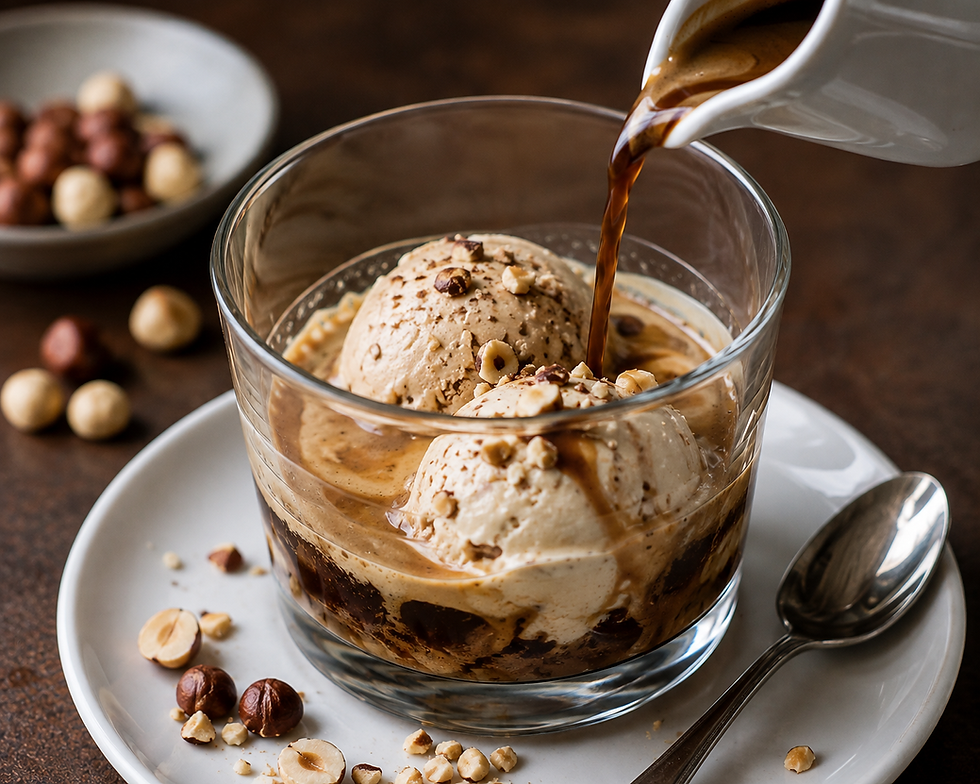
Grind and pull four double shots of about 2 fl oz (60 ml) each, taking 25 to 30 seconds to extract. Have the glasses out of the freezer and on the table before the first shot finishes. Pour the coffee at the centre of each scoop in one steady movement, never around the edge, where it runs straight to the bottom of the glass. Dust with cocoa, scatter the crushed hazelnuts and two or three grains of flaked salt, and send the glasses immediately.
Plating
The glass is part of the recipe. Use a small stemmed coupe or a heatproof tumbler of about 5 fl oz (150 ml), wide enough for a spoon and narrow enough that one scoop nearly fills it. Too large a glass and the coffee spreads across the base instead of pooling around the gelato. Too small and it overflows the moment you pour.
Serve it with a small spoon and nothing else: no wafer, no biscuit, no whipped cream on top. The dessert is already finished when it leaves the pass. Carry the glasses yourself if you can, tell the table to start at once, and accept that this is the one dessert nobody gets to photograph at leisure. Anyone who waits three minutes is drinking it rather than eating it.
Professional Technique
Everything technical in an affogato happens in the first fifteen seconds, and it is governed by a single number: the difference between the temperature of the coffee and the temperature of the gelato. Espresso leaves the group head at around 195°F (90°C). Gelato held for service sits near 5°F (minus 15°C). That is a gap of roughly 190 Fahrenheit degrees meeting across a few square inches of surface, and where you land on that scale decides whether you have made a dessert or a beverage.
The two failures sit on either side of the useful window. Gelato that is too soft, or that has been kept in the refrigerator instead of the freezer, has no reserve of cold left in it: the coffee dissolves the scoop in seconds and the glass becomes a sweet iced coffee with nothing to put a spoon into. Gelato taken out rock hard does the opposite. The coffee gets no purchase on the surface at all, so it slides off the dome and collects underneath, and the two components never meet.
The working point is between those two, and the whole procedure exists to hold it there. The glass goes into the freezer so that it does not spend the gelato's reserve of cold before the coffee arrives. The gelato is tempered for a few minutes so its surface can give, then portioned at the last possible moment. And the shot is poured at the centre of the dome, where the coffee has the deepest cold beneath it to work against and freezes into a thin dark shell, rather than at the wall of the glass, where it simply runs past. Fifteen seconds of contact, poured in the right place, is what an affogato actually is.
Texture and Moisture Control
Three textures have to arrive at the same instant: a crust where the coffee has refrozen against the gelato, a soft melting layer directly under it, and a firm cold core at the centre. The crust is the part people remember, and it forms only when the surface of the gelato is cold enough to take heat out of the coffee faster than the coffee can put heat in.
Water content is the other variable, and it is settled long before service. A gelato holding too much free water freezes stiff and refuses to give under the shot, which is why the base carries dextrose and milk powder rather than sugar alone. An overly light commercial tub full of air collapses for the opposite reason: there is very little frozen substance in it to begin with, so the coffee has almost nothing to work against.
Keep the coffee dry, meaning without milk, sugar or syrup of any kind. Anything dissolved in the shot raises the amount of heat it carries and lowers the point at which it will freeze, and both of those work against the shell. If you want the glass sweeter, the sweetness belongs in the gelato.
Professional Mise en Place
There is nothing to cook at service, only a sequence to respect, and it fails if one item is missing. Everything below is in place before the guests finish the main course, and from there the dessert takes under two minutes.
Equipment and tools
Four small heatproof glasses or coupes, about 5 fl oz (150 ml)
Espresso machine and burr grinder, both up to temperature
Gelato scoop, plus a jug of hot water and a cloth
Digital thermometer for the base and for the tempered gelato
Shallow container for the gelato, with parchment cut to fit
Prepared ahead
Gelato churned and hardened, at least 3 hours ahead
Hazelnuts toasted, crushed and stored airtight, the same day
Glasses and scoop in the freezer, at least 1 hour ahead
Cocoa in a small sieve, flaked salt in a pinch bowl
Service setup
Gelato tempering in the refrigerator, timed to 12 minutes before service
Scoops portioned into frozen glasses at the last minute
Shots pulled only once the glasses are already on the table
Spoons chilled, table cleared, nothing else left to carry
Chef Tips
Taste the gelato before you commit to it. A commercial gianduia often carries more sugar than a homemade one, and sugar is the first thing the coffee attacks. If the tub tastes sweet on its own it will taste cloying under espresso.
Use a coffee you would happily drink on its own, pulled slightly short. A bitter, over extracted shot flattens the hazelnut completely, and the hazelnut is the reason you chose this gelato.
Warm the scoop in hot water and dry it before every portion rather than dragging a cold one through the tub. It takes a clean curl in a single pass, which means less handling and a smooth dome the coffee can sit on.
If you are serving more than four, work in rounds of four. Two rounds ninety seconds apart give everybody a proper affogato. One round of eight gives four good ones and four glasses of coffee.
Common Mistakes
Keeping the gelato in the refrigerator before serving. It reaches the glass with no cold left in it, so the espresso dissolves the scoop before it reaches the table. Temper it for minutes, never for hours.
Pouring the coffee down the side of the glass. The shot bypasses the gelato entirely and collects at the bottom, where it neither freezes nor flavours anything. Pour at the centre of the dome, in one movement.
Assembling the glasses in advance. Even two minutes on the pass costs the surface its crust. Portion at the last moment into frozen glasses.
Cooling the espresso to be gentle on the gelato. A tepid shot does not protect the scoop, it only loses the aroma and the crema. The gap in temperature is the dish, so pour the coffee as hot as it comes.
Using a long coffee instead of espresso. Four fluid ounces of filter coffee carries far more heat and far more water than a double shot, and it drowns the scoop in the literal sense. Keep to 2 fl oz (60 ml) per glass.
Wine Pairing
Marsala DOC: A dry Superiore or a Vergine rather than a sweet cooking bottle. Oxidative ageing gives it dried fig, walnut and a faintly saline edge that meets the roasted hazelnut directly, while the alcohol carries flavour across a palate that the cold has partly numbed. Serve it at 57°F (14°C) in a small glass: any warmer and it turns spirity against the coffee.
Vin Santo del Chianti Classico DOC: Dried Malvasia and Trebbiano grapes give a sweetness that stays behind a firm line of acidity, and that acidity is what keeps the pairing from turning heavy over a glass of cream and chocolate. Its own notes of walnut and candied orange peel sit naturally beside the hazelnut, and the long finish outlasts the bitterness of the espresso.
Recioto della Valpolicella DOCG: The red option, for anyone who wants the chocolate answered rather than balanced. Dried Corvina brings cherry in liqueur and a light tannin that frames the cocoa instead of drying the palate, and the residual sugar is high enough not to be flattened by a frozen dessert. Serve it cool, around 59°F (15°C).
Malvasia delle Lipari DOC: Apricot, orange blossom and honey at a moderate alcohol, which makes it the lightest choice here and the easiest at the end of a long meal. Its aromatic lift reads alongside the toasted hazelnut rather than over it, and the acidity sitting behind the sweetness stops the coffee tasting bitter by comparison.
Storage & Reheating
An assembled affogato does not keep for one minute, let alone one day, so there is nothing to store except the components. The gelato holds in a shallow airtight container in the freezer for up to 2 weeks with parchment pressed onto the surface, though it is at its best in the first three days.
Toasted hazelnuts keep airtight at room temperature for about 5 days, so crush them the day you serve. Ground coffee keeps nothing at all: grind for each round of shots.
Nothing here is reheated, and the one thing that looks like a leftover is not. If a glass has melted before anyone touched it, do not refreeze it: it will set into a solid sweet block. Pour it over ice instead, call it a coffee, and make the next one properly.
Nutrition
Per serving, based on 4 glasses with one scoop of gelato and one double espresso each:
Calories: 330 kcal
Total Fat: 20 g
Saturated Fat: 9 g
Trans Fat: 0 g
Unsaturated Fat: 10 g
Cholesterol: 75 mg
Sodium: 85 mg
Total Carbohydrates: 31 g
Fiber: 2 g
Total Sugars: 27 g
Added Sugars: 21 g
Protein: 6 g
Lactose: 5 g
Principal micronutrients: calcium, phosphorus, magnesium, potassium, vitamin E, copper, iron
These figures are estimates and move with the gelato you use, since commercial tubs vary widely in both sugar and fat.



Comments