
Italian Piedmontese Stuffed Pasta | Agnolotti del Plin

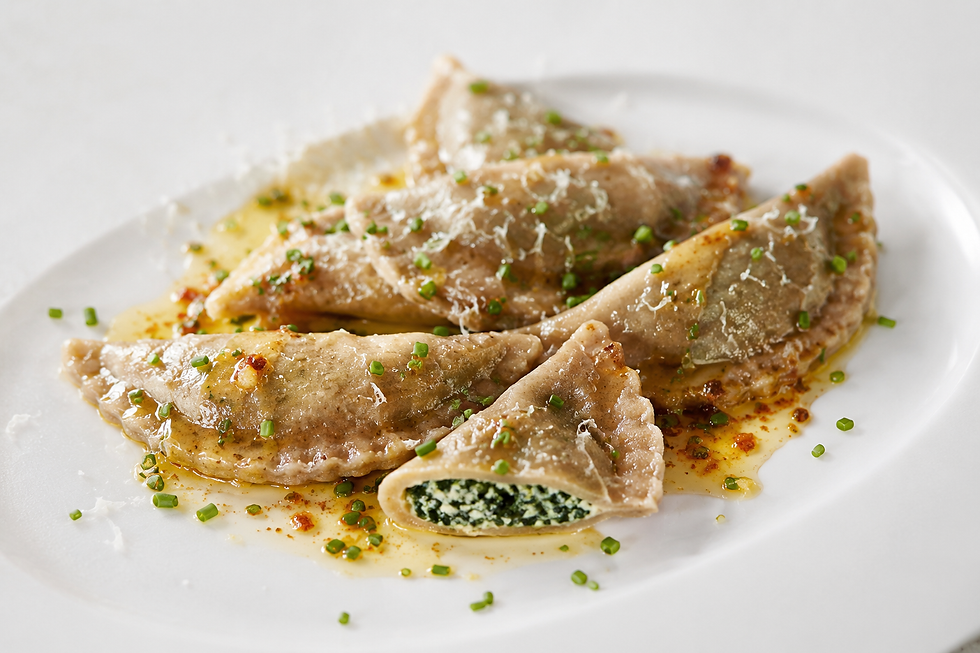
This is agnolotti del plin as they are made in a Langhe kitchen: a roast minced down into a filling, a single thin sheet of yolk pasta, and a row of pinches made with two fingers. There is no stock, no reduction and no truffle. The pasta is dressed with the juices from the roasting tray it came out of, or with nothing at all.
The whole dish turns on one gesture. The plin is the pinch, and it seals the pasta, separates the pockets and squeezes the air out in a single movement. Made properly the agnolotti come out tiny, barely 1 in (2.5 cm) across, which is the point: they are eaten several at a time and the pasta has to be thin enough to disappear behind the meat.
Yield: 4 servings, about 20 agnolotti each. Roast: 1 hour 30 minutes. Filling: 30 minutes plus 2 hours chilling. Dough and shaping: 1 hour 30 minutes. Cooking: 2 minutes. Difficulty: intermediate to advanced. Course: primo. Region: Piedmont, the Langhe and the Monferrato.
The Story
Plin is the Piedmontese word for a pinch, the small nip you give between thumb and forefinger, and the pasta is named after the hand that makes it rather than anything inside it. That is unusual. Italian pasta names normally describe a shape, a place or an ingredient, while this one describes a gesture, and the verb survives in dialect: a cook in Alba will say she is going to plinte the sheet. Anyone who has watched a Langhe grandmother work knows why. The gesture is fast, rhythmic, and it never stops.
The filling comes from Monday, not Sunday. Farm kitchens in the Langhe and the Monferrato roasted veal, pork and rabbit for the Sunday table, and what was left over was too little to serve again as meat but far too good to waste. Minced with the roasting juices, bound with egg and grated cheese and stretched with escarole from the garden, it became the filling for the next day. The smallness of the agnolotti is part of that economy: a little meat spread thin across a lot of pasta.
There are three traditional ways to serve them and all three are still normal in Piedmont. Al tovagliolo means drained onto a folded linen napkin with no sauce at all, so pasta and filling are tasted alone; in old osterie they were eaten from the hand. Col sugo d'arrosto means dressed in the deglazed juices of the roast that made them. In brodo means floated in clear meat broth, the winter version. The larger agnolotti gobbi of the Monferrato, with their hump, are a different pasta and a different fold.
Ingredients
For the roast and the filling
Veal shoulder, in large pieces, 10 oz (280 g)
Pork loin or shoulder, 7 oz (200 g)
Boneless rabbit leg, or turkey thigh, 5 oz (150 g)
Unsalted butter, 3 tbsp (42 g)
Extra virgin olive oil, 2 tbsp (30 ml)
Yellow onion, chopped, 1 small (80 g)
Carrot, chopped, 1 small (60 g)
Celery stalk, chopped, 1 (50 g)
Garlic clove, unpeeled, 1
Rosemary, 1 sprig
Sage leaves, 5
Dry white wine, 3/4 cup (180 ml)
Escarole or savoy cabbage, 5 oz (150 g)
Parmigiano Reggiano, finely grated, 1/2 cup (50 g)
Egg yolks, 2
Grated nutmeg, 1 pinch
Fine sea salt, 1 tsp (6 g)
Freshly ground black pepper, to taste
For the pasta dough
Tipo 00 flour, 2 cups (250 g)
Egg yolks, 6
Whole eggs, 2
Fine sea salt, 1/4 tsp (1.5 g)
Durum wheat semola, for dusting the trays
For the sugo d'arrosto
Reserved roasting juices, 1/2 cup (120 ml)
Dry white wine, 1/4 cup (60 ml)
Unsalted butter, 1 tbsp (14 g)
Sage leaves, 3
For serving
Parmigiano Reggiano, finely grated, 1/4 cup (25 g)
Coarse sea salt for the pasta water, 2 tbsp (36 g)
Unsalted butter, 2 tbsp (28 g), only for the butter and sage version
A clean linen napkin, for the service al tovagliolo
Preparation
Roast the three meats slowly
Heat the oven to 325°F (165°C). Brown the veal, pork and rabbit in the butter and oil in a heavy casserole, in batches so nothing steams, then add the onion, carrot, celery, garlic, rosemary and sage. Pour in the white wine, let it bubble a minute, cover and roast for 1 hour 15 minutes, turning the meat twice, until it pulls apart under a fork.
Rest the meat and save every drop
Lift the meat onto a board and let it cool until just warm. Tip the vegetables and all the liquid from the casserole into a bowl and keep it, because this is the sugo and it is the only sauce the dish will get. If the base has caught, put it back on the flame with a splash of water and scrape it clean rather than throwing that flavour away.
Wilt the greens and squeeze them dry
Blanch the escarole or savoy cabbage in salted water for 2 minutes, refresh it under cold water and then squeeze it in a cloth until no more liquid runs out. Do it harder than feels reasonable: greens hold water long after they feel drained, and every drop left will soften the seal from inside.
Mince and bind the filling
Pass the meat, the roasted vegetables and the greens twice through the fine plate of a mincer, discarding the rosemary stalk and the garlic skin. Stir in the Parmigiano, yolks, nutmeg, salt, plenty of pepper and 3 tablespoons of the reserved juices. Taste it cold rather than warm, then chill it 2 hours until firm enough to pipe.
Mix the dough and rest it
Pile the flour and salt on a board, make a well and add the yolks and whole eggs. Bring it together with a fork, then knead for 10 minutes until it is smooth, elastic and springs back slowly under a thumb. This dough carries whole eggs as well as yolks, so it is more extensible and rolls thinner. Wrap it and rest it 1 hour at room temperature.
Roll one sheet at a time
Cut the dough into four, keeping the rest wrapped. Roll each piece through the machine down to the thinnest or second thinnest setting, until print is clearly readable through it. Lay it with a long edge towards you on a lightly floured board and work at once. A sheet this thin dries at the edges within minutes, and a dry edge will not seal.
Pipe the line and pinch the plin
Pipe small mounds of filling, no more than 1/2 tsp each, in a row along the lower third of the sheet, spaced about 3/4 in (2 cm) apart. Fold the lower edge up over them and press it down beyond the line, pushing the air out as you go. Now pinch between each mound with thumb and forefinger, one firm squeeze. Keep the rhythm steady and the pinches identical.
Trim, cut and cook them
Run a fluted wheel along the top to trim the sealed edge, then cut straight down through each pinch to free the agnolotti, and lay them on semola dusted trays without touching. Boil 5 qt (4.7 l) of water with the coarse salt and cook them for 2 minutes from the moment they float. They are small and thin, and thirty seconds too long will burst them.
Plating
For the service al tovagliolo, fold a clean linen napkin over a warm plate, lift the drained agnolotti straight onto it and send them with nothing else, not even cheese. The cloth takes the last water off the pasta so the pieces stay separate. It looks like almost nothing and it is the most demanding service, because there is no sauce to hide behind.
For the sugo, warm the reserved juices with the wine in a wide pan, reduce them by a third, drop in the sage and swirl in the tablespoon of butter off the heat. Lift the agnolotti in with a spider and turn them gently twice, never with a spoon. Serve in warm shallow bowls at around 140°F (60°C), twenty pieces to a portion, with grated Parmigiano handed separately at the table.
Professional Technique
The technique here is a production method, not a sauce. Everything is built around one sheet and two hands: the filling goes on in a continuous line rather than in measured spoonfuls, the fold happens in one pass, and the pinches are made in a single run down the sheet without stopping. No cutter is used to mark the pockets, because the pinch itself defines them. A cook working this way fills three hundred agnolotti in the time it takes to stamp sixty ravioli.
The sugo d'arrosto is the second technique and it is the opposite of a stock. Nothing is added to it. The flavour comes from the fond left in the casserole, loosened with white wine and the vegetables that roasted with the meat, and it is reduced only slightly. Adding broth would dilute the one thing connecting the sauce to the filling, since both come out of the same pan.
Size discipline is the third, and it is what separates plin from ravioli. Mounds larger than half a teaspoon cannot be pinched cleanly, because the filling gets in the way of the fingers and the seal fails. Spacing wider than 3/4 in (2 cm) leaves too much pasta between the pockets and the finished agnolotto tastes doughy. Keeping both measurements small is not decoration, it is what makes the shape possible at all.
Texture and Moisture Control
The filling has to be moist enough to taste of roast meat and dry enough to seal. The reserved juices do the first job and the hard squeezing of the greens does the second, with the yolks in between, binding the mince so it holds a shape when cut. Mince rather than blend: a processor run too long turns roast meat into a wet paste that leaks at the seam.
This dough is deliberately different from a yolk only pasta. Six yolks with two whole eggs raise the hydration and add albumen, which makes the sheet more extensible and lets it go one setting thinner without tearing. That matters because a plin is one bite and the pasta has to be almost invisible. The trade is that a wetter dough needs a dry work surface and a fast hand.
In the water, two minutes is the whole cooking time and the agnolotti should be lifted the moment they float and hold. Overcooked plin split at the pinch and lose their filling into the pot. The starch on the pasta gives the sugo just enough body to cling, so do not shake them dry before they go into the pan, and never rinse them.
Professional Mise en Place
Everything except the cooking is done ahead. The roast and the filling belong to the day before, the shaping to the morning, and service takes two minutes.
Equipment and tools
Heavy casserole with a tight lid for the roast
Mincer with a fine plate, or a processor used in short pulses
Pasta machine with rollers and a fluted cutting wheel
Piping bag with a plain 3/8 in (10 mm) nozzle
Semola dusted trays and a spider
Clean linen napkin if serving al tovagliolo
Prepared ahead
Meat roasted and the juices strained and reserved, up to 2 days
Filling minced, bound and chilled, up to 2 days
Dough mixed and rested, up to 1 day, wrapped and refrigerated
Agnolotti shaped on semola dusted trays, up to 5 hours, uncovered and cold
Parmigiano grated and kept covered
Service setup
Pasta water at a rolling boil, well salted
Sugo reducing in a wide pan, held just off the boil
Napkin folded over a warm plate for the tovagliolo service
Bowls warming to about 140°F (60°C)
Spider, sage and cold butter within reach
Chef Tips
Roast the meat the day before. It slices and minces far better cold, the juices separate so the fat can be lifted off, and the filling tastes noticeably deeper after a night in the refrigerator. Nothing about this dish improves by being rushed.
Use three meats rather than one. Veal gives the body, pork gives the fat, rabbit or turkey gives the lean edge that keeps the filling from tasting heavy, and the mixture is what makes it taste Piedmontese rather than simply meaty.
Work with half a sheet at a time if you are new to the pinch. Pipe a short row, fold, pinch and cut before rolling the next piece. A full length sheet looks efficient but dries while you are still pinching the first half.
If the seal keeps failing, the sheet is too dry or too floury. Brush nothing with water; instead roll a fresh piece and use less flour on the board. Water on the seam makes it slippery rather than sticky and the pinch will not hold.
Common Mistakes
Making the mounds too big. Filling larger than half a teaspoon gets under the fingers and the pinch cannot close, so the agnolotti open in the water. Small mounds, closely spaced, are what the shape requires.
Leaving water in the greens. Escarole and cabbage hold liquid long after they feel drained, and it softens the seal from inside. Squeeze them in a cloth until the cloth comes away damp rather than wet.
Blending the filling instead of mincing it. A processor run continuously turns roast meat into a smooth wet paste that leaks at the seam and tastes flat. Use a mincer, or pulse very briefly and stop while the texture is still visible.
Adding broth to the sugo. The juices from the roasting pan are the only link between the sauce and the filling, and diluting them with stock or water breaks it. Reduce them slightly with wine and leave them alone.
Rolling the sheet too thick. A plin is one mouthful and thick pasta makes it doughy, especially at the double layer of the pinch. Roll to the point where print is clearly readable through the sheet.
Cooking them too long. Two minutes from the moment they float is the whole cooking time. Thirty seconds more and the pinches split and the filling ends up in the water instead of the bowl.
Wine Pairing
Barbera d'Asti DOCG: The house red of the Monferrato and the bottle most likely to be open when plin are on the table. Barbera has high acidity and almost no tannin, which is exactly right for a filling of roast meat and cheese: the acidity cuts the fat and nothing dries the palate. Serve it at around 59°F (15°C) and choose an unoaked bottling.
Dolcetto d'Alba DOC: The everyday red of the Langhe, drunk young and without ceremony. Its soft dark fruit and faintly bitter almond finish suit the service al tovagliolo, where there is no sauce and the wine has to meet the filling directly. Low acidity and gentle tannin keep it out of the way of a delicate pasta.
Roero Arneis DOCG: The white to pour when the agnolotti go out with butter and sage rather than roast juices. Arneis is dry, with white peach and a chalky mineral finish from the sandy Roero soils, and it has enough weight to carry a rich filling without the tannin of a red. Serve it at 50°F (10°C).
Erbaluce di Caluso DOCG: A sharper, more nervous white from northern Piedmont, high in acidity and lean rather than fruity. That austerity works particularly well against the Parmigiano in the filling, which it lifts instead of matching, and it makes a very good glass for a first course when a heavier second is coming.
Ghemme DOCG: Nebbiolo grown on the glacial soils north of Novara, lighter in body than the Langhe versions and more savoury. Its dried rose and iron character suits a filling built on three roasted meats, and its firm acidity handles the fat in the sugo. The best red on this list for the version served in brodo.
Storage & Reheating
Store the agnolotti raw and shaped, never cooked. On semola dusted trays, uncovered and refrigerated, they hold about 5 hours. For longer, freeze them flat on the tray until hard, then bag them for up to 2 months and cook them straight from frozen, adding a minute. A thawed plin turns into a wet sheet and cannot be saved.
The filling keeps refrigerated in an airtight container for 2 days and does not freeze well once the yolks are in. The sugo keeps 3 days refrigerated and freezes for 2 months, and it is worth freezing in small portions, since half a cup is enough for four people.
Cooked agnolotti are best eaten at once, but leftovers can be warmed the Piedmontese way: a small pan with a knob of butter and a spoonful of water, covered, over low heat for 3 minutes, turned once. Do not microwave them, which dries the pasta and bursts the seams, and do not reboil them.
Nutrition
Per serving, based on 4 servings of about 20 agnolotti dressed with the sugo:
Calories: 660 kcal
Total Fat: 29 g
Saturated Fat: 12 g
Trans Fat: 0.3 g
Unsaturated Fat: 15 g
Cholesterol: 430 mg
Sodium: 780 mg
Total Carbohydrates: 52 g
Fiber: 3 g
Total Sugars: 2 g
Added Sugars: 0 g
Protein: 44 g
Lactose: 0.5 g
Principal micronutrients: iron, zinc, selenium, vitamin B12, niacin, calcium, phosphorus
These figures are estimates. Served al tovagliolo, without the sugo and the cheese, each portion loses roughly 90 calories and 8 g of fat.


Comments