
Italian Tyrolean Stuffed Pasta | Schlutzkrapfen Tirolesi
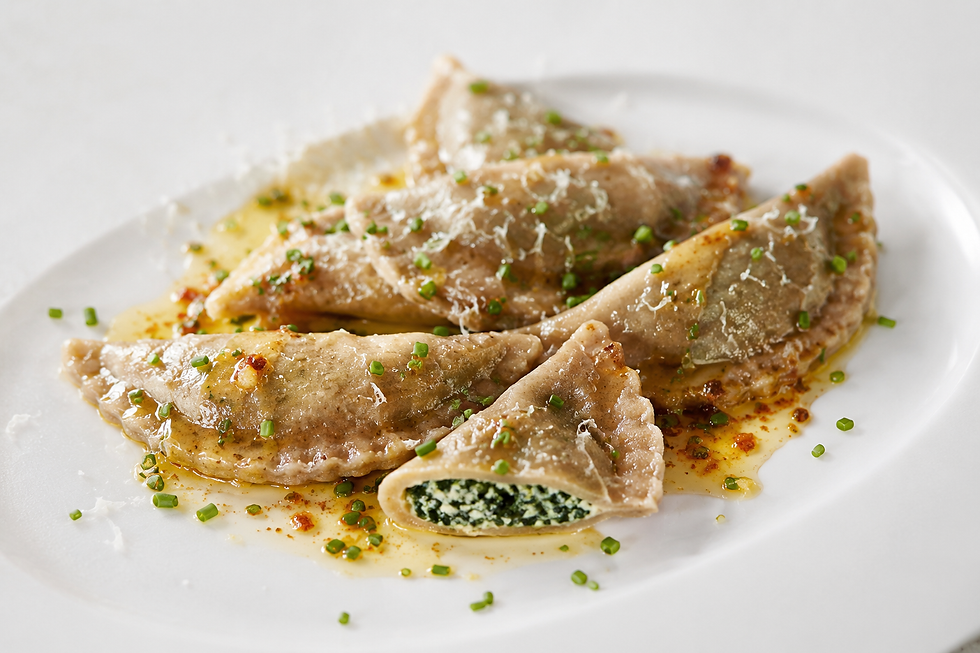
Schlutzkrapfen are the stuffed pasta of the Alto Adige, and they are not ravioli wearing a German name. The dough carries rye flour alongside the wheat, which is the first thing that sets them apart and the reason they taste faintly sour and earthy before you reach the filling. They are shaped as half circles, sealed by hand and pressed with the fingertips, and dressed with melted butter, grated Grana and chives, never with a sauce cooked separately.
The filling is spinach and quark, the fresh sour curd of the German speaking Alps, sharpened with nutmeg and onion softened in butter. Ricotta is the usual substitute outside the region and it works, but it is sweeter and blander, and the dish loses the lactic tang that makes it recognisable.
What makes them difficult is the rye. It carries almost no gluten forming protein, so the dough does not stretch the way a wheat dough does, tears more easily, and has to be rolled thinner than feels safe. The reward is a pasta with flavour of its own rather than a neutral wrapper, which is why the dish belongs to the valleys around Bressanone and the Val Pusteria.
Yield: 4 servings, about 32 pieces. Prep: 1 hour. Rest: 1 hour. Cook: 10 minutes. Total: about 2 hours 10 minutes. Difficulty: intermediate. Course: primo piatto. Region: Alto Adige, Val Pusteria and the Isarco valley.
The Story
The name is pure Tyrolean dialect: krapfen for a filled parcel, schlutz from schlutzen, to slide, which is what the soft half circles do on the plate. In Italian they appear as mezzelune tirolesi or ravioli tirolesi, but nobody in the Val Pusteria calls them that. They belong to the same culinary world as Kaiserschmarrn and canederli, a kitchen that answers to Innsbruck and Vienna more than to Rome.
Rye is in the dough because rye is what grew. Wheat struggles above 3000 feet (900 m) and the high valleys of the Isarco and the Pusteria were rye country for centuries, producing the dark sour bread that still defines the region and the flour that found its way into the pasta. The proportion varies by household, from a third to nearly half. This version uses a third, the working compromise most Alto Adige kitchens settle on.
The filling is a Lenten one in origin. Spinach and fresh curd cheese were what a farmhouse produced without meat, and Schlutzkrapfen were a dish of the meatless days and the weeks before Easter before they became a menu fixture. The butter and chives on top are the local luxury: Alpine butter from summer pasture milk, and the chives of those kitchen gardens. Nothing in the dish comes from further than the next farm.
Ingredients
For the rye pasta dough
Rye flour, 1 cup (120 g)
Type 00 wheat flour, 1 3/4 cups (220 g)
Whole eggs, large, 2
Lukewarm water, 3 tbsp (45 ml)
Extra virgin olive oil, 1 tbsp (15 ml)
Fine sea salt, 1/2 tsp (3 g)
For the spinach and quark filling
Fresh spinach, 1 lb 2 oz (500 g), or 7 oz (200 g) frozen leaf spinach
Quark, drained, 7 oz (200 g), or well drained ricotta
Yellow onion, finely diced, 1 small
Unsalted butter, 1 tbsp (14 g)
Grana Padano, finely grated, 1/3 cup (35 g)
Egg yolk, large, 1
Freshly grated nutmeg, 1/4 tsp
Fine sea salt, 3/4 tsp (4 g)
Freshly ground black pepper, to taste
For finishing
Unsalted butter, 5 tbsp (70 g)
Grana Padano, finely grated, 1/2 cup (50 g)
Fresh chives, finely snipped, 3 tbsp (10 g)
Reserved cooking water, about 1/4 cup (60 ml)
Coarse sea salt for the water, 2 tbsp (30 g) per 4 quarts (4 litres)
Preparation
Step 1. Mix and rest the rye dough
Combine the rye flour, wheat flour and salt on a board and make a well. Add the eggs, the oil and 2 tablespoons of water, work them in with a fork, then bring the dough together by hand, adding the last tablespoon only if it stays crumbly. Knead for a full 10 minutes. Rye dough feels stiffer and never becomes truly springy, so judge it by smoothness rather than bounce. Wrap it tightly and rest it at room temperature for 1 hour.
Step 2. Cook and dry the spinach
Wilt the spinach in a dry pan with only the water clinging to the leaves, about 3 minutes, then cool it under running water. Squeeze it in a clean towel until no more liquid comes out, which takes more force than most people apply: 1 lb 2 oz (500 g) of raw leaf gives around 7 oz (200 g) of compact green. Chop it finely by hand. Frozen leaf spinach works and needs the same squeezing after thawing.
Step 3. Build the filling
Melt the butter and cook the diced onion over low heat for 6 to 8 minutes until completely soft and translucent with no colour at all, since browning pushes it towards sweetness and away from the clean savoury note this filling needs. Let it cool. Combine the spinach, quark, Grana, egg yolk, nutmeg, salt and pepper, fold in the onion and taste. The mixture should hold a shape on a spoon.
Step 4. Roll the sheet very thin
Divide the rested dough in two and keep one half covered. Roll the first piece down to about 1 millimetre, thin enough to read a hand through it. Rye tears rather than stretches, so go down one setting at a time and never pull it with your hands. Work quickly: a rye sheet dries much faster than a wheat one, and a dry edge will not seal.
Step 5. Cut and fill the half circles
Cut discs about 2 3/4 inches (7 cm) across with a plain round cutter and place a rounded teaspoon of filling slightly off centre on each, leaving a clear border. Do not overfill: too much inside splits the seam in the water. The ratio here is generous dough to modest filling, the opposite of a Ligurian raviolo.
Step 6. Seal them properly
Brush the border lightly with water, fold into a half circle and press from the centre outward, pushing the air out as you go, since trapped air expands and opens the seam. Then press the rim with your fingertips to make the shallow scalloped edge that identifies the shape. Set them on a rye floured tray in a single layer, not touching, uncovered and cool for 20 minutes.
Step 7. Cook them gently
Bring at least 4 quarts (4 litres) of water to the boil, salt it with 2 tablespoons (30 g), then lower the heat to a gentle simmer. Slide in no more than ten pieces at a time. They rise after about 3 minutes and need 1 minute more. Rye seams are weaker than wheat seams and a hard boil finds every one of them.
Step 8. Butter, cheese and serve
While the last batch cooks, melt the butter in a wide pan until foaming and just beginning to smell nutty, and stop there rather than browning it fully. Lift the Schlutzkrapfen out draining and slide them into the butter with 2 tablespoons of cooking water. Swirl over low heat for 30 seconds so butter and water emulsify around them, then scatter the Grana and chives and serve at once.
Plating
Warm the plates to around 140°F (60°C). The butter is the only sauce, and on a cold plate it sets into a film in seconds. A wide shallow plate suits the shape better than a bowl, because the half circles should be seen individually rather than heaped.
Eight pieces per person is a serving. Lay them overlapping in a loose row or a shallow fan, scalloped edges facing the same way, rather than piling them up. Spoon the emulsified butter over them, letting a little collect around the base.
Finish with a second scattering of Grana and a generous amount of chives, snipped just before serving so they stay bright. One turn of black pepper is the last thing. Nothing else: no cream, no tomato, no sage, no speck. The plate is green, pale gold and dark at the edges of the dough.
Professional Technique
The technical problem of Schlutzkrapfen is rye, and everything in the method answers to it. Rye contains gliadin but almost no functional glutenin, so it cannot build the elastic gluten network that lets a wheat sheet be stretched. What it builds instead is a viscous mass held together by pentosans, gums that absorb many times their weight in water. The consequences are three: the dough needs longer kneading to hydrate, it must be rolled rather than stretched, and it dries out fast once the sheet is open.
The proportion is therefore a decision. At a third rye to two thirds wheat there is enough gluten to hold a sheet at 1 millimetre and enough rye to carry the flavour and the colour. Push the rye above half and the sheet becomes unworkable that thin and has to be rolled thicker, which makes the pasta doughy. The hour of rest matters more here than with wheat pasta, because the pentosans take time to take up water and a rested rye dough is far easier to roll.
Sealing is the second point of failure and it is mechanical. The border must be free of dry flour and only lightly dampened, and the press has to start at the centre of the fold and move outward so air is driven ahead of the fingers and out of the open edge. Any trapped pocket expands as the parcel heats and forces the weakest part of the seam open. The fingertip scalloping is not only decorative: it compresses the rim a second time and doubles the seal.
Texture and Moisture Control
Two opposite moisture problems run through this recipe. The dough must stay damp enough to seal while the sheet is open, and the filling must be dry enough not to soften the dough from inside. Keep the unused half wrapped, work one sheet at a time, and fill each sheet before rolling the next. If the discs sit and dry, the water brushed on the border will not rehydrate them enough to bond and the seam fails in the pot.
On the filling side, everything depends on how hard the spinach is squeezed and how well the quark is drained. Quark is firmer than ricotta but tubs can still carry whey, so drain it in a sieve for an hour if it looks loose. A wet filling weeps into the dough while the parcels rest and makes soft grey patches that split in the water. The egg yolk binds what moisture remains and sets during cooking.
The final texture is decided in the butter pan. Melted butter alone leaves the pasta greasy and the cheese in clumps, while 2 tablespoons of starchy cooking water swirled in off high heat gives a light emulsion that clings to the rye dough and carries the Grana across every piece. Do not brown the butter fully: the rye already contributes a toasted note, and nut brown butter on top of it pushes the plate towards bitterness.
Professional Mise en Place
Everything except the cooking is done ahead. Once the parcels are shaped, service is under 5 minutes, and the rye sheet is the only part that cannot wait.
Equipment and tools
Pasta machine or long rolling pin, 2 3/4 inch (7 cm) plain round cutter
Wide pan of at least 4 quarts (4 litres), never a narrow stockpot
Wide sauté pan for the butter, big enough for a full serving
Rye floured trays, slotted spoon, damp cloth to cover open sheets
Fine sieve for the quark, clean towel for wringing the spinach
Prepared ahead
Dough kneaded and wrapped, up to 6 hours ahead, cool room temperature
Filling made and chilled, up to 1 day ahead, covered
Quark draining in a sieve if it looks loose, 1 hour
Parcels shaped on rye floured trays, up to 2 hours ahead, uncovered
Grana grated, chives snipped at the last moment only
Service setup
Water salted and holding at a gentle simmer, never a rolling boil
Butter weighed into the sauté pan, ready to melt as the last batch cooks
A ladle of cooking water reserved before the pasta comes out
Plates warming at 140°F (60°C), eight pieces per plate
Batches of ten at most, plated immediately, never held in water
Chef Tips
Use a fine stoneground rye rather than a dark wholegrain one. Wholegrain rye carries bran that cuts the sheet as you roll it and makes small tears that only appear once the parcel is in the water. Fine rye gives the same flavour and colour without the damage.
Find quark if you can. Ricotta is the accepted substitute and the recipe works with it, but it is sweeter, so add a teaspoon of lemon juice to the filling to recover the lactic sharpness the dish is built around, and drain it hard.
Test cook two parcels before shaping the rest. Watch the seams and taste the filling for salt. Filling seasoned to taste raw always tastes underseasoned inside dough, and this is the only moment when correcting it costs nothing.
Freeze them rather than refrigerating if service is more than 2 hours away. On the tray in a single layer, frozen solid and bagged, they keep a month and cook straight from frozen. Refrigerated for hours they take up moisture from the filling and stick to the tray.
Common Mistakes
Using too much rye. Above about half the total flour the dough will not hold together at 1 millimetre and has to be rolled thick, which gives a heavy doughy Schlutzkrapfen. A third rye is the working proportion for a sheet you can actually handle.
Rolling the sheet too thick. The dough to filling ratio here is already generous on the dough side, so a thick sheet makes the dish stodgy. Go to 1 millimetre, thin enough to see a hand through, and accept the occasional tear.
Overfilling the parcels. A rounded teaspoon is the limit. More filling leaves too little sealed border, and rye seams under pressure open in the water and release everything into the pot.
Trapping air inside. Air expands as the parcel heats and blows the seam apart from the inside. Press from the centre of the fold outward every time, driving the air out through the open edge before the rim is closed.
Boiling them hard. Rye seams are weaker than wheat seams and a rolling boil will find them. Bring the water to the boil for the salt and then drop it to a gentle simmer for the whole service.
Wine Pairing
Alto Adige Gewürztraminer DOC: The regional white, from Termeno in the valley below these mountains, in the dry version rather than anything off dry. Its lychee and rose aromatics meet the nutmeg in the filling directly, and its weight and slightly oily texture stand up to melted butter where a lean white would be flattened. Serve it at around 50°F (10°C) so the perfume stays lifted.
Alto Adige Santa Maddalena DOC: Schiava from the hills above Bolzano, the everyday red of these valleys. It is pale, low in tannin and lightly perfumed with violet and almond, which is what a delicate stuffed pasta can take without being overwhelmed. Serve it at 55°F (13°C), cooler than a normal red, and it refreshes between mouthfuls the way a white would.
Alto Adige DOC Pinot Nero: The more serious red, grown at altitude on the Mazon slopes where it keeps real acidity. Its earthy undergrowth character answers the rye in the dough, the one element most wines ignore, and its fine tannin does not clash with fresh curd cheese. Choose restrained oak so the wood does not sit on top of a quiet plate.
Alto Adige DOC Lagrein: The darker local red, and the choice only if the plate carries a heavier hand of butter and cheese. Lagrein brings deep colour, dark plum fruit and a firm bitter edge that cuts fat effectively, though it must be a young unoaked example. An oak aged riserva would bury this dish.
Storage & Reheating
Store them uncooked. Shaped Schlutzkrapfen keep on their rye floured tray, uncovered and cool, for up to 2 hours, after which the filling begins to soften the dough from inside. For anything longer, freeze them on the tray in a single layer until solid, about 2 hours, then transfer them to a sealed bag and keep them for up to 1 month.
Cook frozen parcels straight from the freezer and never thaw them, since thawing releases filling moisture into the dough and they collapse on the tray. Drop them into gently simmering salted water for about 6 minutes, 2 minutes longer than fresh, watching for the same rise followed by a further minute.
Cooked leftovers keep refrigerated in a sealed container for 2 days. Do not reheat them in water, which waterlogs the rye dough, and do not microwave them, which makes the quark grainy. Warm them in a covered sauté pan over low heat with a tablespoon of butter and a splash of water for about 4 minutes, shaking rather than stirring. Cooked parcels do not freeze successfully.
Nutrition
Per serving, based on 4 servings of eight pieces each:
Calories: 610 kcal
Total Fat: 30 g
Saturated Fat: 17 g
Trans Fat: 0.6 g
Unsaturated Fat: 11 g
Cholesterol: 185 mg
Sodium: 780 mg
Total Carbohydrates: 62 g
Fiber: 7 g
Total Sugars: 4 g
Added Sugars: 0 g
Protein: 25 g
Lactose: 3 g
Principal micronutrients: calcium, iron, folate, vitamin A, vitamin K, magnesium, phosphorus
These figures are estimates. Most of the salt in the cooking water is discarded, and the final sodium depends on how much Grana is grated over the plate at the table.


Comments