
Italian Bergamo Stuffed Pasta | Casoncelli alla Bergamasca

Casoncelli alla Bergamasca are the filled pasta of the Lombard prealps, and they rest on an idea that surprises almost everyone the first time. The filling is savoury, meaty and salted, then deliberately pulled towards sweetness with amaretti, pear and raisins. It is the last mainstream survivor of a Renaissance filling that once ran through courtly cooking from Milan to Ferrara.
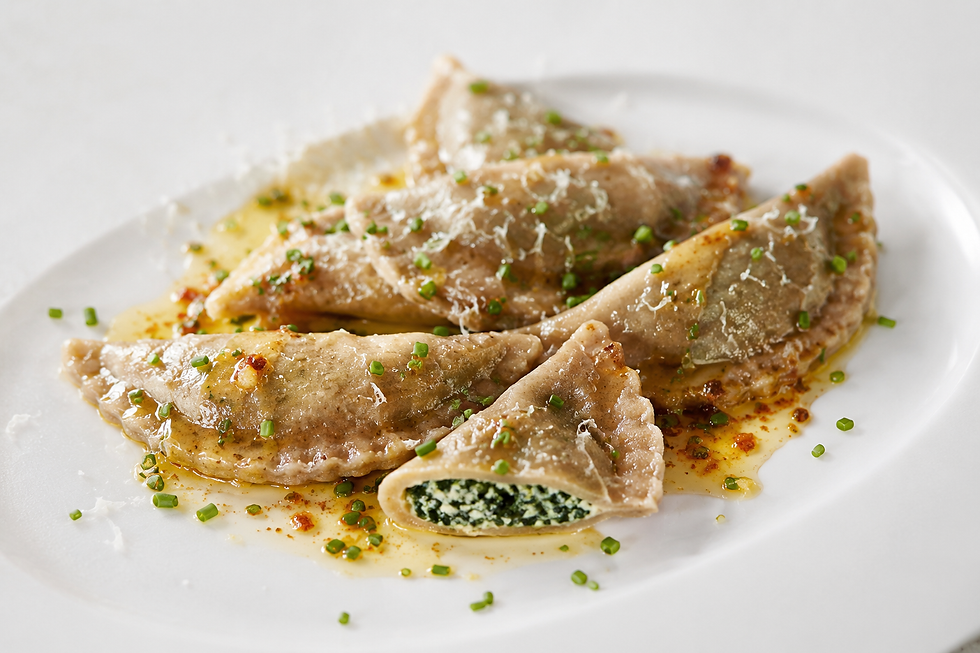
The shape matters as much as the filling. A casoncello is not a ravioli: the disc of dough is folded over and pinched at the centre so the two ends flare outward, giving what Bergamo calls a wrapped sweet. Those ends catch the butter and the crisp pancetta, and leave every piece a band of thin dough against the soft centre.
The dressing is brutally short: butter, sage, pancetta, Grana Padano. No tomato, no cream, nothing that simmers. What reaches the table is an emulsion built in thirty seconds from butter, starchy cooking water and a hard cheese, and it either works or it does not.
Yield: 4 servings of about 12 pieces. Prep: 1 hour 15 minutes. Dough rest: 45 minutes. Filling rest: 2 hours or overnight. Cook: 4 minutes. Difficulty: intermediate to advanced. Course: primo piatto. Region: Lombardy, province of Bergamo.
The Story
Bergamo takes this pasta seriously enough to have written it down. In 2003 local restaurateurs, producers and food historians founded the Accademia del Casoncello and published a reference formula: braised or roasted meat, stale bread, Grana Padano, egg, amaretti, pear, raisins, garlic and parsley, in thin egg dough, dressed with butter, sage and pancetta. The aim was to stop restaurants in the old city selling anything folded over ricotta as a casoncello.
The dish follows the economic logic of northern filled pasta. Sunday meat was braised, Monday the leftovers were minced with bread soaked in the cooking juices, stretched with cheese and egg and sealed in dough. The amaretti and raisins are the one element that does not fit: they are the fingerprint of an older tradition, sugar and spice as a marker of status in Lombard cooking from the fifteenth century, kept alive in the countryside long after the cities abandoned it.
Even inside the province there is no single version. In the Val Seriana the filling leans harder on meat and the sweetness nearly vanishes; in the lower plain the pear is more assertive; the Brescian neighbours make theirs larger and without the amaretto note. What every version shares is the butter and sage finish and the refusal to let the pasta sit in liquid. Casoncelli are a feast dish, still counted by the dozen rather than weighed.
Ingredients
For the pasta dough
Italian 00 flour, 1 3/4 cups (225 g)
Durum wheat semola rimacinata, 1/4 cup (40 g)
Whole eggs, large, 2
Egg yolk, large, 1
Extra virgin olive oil, 1 tsp (5 ml)
Fine sea salt, 1/4 tsp (1.5 g)
For the filling
Beef chuck or veal shoulder, 7 oz (200 g)
Pork shoulder, 3 1/2 oz (100 g)
Italian pork sausage, casing removed, 2 oz (55 g)
Unsalted butter, 1 tbsp (14 g)
Extra virgin olive oil, 1 tbsp (15 ml)
Dry white wine, 1/3 cup (80 ml)
Meat stock, 1/2 cup (120 ml)
Stale country bread, crust removed, 1 1/2 oz (45 g)
Whole milk, 3 tbsp (45 ml)
Grana Padano, finely grated, 1/2 cup (50 g)
Amaretti biscuits, crushed, 1/2 oz (15 g)
Firm ripe pear, peeled and grated, 1 1/2 oz (45 g)
Golden raisins, 1 tbsp (12 g)
Egg, large, 1
Garlic clove, minced, 1 small
Flat leaf parsley, chopped, 1 tbsp (4 g)
Grated nutmeg, 1/8 tsp
Fine sea salt, 1/2 tsp (3 g)
Freshly ground black pepper, to taste
For the butter, sage and pancetta dressing
Unsalted butter, cold, 5 oz (140 g)
Pancetta, in short thin batons, 3 oz (85 g)
Fresh sage leaves, 12 to 14
Reserved pasta cooking water, 1/2 cup (120 ml)
For finishing
Grana Padano, finely grated, 1/2 cup (50 g)
Freshly ground black pepper, to taste
Coarse sea salt, 1 tbsp per 4 quarts (15 g per 3.8 litres)
Preparation
Make the dough
Combine the 00 flour and the semola on a board, make a well, and add the eggs, the extra yolk, the oil and the salt. Break the eggs with a fork and draw the flour in from the inside wall. Knead a full 10 minutes, until the surface turns smooth and slightly tacky. The semola gives bite and a roughness that helps butter cling. Wrap tightly and rest 45 minutes: skipping that rest is why sheets tear when rolled thin.
Braise the meats
Cut the beef and pork into large cubes. Heat the butter and oil in a small heavy pan, brown the cubes hard on all sides, then add the crumbled sausage and let it colour. Pour in the wine, scrape the base and let the alcohol cook off. Add the stock, cover, and cook gently about 45 minutes, until the meat gives under a fork. Uncover at the end so the liquid reduces to a few spoonfuls of concentrated juice, which must never be dried out or drained away.
Build the filling and rest it
Soak the bread in the milk 5 minutes, then squeeze it firmly. Pass the meat, its pan juices and the bread through the medium plate of a grinder, or pulse in a processor until finely minced but not smooth. Work in the Grana, amaretti, pear, raisins, egg, garlic, parsley, nutmeg, salt and pepper. It should read savoury first, the sweetness a beat later. Refrigerate at least 2 hours, ideally overnight.
Roll the sheets
Divide the dough into four and keep three covered. Run the first through the widest setting of a pasta machine, folding and repeating five times, then take it down one notch at a time to the second thinnest setting, around 1 mm. Held to the light you should see the shadow of your hand but not the detail. Thicker and the folded centre turns doughy; thinner and the seam splits.
Cut and fill
Cut discs of about 2 3/4 inches (7 cm) with a plain round cutter and place a level teaspoon of filling, roughly 1/3 oz (10 g), slightly off centre on each. Resist overfilling, the fastest route to a burst casoncello. If the edges have dried, brush the rim with a film of water; a fresh sheet seals better dry.
Shape the casoncelli
Fold each disc over the filling into a half moon and press the air out from the centre outward, sealing the curved edge firmly. Then take it between thumb and forefinger at its middle and pinch hard, so the two tips lift and flare apart into the wrapped sweet shape that defines this pasta. Set the pieces on a semola dusted tray, not touching.
Cook them properly
Bring 4 quarts (3.8 litres) of water to a rolling boil and salt it with 1 tablespoon (15 g) of coarse salt, less than you would for dry pasta, because the filling already carries salt from the meat and the Grana. Drop the casoncelli in, stir once, and immediately drop to a lively simmer, never a hard boil, which tears seams. They are ready 3 to 4 minutes after they rise. Draw a mug of cooking water, then lift them out with a spider.
Brown the butter and finish in the pan
Render the pancetta in a wide pan over medium heat until the fat runs and the edges crisp. Add the cold butter and the sage, and let the butter foam then quieten, turning hazelnut brown. Kill the heat, add two tablespoons of the reserved water and swirl: water, milk solids and starch pull the butter into a glossy emulsion. Slide in the casoncelli with half the Grana and toss by moving the pan, not stirring. Serve within a minute.
Plating
Warm the plates, and treat that as a rule rather than a nicety. The whole dressing is butter, and butter sets the instant it meets a cold surface, turning a glossy coating into a dull film with white streaks. A wide shallow bowl held at around 140°F (60°C) keeps the emulsion moving through service.
Arrange the casoncelli in a single loose layer rather than a heap, flared ends upward where you can manage it, so the pleats stay visible and each piece holds a little butter in its folds. Spoon over the emulsion left in the pan, then set the crisp pancetta and the fried sage on top, never buried underneath where they soften.
Finish with the remaining Grana Padano, grated from a height so it falls evenly, and a firm grind of pepper. Nothing else belongs here: no parsley, no oil, no cream. In Bergamo a second bowl of cheese goes on the table and the rest is left to whoever is eating.
Professional Technique
The defining technique here is the balance of the filling, and it is arithmetic more than taste. Three sweet elements, amaretti, pear and raisins, sit against a large mass of braised meat and salted hard cheese, and the classic proportion holds them to roughly one tenth of the filling by weight. Below that the amaretto note vanishes and you have an ordinary meat ravioli; above it the sweetness takes over. Weigh those three, and taste the filling cold, since it reads sweeter once warmed inside the pasta.
The second is the pinch that makes the shape. A ravioli seals on two flat surfaces; a casoncello seals on a curve and is then compressed at its waist, which does three things at once. It forces out trapped air that would expand and burst the seam, it locks the filling into the two ends, and it creates the flared tips that trap butter. Pinch firmly and once, because repeated pinching warms the dough and thins it exactly where it must be strongest.
The third is the browned butter, burro nocciola, a cooked ingredient rather than melted fat. Butter is roughly eighteen percent water and two percent milk solids: over moderate heat the water boils off, the foam subsides and the proteins toast to hazelnut, producing aromatics raw butter does not have. The window between hazelnut and burnt is short, so add the sage and the water at the pale end of brown.
Texture and Moisture Control
Three textures have to land together: dough tender but resistant at the seam, a filling moist and loose without being wet, and a dressing that coats rather than pools. The dough is controlled at rolling. At 1 mm the single layer cooks in the same time as the double layer at the fold, which is why a thicker sheet leaves a chewy band across the middle of every piece.
Moisture in the filling is what most people get wrong. Bread soaked in milk and squeezed hard, plus the reduced braising juices, gives a paste that holds a shape on the spoon without being stiff. Too wet and it steams inside the pasta, softening the dough from within so the piece collapses when lifted; too dry and it turns crumbly, and the pear and amaretti never bloom. Grated pear beats diced for exactly this reason: it spreads its moisture instead of leaving a wet pocket.
The emulsion is where the dish stands or falls. Butter and water do not combine alone: the milk solids, the starch in the pasta water and the casein in the Grana act together as emulsifier. Off the heat, swirled hard, they give a pale glossy sauce that clings. Too hot and it splits; too much water and it goes thin and grey. Add water a spoonful at a time and stop when the surface turns from oily to satin.
Professional Mise en Place
Everything except the last two minutes can be done ahead, and for a dish served in quantity it has to be. Work in this order and service becomes boiling water and swirling a pan.
Equipment and tools
Pasta machine, or a long rolling pin and a large wooden board
Plain round cutter, 2 3/4 inches (7 cm)
Meat grinder with a medium plate, or a food processor
Small heavy lidded pan for the braise
Wide low sided pan able to hold all the pasta at once
Spider skimmer and trays dusted with semola
Prepared ahead
Filling, made and refrigerated 1 day ahead, which improves it
Dough, rested and held wrapped at room temperature up to 3 hours
Casoncelli shaped up to 4 hours ahead, uncovered, refrigerated
Pancetta cut into batons, sage leaves picked and dried
Grana Padano grated fresh, never bought grated
Service setup
Large pot of salted water at a rolling boil, held ready
Butter weighed and kept cold until it goes into the pan
A mug beside the pot, to draw cooking water before draining
Plates warming at around 140°F (60°C)
Everything within reach, since the finishing window is under a minute
Chef Tips
Make the filling the day before, always. Overnight the bread absorbs the braising juices, the amaretti soften into the meat instead of sitting in it as crumbs, and the raisins plump. Used within an hour of mixing it tastes like a list of ingredients; the next day it tastes like one thing.
Cook one casoncello before shaping the rest. Boil a test piece, taste it, correct the batch. Filling seasoned cold almost always needs more salt and considerably more pepper once enclosed in dough and heated, and this is the last moment you can fix it.
Use cold butter and add it in one go. It browns more evenly than butter left to soften, because the water comes off at a steadier rate and the solids toast rather than scorch. If the pan runs hot, lift it off the flame rather than lowering the heat.
Freeze them raw, on the tray. Spread the shaped pieces so none touch, freeze solid, then bag them and cook from frozen into simmering water with about 90 seconds added. Casoncelli frozen after cooking are a different and much sadder dish.
Common Mistakes
Overfilling the pasta. A heaped teaspoon looks generous and guarantees split seams, because no room is left to press the air out before sealing. A level teaspoon, about 1/3 oz (10 g), is correct and still eats richly.
Rolling the sheet too thick. At 2 mm the folded seam is effectively 4 mm and stays doughy while the body of the piece is cooked. Take the machine to its second thinnest setting and check the sheet against the light before cutting a disc.
Boiling hard instead of simmering. A rolling boil throws filled pasta against the sides of the pot and tears the seams, and a burst casoncello empties into the water and becomes a flap of dough. Boil, add the pasta, then drop straight to a lively simmer.
Melting the butter instead of browning it. Pale melted butter contributes fat and nothing else. The whole aroma of this dish comes from toasted milk solids, so let the foam subside and the colour turn hazelnut before the sage goes in.
Leaving out the sweet elements. Cooks who find the idea strange quietly drop the amaretti, pear and raisins, and produce a decent meat ravioli that is not a casoncello. The sweetness is the signature of the dish, not a garnish.
Wine Pairing
Valtellina Superiore DOCG: The Lombard red made for this plate. Nebbiolo from the terraces above the Adda gives high acidity and a fine dusty tannin that cuts straight through 5 oz of browned butter, while its rose petal and dried cherry aromatics sit beside the amaretto and pear. It is lighter bodied than Piedmontese Nebbiolo, which matters, because the pasta is delicate.
Franciacorta DOCG: A Brut from the hills between Bergamo and Brescia, and the most effective foil for the richness. The bead and bracing acidity scrub butter from the palate between mouthfuls, while the bread and toasted almond character of long lees ageing picks up the crushed amaretti directly.
Lugana DOC: The white option, from the southern shore of Lake Garda, for anyone who finds a red heavy here. Turbiana on clay gives firm citrus and white almond with more body than most Italian whites, enough to stand against the Grana Padano and the pancetta, and a saline finish that answers the salt in the filling rather than amplifying it.
Pinot Nero dell'Oltrepo Pavese DOC: The elegant choice for the sweet and savoury tension in this filling. Light tannin leaves the texture of the pasta untouched, the acidity handles the butter, and the red fruit and undergrowth notes run alongside the braised meat and the raisins without competing. Serve at around 59°F (15°C).
Barbera d'Asti DOCG: Cross into Piedmont for the highest acidity on this list and the lowest tannin, which is what a butter dressing wants: it slices the fat without adding drying grip. Choose an unoaked bottling, since oak and vanilla push the amaretti note towards pastry.
Storage & Reheating
The filling keeps refrigerated in an airtight container for 3 days and freezes for 2 months. Raw shaped casoncelli hold on a semola dusted tray, uncovered, in the refrigerator up to 8 hours; beyond that the dough absorbs moisture from the filling and the base of each piece sticks.
For longer storage, freeze them raw. Spread the pieces on a lined tray so none touch, freeze solid, about 2 hours, then bag them for up to 2 months. Cook straight from frozen in simmering salted water with roughly 90 seconds added, and never thaw first: thawed raw pasta becomes a wet mass that cannot be separated.
Dressed casoncelli do not truly reheat, but leftovers keep refrigerated for 2 days. Revive them in a wide pan over low heat with a knob of butter and two tablespoons of water, covered, about 3 minutes, shaking rather than stirring, then uncover and swirl until the emulsion returns. Never microwave them, which boils the filling and toughens the dough.
Nutrition
Per serving, based on 4 servings of about 12 pieces each:
Calories: 890 kcal
Total Fat: 55 g
Saturated Fat: 29 g
Trans Fat: 1.5 g
Unsaturated Fat: 22 g
Cholesterol: 290 mg
Sodium: 1150 mg
Total Carbohydrates: 62 g
Fiber: 3 g
Total Sugars: 8 g
Added Sugars: 3 g
Protein: 38 g
Lactose: 2.5 g
Principal micronutrients: calcium, phosphorus, zinc, iron, selenium, vitamin A, vitamin B12
These figures are estimates. Most of the salt in the cooking water is discarded rather than eaten, and the totals move with the fat content of the pancetta and with how much butter reaches the plate rather than staying in the pan.


Comments