Vegan Florentine Seitan Arista Roast, Reinterpreted | Arista Vegana di Seitan alla Fiorentina Rivisitata

Arista is the Sunday roast of Florence: a loin perfumed with garlic, rosemary and fennel, roasted slowly and served in thin slices with the potatoes that cooked beside it. The Florentine original is a bone-in pork loin; this vegan version is a reinterpretation that keeps every aroma of the classic and replaces the loin with a homemade seitan roast, rolled around a paste of garlic, rosemary and fennel seed so each slice shows a green spiral at its center. The roast is steamed first, so the gluten sets tender and even, then roasted at high heat and basted with a white wine jus until the surface is lacquered and deeply browned. The result slices cleanly and stays juicy.
Yield: 6 servings. Prep: 40 minutes. Cook: 2 hours. Rest: 2 hours, or overnight. Course: secondo piatto. Region: Tuscany.
The Story
Arista belongs to Florence and to the Tuscan countryside around it. The classic is a bone-in pork loin, from the pigs raised on every farm of the region, rubbed with garlic, rosemary, fennel and black pepper, tied and roasted for hours. In the Florentine dialect rosemary is called ramerino, and the herb is so tied to the dish that many families still pierce the roast with small slits and push the needles and slivers of garlic directly inside. Potatoes roast in the same pan and absorb the juices, and they are often considered the best part of the meal.
A popular legend explains the name. During the Council of Florence of 1439, when the bishops of the Greek and Latin churches met in the city, a Greek prelate is said to have tasted the roast and exclaimed "aristos", the best. Pellegrino Artusi repeats the story in his book of 1891, La scienza in cucina e l'arte di mangiar bene, but the word arista already appears in the Tuscan stories of Franco Sacchetti in the fourteenth century, decades before the Council.
Arista is a dish of patience and of thrift. It was roasted on Sunday and eaten hot at lunch, then cold for days afterwards in thin slices with bread. Its aromatic trio, garlic, rosemary and fennel, is the signature of Tuscan roasting, the same that perfumes porchetta in central Italy and the herbs used on spit roasts across the countryside. Wild fennel, finocchietto selvatico, grows along every Tuscan roadside, and its seeds and pollen are the soul of the seasoning.
The vegan version replaces the loin with seitan, the dough of wheat gluten that has been cooked for centuries in Chinese and Japanese Buddhist kitchens and that took the name seitan in the macrobiotic movement of the twentieth century. Seitan is not Tuscan, and this recipe does not pretend otherwise: it is a reinterpretation, an arista rivisitata, not the traditional Florentine pork roast. What is Tuscan is everything around it: the aromatic paste, the long roasting, the basting, the potatoes in the pan and the way the roast is sliced thin and served hot or cold. The fat of the original is replaced by extra virgin olive oil, and the pan juices by a jus of white wine, vegetable broth and roasted aromatics. Precision in the hydration of the dough and in the two stage cooking gives a roast with a fine grain and a juicy center.
Ingredients
Vital wheat gluten is the base of the roast: buy it from a shop with high turnover and keep it sealed, because old gluten absorbs humidity and binds poorly. Chickpea flour and cooked cannellini beans soften the texture and keep it from turning rubbery, while white miso and soy sauce give the savory depth that a plain wheat dough lacks. Use fresh rosemary, never dried, and whole fennel seeds toasted and crushed at the moment. For the potatoes choose a waxy, yellow variety that holds its shape. Finish with a fruity Tuscan extra virgin olive oil, such as Toscano IGP or Chianti Classico DOP, which brings the green, peppery note of the region.
For the seitan roast
Vital wheat gluten, 2 1/4 cups (300 g)
Chickpea flour, 1/3 cup (40 g)
Cooked cannellini beans, drained, 3/4 cup (130 g)
Vegetable broth, cold, 1 cup (240 ml)
White miso, 1 tbsp (18 g)
Soy sauce or tamari, 2 tbsp (30 ml)
Extra virgin olive oil, 2 tbsp (30 ml)
Garlic powder, 1 tsp (3 g)
Onion powder, 1 tsp (3 g)
Fine sea salt, 1/2 tsp (3 g)
Freshly ground black pepper, 1/2 tsp (1 g)
For the aromatic filling
Garlic, 6 cloves, peeled
Fresh rosemary needles, 3 tbsp (8 g)
Fennel seeds, toasted, 2 tsp (4 g)
Fresh sage leaves, 6
Coarse sea salt, 1 tsp (5 g)
Freshly ground black pepper, 1/2 tsp (1 g)
Extra virgin olive oil, 3 tbsp (45 ml)
For the roasting and the jus
Yellow waxy potatoes, 2 lb (900 g), peeled and cut into 1 1/2 inch (4 cm) chunks
Extra virgin olive oil, 1/3 cup (80 ml)
Garlic, 1 head, cloves separated and left unpeeled
Fresh rosemary, 4 sprigs
Dry white wine, such as Vernaccia di San Gimignano, 3/4 cup (180 ml)
Vegetable broth, hot, 1 1/2 cups (360 ml)
Fine sea salt and freshly ground black pepper, to taste
Fennel pollen or crushed fennel seed, to finish, 1 pinch
Preparation
Step 1

Make the aromatic paste. Pound the garlic, rosemary, toasted fennel seeds, sage and coarse salt in a mortar until they form a rough green paste, then work in the pepper and the olive oil. A mortar crushes the cells of the herbs and releases their aromatic oils without heating them, as a blender would; it also leaves small fragments that stay visible in the slices. Toast the fennel seeds first in a dry pan over medium heat for about 1 minute, just until they smell sweet, because toasting turns their raw, slightly bitter note into a warm anise aroma.
Step 2

Mix and knead the dough. Blend the cannellini beans with the cold broth, miso, soy sauce and olive oil until smooth. In a large bowl whisk the vital wheat gluten, chickpea flour, garlic powder, onion powder, salt and pepper. Pour in the liquid and mix with a spatula until no dry flour remains, then knead by hand for 3 minutes, no longer. The dough should feel elastic and slightly springy. Kneading develops the gluten network that gives the roast its structure, but too much kneading tightens it into a rubbery, bouncy texture; 3 minutes gives a fine, tender grain. Cover the dough and rest it for 10 minutes so the gluten relaxes.
Step 3

Roll the roast. Press the dough on a sheet of parchment into a rectangle about 8 by 10 inches (20 by 25 cm) and 3/4 inch (2 cm) thick. Spread the aromatic paste over it, leaving a border of 1 inch (2.5 cm) on all sides, then roll it tightly from the short side into a firm log. Pinch the seam closed. Wrap the log tightly in the parchment, twisting the ends like a candy, then in two layers of aluminum foil. Finally tie it with kitchen string every 1 1/2 inches (4 cm), as you would tie the original roast. The tight wrapping is essential: gluten expands with heat, and without a firm wrapping the roast swells, loses its shape and develops a spongy texture.
Step 4

Steam the roast. Set the wrapped roast in a steamer basket over simmering water, cover and steam for 75 minutes, turning it once halfway. Keep the water at a steady simmer, never a violent boil, and top it up with boiling water if needed. Steam cooks the gluten gently and evenly to the center at about 212°F (100°C), setting its proteins without drying them. The roast is ready when it feels firm and springs back when pressed through the foil, and an instant-read thermometer pushed into the center reads at least 195°F (90°C).
Step 5

Rest the roast. Leave the roast in its wrapping until it reaches room temperature, about 2 hours, then refrigerate it, ideally overnight. This rest is not optional. As it cools, the gluten network firms and the moisture spreads evenly through the roast, which then slices cleanly and holds together in the oven. A seitan roast cut or roasted while still hot from steaming tears and feels damp at the center. The roast can be prepared up to 3 days ahead at this stage.
Step 6
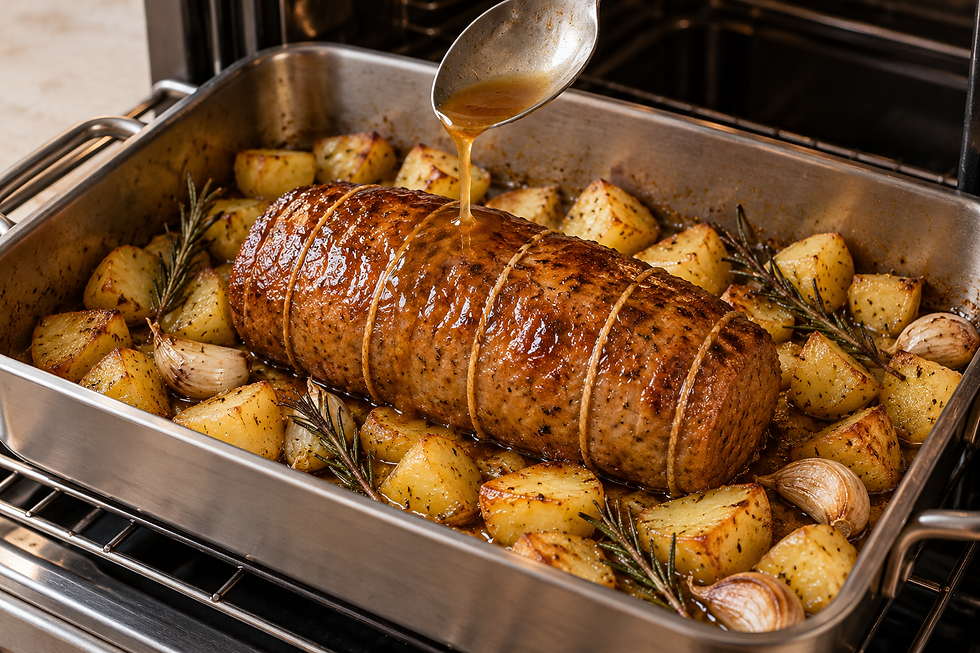
Roast with the potatoes. Heat the oven to 400°F (200°C). Toss the potatoes with half the olive oil, the unpeeled garlic cloves, the rosemary sprigs and a good pinch of salt in a heavy roasting pan and roast for 20 minutes. Meanwhile unwrap the seitan, keep the string, and brush it all over with the remaining olive oil. Push the potatoes to the sides, set the roast in the center and pour in the wine. Roast for 35 to 40 minutes, turning the roast every 10 minutes and basting it with the pan juices, adding the hot broth a little at a time whenever the pan looks dry. The surface browns through the Maillard reaction between the gluten proteins, the sugars of the miso and the wine, and repeated basting builds a glossy, savory lacquer.
Step 7

Finish the jus and rest. Lift the roast onto a board and let it rest for 10 minutes. Move the potatoes to a warm dish. Squeeze the soft roasted garlic out of three or four cloves into the roasting pan, add a splash of hot broth and scrape the bottom over medium heat, reducing for 2 to 3 minutes until the jus coats a spoon. Season with salt and pepper and strain. The brown residue on the pan holds most of the flavor of the dish; dissolving it into a short, concentrated jus gives the roast the depth that the fat of the original gives in Florence.
Plating
Warm the plates to about 140°F (60°C). Remove the string and slice the roast with a long, sharp knife into slices about 3/8 inch (1 cm) thick, so the green spiral of rosemary and garlic shows clearly at the center of each slice. Overlap three slices on one side of the plate and set a generous spoonful of the roasted potatoes beside them, with one whole roasted garlic clove.
Spoon the jus over the slices, about 2 tbsp (30 ml) per serving, add a thin thread of raw olive oil, a pinch of fennel pollen and a few fresh rosemary needles. The guest cuts the roast with a knife, and each bite should carry the browned edge, the tender center and the aromatic spiral together. Serve any extra jus in a small warm jug.
Professional Technique
The key ratio is the hydration of the dough. For 300 g of vital wheat gluten, the total liquid, broth plus the water in the beans, miso and soy sauce, should be about 1 1/4 cups (300 ml), roughly 1 part liquid to 1 part gluten by weight. Less liquid gives a dry, tight roast; more gives a soft, spongy one that falls apart in the oven. The cannellini and chickpea flour act as tenderizers: they interrupt the gluten network so the grain stays fine and short, like a roast rather than a chewy bread.
The hidden variable is the wrapping pressure. A loose wrap lets the gluten swell into air pockets during steaming, a tight one forces it to set dense and even. Wrap firmly, twist the parchment ends hard and tie the roast with string: the same gesture that holds the shape of the original arista also controls the texture of the seitan.
The doneness test comes at two moments. After steaming, the center must reach at least 195°F (90°C) and the roast must feel firm and springy. After roasting, the surface must be deep brown and lacquered, and a thin skewer pushed into the center must come out hot. The color matters more than the time: pale seitan tastes of raw wheat, browned seitan tastes roasted.
Texture and Moisture Control
Seitan is mostly protein and water, and moisture decides its texture. Steaming in a closed wrap keeps all the moisture inside, so the roast reaches the oven juicy. The oven then works only on the outside: high heat, short time and frequent basting brown the surface before the interior can dry. Roasting an unwrapped raw dough instead would dry the outside long before the center set.
Basting is the second control. The wine and broth in the pan keep the atmosphere humid around the roast, and each spoonful of juice deposits sugars and dissolved proteins on the surface, which then brown in the dry heat. Turn the roast every 10 minutes so every side meets the hot pan and the juices in turn. If the pan dries out completely, the juices burn and the jus turns bitter.
The rest after roasting matters as much as the rest after steaming. In 10 minutes on the board the surface firms, the juice that moved toward the center redistributes and the slices hold their shape under the knife. A roast sliced straight from the oven crumbles at the edges and loses its spiral.
Professional Mise en Place
The roast is a two day preparation in a professional kitchen: mixed, rolled and steamed the day before, roasted on the day. Plan the potatoes so they finish with the roast, and keep the jus ready to reduce while the roast rests.
Equipment and tools
Mortar and pestle, large mixing bowl, flexible spatula
Parchment paper, heavy aluminum foil, kitchen string
Large steamer with a lid, instant-read thermometer
Heavy roasting pan, basting spoon, long slicing knife, fine strainer
Prepared ahead
Seitan roast mixed, rolled, steamed and cooled, up to 3 days ahead, refrigerated in its wrapping
Aromatic paste, extra portion for finishing, covered with oil, up to 1 day ahead
Potatoes peeled and cut, kept in cold water, up to 4 hours ahead
Vegetable broth hot on the stove during roasting
Service setup
Plates warmed to about 140°F (60°C)
Roast resting on a board, slicing knife and a damp cloth to clean the blade between slices
Jus warm in a small pan with a ladle, olive oil in a jug
Fennel pollen, rosemary needles and flaky salt on the pass
Chef Tips
Make the roast the day before. Seitan improves with a night in the refrigerator: the texture firms, the aromas of the filling move into the dough and the slices come out sharper. This also turns a long recipe into a simple one on the day, when only the roasting remains.
Arista is excellent cold, as Florentine families eat it on Monday. Slice the cold roast very thin, about 1/8 inch (3 mm), and serve it with a salad of bitter leaves, a few drops of good olive oil and a pinch of flaky salt, or between slices of unsalted Tuscan bread.
For a stronger aroma, mix a teaspoon of finely grated lemon zest into the aromatic paste. It does not belong to every family version, but it lifts the rosemary and balances the savory notes of the miso and soy sauce.
Save every drop of jus. Leftover jus keeps for 4 days in the refrigerator and is an excellent base for sautéing cannellini beans, cavolo nero or the leftover potatoes, exactly as Tuscan cooks use the pan juices of the original.
Common Mistakes
Over-kneading the dough. Long kneading turns seitan rubbery and bouncy. Knead for 3 minutes only, then let the dough rest.
Wrapping too loosely. A loose wrap lets the roast swell and become spongy. Wrap it tightly in parchment and foil, twist the ends and tie it with string.
Boiling instead of steaming. Seitan cooked directly in boiling water absorbs water, swells and loses its fine grain. Steam it in its wrapping at a gentle, steady simmer.
Roasting it hot from the steamer. Freshly steamed seitan is soft and damp at the center. Let it cool completely, ideally overnight, before roasting.
Burning the garlic in the paste. Garlic on the outside of the roast burns at high heat and turns bitter. Keep the paste inside the roll and protect the unpeeled cloves in the pan with the potatoes.
Letting the pan dry out. Without liquid, the juices scorch and the jus turns bitter. Add hot broth a little at a time and baste often.
Slicing too thick. Thick slices feel dense and hide the spiral. Slice about 3/8 inch (1 cm) thick for hot service and thinner for cold.
Wine Pairing
Chianti Classico DOCG: The red of the hills between Florence and Siena, made mainly from Sangiovese, with red cherry, violet and a savory, herbal finish. Its firm acidity and fine tannins meet the browned crust of the roast, and its herbal notes echo the rosemary and fennel. Serve it at about 61-64°F (16-18°C).
Vernaccia di San Gimignano DOCG: The white of the towered town of San Gimignano, with notes of almond, yellow apple and a slightly bitter, mineral finish. The same wine used in the pan, it ties the jus to the glass and refreshes the palate after the olive oil of the potatoes. Serve it at about 50-54°F (10-12°C).
Rosso di Montalcino DOC: A younger, fresher expression of Sangiovese from Montalcino, with bright red fruit and supple tannins. It has enough structure for a roast and enough freshness for a dish without animal fat, and it suits the cold arista of the next day. Serve it at about 60-62°F (16-17°C).
Carmignano DOCG: From the hills west of Florence, Sangiovese blended with a share of Cabernet, with dark fruit, spice and a rounder body. Its depth matches the savory miso and the concentrated jus, while its acidity keeps the pairing fresh. Serve it at about 62-64°F (17-18°C).
Storage & Reheating
Refrigerator: the steamed roast keeps for up to 4 days in its wrapping, and the roasted, sliced roast for up to 4 days in an airtight container with a spoonful of jus. Roasted potatoes keep for 2 days but lose their crispness. Freezer: the steamed, unroasted roast freezes well for up to 3 months, wrapped tightly; thaw it overnight in the refrigerator and roast it as in the recipe. Freezing the sliced roasted seitan is possible, but the slices dry slightly.
Reheat slices in a covered pan over low heat with 2 tbsp (30 ml) of jus or broth for 3 to 4 minutes, turning once, until hot through. Reheat potatoes in the oven at 400°F (200°C) for 10 minutes on a tray, uncovered, to restore the crust. In the microwave, cover the slices with a little jus and heat at 50 percent power for 1 to 2 minutes, so the seitan stays tender.
Nutrition
Per serving, based on 6 servings:
Calories: 560 kcal
Total Fat: 22 g
Saturated Fat: 3 g
Trans Fat: 0 g
Unsaturated Fat: 19 g
Cholesterol: 0 mg
Sodium: 980 mg
Total Carbohydrates: 52 g
Fiber: 6 g
Total Sugars: 3 g
Added Sugars: 0 g
Protein: 41 g
Principal micronutrients: iron, selenium, potassium, vitamin C, vitamin B6, vitamin E
These figures are estimates, calculated on the quantities listed and rounded to the nearest whole number, assuming that about half of the roasting oil remains in the pan. They vary with the brand of vital wheat gluten, the potatoes and the amount of jus served.


Comments